
No Income Verification Investment Property Loans: 2026 Buying Guide
Written by Eddie Luhrassebi · Published August 30, 2026
Get a no income verification investment property loan in 2026. Our guide shows you how to use property cash flow, not tax returns, to secure your next deal.
Your tax professional works tirelessly to minimize your taxable income, yet those very same deductions are exactly what traditional banks use to disqualify your next mortgage. It's a frustrating cycle where financial savvy actually hinders your ability to scale. You shouldn't be penalized for running an efficient business or having a complex 1099 income structure that conventional underwriting simply wasn't built to understand. This guide shows you how to break free from the W-2 requirement by securing a no income verification investment property loan that prioritizes the cash flow of the asset over your personal tax returns.
Since 2005, Evoque Lending has served as a seasoned guide for investors who don't fit into standard institutional boxes. We understand that in 2026, the strength of your portfolio should speak louder than a line item on a tax return. In the following sections, we will explore how modern asset-based qualification works, the specific requirements for DSCR and bank statement programs, and the strategic steps you can take to expand your real estate holdings without the traditional paperwork burden. You'll learn how to leverage property performance to secure the capital you need for your next acquisition while maintaining the speed necessary to compete in today's market.
What is a No Income Verification Investment Property Loan in 2026?
In 2026, the term "no-doc" doesn't mean what it used to. A no income verification investment property loan is a specialized financial instrument designed for the modern real estate landscape. It qualifies borrowers based on alternative documentation, such as bank statements or rental income, rather than traditional W-2s or tax returns. This approach recognizes that for an investor, a personal salary is often secondary to the health of the asset itself. It's a pragmatic solution for a market that moves faster than traditional underwriting can handle.
The industry has moved far beyond the unregulated environment of the mid-2000s. While a traditional No-doc loan was once synonymous with high-risk lending, today’s versions are sophisticated Non-QM (Non-Qualified Mortgage) products. They are rigorously regulated and require a clear "ability to repay," but they use property cash flow or liquid assets as the primary evidence. Modern lenders focus on the tangible performance of the investment rather than digging through years of personal tax history. This shift allows for more flexibility without compromising the stability of the loan.
The Shift from Personal Income to Property Performance
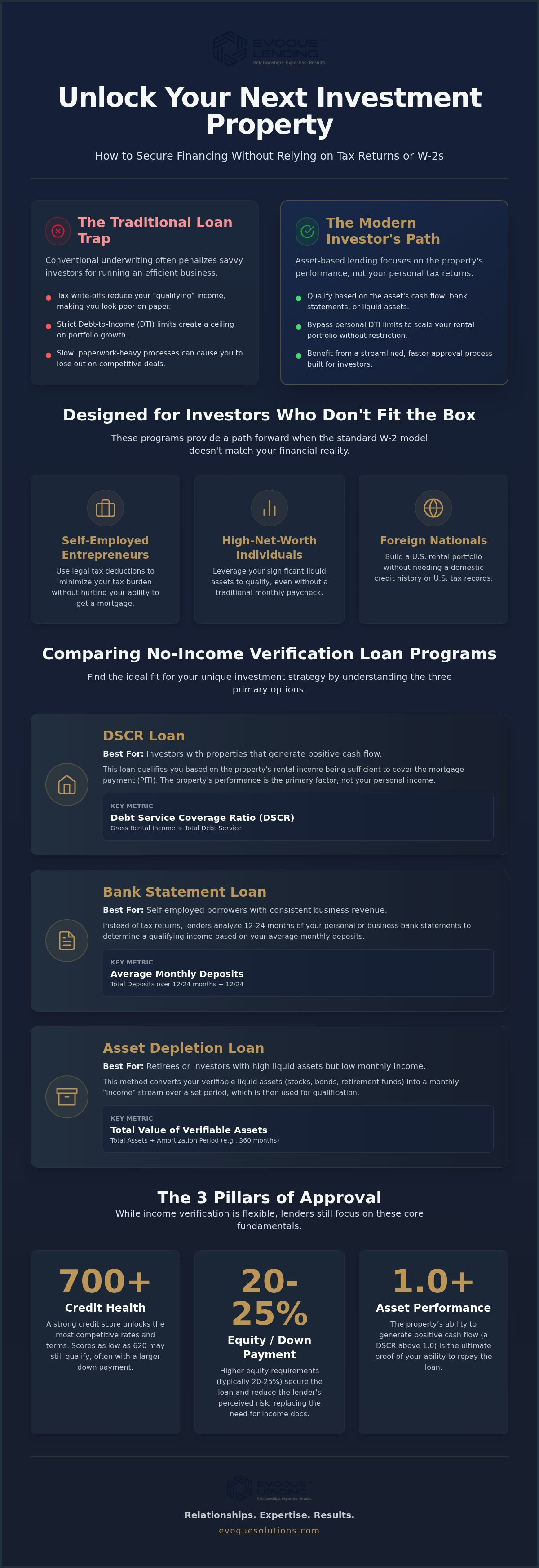
Lenders today prioritize the "Debt Service Coverage Ratio" (DSCR). This calculation compares the property’s gross rental income to its annual debt obligations. To verify this, appraisers use a 1007 Rent Schedule to determine the fair market rent for the area. In 2026, the property’s projected cash flow effectively replaces the traditional paystub as the primary evidence of a borrower’s ability to repay. This allows you to scale your portfolio without hitting the debt-to-income (DTI) ceilings that often trap conventional borrowers. It's about looking at the business case for the property rather than your personal spending habits.
Who These Loans Are Designed For
These programs solve specific problems for three main groups of investors who often find themselves rejected by retail banks. They provide a path forward when the "standard box" doesn't fit your financial reality.
- Self-Employed Entrepreneurs: Those who use legal tax deductions to reduce taxable income, making them look "poor" on paper despite high revenue.
- Retirees and High-Net-Worth Individuals: Investors who have significant liquid assets but lack a traditional monthly paycheck to satisfy a bank's DTI requirements.
- Foreign Nationals: Non-U.S. citizens who want to build a domestic rental portfolio but don't have a U.S. credit history or domestic tax record.
For these borrowers, a no income verification investment property loan isn't just a convenience; it's a critical tool for growth. It eliminates the friction of traditional documentation while providing the capital needed to secure high-performing assets in a competitive environment.
The Mechanics of Modern No-Doc Real Estate Financing
Modern lenders haven't abandoned due diligence; they've simply changed the data points they analyze. The foundation of any no income verification investment property loan rests on three primary pillars: credit health, equity, and asset performance. While the CFPB's Ability-to-Repay rule mandates that lenders verify a borrower's financial capacity, it provides the flexibility to use alternative methods that don't rely on tax transcripts or W-2s. This shifts the focus from your personal history to the current reality of your business and property.
Credit scores act as the primary lever for risk. A score above 700 often unlocks the most competitive rates, while scores as low as 620 to 640 may still qualify with higher equity requirements. Because the lender is taking on more perceived risk by skipping income verification, down payments typically range from 20% to 25%. You should also expect interest rates to be 0.5% to 2.0% higher than conventional mortgages. This premium is the trade-off for the speed, flexibility, and lack of personal paperwork these programs offer.
The DSCR Formula: Your Key to Approval
The Debt Service Coverage Ratio (DSCR) is the gold standard for qualifying without personal income. Lenders calculate this by dividing the property’s gross monthly rent by the PITIA (Principal, Interest, Taxes, Insurance, and Association fees). For example, if a property generates $2,500 in rent and the total mortgage payment is $2,000, your DSCR is 1.25. A ratio of 1.25 or higher is the industry sweet spot for securing the best terms, though some programs allow for a "no-ratio" approach if you have a larger down payment. You can explore these nuances further in our DSCR Loans: 2026 Guide to Scaling Your Portfolio.
Asset Depletion and Bank Statement Alternatives
If the property’s rent doesn't tell the whole story, lenders look at your liquid stability. Bank statement loans analyze 12 to 24 months of deposits to calculate a qualifying "income" based on your business’s actual cash flow. Alternatively, asset depletion programs turn your 401k, IRA, or brokerage accounts into a qualifying monthly figure by dividing the total value by the loan term. These methods are ideal for self-employed individuals who have high revenue but low taxable income. If you're unsure which method fits your portfolio, our streamlined online questionnaire can help match you with the right program. For a deeper dive into these methods, see our Self-Employed Bank Statement Loans: Ultimate 2026 Guide.
Comparing No-Income Verification Loan Programs
Identifying the right no income verification investment property loan requires a clear understanding of your current financial leverage. Traditional banks demand a uniform set of documents, but the Non-QM market offers a menu of solutions tailored to how you actually build wealth. Unconventional mortgages have returned to the mainstream because they prioritize logical qualification over rigid, outdated checklists. For seasoned investors with multiple units, DSCR programs often offer the most competitive interest rates because the lender's risk is mitigated by the property's proven performance rather than your personal spending habits.
Matching your specific profile to the right program is the difference between a stalled application and a successful closing. If you're a 1099 contractor with high gross revenue but significant business expenses, your needs differ from a portfolio owner looking to pull equity out of an existing rental. Choosing the wrong path can lead to higher costs or unnecessary delays. You can explore the broader landscape of these options in our Non-QM Loans for Real Estate Investors: The 2026 Portfolio Growth Guide.
DSCR vs. Bank Statement Loans
DSCR loans are built for speed and scaling. They don't require personal income verification, making them the fastest path to closing in a competitive market. If the rental income covers the mortgage, you're essentially cleared. Conversely, bank statement loans are the preferred tool for self-employed borrowers buying a specific property that might not yet be cash-flowing at a high ratio. In this scenario, the lender looks at 12 or 24 months of business deposits to verify stability. While bank statement loans require slightly more documentation than DSCR, they provide a solution when the property’s current rent doesn't tell the whole story.
Asset Depletion for High-Net-Worth Investors
High-net-worth individuals often face a unique paradox; they have millions in liquidity but no "active" monthly income to show a traditional loan officer. Asset depletion programs solve this by treating your brokerage accounts, 401ks, or IRAs as a stream of qualifying income. It's an ideal choice for retirees or investors between major projects who want to keep their capital working in real estate. Instead of liquidating assets and triggering tax events, you use your balance sheet to secure a no income verification investment property loan. This method is particularly effective for those with significant reserves who want to maintain their investment momentum without a traditional paycheck.
How to Qualify for an Investment Loan Without Tax Returns
Qualifying isn't about hiding income. It's about presenting a different kind of financial strength. To prepare for a no income verification investment property loan, you should follow five essential steps: optimizing your credit, documenting reserves, analyzing rental potential, organizing entity paperwork, and sourcing your down payment. Your credit score serves as the primary indicator of reliability. Aim for a score of 700 or higher to secure the most favorable interest rates, though options exist for those in the mid-600s. Beyond credit, lenders look for "liquid reserves." This usually follows the 3-6 month rule; you must show enough cash or liquid assets to cover the property's PITIA for at least half a year.
Step 1: Focus on the Property’s Rental Potential
Before the appraiser even visits, you should have a firm grasp of the local market. Lenders rely on a professional rental analysis, typically the 1007 Rent Schedule, to verify that the property can support its own debt. If you're targeting the short-term rental market, ensure you have data from platforms like AirDNA to justify the projected Airbnb income. In the 2026 investment market, the property's fair market rent effectively serves as the "W-2" of the investment world. If the numbers don't pencil out, you might need a larger down payment to lower the loan amount and balance the ratio.
Step 2: Organizing Your Non-Traditional Documentation
Efficiency is the key to a fast close. While you aren't providing tax returns, you still need a clean paper trail for your entity and your funds. Most specialized lenders operate with a solution-oriented mindset, but they still require fundamental verification of your legal and financial structure.
- Entity Documents: Have your LLC filing, EIN, and Operating Agreement ready. Most Non-QM lenders prefer or require you to close in a business name for asset protection.
- Sourced Funds: Your down payment must be "seasoned," meaning it has sat in your account for at least 60 days. Lenders will track the source of any large, recent deposits to ensure they aren't undisclosed loans.
- Alternative Proof: Keep 1099s or 12 months of bank statements organized if you are opting for a program that supplements the property's income with your business cash flow.
For a detailed walkthrough of this process, see our guide on How to Buy Rental Property Without Tax Returns: A 2026 Investor’s Guide. If you are ready to see which programs fit your current portfolio, apply for a pre-qualification today to get started.
Scaling Your Portfolio with Evoque Lending’s National Solutions
Local retail banks often lack the specialized infrastructure to support a growing national portfolio. While they might suggest checking local branches, this fragmented approach forces you to manage multiple relationships and conflicting underwriting standards. Working with a specialized broker like Evoque Lending allows you to centralize your financing through a single point of contact. Since 2005, we've helped investors secure a no income verification investment property loan by focusing on the asset's performance rather than the borrower's personal salary. This national reach is a significant advantage for those looking to diversify across 40+ states without being held back by regional lending caps.
One of the most effective ways to scale quickly is through a DSCR cash-out refinance. This strategy lets you tap into the equity of your existing rentals to fund your next acquisition. Because these programs don't require personal income verification, you can move from one closing to the next without the standard debt-to-income hurdles that stop most conventional borrowers. You can find more about these advanced strategies in our Creative Real Estate Financing: 2026 Portfolio Guide. By leveraging the value you've already built, you can expand your holdings without waiting years to save for a new down payment.
Streamlined Approval for Multi-State Investors
For multi-state investors, speed is a competitive necessity. Conventional bank loans often take 45 to 60 days to close, which is a lifetime in a high-demand market. Evoque Lending leverages Non-QM flexibility to close most loans in 21 to 30 days. We understand the nuances of managing complex multi-property portfolios and use a streamlined online questionnaire to match your specific scenario with the most efficient program available. This methodical approach ensures that your no income verification investment property loan aligns with your long-term growth goals while maintaining the agility needed to win deals.
Your Next Step: Getting a Custom Loan Quote
Your path to a larger portfolio starts with a clear understanding of your options. During an initial consultation with an Evoque specialist, we'll review your specific property scenarios and credit profile to find the ideal fit. There is no obligation, and we provide transparent, thorough scenario reviews for both new purchases and cash-out refinances. We pride ourselves on being a long-term partner that values professional relationships over quick transactions. Don't let traditional bank rejections or slow processing times stop your momentum. Get started with your no-income verification loan quote today and see how asset-based lending can transform your investment strategy.
Secure Your Financial Future Through Asset-Based Lending
The landscape of real estate financing has evolved to meet the needs of modern entrepreneurs. You've seen how a no income verification investment property loan shifts the focus from your personal tax history to the actual performance of your assets. By leveraging DSCR and bank statement programs, you can bypass the rigid debt-to-income limits that often stall traditional bank applications. This transition from personal paperwork to property-centric qualification is the key to scaling a diverse portfolio in 2026.
Since 2005, Evoque Lending has acted as a specialized guide for investors across 40+ states. We understand the unique challenges faced by self-employed borrowers and high-net-worth individuals who don't fit into conventional boxes. Our Non-QM expertise ensures that your loan is structured for stability and growth. If you're ready to take the next step toward your investment goals, Apply for a No Income Verification Investment Loan today. Your future acquisitions shouldn't be limited by your tax write-offs; it's time to let your properties speak for themselves.
Frequently Asked Questions
Are no-income verification loans still legal in 2026?
Yes, these loans are fully legal for business purposes in 2026. While the Dodd-Frank Act restricted "no-doc" lending for consumer primary residences, it allows for alternative documentation in the investment sector. These products are classified as Non-Qualified Mortgages (Non-QM). Lenders verify the ability to repay through property cash flow or liquid assets rather than tax returns. This regulatory framework ensures stability while providing the flexibility that professional real estate investors require.
What is the minimum credit score for a no-doc investment property loan?
Most lenders require a minimum credit score between 620 and 640. While you can secure a loan with a score in this range, you'll likely face higher interest rates and larger down payment requirements. To access the most competitive 2026 terms and higher leverage, a score of 700 or above is typically necessary. Your credit health remains a primary factor in determining your loan-to-value limits when personal income is removed from the equation.
Can I use a no-income verification loan for a primary residence?
No, you cannot use these programs for a primary residence. Federal law, specifically the Ability-to-Repay rule, mandates that lenders use traditional income verification like W-2s and tax returns for owner-occupied homes. A no income verification investment property loan is strictly for business-purpose assets. This includes rental properties, fix-and-flip projects, or short-term rentals. Attempting to use these specialized funds for a personal home would violate regulatory compliance and lending agreements.
How much down payment is required for a DSCR investment loan?
You should expect to provide a down payment of 20% to 25% for most DSCR programs. Some specialized lenders may allow as little as 15% if your credit score is exceptionally high. Conversely, if you're opting for a "no-ratio" loan where the property’s income doesn't fully cover the debt, you might need to bring 25% to 30% to the closing table. These equity requirements help mitigate the lender’s risk in the absence of tax returns.
Do no-doc loans have higher interest rates than conventional mortgages?
Yes, interest rates for these programs are generally 0.5% to 2.0% higher than conventional 30-year fixed mortgages. As of August 2026, while conventional investment rates might sit near 6.5%, DSCR or bank statement options often range between 7.3% and 7.8%. This premium reflects the specialized underwriting process and the increased flexibility offered to the borrower. Many investors find the slightly higher cost is offset by the ability to scale their portfolios quickly.
Can I qualify for a mortgage if I am self-employed and show a loss on my taxes?
Yes, showing a tax loss doesn't disqualify you from these specialized programs. Many self-employed individuals use legal deductions that reduce their taxable income to zero or a net loss. Because a no income verification investment property loan ignores tax transcripts, lenders focus instead on your property's Debt Service Coverage Ratio or your gross bank deposits. This allows you to qualify based on your actual business cash flow rather than the "on-paper" income reported to the IRS.
What documents do I need if I am not providing tax returns?
You will typically need alternative proof of financial stability. This includes 12 to 24 months of personal or business bank statements, 1099 forms, or a schedule of real estate owned. For DSCR loans, the primary document is often the 1007 Rent Schedule provided by the appraiser. You should also prepare your LLC operating agreement and proof of liquid reserves. These documents provide a transparent view of your liquidity without requiring years of personal tax history.
How fast can a no-income verification loan close?
These loans typically close within 21 to 30 days. This is significantly faster than traditional bank financing, which often drags on for 45 to 60 days due to intensive personal income audits. Because the underwriting focus is narrowed to the property’s performance and your credit health, the approval process is much more efficient. This speed allows you to compete with cash buyers and secure high-performing assets in a fast-moving 2026 real estate market.
Reviewed by Eddie Luhrassebi, Founder & CEO, NMLS #337071 | CA DRE #01230650
Last updated: August 30, 2026 · About the reviewer