How to Buy Rental Property Without Tax Returns: A 2026 Investor’s Guide
Written by Eddie Luhrassebi · Published August 28, 2026
Don't let tax deductions stop you. Learn how to buy rental property without tax returns using DSCR or bank statement loans. Your 2026 investor guide.
What if the very tax deductions that save you thousands every April are the same reason a traditional bank just denied your mortgage application? It's a frustrating paradox for many successful investors: your business is thriving, yet your "on-paper" income looks insufficient to a standard underwriter. You shouldn't have to choose between tax efficiency and portfolio growth. Fortunately, it's entirely possible to buy rental property without tax returns by shifting the focus from your personal 1040s to the actual performance of your assets.
You've likely felt the sting of a rejection letter despite having the capital and the experience to make a deal work. We understand that your financial strength isn't always captured in a standard tax filing. This guide will show you exactly how to secure financing using the cash flow of the property itself or your monthly bank statements. We'll break down the specific requirements for DSCR and Bank Statement loans, helping you find a national lending partner that values the reality of your financial success over outdated institutional checklists.
Why Traditional Tax Returns Often Fail Real Estate Investors
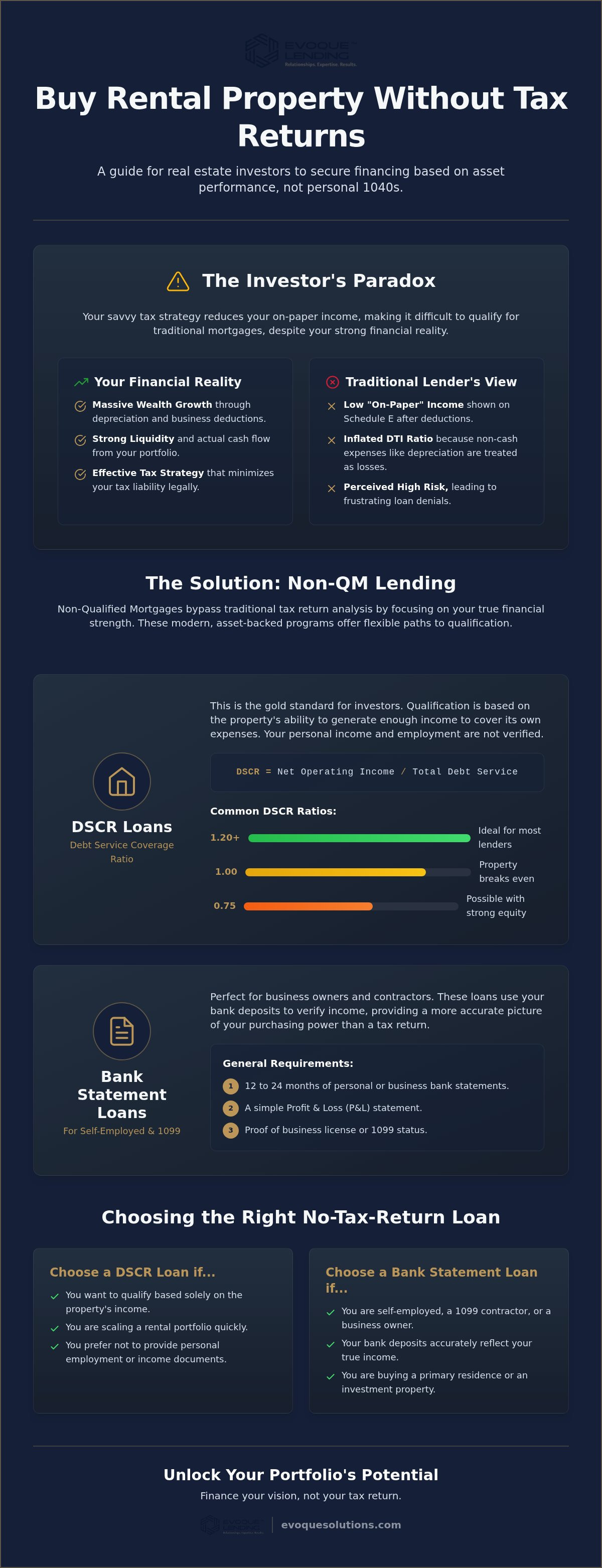
Most real estate investors eventually hit a wall known as the "Investor’s Paradox." This happens when your tax strategy is so effective at reducing your liability that it simultaneously destroys your ability to qualify for a traditional mortgage. You're building massive wealth through depreciation and business deductions, but on paper, you look like you barely earn a living. Conventional lenders see these paper losses as a lack of stability. They don't see the savvy investor; they see a risk.
Conventional institutions rely on rigid formulas. They look at your Schedule E and see the net income after every possible deduction has been applied. This approach is fundamentally flawed for anyone trying to buy rental property without tax returns. It ignores the liquidity you hold and the actual cash flow your portfolio generates. For 1099 contractors or business owners with multiple LLCs, a single year of high reinvestment can lead to an immediate rejection from a big-box bank.
The Problem with Standard Debt-to-Income (DTI) Ratios
Standard DTI calculations are designed for W-2 employees with predictable, flat incomes. When you're an investor, your income is dynamic. Traditional banks calculate DTI by dividing your monthly debt by your taxable net income. They rarely account for non-cash expenses. Depreciation, for example, is a massive tax benefit that doesn't actually cost you a cent in monthly cash flow. Yet, traditional underwriters treat it as a loss. This creates an artificial ceiling for your portfolio. You might have $500,000 in liquidity, but if your DTI is too high due to paper losses, the bank will say no every time.
The Rise of Non-QM Lending in 2026
The financial landscape of 2026 demands more flexibility. This is where Non-Qualified Mortgage (Non-QM) lending fills the gap. Unlike the subprime era of 2008, modern Non-QM programs are built on transparency and asset-backed security. They allow you to buy rental property without tax returns by using alternative documentation. As detailed in our Non-QM Loans for Real Estate Investors: The 2026 Portfolio Growth Guide, these loans focus on the property’s ability to pay for itself or your actual bank deposits. It's a logical, common-sense approach to lending that prioritizes your real-world financial health over a tax form.
Alternative Qualification Methods: DSCR, Bank Statements, and Asset Depletion
Traditional banks remain stuck in a loop of tax return analysis. The private market has evolved. You can now buy rental property without tax returns by matching your specific financial profile to the right documentation program. This shift allows you to leverage your actual buying power rather than an "on-paper" figure. By focusing on your assets or the property's performance, you can bypass the rigid DTI limits that often stall portfolio growth.
Debt Service Coverage Ratio (DSCR) Loans Explained
DSCR loans are the gold standard for investors who want to decouple their personal income from their acquisitions. The lender looks at one primary factor: does the property generate enough rent to cover its own mortgage, taxes, and insurance? The formula is simple. You take the Net Operating Income and divide it by the annual Debt Obligations. A 1.0 ratio means the property breaks even. Most lenders look for a 1.2 ratio, but in 2026, many programs allow for a 0.75 ratio if you have strong equity. Best of all, your personal employment history isn't verified. This makes it the premier way to buy rental property without tax returns while scaling a portfolio quickly.
Bank Statement and 1099 Loan Programs
If you're a business owner or a 1099 contractor, your bank deposits are a truer reflection of your buying power than your tax returns. These programs review 12 or 24 months of statements to calculate your average monthly income. You can choose between personal or business accounts depending on where your revenue flows. Lenders typically apply an expense ratio to business accounts to estimate net income, whereas personal statements often allow for 100% of deposits to be counted. You'll generally need:
- 12 to 24 months of bank statements.
- A simple Profit & Loss statement.
- Proof of business license or 1099 status.
For a deep dive into these requirements, see our Self-Employed Bank Statement Loans: Ultimate 2026 Guide.
Asset Depletion for High-Net-Worth Individuals
Sometimes, your strength lies in what you own rather than what you earn monthly. Asset depletion allows you to convert liquid net worth into qualifying income. Lenders look at your stocks, bonds, and cash reserves to create a "virtual" monthly payment. They use a formula: (Total Assets - Down Payment) / Loan Term. This is an ideal scenario for retirees or investors who are between active projects but maintain high liquidity. It's a sophisticated way to prove your long-term stability through existing wealth instead of a paystub.
If you're ready to see which of these programs aligns with your goals, our team at Evoque Lending can help you navigate the options.
Choosing the Right "No Tax Return" Loan for Your Investment Strategy
Choosing the right financing is a matchmaking exercise. You need to align your current financial strengths with the specific underwriting requirements of the loan. While several programs allow you to buy rental property without tax returns, selecting the wrong one can lead to higher costs or missed opportunities. It's about finding the path of least resistance for your specific documentation profile.
If you've found a turnkey property with high market rents, but your personal tax returns show a net loss due to heavy depreciation, a DSCR loan is your best bet. It focuses entirely on the asset's performance. Conversely, you might be a high-earning entrepreneur looking to buy a "fixer-upper" with low current rent. In this case, the property's DSCR won't qualify on day one. You should pivot to a Bank Statement loan to use your business revenue as the qualifying factor. For those who are retired or recently exited a business with high liquidity, Asset Depletion bridges the gap between having wealth and having a monthly paycheck.
Matching Loan Types to Property Categories
The type of property you target dictates which documentation path is most viable. Short-term rentals (STRs) like those on Airbnb require lenders who accept projected AirDNA data or "transient" income rather than just standard long-term lease estimates. Similarly, while residential DSCR programs are perfect for single-family homes and four-plexes, moving into five-unit buildings or larger typically triggers commercial underwriting standards. We help you navigate these nuances to ensure your loan matches the property’s intended use and income potential.
Financial Trade-offs: Rates, Points, and Down Payments
Flexibility comes with a cost. Because these programs offer a way to buy rental property without tax returns, they represent a higher perceived risk to the lender. You should expect interest rates that are slightly higher than conventional 30-year fixed options. Down payments typically range between 20% and 30%. Your credit score remains a primary driver of your loan-to-value (LTV) ratio; a higher score often unlocks lower down payment requirements.
It's also vital to consider prepayment penalties. Many Non-QM loans include a "step-down" penalty if you refinance or sell within the first few years. If your strategy involves a quick exit or a "buy, rehab, refinance" (BRRRR) model, we can often structure a loan with a shorter penalty period or none at all. Understanding these trade-offs ensures your financing supports your long-term wealth goals rather than creating a bottleneck for your next acquisition.
A Step-by-Step Guide to Securing Your Loan Without Tax Paperwork
The transition from theory to acquisition requires a methodical approach. When you decide to buy rental property without tax returns, you aren't skipping the verification process; you're simply changing the data points the lender evaluates. Following a structured path ensures that your file moves through underwriting without the typical friction associated with non-traditional income. It's about presenting a clear, logical picture of your financial strength through alternative means.
- Step 1: Define your Documentation Profile. Before looking at houses, determine if your strength lies in the property’s projected income (DSCR) or your business’s cash flow (Bank Statements).
- Step 2: Prepare your records. If you're going the bank statement route, organize 12 to 24 months of digital statements. A clean Profit & Loss statement signed by a tax professional is often required to verify your business's health.
- Step 3: Secure a rental market analysis. This involves an appraisal that includes a rent schedule to prove the property’s earning potential.
- Step 4: Submit an online questionnaire. This preliminary step allows a specialist to match your profile with the best available wholesale program to buy rental property without tax returns.
- Step 5: Underwriting and Closing. Once your documentation is verified, the final 30 days involve title work, insurance, and final asset confirmation.
Organizing Your Alternative Documentation
Efficiency in the underwriting phase depends on how well you separate your business and personal expenses. Mixing these accounts can complicate the review of your bank statements and may lead to a lower calculated income. Lenders also look for "Liquid Reserves," which are cash or cash equivalents set aside to cover 3 to 6 months of mortgage payments. Appraisal Form 1007 is a supplemental report that provides the lender with an official estimate of the property’s fair market rent, serving as the primary document to calculate the debt service coverage ratio.
Navigating the 2026 Underwriting Process
The underwriting landscape has shifted toward automated digital verification. Instead of mailing stacks of paper, you'll likely use secure portals to link your bank accounts for real-time asset verification. This technology has streamlined the timeline, often allowing for a full approval and funding within 21 to 30 days. Underwriters in the Non-QM space also have more flexibility with "gift funds" for down payments, provided the source is clearly documented and seasoned. This modern approach makes the closing process feel less like an interrogation and more like a professional partnership.
If you're ready to begin the process, you can start your online application with Evoque Lending today to see which programs fit your portfolio needs.
Scaling Your Portfolio with Evoque Lending’s Specialized Programs
Scaling a real estate portfolio requires more than just capital. It requires a lending partner that grows with you. While local banks might limit you to a handful of properties, specialized programs allow you to buy rental property without tax returns across multiple jurisdictions. This freedom is essential for investors looking to diversify their holdings in the 2026 market. At Evoque Lending, we provide the infrastructure needed to transition from a single acquisition to a scalable business model.
Our focus is on identifying the best fit for 1099 and self-employed borrowers who are often misunderstood by traditional institutions. By accessing wholesale Non-QM rates, we ensure that your financing costs remain competitive even as you move away from conventional documentation. Our approach is built for the modern entrepreneur who needs to buy rental property without tax returns to stay agile in a competitive landscape. For those ready to leverage property income to expand their reach, our guide on DSCR Loans for Real Estate Investors provides the blueprint for strategic growth.
Why National Investors Choose Evoque Lending
Many lenders are restricted by state lines, forcing you to find a new partner every time you cross a border. We operate in over 40 states, providing a consistent experience whether you're buying a short-term rental or a multi-family unit. This national reach is paired with deep experience; we've been navigating shifting market cycles since 2005. We position ourselves as a long-term partner, not just a transactional service.
Our loan specialists don't just process paperwork. They act as seasoned guides who understand complex tax structures and LLC hierarchies. Whether you need a new purchase loan, a cash-out refinance to fund your next deal, or a portfolio consolidation to simplify your debt, we provide the technical expertise to make it happen. We understand that your financial story is more than a single tax year.
Get Started with a Streamlined Quote
Time is the most valuable asset for any investor. Our streamlined online questionnaire is designed to save you from the "document chase" by pre-screening your eligibility for specific programs. This allows us to provide a custom match quickly, so you can focus on finding the next property. To get the most accurate quote, have the following information ready:
- An estimated value of the target property or your current portfolio.
- Your current credit score.
- Approximate amount of liquid assets for down payments and reserves.
Ready to grow your portfolio? Get a custom loan match from Evoque Lending today.
Securing Your Next Acquisition with Confidence
The traditional banking system often fails to account for the strategic complexity of a modern real estate portfolio. You've learned that paper losses and high deductions don't have to stall your progress. By shifting your focus toward property cash flow or verified bank deposits, you can effectively buy rental property without tax returns while maintaining your tax efficiency. This approach turns the "Investor's Paradox" into a competitive advantage for those who know which documentation path to follow.
At Evoque Lending, we've specialized in these Non-QM solutions since 2005. Our national reach across more than 40 states ensures that your expansion isn't limited by geography. Whether you're targeting a high-yield short-term rental or consolidating a multi-state portfolio, our team provides the seasoned guidance necessary to navigate the 2026 lending environment. Use our quick-match online questionnaire to identify the specific program that fits your current financial profile.
Match your documentation profile to the right loan—Get Started with Evoque Lending
Your portfolio growth shouldn't be dictated by a standard tax form. We're here to help you unlock the financing you've already earned.
Frequently Asked Questions
Can I really buy a rental property without showing my tax returns?
Yes, you can. Specialized Non-QM programs allow investors to qualify based on alternative documentation like bank statements or the property's income potential. These methods are designed specifically for individuals whose tax returns don't reflect their actual liquidity due to heavy write-offs or complex business structures. It's a standard practice in the private lending sector to focus on cash flow rather than personal 1040 filings.
Is a DSCR loan considered a "no doc" loan?
No, a DSCR loan is not a "no doc" loan; it is a "reduced doc" or "alternative doc" program. While you don't provide tax returns or paystubs, you must still provide documentation for the property's rental income, your credit history, and your liquid assets. Lenders still verify your ability to manage the debt; they do so by evaluating the property’s performance rather than your personal employment status.
What is the minimum credit score for a no-tax-return investment loan?
Lenders generally look for a minimum credit score of 620 to 660 for these specialized programs. However, your credit score directly impacts your loan-to-value ratio and your down payment requirements. A higher score, such as 720 or above, often unlocks more favorable terms and lower down payments. It's important to maintain a healthy credit profile to access the full range of flexible financing options available in the 2026 investment market.
Do I need to have a job to qualify for a DSCR rental loan?
You don't need a traditional W-2 job to qualify for a DSCR loan. Because the underwriting focuses on the property's ability to cover its own debt obligations, your personal employment history is not verified. This makes it an ideal solution for retirees, full-time investors, or those between professional projects. As long as the property generates sufficient rental income and you have the required reserves, you can successfully buy rental property without tax returns.
How much down payment is required for a bank statement loan?
Down payment requirements for bank statement loans generally range from 15% to 25% depending on your credit score and the property type. While traditional loans might offer lower down payments for primary residences, investment properties in the Non-QM space require more skin in the game. Higher liquidity and a strong history of deposits can sometimes help you secure the lower end of that down payment range, providing more leverage for your portfolio expansion.
Can I use a DSCR loan to buy an AirBnB or short-term rental?
Yes, DSCR loans are frequently used for short-term rentals and vacation properties. Lenders often use specialized data sources like AirDNA or the property's actual 12-month history to estimate income potential. This flexibility is crucial because short-term rentals often generate higher gross revenue than traditional long-term leases. We help you navigate the specific appraisal requirements to ensure your short-term rental income is fully recognized during the qualification process, helping you scale your STR portfolio.
Are interest rates higher for loans that don’t require tax returns?
Interest rates for alternative documentation loans are typically slightly higher than those for conventional, government-backed mortgages. This premium accounts for the increased flexibility and the lender’s reliance on non-traditional income verification. However, many investors find the slightly higher rate is a worthwhile trade-off for the ability to scale their portfolio without the constraints of rigid DTI ratios or the need to present personal tax filings. It's a tool for growth rather than a simple cost.
Can I get a no-tax-return loan through an LLC?
Closing in the name of an LLC is a standard feature for many Non-QM and DSCR programs. In fact, many professional investors prefer this structure for liability protection and tax planning purposes. While the loan is made to the entity, you will likely still provide a personal guarantee. This alignment with business-minded structures is one reason why these programs are the preferred choice for those looking to buy rental property without tax returns.
Reviewed by Eddie Luhrassebi, Founder & CEO, NMLS #337071 | CA DRE #01230650
Last updated: August 28, 2026 · About the reviewer