
Non-QM Loans for Real Estate Investors: The 2026 Portfolio Growth Guide
Written by Eddie Luhrassebi · Published August 27, 2026
Scale your portfolio past 10 loans with non-qm loans for real estate investors. Learn how DSCR & bank statement loans unlock growth without personal DTI fric...
You have built a successful portfolio, yet your traditional bank treats your 1099 income like a liability rather than an asset. It is a common frustration for high-growth individuals. The more you expand, the harder it becomes to fit into the rigid "Qualified Mortgage" box. You understand that rental properties are about cash flow, not just your personal debt-to-income ratio. It is exhausting to hit an arbitrary 10-loan limit or spend weeks proving your income when the property's performance speaks for itself.
This guide demonstrates how non-qm loans for real estate investors act as a strategic bridge, allowing you to bypass institutional friction and maintain your portfolio's velocity. You will discover how alternative financing unlocks scalability for those who do not fit traditional lending criteria. We will explore how to qualify using bank statements or DSCR Purchase Loans. We also look at how the August 2026 regulatory landscape, including the CFPB's current review of ATR/QM rules, is shifting the way sophisticated investors scale across state lines without personal income friction.
What are Non-QM Loans and Why Do They Matter in 2026?
Non-QM loans are defined by what they are not. They don't follow the rigid "Qualified Mortgage" standards established after the 2008 financial crisis. Instead, these loans provide a flexible path for borrowers who have strong financial profiles but don't fit into the neat boxes required by government-backed lenders. For many, non-qm loans for real estate investors represent the primary way to scale a portfolio once traditional debt-to-income (DTI) limits are reached.
The legal foundation for these loans traces back to the Dodd-Frank Wall Street Reform and Consumer Protection Act. This legislation introduced the "Ability to Repay" (ATR) rule, requiring lenders to verify that a borrower can afford their mortgage. While traditional lenders use tax returns and W-2s to meet this requirement, Non-QM lenders use alternative methods. They might look at bank statements or the rental income of the property itself to verify financial stability. It's a shift from personal income verification to asset-based evaluation.
It's vital to distinguish modern Non-QM lending from the "subprime" era of the past. Today's market is built on stability and transparency. Borrowers typically need a solid FICO score, often 640 or higher, to qualify. Unlike the 2008 era, these loans require significant equity. Most programs demand down payments between 15% and 25%, ensuring the investor is well-capitalized. Non-QM is not about lending to risky borrowers; it's about lending to complex borrowers.
The Role of the Consumer Financial Protection Bureau (CFPB)
The CFPB oversees the ATR rule to protect residential homeowners from predatory terms. However, investment properties often fall into a different category where the focus shifts from personal consumption to business performance. Because Non-QM loans don't meet the strict criteria for sale to Fannie Mae or Freddie Mac, they're typically held by private investors. This independence allows for more creative underwriting that prioritizes the actual cash flow of a rental property over the borrower's personal tax history.
Why Real Estate Investors Choose Non-QM Financing
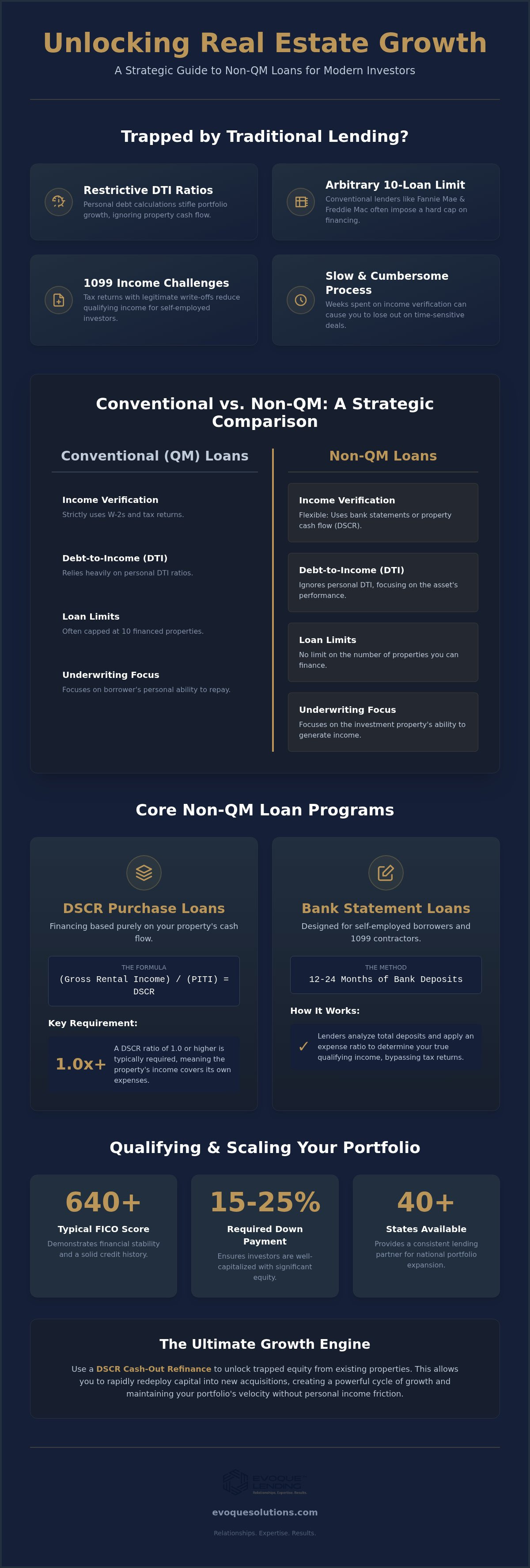
Traditional banks often stop lending once an investor hits a 10-loan limit. They also struggle with self-employed individuals who use legal tax deductions to lower their taxable income. Non-QM programs solve this by ignoring personal DTI ratios. Investors can qualify using 12 or 24 months of bank statements or through DSCR Purchase Loans. This flexibility is essential for those looking to diversify across state lines. Since many Non-QM lenders operate in 40 or more states, non-qm loans for real estate investors provide a consistent national lending partner for rapid portfolio expansion.
Core Non-QM Loan Programs for National Investors
Real estate entrepreneurs often hit a wall when their tax returns don't reflect their true liquidity. While a Qualified Mortgage requires strict W-2 verification and debt-to-income (DTI) calculations, Non-QM programs utilize "Alternative Documentation." This framework allows for rapid acquisition and the ability to execute a DSCR Cash-Out Refinance to keep capital moving. These programs are designed for speed and are available in over 40 states, providing a consistent solution for national scaling.
DSCR Purchase Loans: Financing Based on Rental Cash Flow
The Debt Service Coverage Ratio (DSCR) is the gold standard for portfolio growth. The formula is straightforward: monthly gross rental income divided by the full mortgage payment, including principal, interest, taxes, and insurance (PITI). Most DSCR loans for real estate investors in 2026 require a ratio of 1.0x or 1.2x. This means the property's income must meet or exceed its own debt. Because these programs ignore personal DTI, you can scale your portfolio without your personal debt load stopping the next deal.
Bank-Statement Loans for Self-Employed Borrowers
For the entrepreneur, tax returns often show significant write-offs that lower qualifying income. These bank statement loans for self employed borrowers look at 12 or 24 months of actual deposits instead. Lenders typically apply an expense ratio to these deposits to determine qualifying income. For example, a business account might have a 50% expense ratio applied, while a personal account might use 100% of the deposits. It's a more accurate reflection of real-world cash flow for business owners and contractors.
Asset-Depletion and 1099 Borrower Loans
High-net-worth individuals often have low taxable income but significant liquid reserves. Asset-Depletion Loans convert this liquid net worth into a monthly qualifying income stream by dividing eligible assets over a set term, such as 84 or 120 months. Similarly, 1099 Borrower Loans cater to the modern gig economy and independent contractors who receive consistent payments but lack a standard salary. These programs ensure that non-qm loans for real estate investors remain accessible to those with non-traditional income structures. If you are ready to evaluate your eligibility, you can speak with a specialized guide to find the right fit for your scenario.
Strategic Comparison: Non-QM vs. Conventional Financing
Conventional loans offer the lowest interest rates. However, the hidden costs of strict debt-to-income requirements and lengthy approval windows can stall a growing portfolio. For many, non-qm loans for real estate investors represent a strategic choice to prioritize speed and scalability over the absolute lowest rate. While conventional rates might sit near 7.00% in August 2026, non-QM rates typically range between 1.25% and 3.00% higher depending on your credit profile. This premium is often the price of bypassing the "10-loan limit" that stops traditional lenders from financing seasoned investors with multiple properties.
The myth that non-QM is "expensive" ignores the broader market. When compared to hard money rates, which often exceed 10% or 12%, non-QM products are a cost-effective long-term solution. They provide 30-year stability that hard money cannot match. Industry analysis from publications like Forbes, which ranks the Best Non-QM Lenders, highlights that these programs are designed for high-net-worth individuals and entrepreneurs who need capital to move at the speed of the market. The opportunity cost of losing a high-yield property while waiting 60 days for a bank approval far outweighs a 1.5% difference in interest.
Speed and Leverage: The Investor's Edge
Closing times are a major differentiator. A conventional loan often takes 45 to 60 days to navigate through heavy documentation and secondary market audits. Non-QM transactions frequently close within 21 to 30 days. Since these programs don't require personal income verification, the underwriting process is streamlined. Appraisals and title work become the primary timeline drivers. In a competitive market, being able to guarantee a 30-day close can be the single factor that convinces a seller to accept your offer over a traditional buyer.
Qualification Flexibility and Loan Limits
Traditional lenders are bound by conforming loan limits and rigid credit overlays. If you've had a recent credit event like a bankruptcy or foreclosure, a conventional lender might make you wait seven years. Non-QM lenders are more pragmatic, often considering borrowers with FICO scores as low as 550 or those only two years past a credit event. These programs also support "Jumbo" amounts that exceed standard limits, allowing for the acquisition of high-value assets. Furthermore, borrowing through an LLC or corporate entity is standard practice in the non-QM space, providing the liability protection that serious investors require.
How to Qualify: Documentation and Requirements Guide
Qualifying for non-qm loans for real estate investors is a process that prioritizes your current financial strength over historical tax filings. Because these programs are designed for agility, the underwriting focus shifts toward tangible assets and property performance. Success begins with identifying the right program for your specific income structure. If you are a high-volume landlord, a DSCR Purchase Loan is likely the best fit. For business owners, bank statement programs offer a more accurate reflection of qualifying income than a standard 1040 form.
Once you have identified your path, follow these strategic steps to ensure a smooth approval:
- Gather Alternative Documentation: Collect 12 to 24 months of bank statements or current lease agreements.
- Run Preliminary Numbers: Conduct a basic DSCR calculation to ensure the property's income supports the debt or verify that your business deposits meet the lender's expense ratio requirements.
- Consult a Specialized Guide: Engage a broker who understands the nuances of national alternative lending to match you with the right program.
- Undergo Property Evaluation: Navigate the appraisal process, which often includes a market rent analysis (Form 1007) to verify the property's income potential.
The Documentation Checklist for Alternative Loans
The hallmark of non-QM lending is the exclusion of personal tax returns from the loan file. This removes the friction caused by legal tax deductions that often disqualify self-employed investors at traditional banks. Instead, lenders require a specific set of alternative documents. You should prepare to provide:
- Personal or business bank statements (12 or 24 months).
- 1099 forms for the most recent two years for independent contractors.
- A third-party prepared Profit and Loss (P&L) statement if using certain bank statement programs.
- Existing lease agreements or a schedule of real estate owned (SREO).
It is vital that your bank statements remain "clean." Lenders scrutinize these records for excessive non-sufficient funds (NSF) notices or overdrafts. A pattern of financial mismanagement in your accounts can lead to a denial, regardless of your total deposits.
Credit and Equity Standards for 2026
While documentation is flexible, equity and credit requirements remain firm to ensure portfolio stability. In the 2026 market, most investment deals require a Loan-to-Value (LTV) ratio between 70% and 80%. This means you should expect a down payment of 20% to 30%. Credit scores play a significant role in determining your final interest rate and required equity. While some programs allow scores as low as 550, the most competitive terms are reserved for those in the 720+ tier. Additionally, ensure your down payment funds have been "seasoned" in your account for at least 60 to 90 days to meet anti-money laundering requirements. If you are ready to see how your scenario fits these guidelines, you can apply for a specialized loan review today.
Scaling Your Portfolio: Using Non-QM as a Growth Engine
Scaling a real estate empire requires a shift in mindset from personal income to property performance. Traditional lenders often cap investors at 10 financed properties, effectively stalling growth for seasoned professionals. Using non-qm loans for real estate investors removes this ceiling. Because DSCR programs look at the property's ability to cover its own debt, there is no limit to the number of properties you can finance. This allows you to scale based on the strength of your deals rather than your personal tax returns.
A core component of this growth engine is the DSCR Cash-Out Refinance. By unlocking equity from stabilized assets, you can generate the down payments needed for your next acquisition. This strategy is particularly effective for the growing Short-Term Rental (STR) market. Specialized Short-Term Rental Loans allow you to qualify based on projected Airbnb or VRBO revenue, tapping into high-yield markets that traditional banks often avoid. This flexibility ensures your capital remains active rather than trapped in a single property.
The Velocity of Capital Strategy
Investors often follow a methodical path: purchase, stabilize, and refinance. In the world of alternative lending, portfolio velocity is the measured speed at which an investor can recycle equity from one asset into the acquisition of the next. Using DSCR loans creates a self-sustaining ecosystem. Each property qualifies on its own merits, ensuring that your personal debt-to-income ratio never becomes a bottleneck. This allows for a much faster acquisition pace than conventional financing could ever support.
Partnering with a Seasoned Non-QM Guide
Navigating 40+ states and dozens of alternative programs requires more than just a lender; it requires a strategic partner. Evoque Lending has been operating since 2005, serving as an advocate for borrowers who don't fit into standard institutional boxes. Whether you are dealing with complex 1099 income or need a solution for foreign national investments, personalized loan matching is essential. A guide with national reach ensures that your scaling strategy remains consistent across different markets as you utilize non-qm loans for real estate investors to reach your goals. Ready to scale? Contact an Evoque Lending specialist to explore your Non-QM options today.
Accelerate Your Portfolio Growth in 2026
The path to a multi-state portfolio is rarely paved with standard W-2 tax returns. You have seen how non-qm loans for real estate investors provide the necessary flexibility to bypass institutional friction and focus on property performance. By utilizing specialized instruments like DSCR Purchase Loans and Bank-Statement programs, you can maintain capital velocity without hitting the arbitrary loan limits of traditional banks. These tools allow you to scale based on the actual cash flow of your assets rather than your personal debt-to-income ratio.
Evoque Lending has served as a seasoned guide for non-traditional borrowers since 2005. With national reach across more than 40 states, we understand the practical realities of modern investment scenarios. Whether you are a self-employed entrepreneur or a high-volume landlord, our focus is on aligning your financing with your long-term growth goals. We provide the stability and expertise needed to navigate the evolving regulatory landscape of 2026. Don't let rigid institutional boxes stall your momentum.
Start your Non-QM loan inquiry with Evoque Lending's online questionnaire to see how our specialized expertise can unlock your next acquisition. Your growth doesn't have to wait for a traditional approval that may never come. It is time to secure the financing your portfolio deserves.
Frequently Asked Questions
What is the difference between a Non-QM loan and a subprime loan?
Non-QM loans are distinct from subprime lending because they require substantial equity and solid credit. While subprime loans of the past often involved high-risk profiles, modern non-qm loans for real estate investors focus on borrowers with complex income but strong financials. Most programs require a FICO score of 640 or higher and a down payment of at least 20%. This ensures the borrower is well-capitalized and the investment remains stable.
Can I get a Non-QM loan for an investment property without showing tax returns?
You can qualify for an investment property loan without providing personal tax returns. Programs like Bank-Statement Loans and DSCR Purchase Loans use alternative verification methods. Lenders review 12 to 24 months of deposits or the projected rental income of the property itself. This approach is ideal for self-employed individuals who utilize legal tax deductions that would otherwise lower their qualifying income at a traditional bank.
Are interest rates significantly higher for Non-QM loans compared to conventional?
Interest rates for Non-QM products are typically 1.25% to 3.00% higher than conventional rates. In August 2026, a borrower with a 720 credit score might see rates in the 8.25% to 8.75% range compared to a 7.00% conventional rate. While the cost is higher, the benefit lies in the ability to close deals that traditional lenders reject due to rigid debt-to-income or property limit rules.
Do Non-QM loans require a larger down payment for real estate investors?
Most non-qm loans for real estate investors require a down payment between 20% and 25%. Traditional residential loans might offer lower entry points, but the alternative lending market uses higher equity to balance the risk of non-traditional income verification. For highly experienced investors with significant reserves and high credit scores, some specialized programs may consider a 15% down payment, though 20% remains the industry standard in the current market.
Can I qualify for a Non-QM loan if I am an independent contractor with 1099 income?
Independent contractors with 1099 income are ideal candidates for these programs. 1099 Borrower Loans specifically target gig-economy professionals and consultants who lack a standard W-2. Lenders verify income by reviewing 1099 forms from the last two years or by analyzing consistent deposits in bank statements. This allows you to qualify based on your actual earnings rather than the net income shown after business expenses on tax filings.
What is a DSCR loan and how does it help real estate investors?
A DSCR loan stands for Debt Service Coverage Ratio and qualifies a property based on its rental income. The lender divides the monthly gross rent by the total mortgage payment, including taxes and insurance. If the ratio is 1.0 or higher, the property covers its own debt. This helps investors scale quickly because the loan is tied to the asset's performance rather than the borrower's personal debt-to-income ratio.
Are Non-QM loans available for foreign nationals investing in US real estate?
Yes, Foreign-National Loans are available for non-US citizens looking to invest in domestic real estate. These programs don't require a US credit score or a social security number. Instead, the lender focuses on the property's cash flow and the borrower's liquid reserves. This specialized path allows international entrepreneurs to diversify their wealth into the US market without the friction of standard domestic residency requirements or personal income history.
How long does it typically take to close a Non-QM mortgage?
Closing a Non-QM mortgage typically takes between 21 and 30 days. This is significantly faster than the 45 to 60 days often required for conventional financing. Because the underwriting process bypasses the complex audit of personal tax returns, the timeline is driven primarily by the appraisal and title work. This speed gives you a competitive advantage when negotiating with sellers who prioritize a certain closing date.
Reviewed by Eddie Luhrassebi, Founder & CEO, NMLS #337071 | CA DRE #01230650
Last updated: August 27, 2026 · About the reviewer