Self-Employed Bank Statement Loans: Ultimate 2026 Guide
Written by Eddie Luhrassebi · Published August 20, 2026
Unlock your mortgage with bank statement loans for self employed. Our 2026 guide shows how to use your real cash flow, not tax returns, to get approved.
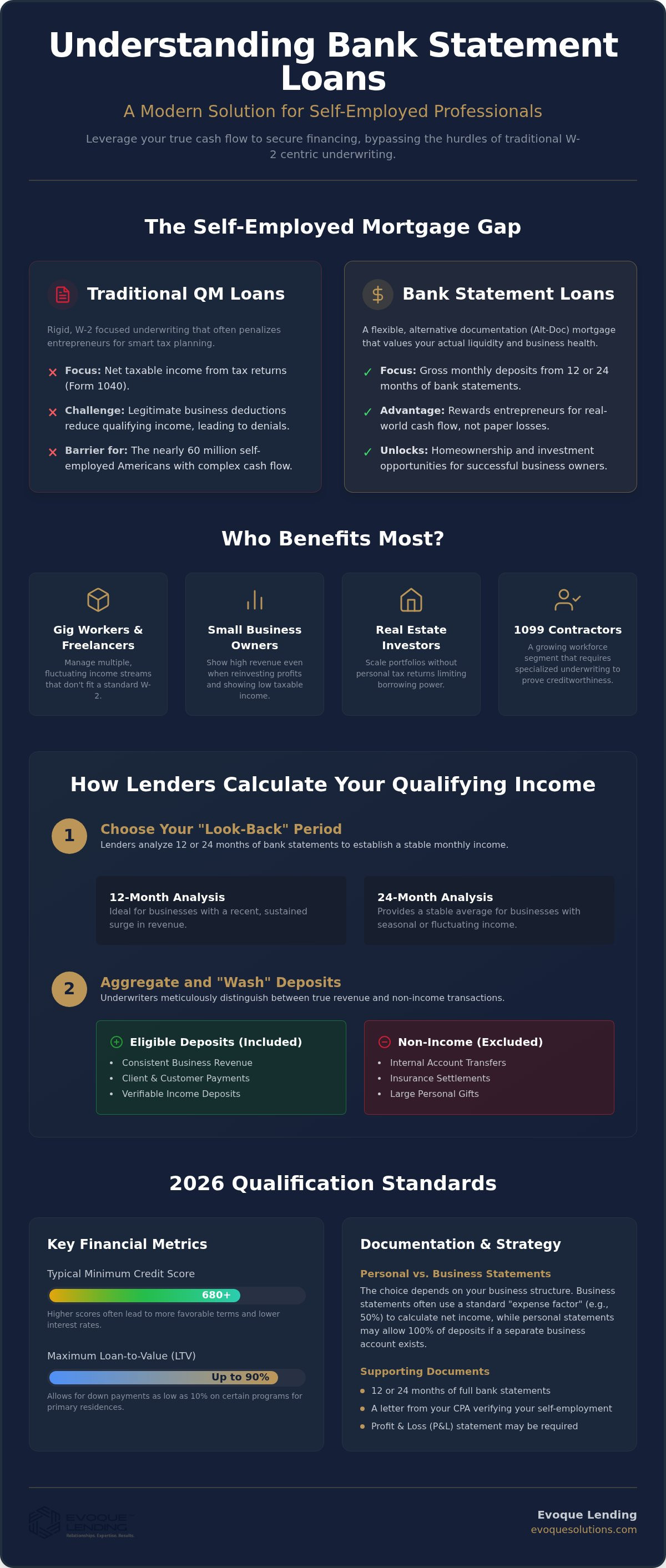
Bank statement loans are not subprime loopholes; they are sophisticated financial instruments that reward entrepreneurs for their real-world liquidity. If you've been turned away by traditional lenders because of your 1099 status, you know the frustration of having your success used against you. Most banks prioritize tax returns that often reflect aggressive deductions rather than your true earning power. This creates an unnecessary barrier for the nearly 60 million Americans earning self-employed income in 2026. Specialized bank statement loans for self employed professionals solve this by focusing on your actual cash flow rather than paper losses.
You deserve a lending partner that understands the nuances of business ownership and the practical realities of how modern investors operate. We will show you how to leverage your monthly deposits to secure a home or investment property without the anxiety of complex tax paperwork. This guide breaks down the documentation needed for a 12 or 24-month analysis, clarifies how lenders calculate your qualifying income, and provides a clear path to finding a lender that values your liquidity over your tax history.
The Self-Employed Mortgage Gap: Why Traditional Banks Say No
Traditional mortgage lending is built for the predictable. It favors the W-2 employee with a steady paycheck and a simple tax return. For the entrepreneur, this rigid structure often leads to a dead end. Standard banks rely on Qualified Mortgage (QM) standards, which are heavily regulated and restricted. These rules require lenders to verify income using federal tax returns. While tax planning is essential for business growth, the legal deductions you take to reduce your tax liability often disqualify you for a traditional loan. Specialized bank statement loans for self employed professionals provide the flexibility needed to navigate these hurdles.
A bank statement loan is an alternative documentation (Alt-Doc) mortgage designed to bridge this gap. Instead of looking at the "taxable income" reported to the IRS, these loans focus on your actual liquidity. Lenders analyze your bank statement deposits to determine your true earning capacity. By evaluating gross deposits rather than net profit on a 1040, these programs recognize the cash flow that actually flows through your business. This shift in perspective allows you to leverage your real-world success to secure financing.
The Problem with W-2 Centric Underwriting
Traditional underwriting is inherently W-2 centric. It assumes that income is static and easily verifiable through a paystub. For a self-employed individual, income fluctuates. One month might bring a massive contract, while the next is focused on reinvestment. Big banks struggle with this variance. They apply the "Ability to Repay" (ATR) rule through a narrow lens, often failing to account for the unique financial structures of high-net-worth entrepreneurs. It's frustrating to be rejected by a retail bank despite having a healthy balance sheet; that rejection is usually a result of rigid institutional boxes rather than your financial health.
Who Benefits Most from Bank Statement Loans?
These loans aren't just for struggling businesses. They are strategic tools for those with complex financial profiles. bank statement loans for self employed individuals serve several key groups that the traditional market ignores. This is particularly relevant given that nearly 60 million Americans earn self-employed income as of 2026. Target profiles include:
- Gig Workers and Freelancers: Professionals who manage multiple income streams that don't fit into a single W-2 line item.
- Small Business Owners: Entrepreneurs who reinvest heavily into their operations, resulting in low taxable income despite high revenue.
- Real Estate Investors: Sophisticated buyers who want to scale their portfolios without their personal tax returns limiting their borrowing power.
- 1099 Contractors: A rapidly growing segment of the workforce that requires specialized underwriting to prove their creditworthiness.
How Bank Statement Loans Work: The 2026 Mechanics
Understanding the mechanics of bank statement loans for self employed borrowers is the first step toward homeownership. Most programs offer two primary look-back periods: 12 months or 24 months. A 12-month program is ideal for businesses that have seen a recent surge in revenue. Conversely, a 24-month analysis provides a more stable average for seasonal businesses. Underwriters don't just glance at your balance. They meticulously aggregate eligible deposits to calculate a monthly income figure. This process allows you to use your actual cash flow to qualify for primary residences, second homes, or investment properties.
The underwriter acts as a financial detective. They must distinguish between legitimate revenue and internal transfers. If you move $5,000 from a savings account to your business checking, that isn't income. It's a transfer. To avoid "double-counting," these movements are strictly excluded. Similarly, non-business deposits like insurance settlements or personal gifts are backed out of the calculation. A Profit and Loss (P&L) statement often serves as a secondary verification tool. It provides context for your overhead costs and helps the lender understand how you can leverage your bank statements without overextending your debt-to-income ratio. An "income wash" occurs when the underwriter balances these documented business expenses against your gross revenue to finalize your qualifying figure.
The Underwriting Process for Alt-Doc Loans
Underwriters focus on consistency. They look for a steady stream of deposits that suggest a sustainable business model. Large, unexplained deposits can trigger additional questions, so transparency is vital. If you have multiple business entities, the lender will require documentation showing your ownership percentage in each to accurately attribute income. This methodical approach ensures the loan is sustainable for both the borrower and the lender.
Interest Rates and Terms in the Current Market
In 2026, the market for alternative documentation loans remains robust. You should expect interest rates to be approximately 1% to 2% higher than conventional mortgages. This risk premium compensates the lender for the lack of traditional tax verification. Borrowers can choose between 30-year fixed rates or Adjustable-Rate Mortgages (ARMs), which may offer lower initial payments. Specialized bank statement loans for self employed individuals often feature interest-only payment options, which are a popular tool for maximizing monthly cash flow. If you're unsure which structure fits your business model, you can explore customized loan terms that align with your specific liquidity needs.
Choosing Your Path: Personal vs. Business Bank Statements
Deciding which statements to submit is a critical strategic pivot in the mortgage process. For bank statement loans for self employed applicants, this choice often dictates the final loan amount you qualify for. The primary differentiator is the "Expense Factor." Lenders assume every business has overhead costs. If you provide business statements, underwriters typically apply a default 50% expense factor. This means only half of your total deposits are counted as qualifying income. However, personal bank statements are often viewed through a more favorable lens. They frequently allow for a 100% deposit credit if you can prove the business pays its own bills from a separate account.
Ownership requirements are strict. You generally need to own at least 25% of the entity to use its statements, though some specialized programs require a 50% stake. For sole proprietors who use co-mingled accounts, the documentation process is more nuanced. You'll need to demonstrate that the account effectively handles both business revenue and personal obligations without compromising the integrity of the income calculation. It's about fit and alignment with your actual daily operations.
When to Use Personal Bank Statements
Personal statements are ideal for consultants, freelancers, or digital creators with minimal overhead. Since you aren't carrying inventory or a large payroll, using personal accounts avoids the heavy expense "haircuts" associated with business entities. In many cases, this path removes the need for a third-party Profit and Loss statement. You'll still need to provide two months of business bank statements; however, this is simply to verify the business is active rather than to calculate income. This streamlined approach reduces paperwork and maximizes your borrowing power.
When Business Statements Make More Sense
If your company has employees, physical storefronts, or significant inventory, business statements are the logical choice. While the default expense factor is 50%, a CPA-signed letter can often lower this figure based on your actual industry standards. This is where the "business narrative" becomes essential. Underwriters want to understand the story behind the numbers. They need to see how your business operates day-to-day to justify a higher income figure. This specialized approach ensures that bank statement loans for self employed entrepreneurs with complex corporate structures aren't unfairly penalized for their business size.
Qualifying Criteria: FICO, LTV, and Credit Seasoning
Qualifying for a mortgage without a W-2 requires a shift in how you view creditworthiness. In 2026, the baseline FICO score for bank statement loans for self employed borrowers typically starts at 620. However, to access a 90% loan-to-value (LTV) ratio, you'll generally need a score of 720 or higher. If your score sits in the mid-600s, expect a maximum LTV of 80%, which necessitates a 20% down payment. These factors interact directly to determine your final interest rate. A higher down payment can often offset a lower credit score, providing the lender with a greater margin of safety while securing your approval.
Debt-to-income (DTI) ratios are also more flexible here than in the conventional world. Most programs allow for a DTI of up to 50%, with some exceptions reaching 55% for well-qualified borrowers with high cash reserves. Regarding credit seasoning, major events like bankruptcy, foreclosure, or a short sale don't disqualify you forever. Most non-QM lenders require a two to four-year waiting period. This is significantly shorter than the requirements for many traditional products, allowing you to return to the housing market sooner after a financial setback.
The Role of Liquid Reserves
Liquid reserves act as a vital financial safety net for the lender. Lenders typically require three to twelve months of principal, interest, taxes, and insurance (PITI) payments to be held in an accessible account. You can use various assets to meet this requirement, including cash in checking or savings, 401k balances, and brokerage accounts. Strong reserves are a powerful compensating factor. They can often be the deciding factor in an approval, especially if your credit score is on the lower end of the spectrum.
Understanding the Expense Factor
The "Expense Factor" is often the most misunderstood part of the qualification process. While service-based industries like consulting often enjoy a standard 50% expense ratio, high-overhead businesses face different standards. For example, restaurants or retail shops may face factors as high as 70% to 80% because of their significant inventory and labor costs. This calculation directly impacts your qualifying income. Providing a professional bookkeeping statement or a CPA-certified Profit and Loss statement can often lower this factor, saving a deal that would otherwise fail under default assumptions. If you're ready to see how your specific business overhead impacts your borrowing power, you can request a custom rate quote based on your actual cash flow.
Securing Your Loan: The Evoque Lending Advantage
Retail banks often follow rigid, automated systems that trigger automatic rejections for entrepreneurs. These institutions are designed for the simplicity of a W-2, leaving the self-employed to struggle with standardized paperwork that doesn't reflect their true financial health. Evoque Lending has operated as a specialized brokerage since 2005, positioning us as a seasoned guide for those who don't fit into institutional boxes. We have spent two decades refining our expertise in alternative income documentation, ensuring we can navigate even the most complex financial scenarios. As a partner in your investment journey, we focus on tangible outcomes and long-term professional relationships rather than quick, impersonal transactions.
Working with a specialized brokerage provides a distinct advantage over a retail bank. We have access to a diverse range of bank statement loans for self employed borrowers across a network of non-QM lenders. This allows us to find the specific program that aligns with your cash flow and business structure. With national coverage in 40+ states, our team provides a stable and reassuring presence for borrowers looking to secure a home or investment property. We understand the practical realities of how modern investors operate and work to present your liquidity in the most favorable light to underwriters.
Step-by-Step Application Workflow
The path to securing your loan is methodical and designed to reduce the stress of traditional lending. It begins with an initial questionnaire and a credit pull to establish your baseline eligibility and identify any potential hurdles early. This is followed by the "Bank Statement Dump," where you provide your 12 or 24 months of data for a comprehensive analysis. Our specialists then perform a preliminary income calculation to provide a pre-approval. This structured approach demystifies the process, making the transition from application to funding feel navigable and steady.
Beyond Bank Statements: A Suite of Solutions
While bank statement loans for self employed professionals are a primary solution, we offer a full suite of specialized financial instruments to meet varying needs. For those focused purely on the revenue potential of a rental property, we provide DSCR Loans for Real Estate Investors. These programs allow you to qualify based on the property's cash flow rather than your personal income. We also offer 1099-only programs for independent contractors who may not maintain separate business accounts but possess consistent contract earnings. Our goal is to provide the flexibility and resourceful problem-solving required to help you succeed in a competitive real estate market.
Take Control of Your Mortgage Journey
Securing a mortgage as an entrepreneur doesn't have to be an exercise in frustration. By shifting the focus from taxable income to actual cash flow, bank statement loans for self employed professionals provide a viable path to property ownership that traditional institutions often ignore. You've learned how to choose between personal and business statements to maximize your borrowing power and how to navigate the 2026 qualification standards for FICO and liquid reserves. The key is alignment between your business reality and your lending solution.
Since 2005, Evoque Lending has served as a seasoned guide for non-traditional borrowers across more than 40 states. We provide direct access to alternative lending underwriters who understand the nuances of your unique financial profile. Don't let tax write-offs stand in the way of your next investment or your dream home. You can Get a Personalized Bank Statement Loan Quote from Evoque Lending today and see how your liquidity translates into real-world purchasing power. Your success as a business owner should be your greatest asset, not a barrier to your goals.
Frequently Asked Questions
Can I get a bank statement loan with only 12 months of statements?
Yes, you can qualify for bank statement loans for self employed borrowers with as little as 12 months of documentation. This option is particularly beneficial if your business has experienced a significant increase in revenue over the last year. While a 24-month look-back period offers a more comprehensive view of your income stability, the 12-month program allows you to leverage your most recent success to secure a higher loan amount.
What is the minimum credit score for a bank statement mortgage in 2026?
The minimum credit score for a bank statement mortgage in 2026 generally starts at 620. While some lenders might require a 660, a score of 720 or higher typically unlocks the most competitive interest rates and the lowest down payment requirements. If your score is on the lower end of the spectrum, you can often compensate by providing a larger down payment or showing significant liquid reserves in your business or personal accounts.
Do I need a Profit and Loss (P&L) statement if I provide bank statements?
You don't always need a Profit and Loss (P&L) statement, but it can be a strategic asset. While the bank statements themselves serve as the primary income verification, a CPA-prepared P&L can help justify a lower expense factor than the standard 50% default. This is especially useful for service-based businesses with low overhead, as it ensures the underwriter has a clear and accurate understanding of your actual take-home pay.
Are bank statement loans only for investment properties?
No, these loans are available for primary residences, second homes, and investment properties alike. The flexibility of the program is designed to support the lifestyle and investment goals of entrepreneurs. Whether you are looking to purchase a new family home or expand your real estate portfolio with a short-term rental, the underwriting process remains focused on your cash flow rather than your tax returns or corporate deductions.
How much larger of a down payment is required for self-employed loans?
Most lenders require a minimum down payment of 10% for self-employed borrowers, though 20% is more common for those seeking the best terms. If you have exceptional credit, typically a score of 740 or higher, you may qualify for the 10% threshold. This is slightly higher than some conventional products but reflects the specialized nature of alternative documentation lending and the unique risk profile of non-traditional income streams.
Can I use a bank statement loan for a cash-out refinance?
Yes, a cash-out refinance is a standard option within this loan category. You can typically access up to 80% of your property's value to reinvest in your business, consolidate debt, or fund new investment opportunities. This is a powerful tool for business owners who have significant equity in their property but can't verify their income through traditional tax returns because of aggressive business expense write-offs or depreciation.
What industries are considered "high expense" by lenders?
High-expense industries typically include retail, restaurants, and manufacturing companies that carry significant inventory or have large payrolls. Lenders may apply an expense factor of 70% to 80% for these sectors unless you provide a CPA-certified letter or a detailed P&L. Conversely, service-based professionals like consultants or digital designers often benefit from lower factors because their overhead is naturally minimal, allowing more of their gross deposits to count toward qualifying income.
How long does it take to close a bank statement loan compared to a conventional one?
Closing times for these loans are increasingly competitive with conventional mortgages. While traditional banks can take 30 to 45 days, specialized lenders utilizing AI-driven analysis can sometimes fund a loan in as little as 11 days. The key to a fast closing is the "Bank Statement Dump." Once your documentation is organized and submitted, the underwriting process moves quickly because the lender isn't waiting on complex tax transcripts from the IRS.
Reviewed by Eddie Luhrassebi, Founder & CEO, NMLS #337071 | CA DRE #01230650
Last updated: August 20, 2026 · About the reviewer