
DSCR Loans: 2026 Guide to Scaling Your Portfolio
Written by Eddie Luhrassebi · Published August 20, 2026
Learn to scale your portfolio with DSCR loans for real estate investors. This 2026 guide shows how to use property cash flow to bypass DTI & loan limits.
What if your ability to scale a real estate portfolio had nothing to do with your personal income or the number of properties you already own? For many professional investors, the frustration of a high debt-to-income ratio or a complex tax return that hides actual cash flow is a constant barrier to growth. You've likely felt the sting of a conventional lender turning you away because you've hit the 10-property cap. Perhaps your tax write-offs make you look unqualified on paper. It's a common hurdle that slows down even the most ambitious entrepreneurs.
This is where dscr loans for real estate investors change the game. We're going to unlock the blueprint for financing rental properties using property cash flow instead of your personal tax returns. This 2026 guide details how you can secure financing based on property performance, scale your portfolio rapidly through an LLC, and minimize the heavy paperwork that usually drags out closing times. You'll learn how to treat each property as its own business entity. This allows you to bypass personal income limits and focus entirely on the actual performance of the asset to grow your empire with confidence.
Beyond the W-2: Why DSCR Loans are the Investor’s Secret Weapon in 2026
Traditional banking often fails the modern investor. If you've spent years building a business, your tax returns likely reflect a sophisticated strategy of deductions and reinvestment. While this is great for your bottom line, it's often a deal-breaker for conventional lenders who rely on simple W-2 income. In 2026, dscr loans for real estate investors have emerged as the primary solution to this disconnect. These are Non-Qualified Mortgage (Non-QM) products that prioritize the asset's performance over the borrower's personal financial history.
The fundamental shift here is moving the qualification focus from your personal tax returns to the property's income. In the current market, this approach is more than a convenience; it's a strategic necessity. Through July 2026, data shows that DSCR loans have become a dominant financing tool, accounting for roughly 40% of funded volume in the specialized lending space. High-net-worth individuals and professional flippers use this "No Income Verification" reality to move faster. It means your personal privacy remains intact and your closing times are slashed. While a traditional mortgage might take 45 days or more, a DSCR loan can often close within 21 to 30 days.
The Problem with Conventional Investment Financing
Conventional financing comes with a built-in ceiling. Most institutional lenders enforce a 10-property limit. Once you hit that cap, your expansion stops. Additionally, investors often fall into the "Tax Return Trap." You use depreciation and expenses to lower your taxable income, but the bank sees this as a high Debt-to-Income (DTI) ratio. This metric can block approvals even if your properties are highly profitable. DSCR loans bypass DTI constraints entirely because the borrower's personal income isn't part of the calculation. This allows you to keep buying as long as the deals themselves make sense.
Who Benefits Most from DSCR Loans?
Self-employed entrepreneurs with complex income structures are the primary beneficiaries. If your money moves through various entities, a standard bank will struggle to verify your earnings. Investors also use these loans to close in an LLC. This provides a layer of liability protection and privacy that personal mortgages cannot offer. Finally, 1099 contractors and foreign national investors find these programs essential. Since the lender focuses on the Debt Service Coverage Ratio, the lack of traditional US employment documentation is no longer a barrier to building a real estate empire. It's about the property's potential, not your personal paperwork.
The Math of Approval: Calculating Your Debt Service Coverage Ratio
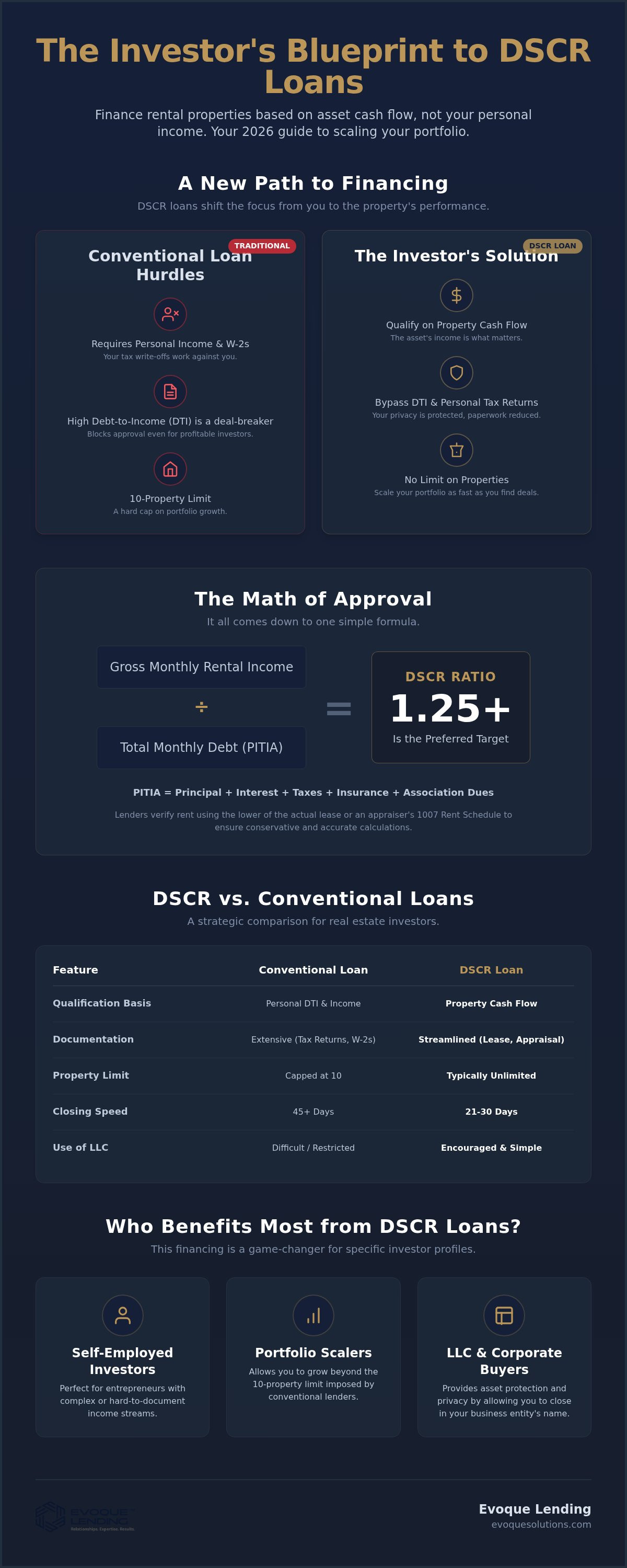
Securing dscr loans for real estate investors depends on a single, transparent calculation. Unlike conventional mortgages that scrutinize your personal debt-to-income ratio, these loans focus on the property’s ability to pay for itself. The fundamental formula is straightforward: divide the Gross Monthly Rental Income by the PITIA. PITIA represents the total monthly housing expense, including Principal, Interest, Taxes, Insurance, and any applicable Association fees. If a property generates $2,500 in rent and the PITIA is $2,000, your ratio is 1.25.
Lenders use specific thresholds to determine your loan terms. A ratio of 1.0 means the property breaks even. Most standard programs in 2026 prefer a ratio of 1.25 or higher, as this provides a safety cushion for the lender. However, the market has evolved to include "No-Ratio" programs. These are designed for high-equity properties where the current cash flow might be low, but the investor’s credit and down payment are strong. To verify these numbers, lenders rely on the 1007 Rent Schedule. This is a specific part of the appraisal process where a professional appraiser confirms that the projected or current rent aligns with local market averages. Lenders typically use the lower of the actual lease agreement or the 1007 Rent Schedule to ensure the math remains conservative.
DSCR for Short-Term Rentals (Airbnb/VRBO)
Underwriting for short-term rentals (STRs) requires a more nuanced approach than traditional long-term leases. Instead of a simple one-year lease, lenders now utilize AirDNA data and automated valuation models (AVMs) to project annual revenue. This allows you to qualify based on the high-yield potential of vacation rentals rather than being capped by lower long-term market rents. The Z-ratio is the 2026 industry standard multiplier applied to projected short-term rental revenue to account for seasonal volatility and higher operational costs compared to long-term leases. This specialized data allows for a more accurate reflection of an STR's true earning power.
Impact of the DSCR Ratio on Loan Terms
Your ratio directly dictates your interest rate and leverage. A high ratio, such as 1.5 or above, signals a lower risk to the lender and often unlocks the most competitive interest rates. Conversely, if your ratio is lower, you may be required to provide a larger down payment to reduce the lender's exposure. For investors eyeing high-appreciation markets where monthly cash flow is tight, a dscr purchase loan with a no-ratio option can be the key to acquisition. These programs prioritize the asset's long-term value and your liquid reserves over immediate monthly margins. This flexibility is essential for scaling a portfolio in competitive urban hubs where traditional math might otherwise stall your growth.
Strategic Comparison: DSCR vs. Conventional Financing for Rental Properties
Investors often focus solely on interest rates when choosing a loan. While conventional financing typically offers lower baseline rates, the trade-off is a rigid, slow-moving process that can cost you a deal in a competitive market. In 2026, the speed of dscr loans for real estate investors has become a decisive advantage. When you're in a bidding war, a 21-day closing with a DSCR product often beats a 45-day conventional offer, even if the latter has a slightly lower rate. The true cost of a loan must include the opportunity cost of missed acquisitions and the administrative friction of traditional banking.
Another major differentiator is portfolio concentration. Conventional lenders often have strict caps on the number of properties you can finance, usually stopping at ten. DSCR lenders view each property as a standalone business. This means you can continue to scale your empire as long as each asset's cash flow meets the required thresholds. There is no arbitrary limit on how many properties you can hold, provided your credit remains strong and you have the necessary reserves for each new acquisition.
The Documentation Gap
The administrative burden of a conventional loan is significant. You must provide two years of tax returns, sign a 4506-T for IRS verification, and submit recent pay stubs or W-2s. For self-employed individuals, this process is invasive and often leads to a rejection due to paper losses and depreciation. In contrast, DSCR documentation is streamlined. You provide the rental analysis, a credit report, and proof of liquid reserves. Some investors also utilize Asset-Depletion logic, where your total liquid assets are used to supplement the property's income. This creates a flexible path for those with high net worth but low taxable income on their 1040s.
Flexibility and Asset Protection
One of the most critical differences is the ability to close in an LLC. Conventional lenders almost always require you to hold the title in your personal name, which exposes your personal assets to liability. DSCR programs are built for the professional investor, allowing you to close under an entity from day one. This simplifies asset protection and makes managing a large portfolio much cleaner.
Additionally, dscr loans for real estate investors often feature interest-only payment options. While this doesn't build equity as fast, it maximizes your monthly cash flow, allowing you to reinvest that capital into your next property immediately. You can also negotiate prepayment penalties. By agreeing to a penalty for a period of one to five years, you can often secure a lower interest rate. This aligns the loan's cost with your long-term hold strategy, offering a level of customization that simply isn't available through traditional institutional channels.
Qualifying for a DSCR Loan: Requirements and Portfolio Strategy
While the property's performance is the primary focus, your personal profile still plays a supporting role in determining the final terms. In 2026, the "sweet spot" for dscr loans for real estate investors is a credit score between 680 and 720. While some programs allow for scores as low as 620, staying above 680 typically unlocks more favorable loan-to-value (LTV) ratios. You should expect to provide a down payment between 20% and 30%. Although some lenders offer 15% down for borrowers with scores above 740, the 20% to 25% range remains the standard for most multi-family and single-family acquisitions.
Lenders also require a liquidity cushion, known as reserves. You'll typically need to show three to six months of PITIA (Principal, Interest, Taxes, Insurance, and Association dues) in a liquid account. For larger loans exceeding $1 million, this requirement may increase to nine or 12 months. This ensures you can handle vacancies or unexpected repairs without defaulting. Eligible properties include single-family residences, townhomes, condos, and 2-4 unit multi-family buildings. Meeting these benchmarks makes you a reliable partner for specialized lenders.
The Application Journey
The process begins with a preliminary property cash flow analysis. You submit the current or projected rent and the estimated expenses to see if the deal hits the required ratio. Once the initial math clears, the lender orders an appraisal. This isn't just a valuation of the physical structure; it includes a 1007 Rent Schedule for long-term rentals or a specialized STR report for vacation properties. Finally, the file moves to underwriting. The underwriter focuses on the asset's earning potential and your liquid reserves rather than your personal debt-to-income ratio.
Using Cash-Out Refinancing to Scale
Professional investors don't just buy and hold; they use equity to fuel further growth. A dscr cash-out refinance is the engine behind the "BRRRR" method. By using dscr loans for real estate investors, you can renovate a property, increase its value, and pull out your initial capital to fund the down payment on your next asset. In 2026, most lenders require a six-month seasoning period before you can refinance based on the new appraised value. If you purchased a property with cash, you might qualify for delayed financing, which allows you to recover your capital immediately without waiting for the seasoning period to end. This strategy turns a single successful deal into a repeatable cycle of expansion. If you're ready to unlock the equity in your current holdings, you can apply for a dscr cash-out refinance to accelerate your portfolio growth.
Scaling Your Portfolio with Evoque Lending’s Specialized DSCR Programs
Evoque Lending has been a cornerstone for non-traditional borrowers since 2005. In a market where traditional banks often struggle with complexity, we provide a stable, long-term partnership for those building a real estate empire. We understand that your tax returns don't always tell the full story of your financial strength. Our specialized dscr loans for real estate investors are designed to bridge that gap. As you look to expand, choosing the right partner for dscr loans for real estate investors becomes your most important strategic decision. By focusing on the tangible performance of your assets, we help you bypass the institutional boxes that often stall growth for entrepreneurs and self-employed individuals.
Our role is to act as a seasoned guide in a niche financial field. We don't just offer products; we provide a clear path forward for investors who have been blocked by high debt-to-income ratios or the 10-property cap of conventional lenders. This commitment to tangible outcomes has made us a reliable resource for over two decades. We maintain the corporate credibility you expect from a financial institution while providing the supportive, solution-oriented service that modern entrepreneurs require to stay competitive.
Why Investors Choose Evoque Lending
Many investors find themselves stuck when their tax write-offs hurt their borrowing power or when their income moves through various entities. We solve this by offering purchase, refinance, and cash-out programs across more than 40 states. Our deep expertise in complex income structures allows us to advocate for 1099 contractors, business owners, and foreign national investors who are often overlooked by standard lenders. We don't just process files; we match your specific investment scenario with the most competitive national programs available. This methodical, thorough approach ensures a higher level of closing certainty. It gives you the confidence to move forward on new acquisitions without the fear of a last-minute rejection based on personal income technicalities.
Get Started on Your Next Investment
Preparation is the key to a smooth closing. To get a quick quote, you'll want to have your property's gross rental income and estimated PITIA ready for review. Working with a dedicated loan specialist is essential for anyone looking to scale a portfolio. A specialist understands the nuances of LLC borrowing and asset protection, ensuring your loan structure aligns with your long-term business goals. You can use our streamlined online questionnaire for an instant scenario review, allowing you to see how your property performs under current market benchmarks.
If you're ready to move beyond the limits of traditional financing, it's time to partner with a guide who understands the practical realities of modern investing. You can speak with an Evoque Lending specialist to review your DSCR scenario and secure the leverage you need to grow your portfolio today.
Building Your Real Estate Empire Without Limits
The transition from traditional, income-based financing to asset-focused leverage marks a turning point for any serious investor. By prioritizing a property's cash flow over personal tax returns, dscr loans for real estate investors provide a sustainable path to scaling your portfolio. You've seen how these specialized instruments bypass conventional debt-to-income limits and allow for faster, more flexible closings through an LLC. This isn't just about finding a loan; it's about adopting a professional strategy that treats every acquisition as a standalone business entity.
Evoque Lending has served as a seasoned guide for non-traditional borrowers since 2005. With national coverage across 40+ states and a deep specialization in Non-QM financing, we provide the expertise needed to navigate complex investment scenarios. We focus on tangible outcomes and long-term partnerships rather than quick transactions. If you're ready to unlock the blueprint for your next acquisition, you can Apply for a DSCR Loan with Evoque Lending today. Your growth shouldn't be limited by a tax return, and with the right partner, it won't be.
Frequently Asked Questions
What is the minimum credit score for a DSCR loan in 2026?
The minimum credit score for a DSCR loan in 2026 is generally between 620 and 640. While you can qualify at these levels, most professional investors aim for the sweet spot of 680 to 720 to unlock more competitive loan-to-value ratios. Higher scores, particularly those above 740, can often reduce your required down payment to as little as 15%. Lenders use your FICO score as a primary risk indicator since personal income isn't part of the calculation.
Can I get a DSCR loan for an Airbnb or short-term rental?
Yes, you can absolutely secure a DSCR loan for an Airbnb or other short-term rental property. Lenders utilize specialized data from sources like AirDNA to project annual revenue instead of relying on traditional long-term lease agreements. This approach allows dscr loans for real estate investors to leverage high-yield vacation markets effectively. Underwriting focuses on the property's potential income and seasonal volatility to ensure the asset can support the debt service over time.
Do DSCR loans require personal tax returns?
No, DSCR loans don't require personal tax returns or W-2 documentation for qualification. The lender’s primary focus is the property’s ability to generate enough rental income to cover the monthly mortgage payments. This makes them an ideal solution for self-employed entrepreneurs or 1099 contractors whose tax write-offs might disqualify them from conventional financing. You simply provide a lease agreement or a market rent analysis to verify the asset's performance during the underwriting process.
Can I close a DSCR loan in the name of an LLC?
You can definitely close a DSCR loan in the name of an LLC to enhance your asset protection. Unlike conventional institutional lenders who typically require titles to be held in an individual's name, specialized lenders encourage entity borrowing. This strategy helps shield your personal assets from property-related liabilities and simplifies the management of a growing portfolio. It's a standard practice for professional investors seeking privacy and corporate stability while scaling their real estate holdings.
How much down payment is required for a DSCR investment loan?
The typical down payment required for a DSCR investment loan ranges from 20% to 25% of the purchase price. While some programs allow for 15% down if you have a credit score of 740 or higher, most lenders prefer a 20% to 30% equity stake to mitigate risk. This down payment ensures that the debt service coverage ratio remains healthy. It also provides a safety cushion for both the borrower and the lender against market fluctuations.
What is a "No-Ratio" DSCR loan and how does it work?
A No-Ratio DSCR loan is a specialized product where the lender doesn't require the rental income to meet a specific debt service threshold. These programs are designed for properties with high equity or significant appreciation potential where the current cash flow might be tight. Qualification relies heavily on your credit score, liquid reserves, and the total down payment rather than the monthly rent-to-expense calculation. It's a powerful tool for strategic acquisitions in competitive, high-value urban markets.
Are DSCR loan interest rates higher than conventional rates?
Yes, interest rates for dscr loans for real estate investors are typically 1% to 2% higher than those for conventional investment properties. This reflects the increased risk associated with the lack of personal income verification and the program's inherent flexibility. However, the gap has narrowed recently due to price adjustments on conventional investor loans. Many borrowers find the slightly higher rate is a worthwhile trade for the speed and scalability these programs offer their business.
What properties are eligible for DSCR financing?
Eligible properties for DSCR financing include single-family residences, 2-4 unit multi-family homes, condos, and townhomes. Most programs also support specialized assets like short-term rentals and properties held within an LLC. As long as the property is used for investment purposes and demonstrates sufficient market rent potential, it can qualify for these programs. This wide range of eligibility allows you to diversify your portfolio across different asset classes and markets without the constraints of traditional banking.
Reviewed by Eddie Luhrassebi, Founder & CEO, NMLS #337071 | CA DRE #01230650
Last updated: August 20, 2026 · About the reviewer