
Creative Real Estate Financing: 2026 Portfolio Guide
Written by Eddie Luhrassebi · Published August 29, 2026
Find alternative mortgage lenders for investment properties. Our 2026 guide shows how to scale your portfolio using cash flow, not personal income verification.
In 2026, your personal tax returns are no longer the ceiling for your real estate ambitions. Most seasoned investors have felt the sting of a traditional bank rejection despite owning a portfolio of high-performing, profitable rentals. It's an exhausting cycle: you find a perfect deal, but the conventional underwriting process stalls because of your complex income structure or a high debt-to-income ratio. This friction is exactly why sophisticated professionals are increasingly moving toward alternative mortgage lenders for investment properties to maintain their competitive edge.
You already know that the old way of financing isn't built for the speed of today's market. You need a path to growth that doesn't require endless boxes of paperwork or months of waiting for a committee's approval. This guide will show you how to bypass these institutional hurdles by using modern, non-QM lending strategies that prioritize property cash flow over personal W-2 data. We'll break down the specific ROI of alternative financing, explain how to scale without personal income verification, and help you identify a reliable national partner to fund your next acquisition in as little as three weeks.
Why Traditional Mortgages Fail Modern Real Estate Investors in 2026
For many investors, the local bank feels like a partner until the moment you try to scale. Traditional underwriting is built for the W-2 employee with a predictable, linear financial life. It isn't built for the entrepreneur who uses legal tax strategies to minimize taxable income. Creative financing is the strategic use of Non-QM loan products to leverage property cash flow over personal income. By utilizing Creative financing techniques, you can shift the focus from your personal tax returns to the actual strength of your real estate assets.
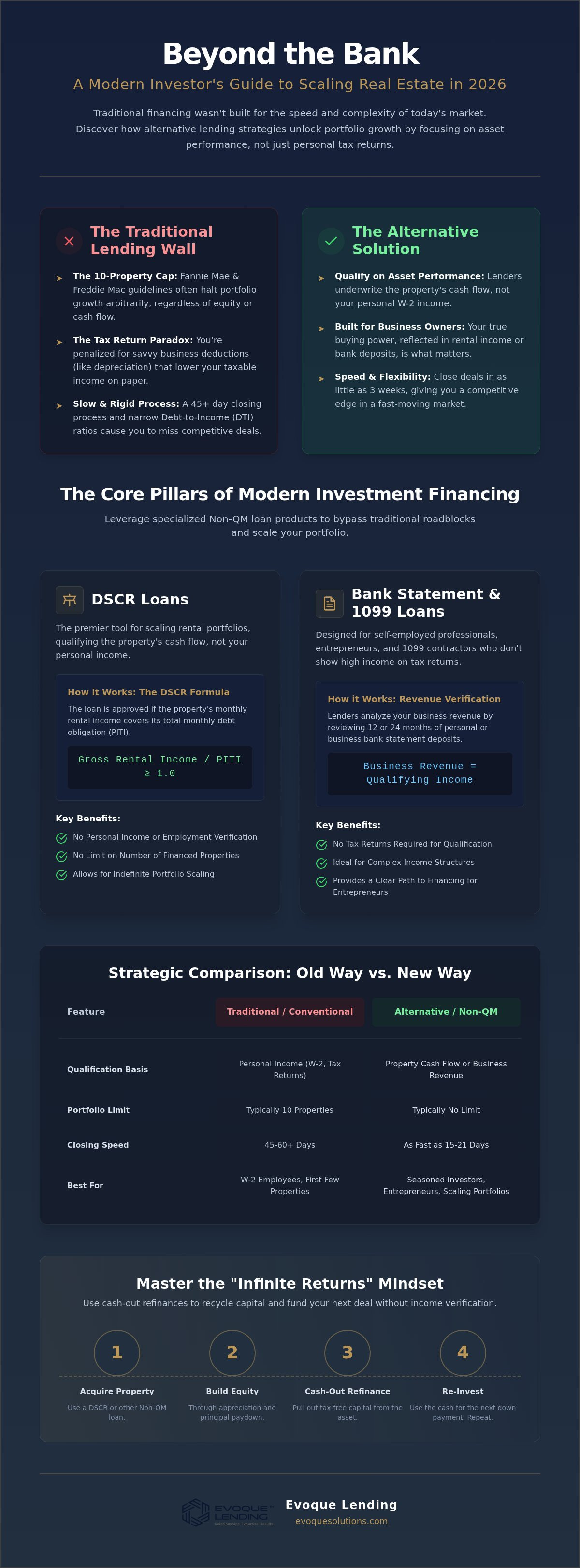
The most common obstacle is the "Lending Wall." Conventional guidelines from Fannie Mae and Freddie Mac typically limit investors to a maximum of 10 financed properties. Even if you have millions in equity and a perfect payment history, a traditional bank will often stop lending once you hit this cap. This arbitrary limit forces growth to a standstill just as you're gaining momentum. It's a systemic bottleneck that ignores the profitability of your rentals and focuses solely on the number of loans you carry.
The friction of tax returns creates another significant paradox. You use depreciation and business expenses to protect your cash flow, which is a fundamental part of wealth building. However, the bank sees these deductions as a lack of income. They're effectively punishing you for being a savvy business owner. When your tax returns don't reflect your actual buying power, the conventional mortgage path becomes a dead end.
The Limitations of Conventional Underwriting
Conventional Debt-to-Income (DTI) ratios are often too narrow for the 2026 market. They fail to account for the reality of diversified investor cash flow. If you're a self-employed professional or a 1099 contractor, you're often caught in the "Qualified Mortgage" (QM) trap. You have the capital and the experience, but you don't fit the rigid institutional box. Speed is another critical factor. While a bank might take 45 days to close, modern investors often need to move in 15 to 21 days to secure the best deals in a competitive environment.
The Evolution of the Non-QM Market
The landscape has shifted. The Non-QM market has moved away from its old associations and is now backed by sophisticated institutional capital. Today, alternative mortgage lenders for investment properties evaluate risk through equity and rental coverage rather than just personal tax forms. This shift allows for a more logical assessment of a deal's viability. Specialized lenders act as seasoned guides, helping you navigate the 2026 market by matching your specific portfolio needs with flexible, asset-based solutions that traditional institutions simply cannot offer.
The Core Pillars of Investment Property Creative Financing
Scaling a portfolio requires moving beyond the limitations of personal income and focusing on the intrinsic value of the assets themselves. This shift is where alternative mortgage lenders for investment properties provide the most value, offering specialized programs that traditional banks simply don't have the infrastructure to support. Modern real estate financing options have evolved into a sophisticated suite of tools designed for specific borrower profiles. These pillars allow you to bypass the "lending wall" and maintain your acquisition momentum regardless of what your personal tax returns show.
DSCR Loans: Qualifying Based on the Property, Not You
The Debt Service Coverage Ratio (DSCR) loan is the premier tool for the 2026 investor. The qualification process is elegantly simple: if the property's rental income covers the principal, interest, taxes, and insurance (PITI), the loan is viable. Because there's no employment or personal income verification, you can close deals without the friction of tax returns or debt-to-income hurdles. This allows you to scale indefinitely, as the lender is underwriting the asset's cash flow rather than your personal paycheck. For a deeper look at this strategy, see our DSCR Loans: 2026 Guide to Scaling Your Portfolio.
Bank Statement and 1099 Solutions for Self-Employed Borrowers
Bank statement and 1099 solutions are specifically designed for entrepreneurs and contractors. Instead of tax returns, lenders review 12 or 24 months of deposits to determine qualifying income. They typically apply a standard expense ratio to your total deposits to estimate your net buying power. If your business has grown significantly in the last year, a 12-month review might provide a higher qualifying amount than a longer look-back period. You can find more details in our Self-Employed Bank Statement Loans: Ultimate 2026 Guide.
Asset depletion and foreign national loans round out these core pillars. Asset depletion allows high-net-worth individuals to turn liquid reserves into a qualifying monthly income stream, which is perfect for retired investors. Foreign national loans provide a streamlined path for international clients to leverage US real estate equity without a domestic credit history or Social Security number. If you're unsure which program aligns with your current strategy, you can explore our specialized loan matching to find the right fit for your next acquisition.
Strategic Comparison: Which Creative Loan Fits Your Strategy?
Choosing the right financial instrument is just as critical as finding the right property. Many investors struggle because they treat all non-traditional financing as a single category. In reality, the best alternative mortgage lenders for investment properties provide a spectrum of products tailored to specific operational styles. While DSCR loans qualify based on the property’s rental income, bank statement loans rely on the borrower’s personal or business cash flow as documented through monthly deposits. Understanding this distinction allows you to align your financing with your specific tax strategy and portfolio goals.
Short-term rentals (STRs), such as those on Airbnb or VRBO, require a different underwriting lens than a standard 12-month lease. For these assets, a DSCR loan that utilizes projected "market rent" or historical STR data is often the most effective path. Conversely, if you're a high-volume fix-and-flip investor, you might prioritize speed and leverage over long-term interest rates. The trade-off is often simple: conventional loans offer lower rates but require exhaustive documentation, while creative products offer ease of execution and higher leverage at a slightly higher cost of capital.
DSCR vs. Conventional Financing
The most immediate difference is the speed of execution. While a conventional bank often takes 45 to 60 days to navigate through a committee, specialized lenders can often close a DSCR loan in 21 to 25 days. This agility allows you to secure deals that other buyers might miss. There's also a significant "Entity" advantage. Conventional loans usually require you to close in your personal name, which limits your liability protection. Creative financing allows you to close directly in the name of an LLC, keeping your personal credit profile clean and your assets shielded.
Asset-Based vs. Income-Based Qualification
Retirees or high-net-worth individuals often find themselves in a unique position where they have significant liquid wealth but no active "income" in the eyes of a traditional bank. Asset depletion loans solve this by calculating a monthly income stream based on your total liquid reserves. This is a powerful alternative to 1099 or bank statement programs, which are better suited for active contractors. When comparing these products, pay close attention to Loan-to-Value (LTV) maximums. Some creative products allow for up to 85% LTV, which preserves your cash for the next acquisition. Matching your specific financial profile to these specialized programs is the key to maintaining a scalable, high-velocity investment strategy in 2026.
Building a Scalable Portfolio Without Personal Tax Returns
True portfolio scaling isn't just about making acquisitions. It's about how effectively you can recycle your capital. Many investors hit a ceiling because they rely on personal income to qualify for each subsequent loan. By shifting to an "Infinite Returns" mindset, you can use the equity in your existing properties to fund your next down payment. This process is much smoother when you work with alternative mortgage lenders for investment properties that don't require years of tax documentation. If you're ready to break free from the paperwork trap, you can learn how to buy rental property without tax returns in our comprehensive 2026 guide.
One of the most common objections to creative financing is the interest rate. It's easy to fixate on a percentage point, but sophisticated investors focus on the Return on Investment (ROI) rather than the rate. A conventional bank might offer a lower rate but reject your application entirely because of your tax deductions. In that scenario, the "cheaper" loan has a 0% ROI because it doesn't exist. Creative loans provide the liquidity needed to capture high-yielding deals that would otherwise be lost to faster, cash-ready competitors. When you structure your acquisitions through an LLC, you also gain the flexibility to scale across multiple states without the liability risks of personal ownership.
The Cash-Out Refinance Loop
The DSCR cash-out refinance is a powerful tool for harvesting equity without the friction of a traditional income audit. While many conventional lenders require a 12-month seasoning period before you can pull cash out based on a new appraisal, specialized lenders often offer more flexibility, sometimes allowing for a 6-month window. This speed is essential for reinvesting equity into higher-yielding short-term rentals or distressed assets that need immediate capital. By treating your portfolio as a revolving source of funds, you keep your cash working rather than sitting idle in a property's walls.
Scaling with Non-QM Portfolio Loans
As your holdings grow, managing individual loans across different lenders becomes a logistical burden. This is where Non-QM loans for real estate investors provide a strategic advantage. You can often consolidate multiple properties under a single lending relationship, which streamlines your reporting and simplifies your debt structure. Working with a national partner that operates in over 40 states is essential for multi-state expansion, as it ensures your financing remains consistent even as you enter new markets. If you're looking to move past the 10-property limit imposed by traditional banks, you can start your personalized loan matching journey today to see how much equity you can unlock.
Navigating the 2026 Market with Evoque Lending’s Solutions
Success in the 2026 real estate market requires more than just capital; it requires a lending partner that understands the nuances of modern entrepreneurship. Since 2005, Evoque Lending has specialized in bridging the gap where traditional institutions fall short. We don't rely on the automated "yes/no" algorithms that often result in immediate rejections for self-employed or non-traditional borrowers. Instead, we position ourselves as a seasoned guide for those seeking alternative mortgage lenders for investment properties, focusing on the tangible outcomes of your investments rather than just your personal tax history.
Our approach is rooted in the belief that every investor's financial profile is unique. While a big bank might see a complex 1099 income structure as a risk, we see it as the mark of a successful modern professional. We've spent two decades refining our processes to ensure that your portfolio growth isn't stalled by rigid, outdated underwriting standards. By using our streamlined online questionnaire, you can move from uncertainty to a clear financial roadmap in minutes, identifying the exact creative product that aligns with your specific acquisition goals.
Personalized Loan Matching for Complex Scenarios
We take pride in handling "outside the box" financial scenarios that others avoid. Whether your liquidity is tied up in cryptocurrency, 1099 contracts, or foreign assets, our dedicated specialists coordinate the underwriting to reflect your true net worth. This personalized matching ensures that you aren't forced into a loan product that doesn't fit your long-term strategy. With a national footprint covering 40+ states, we provide the localized expertise and national support needed to scale your portfolio across the country without changing lenders every time you cross a state line.
Getting Started: Your 2026 Investment Roadmap
Transitioning from research to a funded transaction is a structured process designed for speed and transparency. To prepare for a DSCR application, you should focus on organizing your property cash flow statements and current lease agreements. Our streamlined online qualification process then takes this data to provide an immediate look at your borrowing capacity. You can expect a collaborative experience where your specialist works to eliminate friction at every stage of the approval cycle. If you're ready to move beyond the limitations of traditional banking, contact an Evoque Lending specialist today to unlock your portfolio’s potential and secure the financing your strategy deserves.
Scaling Beyond the Institutional Ceiling
The 2026 real estate market demands a departure from traditional, rigid financing models. You've seen how conventional banks often penalize success by focusing on debt-to-income ratios that ignore the actual profitability of your rentals. Shifting your strategy toward asset-based lending allows you to decouple growth from personal tax returns. Whether you're utilizing DSCR loans to leverage property cash flow or bank statement programs to reflect your true buying power; the path to a larger portfolio is now built on flexibility rather than institutional conformity.
Partnering with alternative mortgage lenders for investment properties ensures you have a seasoned guide to navigate these complex financial instruments. With over 20 years of experience, we specialize in providing the expert support that self-employed and 1099 borrowers need to maintain their momentum. Our specialized DSCR and bank statement programs are designed to turn your vision into a funded reality across more than 40 states. Don't let a committee's rejection stop your expansion. Find Your Creative Financing Solution with Evoque Lending and start building the scalable, high-yielding portfolio your strategy deserves. Your next acquisition is closer than you think.
Frequently Asked Questions
What is the most common creative financing method for rental properties?
The Debt Service Coverage Ratio (DSCR) loan is currently the most popular creative financing method for rental properties. It allows you to qualify based on the property's projected rental income rather than your personal W-2 earnings. This approach is highly effective for scaling because it removes the debt-to-income hurdles that typically stall investors at traditional banks. It's a streamlined process that prioritizes the asset's performance over the borrower's personal tax history.
Can I get an investment property loan without showing tax returns?
You can absolutely secure financing without providing years of tax returns by working with alternative mortgage lenders for investment properties. Specialized programs like bank statement loans or DSCR loans use alternative documentation to verify your ability to repay. Instead of tax forms, lenders review 12 to 24 months of deposits or the property's cash flow. This provides a clear path for self-employed entrepreneurs whose tax deductions might otherwise hide their true buying power.
Are interest rates higher for creative financing and Non-QM loans?
Interest rates for Non-QM and creative loans are typically higher than those for conventional mortgages. This reflects the increased flexibility and specialized underwriting required for non-traditional borrowers. However, many investors view this as a trade-off for the ability to close deals quickly and scale without personal income limits. The return on investment from a profitable property often far outweighs the slightly higher cost of capital compared to a rejected bank application.
What is a DSCR loan and how does it help real estate investors scale?
A DSCR loan is an asset-based financing tool where the lender evaluates the rental income of the property against its debt obligations. If the property's cash flow covers the principal, interest, taxes, and insurance, the loan is approved without employment verification. This helps you scale because your personal debt-to-income ratio isn't a factor. You can continue acquiring properties as long as each asset demonstrates sufficient rental coverage to meet the lender's requirements.
How much down payment is required for an alternative investment property loan?
Down payment requirements for alternative investment loans generally range from 20% to 25%. While some specialized programs allow for as little as 15% down, a 20% equity stake is the standard for most DSCR and bank statement products. These requirements ensure the property has enough equity to weather market volatility while still allowing you to preserve capital for future acquisitions. Your specific credit score and the property type will ultimately determine the final leverage available.
Can I use creative financing to buy a property in an LLC name?
Closing in the name of an LLC is a standard feature of creative financing and is often encouraged by specialized lenders. Unlike conventional loans that usually require personal ownership, Non-QM products are designed for the business of real estate. Buying through an LLC provides essential liability protection and keeps the debt off your personal credit report. This structure is ideal for professional investors who want to separate their personal assets from their growing rental portfolio.
What is the difference between hard money and creative Non-QM lending?
Hard money is a short-term bridge solution typically used for fix-and-flip projects with high rates and brief terms. Creative Non-QM lending, such as the DSCR and bank statement programs we facilitate, provides long-term, permanent financing for rental holds. While hard money focuses on the property's "after-repair value," Non-QM lending prioritizes stable, long-term cash flow and borrower credit. It's a more sustainable tool for investors who plan to hold assets for years rather than months.
How long does it take to close on a creative investment property loan?
Closing times for creative investment loans typically range from 21 to 30 days. This is significantly faster than the 45 to 60 days often required by traditional banks. Because the underwriting process is streamlined and doesn't involve exhaustive personal income audits, the path from application to funding is much more direct. Having your property cash flow statements and entity documents ready can help ensure you meet these aggressive timelines and never miss a time-sensitive deal.
Reviewed by Eddie Luhrassebi, Founder & CEO, NMLS #337071 | CA DRE #01230650
Last updated: August 29, 2026 · About the reviewer