
Best Short Term Rental Mortgage Lenders 2026 Guide
Written by Eddie Luhrassebi · Published September 6, 2026
Find the best short term rental mortgage lenders for your Airbnb. Our 2026 guide covers DSCR loans to help you scale your portfolio without using tax returns.
What if your mortgage approval depended entirely on your property's nightly rate rather than your personal tax returns? For many investors, the dream of scaling an Airbnb portfolio often hits a wall when traditional banks refuse to count projected short-term income. You've likely felt the frustration of a local lender demanding a massive down payment or moving so slowly that a cash buyer snatches the deal from under you. It's a common hurdle, but it shouldn't be the end of your investment journey.
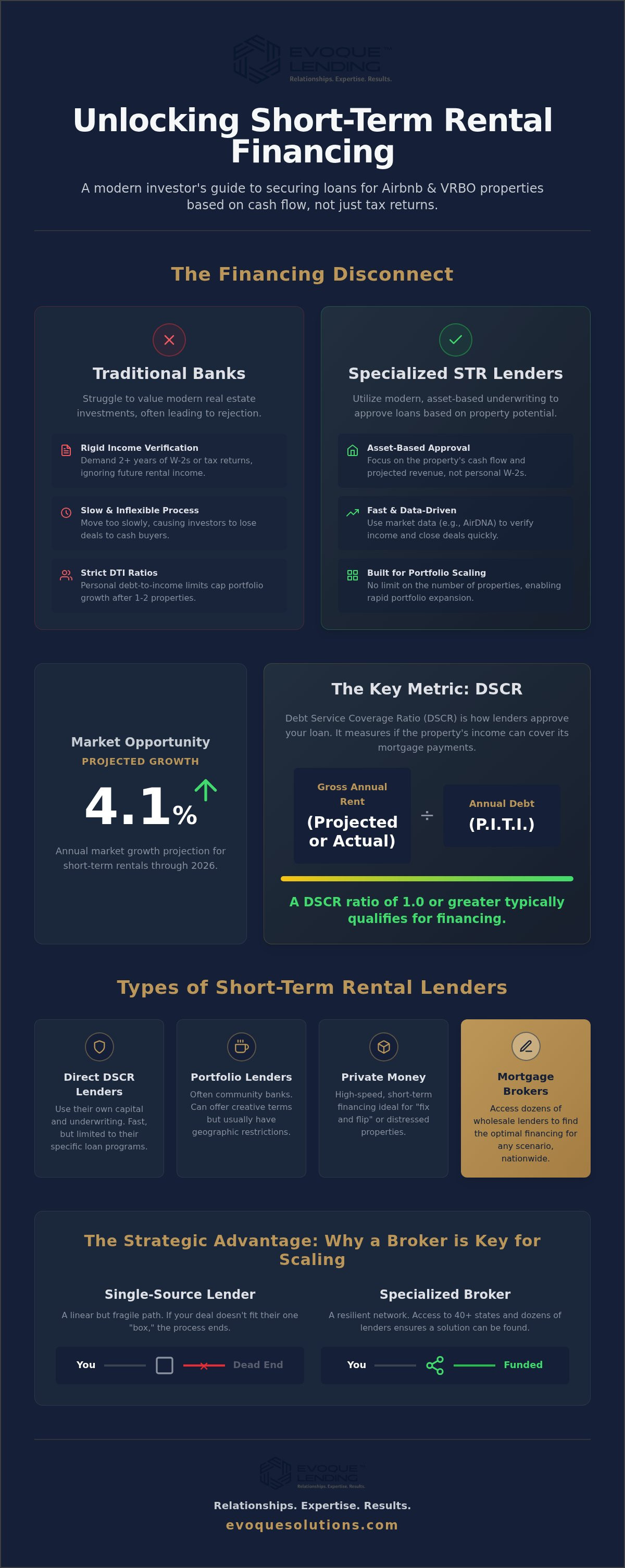
Finding the right short term rental mortgage lenders is the key to unlocking growth in a market where demand is projected to grow by 4.1% through 2026. This guide reveals the most effective financing paths for your VRBO or Airbnb properties. We focus on DSCR specialized lenders and flexible Non-QM brokers who understand the practical realities of how modern investors operate. We will explore how to secure high-leverage financing based on property potential, bypass restrictive debt-to-income ratios, and close deals with the speed required to remain competitive in a fast-moving market.
Navigating the 2026 Short Term Rental Mortgage Landscape
The short-term rental market has matured rapidly. In 2026, the industry has transitioned from "hobbyist" hosting to a sophisticated sector of professionalized real estate investment. Investors aren't just renting out spare rooms; they're building diversified portfolios of high-yield assets. As the market professionalizes, the gap between investor needs and traditional banking products has widened significantly. Most short term rental mortgage lenders in the traditional space haven't kept pace with this evolution.
Current market volatility makes flexible financing more critical than ever. With demand projected to grow by roughly 4.1% per year, the ability to move quickly is a competitive advantage. Relying on slow, rigid institutions often means losing deals to cash buyers or more agile competitors who utilize specialized lending instruments. You need a partner who understands that your property is a business, not just a residence.
Why Conventional Banks Struggle with STR Income
Traditional lenders prioritize stability and predictable W-2 income. This creates a fundamental disconnect for short-term rental investors. Conventional banks often rely on two years of historical tax returns. These documents fail to capture the real-time revenue potential of a newly acquired property or a market experiencing a sudden surge in RevPAR. They also apply rigid Debt-to-Income (DTI) ratios that can stall a portfolio after just one or two purchases.
There's also a lack of understanding regarding local market dynamics. These institutions rarely account for the nuances of short-term rental regulations or the seasonal income fluctuations common in vacation destinations. When a bank sees a "slow" month in a winter ski town, they may view it as a risk. A specialized lender sees it as part of a high-performing annual cycle that balances out over the year.
The Emergence of Non-QM
as the Gold Standard
For those who don't fit into standard institutional boxes, Non-Qualified Mortgages (Non-QM) have become the primary solution. Unlike traditional loans, non-qm loans for real estate investors prioritize the asset's performance over the borrower's personal income. This shift is critical for self-employed individuals, 1099 contractors, or those with complex tax structures that show lower net income than they actually earn.
Specialized short term rental mortgage lenders use an asset-based approach. They look at the property's cash flow potential, often using market data to verify income. This allows you to scale your portfolio based on the strength of your investments rather than the limits of your personal tax return. It's a more logical, structured path for the modern real estate entrepreneur who values tangible outcomes over bureaucratic paperwork.
Types of Short Term Rental Mortgage Lenders to Consider
Identifying the right financing partner is a strategic decision that directly impacts your portfolio's scalability. Not all short term rental mortgage lenders operate under the same rules. Some prioritize speed, while others focus on long-term rate stability. Understanding the landscape allows you to align your financing with your specific investment goals.
- Direct DSCR Lenders: These firms use their own capital and service their own loans. While they offer a direct line of communication, you are limited to their specific underwriting "boxes."
- Mortgage Brokers: These partners act as intermediaries who shop multiple wholesale channels. This model provides the highest level of flexibility for complex deals.
- Portfolio Lenders: Typically community banks, these institutions keep loans on their own balance sheets. This allows for more creative terms but often comes with geographic limitations.
- Private Money Lenders: These are high-speed, short-term options. They are ideal for distressed properties that need renovation before they can qualify for long-term financing.
Direct Lenders vs. Mortgage Brokers
Working directly with a single-source lender can feel efficient, but it carries a hidden risk: if your scenario doesn't match their exact criteria, the deal stops. A broker offers a more resilient path. By accessing wholesale products across 40+ states, a broker can pivot if one channel tightens its requirements. This personalized matching is vital in the 2026 market, where interest rates and regulatory environments change quickly. If you're unsure which path fits your current portfolio, you can explore specialized loan matching to see how diverse wholesale options compare to standard bank offers.
Specialized STR Platforms
The most innovative short term rental mortgage lenders now integrate directly with data providers like AirDNA. This allows them to underwrite loans based on real-time market data rather than just historical tax returns. These platforms typically offer "investor-only" programs. These programs are designed specifically for non-owner-occupied properties, excluding the restrictive requirements of primary residence loans. Experience matters here. Lenders who specialize in this niche understand seasonal income fluctuations and won't penalize you for the natural ebb and flow of a vacation market.
How Short Term Rental Lenders Evaluate Your Application
While traditional banks focus on your personal history, specialized short term rental mortgage lenders prioritize the asset's ability to generate revenue. This shift in perspective is what allows investors to scale beyond the limits of their personal income. Underwriting for a short-term rental (STR) is a data-driven process that balances the property's earning potential against the risks of a seasonal market. In 2026, this evaluation relies heavily on sophisticated market analytics rather than just a borrower's tax returns.
Lenders look for specific indicators of stability. A credit score of 700 or higher is often the baseline for the most competitive terms, and you'll typically need liquid reserves to cover several months of mortgage payments. These reserves act as a safety net for those inevitable "shoulder seasons" when bookings might dip. Most importantly, lenders will scrutinize local regulations to ensure the property can legally operate as an STR, as recent legislative shifts at the state level have created a more favorable, yet strictly defined, landscape for investors.
The DSCR Formula for Short Term Rentals
The Debt Service Coverage Ratio (DSCR) is the heartbeat of specialized financing. DSCR is the primary tool lenders use to measure property self-sufficiency. To calculate this, lenders divide the gross monthly rental income by the total monthly PITI (principal, interest, taxes, and insurance). A ratio of 1.25 is generally considered the "sweet spot" for national lenders; it signals that the property generates 25% more income than its debt obligations.
One critical hurdle is the "market rent" gap. Traditional appraisers often use long-term lease data (form 1007) to estimate income. This frequently undervalues the property's true potential. Specialized short term rental mortgage lenders bridge this gap by using projected data from sources like AirDNA or a 12-month operating history to reflect actual nightly rates and occupancy. If the DSCR falls below 1.15, you might still secure funding, but expect a lower Loan-to-Value (LTV) requirement to offset the perceived risk.
Qualifying Without Tax Returns
Many successful investors don't have a standard W-2. If your tax returns show heavy deductions that lower your taxable income, you can utilize bank statement loans for self employed borrowers. This method uses 12 to 24 months of deposits to prove cash flow, bypassing the need for IRS filings. It's a cleaner, more logical way to demonstrate your financial strength.
This flexibility extends to international markets as well. There are robust paths for us real estate financing for foreign investors looking to enter the US short-term rental market. These programs allow non-residents to qualify based on the property's DSCR without a US credit history or domestic tax records. By focusing on the asset's performance, lenders provide a streamlined entry point for global capital into high-demand vacation markets.
Comparing STR Lenders: What to Look for in 2026
Selecting from various short term rental mortgage lenders requires a nuanced understanding of more than just the headline interest rate. While a low rate is visually attractive, a restrictive prepayment penalty or a low Loan-to-Value (LTV) ratio can stifle your long-term growth. In 2026, the best lenders offer a balance between competitive pricing and the flexibility needed to pivot as market conditions shift. You need a partner that values your portfolio's liquidity as much as its profitability.
You should prioritize these four metrics when evaluating your options:
- Interest Rates vs. Loan Terms: DSCR rates for STRs in 2026 have ranged from 6.12% to 8.5% depending on credit and LTV. Focus on the term that maximizes monthly cash flow rather than just the lowest interest rate.
- Prepayment Penalties: Many specialized loans include a "step-down" penalty. Ensure the penalty period aligns with your intended exit strategy or refinance timeline.
- LTV Ratios: Most short-term rental programs allow up to 80% LTV. Lowering your "skin in the game" preserves essential capital for your next acquisition.
- Closing Speed: A 21-day close has become the new standard for winning deals in competitive markets where cash buyers are your primary rivals.
Hidden Costs and Fee Structures
Transparency is the foundation of a good lending partnership. You'll often see origination fees ranging from 0.5% to 2% of the loan amount. It's also important to account for specialized appraisal requirements. Appraising a short-term rental often costs more than a standard residential appraisal because it requires a detailed analysis of nightly rates and occupancy projections. For value-add properties, look for bridge-to-perm strategies. These allow you to renovate and then transition into a long-term DSCR loan without paying a second set of full closing costs.
The Importance of National Reach
Scaling a portfolio is difficult if you're forced to find a new lender every time you cross a state line. Working with a partner licensed in 40+ states provides a level of consistency that local banks simply can't match. This national reach ensures that your underwriting experience remains the same whether you're buying in the mountains or on the coast. It allows you to build a relationship with a single team that understands your broader investment strategy across different vacation markets. If you're ready to see how a national perspective can streamline your next purchase, you can get a personalized quote from our specialized team today.
Securing Your STR Loan with Evoque Lending
Evoque Lending stands out among short term rental mortgage lenders by focusing on the practical realities of modern real estate investment. Since 2005, we've specialized in demystifying the complex world of Non-QM and asset-based financing. We understand that your situation is unique. Whether you're a self-employed entrepreneur or a foreign national, we look at the property's cash flow potential rather than just your personal tax returns. This approach allows us to serve investors nationally across 40+ states with a focus on tangible outcomes.
Choosing the right financial instrument is essential for long-term success. Our team helps you decide between a dscr vs bank statement loan based on your specific tax structure and portfolio goals. While some competitors rely solely on automated portals, we believe in the power of human expertise. Our dedicated loan specialists act as your advocates; they coordinate with multiple wholesale partners to find the best fit for your deal.
The Application Process Simplified
We've streamlined our procedures to respect your time and the fast-paced nature of the 2026 market. Our three-step process ensures you stay informed from the initial data review to the final closing. This structured path removes the ambiguity often found in traditional banking.
- Step 1: Complete our streamlined online questionnaire. We conduct a preliminary review of your property data and financial goals to ensure alignment.
- Step 2: Our specialists perform competitive loan matching across our extensive national wholesale channels. We find the specific program that fits your investment scenario.
- Step 3: We manage the rapid underwriting coordination to ensure a smooth path to closing. This allows you to secure your asset and begin generating revenue without unnecessary delays.
Scaling Your Portfolio with DSCR Loans
Strategic growth requires access to capital without the bottlenecks of traditional banking. By utilizing DSCR Loans, you can scale your portfolio without the constraints of personal debt-to-income ratios. Many of our clients use a cash-out refinance on existing high-performing properties to fund their next acquisition. This asset-based lending model has no inherent limit. Your growth is only restricted by the performance of your investments and your vision as an entrepreneur. If you're ready to take the next step, you can Get a personalized loan quote from Evoque Lending and start your next chapter today.
Scaling Your Airbnb Portfolio in 2026
The 2026 short-term rental market offers massive potential for those who move beyond the limitations of traditional banking. By prioritizing property cash flow over personal debt-to-income ratios, you can unlock a level of scalability that standard W-2 financing simply doesn't allow. Success in this landscape requires a partner who understands the nuances of nightly rates and seasonal demand. Finding the right short term rental mortgage lenders is no longer just about the lowest rate; it's about the speed to close and the flexibility to grow your portfolio across different markets.
Evoque Lending has been serving real estate investors since 2005. We offer specialized DSCR programs designed specifically for the unique needs of short-term rentals. With a national lending footprint across 40+ states, we provide the consistency and expertise needed to navigate complex Non-QM scenarios. Don't let rigid institutional boxes stall your progress. It's time to align with a team that values your property's potential as much as you do.
Match with a Short Term Rental Loan Specialist and secure the financing you need to dominate the 2026 market.
Frequently Asked Questions
Do short term rental mortgage lenders require tax returns?
No, specialized short term rental mortgage lenders typically don't require personal tax returns if you utilize DSCR or bank-statement programs. These alternative paths allow investors to qualify based on the property's earning potential or 12 to 24 months of business deposits. This is particularly beneficial for self-employed borrowers or those with complex tax structures that show lower net income than they actually earn on paper.
Can I use projected Airbnb income to qualify for a mortgage?
Yes, you can use projected revenue to qualify for specialized financing. Most lenders integrate with data providers like AirDNA or use professional market rent appraisals to estimate future earnings. This forward-looking approach is a core benefit of asset-based lending. It allows you to secure financing for a new acquisition even if the property doesn't have a long track record of historical performance under your current ownership.
What is the minimum down payment for a short term rental loan?
The minimum down payment generally ranges from 20% to 25% for most specialized short-term rental programs. While some high-leverage options might allow for 15% in specific scenarios, maintaining a higher equity position often secures more favorable interest rates. Lenders require this investment to offset the inherent volatility of the vacation rental market compared to long-term residential leases. This ensures the deal remains stable even during seasonal dips.
Is a DSCR loan better than a conventional loan for an Airbnb?
A DSCR loan is often superior for investors looking to scale quickly without personal debt-to-income constraints. While conventional loans may offer lower interest rates, they come with rigid underwriting and strict limits on the number of properties you can finance. DSCR loans focus on the property's self-sufficiency, making them the preferred tool for professionalized investors who treat their rentals as a serious business and value long-term portfolio growth.
How much higher are interest rates for STR mortgage lenders?
Interest rates for short-term rental loans are typically 1.5% to 3.0% higher than those for primary residences. As of September 2026, DSCR rates generally fall between 6.5% and 8.5% depending on your credit score and loan-to-value ratio. This premium accounts for the higher risk and specialized underwriting required to evaluate nightly rental income rather than stable monthly W-2 earnings. It's a standard trade-off for the increased flexibility provided.
Can I get an STR loan as a foreign national investor?
Yes, foreign national investors can secure short-term rental financing through specialized programs. These loans are designed for non-residents who may not have a U.S. credit history or domestic tax records. Qualification is based primarily on the property's Debt Service Coverage Ratio. This provides a streamlined entry point for global investors to participate in high-demand U.S. vacation rental markets across 40+ states without the need for domestic income documentation.
What credit score do I need for a short term rental mortgage?
Most short term rental mortgage lenders look for a credit score of 700 or higher to offer the most competitive terms. While some programs may consider scores as low as 660, a lower score typically results in higher interest rates and increased down payment requirements. Maintaining a strong credit profile demonstrates financial reliability, which balances the property-focused nature of asset-based underwriting and helps you secure the best possible leverage.
How long does it take to close on a DSCR loan for an STR?
Closing times for a DSCR loan typically range from 21 to 30 days. This is significantly faster than traditional bank financing, which can often stretch beyond 45 days. A streamlined process is essential for investors who need to compete with cash buyers in hot vacation markets. Efficient coordination between your loan specialist and the appraiser is the most critical factor in meeting these tight deadlines and securing your asset quickly.
Reviewed by Eddie Luhrassebi, Founder & CEO, NMLS #337071 | CA DRE #01230650
Last updated: September 6, 2026 · About the reviewer