
US Real Estate Financing for Foreign Investors: 2026 Guide
Written by Eddie Luhrassebi · Published September 5, 2026
Unlock US real estate financing for foreign investors in 2026. Learn to secure loans based on property income, not US credit history. Your guide is here.
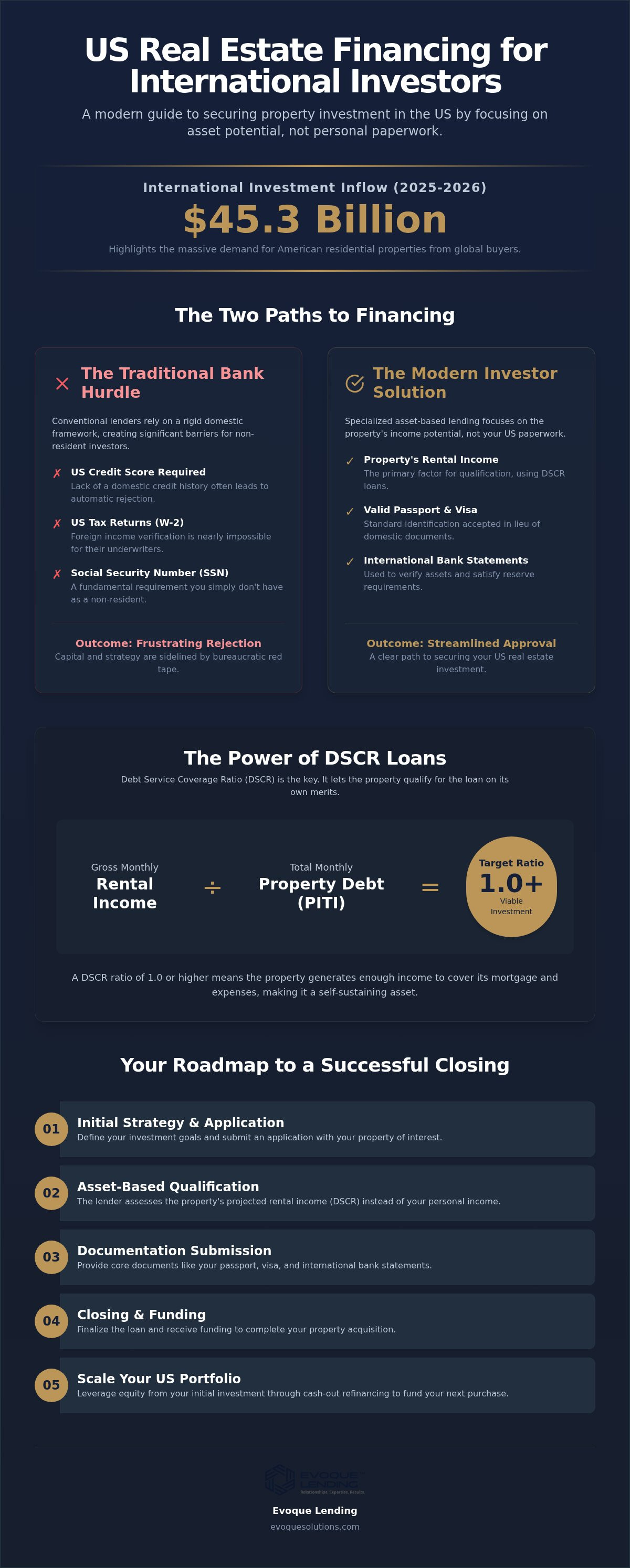
Between April 2025 and March 2026, international buyers invested $45.3 billion into the American residential market. This massive capital influx highlights a persistent reality: the United States remains the premier destination for global wealth. Yet, despite this demand, most international investors hit a brick wall when seeking us real estate financing for foreign investors. Traditional banks often demand years of U.S. tax returns, a domestic credit history, or a Social Security number that you simply don't have. It's frustrating to have the capital and the strategy, only to be rejected because you don't fit into a standard institutional box.
We understand that your financial footprint is global, not just local. This guide will show you how to master the lending process by focusing on the property's potential rather than your personal U.S. paperwork. You'll learn how specialized programs like DSCR loans allow you to qualify based on rental income, bypassing the need for traditional income verification. We'll provide a clear roadmap from your initial application to the closing table, ensuring you have the tools to secure your investment with confidence and navigate the 2026 market with ease.
The Challenge of US Real Estate Financing for Foreign Investors
Many international investors assume that having significant capital is enough to secure a mortgage. They see the resilience of the American market and want to participate. However, Foreign investment in United States real estate often triggers a series of rigid compliance hurdles at major retail banks. These institutions are built for the standard domestic borrower. If you don't have a Social Security number or a local employer, you simply don't exist in their risk models. It's a frustrating paradox where your global success becomes a liability in the eyes of a traditional US loan officer.
Barriers to Entry in Conventional Lending
Traditional underwriters operate within an institutional box that prioritizes two specific metrics: the US credit score and W-2 income. For a non-resident, these requirements are often impossible to meet. Retail banks rarely accept foreign tax returns as valid proof of income because they lack the tools to verify international earnings or local tax laws. Residency status creates another layer of friction. Even with a 40% down payment, a non-resident alien might face an automatic rejection simply because the bank's software cannot process a borrower without a domestic credit history. It's a systemic gap that leaves sophisticated investors sidelined while domestic buyers move forward.
The Shift Toward Asset-Based Financing
The 2026 market has seen a definitive move away from personal income verification toward asset-based lending. This is where Non-QM (Non-Qualified Mortgage) programs have become the primary vehicle for international capital. Instead of scrutinizing your global tax filings, these lenders focus on the Debt Service Coverage Ratio (DSCR). This shift means the property itself qualifies for the loan. If the projected rental income covers the mortgage payment, the lender's risk is mitigated. This is the most effective way to secure us real estate financing for foreign investors without getting bogged down in bureaucratic red tape.
Specialized mortgage brokerages now bridge the gap that big banks created. They prioritize property cash flow as a more reliable metric than personal income. By focusing on the tangible performance of the real estate, these programs provide a streamlined path for international capital to enter the US market. This evolution ensures that the American market remains accessible to those who value tangible results over traditional paperwork. It's about finding the right fit for your capital rather than trying to force yourself into a domestic banking model that wasn't designed for you.
Core Financing Programs: DSCR and Foreign National Loans
The landscape of us real estate financing for foreign investors has shifted toward programs that value the property over the person. According to the latest data on International Transactions in U.S. Residential Real Estate, thousands of global buyers successfully close deals every year by utilizing specialized lending instruments. These programs don't require you to have a domestic credit footprint. Instead, they rely on the underlying strength of the asset and your global financial stability. This evolution in the market ensures that your capital isn't blocked by the absence of a US Social Security Number.
Understanding the DSCR Framework
The Debt Service Coverage Ratio (DSCR) is the most powerful tool in a non-resident's arsenal. It's a simple calculation: the property's gross monthly rental income divided by the monthly debt service. This includes principal, interest, taxes, insurance, and any association fees. If the ratio is between 1.0 and 1.25, the property is typically considered a viable candidate for financing because it covers its own debt. This makes DSCR loans for real estate investors the preferred choice for scaling a portfolio quickly. You don't need to prove your personal income through complex international tax returns. The property does the talking.
Specialized Programs for Non-Resident Aliens
Foreign National Loans are specifically designed for those who live and work outside the United States. These programs allow you to qualify using international credit references or verified assets in your home country. You don't need a Social Security Number to get started. If you have already obtained an Individual Taxpayer Identification Number (ITIN), you can access ITIN loans that bridge the gap between foreign status and domestic requirements. These programs are remarkably flexible for self-employed individuals or those with 1099-style income structures. They focus on your ability to maintain reserves rather than the format of your paycheck.
For high-net-worth investors, asset-depletion options provide another path forward. This method calculates your qualifying income based on your total liquid assets rather than monthly earnings. It's a sophisticated solution for those with significant capital who want to maintain liquidity. If you're ready to explore how these programs fit your strategy, submitting a preliminary inquiry can help clarify your options. By matching your financial profile to the right specialized instrument, you can bypass the hurdles of traditional banking and focus on growth.
Essential Qualification Requirements for International Borrowers
Securing a loan as a non-resident requires a shift in perspective. You aren't being judged by a FICO score you don't have. Instead, lenders look at your liquidity and the property's potential. A down payment of 20% to 30% is the baseline for most programs. This higher equity stake offsets the perceived risk of lending to someone without a domestic footprint. It's a trade-off that allows you to access us real estate financing for foreign investors while keeping the approval process predictable and structured.
Asset Verification and Liquidity
Lenders need to see that your capital is stable. Funds used for the down payment and closing costs should be seasoned. This means they've sat in a recognized international or US-based bank account for at least 60 days. If you're moving money from a foreign account, do it early to avoid anti-money laundering delays at the closing table. Reserve requirements are also standard. Expect to show enough liquidity to cover 6 to 12 months of mortgage payments. For retirees or those with significant liquid wealth, we often use the Asset Depletion method. This converts your total assets into a qualifying monthly income stream, proving you can sustain the loan without a traditional salary.
Documentation Checklist for Foreign Investors
While the paperwork is different, it isn't necessarily more difficult than a domestic application. You will need a valid passport and, in some cases, a visa or an ITIN. Since you likely lack a US credit history, a Credit Reference Letter from a financial institution in your home country is vital. This letter confirms your history of meeting financial obligations. Additionally, the lender will require a professional appraisal and a rent schedule to verify the property's income potential. These documents prove the asset can support itself.
Many investors find that non-qm loans for real estate investors offer the most flexible documentation paths. These programs allow for alternative verification methods that bypass the rigid requirements of traditional retail banks. By focusing on your actual financial capacity rather than domestic benchmarks, these loans provide a realistic way to grow your US portfolio. Having your documents organized ahead of time ensures the underwriting process moves smoothly toward a successful closing. It's about presenting a clear, transparent picture of your financial health to your lending partner.
How to Secure US Real Estate Financing: A Step-by-Step Guide
Securing us real estate financing for foreign investors doesn't have to be a chaotic process. While the logistics of a cross-border transaction are more involved than a domestic purchase, a structured roadmap ensures you don't miss critical deadlines. Success starts with moving away from the "wait and see" approach of traditional banking and toward a specialized, proactive strategy.
- Step 1: Define Your Strategy. Decide if you're targeting high-yield rental markets or long-term appreciation. Your property type directly impacts your DSCR ratio and overall loan terms.
- Step 2: Get Pre-Approved. Work with a specialized Non-QM broker to establish your borrowing capacity before you start making offers. This establishes credibility with US sellers.
- Step 3: Navigate Escrow. Once an offer is accepted, you'll enter the escrow phase. This includes a professional appraisal to verify the property's value and rental potential.
- Step 4: Address Tax Compliance. Understand the Foreign Investment in Real Property Tax Act (FIRPTA). Standard withholding is 15% of the gross sales price, though exemptions exist for properties under $300,000.
- Step 5: Finalize and Manage. Sign your documents and secure a property management team to handle daily operations from abroad.
The Pre-Approval and Property Search
The most efficient way to begin is by using a streamlined online questionnaire. This tool matches your specific financial profile with specialized loan programs across 40+ states. Since these loans are asset-based, your property choice is the most significant variable. A property with strong cash flow will secure better terms because the DSCR ratio remains high. Working with a brokerage that understands the nuances of different state regulations is essential for a smooth approval process. They act as your advocate, ensuring your international status doesn't slow down the search.
Closing the Deal
as a Non-Resident
You don't need to be physically present in the US to close your loan. Most international investors now use remote closing protocols or visit a US embassy to sign legal documents via a webcam or authorized notary. Many also choose to hold their property in a US-based Limited Liability Company (LLC). This structure provides vital liability protection and can offer significant estate-tax planning benefits. In the final 48 hours, expect a flurry of wire transfers and document verifications. If you're ready to see which programs you qualify for, start your pre-qualification questionnaire today to lock in your strategy.
Scaling Your US Portfolio with Specialized Lending
Growth in the American market requires a shift from simple acquisition to strategic optimization. Once you've secured your first property, the next challenge is leveraging that success without constantly injecting massive amounts of new foreign capital. Successful investors don't just buy real estate; they build a self-sustaining ecosystem. By using the right lending instruments, you can turn a single successful unit into a multi-state portfolio while maintaining your global liquidity.
- Leverage Equity: A DSCR Cash-Out Refinance allows you to pull capital from a property that has appreciated or seen a reduction in its principal balance. This US-generated cash can then fund the down payment for your next acquisition.
- Diversify into STRs: Moving from traditional long-term rentals to the short-term rental market (Airbnb/VRBO) can significantly boost your yield. Specialized Short-Term Rental Loans allow you to qualify based on projected vacation rental income rather than traditional leases.
- Simplify with Portfolio Loans: If you're managing multiple properties, a portfolio loan can bundle your assets under a single lending framework. This reduces administrative overhead and can offer more flexible terms for seasoned international investors.
- Maintain Expert Partnerships: A long-term relationship with a Non-QM specialist is vital. They understand your global financial structure, which means you don't have to re-explain your status with every new application.
Leveraging Equity for Future Acquisitions
For many, the choice of how to expand comes down to which qualification path offers the most speed and flexibility. Understanding the nuances of a dscr vs bank statement loan is critical when deciding how to refinance existing assets. While DSCR focuses entirely on the property's performance, bank statement options might suit those who have established a domestic business presence or have significant US-based cash flow. By reinvesting rental profits and equity gains back into the market, you create a cycle of growth that doesn't rely on international wire transfers.
The Future of US Investment for Global Capital
The American real estate market remains a premier safe haven asset in 2026. Digital lending platforms have effectively removed the geographic barriers that once made us real estate financing for foreign investors feel like an impossible task. You no longer need to be a resident to build a substantial legacy in the US. Success is ultimately about finding the right financial framework rather than just chasing the lowest interest rate. It's about alignment, flexibility, and a partner who understands that global entrepreneurs don't fit into standard institutional boxes. As you look toward the future, remember that the right financing structure is the foundation of every successful international portfolio.
Securing Your Global Legacy in the American Market
The American real estate market remains a cornerstone for global wealth preservation, and the barriers that once blocked international capital are rapidly dissolving. You've seen how specialized lending models prioritize property cash flow over personal US paperwork, allowing you to bypass the rigid requirements of traditional banking. By focusing on asset performance and maintaining liquid reserves, you can successfully navigate us real estate financing for foreign investors without a domestic credit footprint.
Since 2005, we've specialized in matching international borrowers with programs that don't require US tax returns, providing expert support across more than 40 states. Whether you're acquiring your first rental or leveraging equity to scale a multi-state portfolio, the right framework is already in place to support your growth. This specialized approach ensures that your global success is treated as an asset, not a hurdle.
Ready to identify the programs that fit your investment strategy? Get Started with Your US Investment Loan Questionnaire today and take the first step toward your next acquisition. The US market is open, and with a seasoned partner by your side, your investment goals are well within reach.
Frequently Asked Questions
Can a non-resident alien get a mortgage in the USA?
Yes, non-resident aliens can absolutely secure a mortgage in the US. While traditional retail banks often require domestic residency or a green card, specialized Non-QM lenders provide programs specifically for international buyers. These options allow you to purchase investment property without being a US citizen or resident. The process focuses on your global financial stability and the income potential of the US asset rather than your local residency status.
Do I need a US credit score to buy investment property?
You don't need a US credit score to qualify for specialized investment loans. Many lenders utilize international credit reference letters from your home country's financial institutions to establish your creditworthiness. Alternatively, asset-based programs like DSCR loans bypass credit score requirements entirely by focusing on the property's cash flow. This flexibility ensures that your lack of a domestic credit history doesn't prevent you from accessing us real estate financing for foreign investors.
What is the minimum down payment for foreign investors in the US?
Foreign investors should generally expect a minimum down payment between 20% and 30%. Because you lack a domestic credit footprint, lenders require a higher equity stake to mitigate their risk. Some programs might allow for slightly lower amounts, but 25% is the standard benchmark for most non-resident applications. This larger initial investment often leads to smoother approvals and more competitive terms since it demonstrates significant commitment to the asset.
How do DSCR loans work for international borrowers?
DSCR loans qualify borrowers based on the property's ability to generate enough rental income to cover the monthly mortgage payments. For international investors, this is the most streamlined path because it eliminates the need for personal US tax returns or employment verification. If the projected rent exceeds the principal, interest, taxes, and insurance, the property qualifies for financing. It's a logical, asset-centric model that prioritizes the investment's performance over your personal financial history.
What documents are required for a foreign national loan?
The documentation checklist typically includes a valid passport, a visa if applicable, and two months of bank statements showing seasoned funds for the down payment. You'll also need a credit reference letter from a bank in your home country and a professional appraisal of the US property. These documents provide a clear picture of your liquidity and the asset's value, allowing underwriters to approve your loan without requiring traditional US-based income documentation.
Can I buy US property through an LLC as a foreign investor?
Yes, purchasing US real estate through a Limited Liability Company (LLC) is a common and often recommended strategy for foreign investors. This structure provides a layer of liability protection and can offer significant benefits for estate tax planning. Most specialized lenders are comfortable closing loans in the name of an LLC, provided the entity is properly registered in the US state where the property is located. It’s an effective way to manage your portfolio professionally.
Do I need a US bank account to get a US mortgage?
You will typically need to open a US bank account before the final closing of your loan. Lenders require this to verify that you have sufficient reserves to cover several months of mortgage payments and to facilitate the monthly automated payments. While you can often start the application process with international statements, having a domestic account ensures the funding and payment process remains seamless and compliant with US banking regulations.
How long does it take to close a foreign national loan?
A foreign national loan usually takes between 45 and 60 days to close. This timeline is slightly longer than a domestic mortgage due to the complexities of international document verification and appraisal coordination. You should factor in extra time for international wire transfers and the potential need for remote notary services or embassy visits. Working with an experienced brokerage that specializes in these transactions helps keep the process methodical and prevents unnecessary delays.
Reviewed by Eddie Luhrassebi, Founder & CEO, NMLS #337071 | CA DRE #01230650
Last updated: September 5, 2026 · About the reviewer