
DSCR vs. Bank Statement Loan: Which Non-QM Path Fits Your 2026 Strategy?
Written by Eddie Luhrassebi · Published September 4, 2026
Deciding on a DSCR vs bank statement loan? Learn to qualify for a mortgage using property cash flow or deposits, not tax returns. Plan your 2026 strategy.
What if the tax strategies that protect your wealth are the same ones preventing you from growing it? For many self-employed entrepreneurs and real estate investors, traditional debt-to-income ratios often feel like a cage. You have the capital and the credit; however, the "taxable income" on your returns tells a story that doesn't match your true financial strength. Deciding on a dscr vs bank statement loan isn't just about finding a mortgage. It's about deciding whether you want to qualify based on your personal cash flow or the performance of the property itself.
You likely already know that traditional banking isn't designed for the modern investor. It's a system built on W-2s and rigid boxes that don't account for legitimate business write-offs or property potential. This article will help you discover the critical differences between these two financing solutions so you can determine which path unlocks your next real estate move. We'll explore the technical requirements, the impact on your scaling strategy, and how to align your choice with the shifting market dynamics of 2026. By the end, you'll have a clear roadmap to secure funding without the headache of tax returns.
The 2026 Non-QM Landscape: Why Traditional Mortgages Fail Modern Borrowers
As we move through 2026, the gap between how modern professionals earn money and how traditional banks verify it has never been wider. An estimated 70.4 million Americans are now part of the freelance or gig economy. This represents roughly 36% of the total workforce. For these high-earners, the conventional mortgage path through Fannie Mae or Freddie Mac is often a dead end. Standard underwriting relies on a "Tax Return Trap" where savvy business owners use legal deductions to lower their taxable income. While this is great for the IRS, it's disastrous for Debt-to-Income (DTI) calculations.
Non-Qualified Mortgages (Non-QM) serve as the essential bridge for these borrowers. These aren't "subprime" products. They are sophisticated financial instruments designed for individuals with strong credit and significant assets who simply don't fit into a standard institutional box. The two primary paths in this space involve the dscr vs bank statement loan choice. One focuses on your business's cash flow, while the other looks at the property's potential. This market is maturing rapidly; Non-QM securitizations are projected to exceed $75 billion by the end of 2026 as more investors seek alternatives to rigid banking rules.
The Rise of the Self-Employed Investor
Today's borrowers are rarely one-dimensional. You might be a consultant by day and a real estate developer by night. Traditional W-2 lending cannot see the full picture of a diversified portfolio. It treats every deduction as a loss rather than a strategic business move. Alternative documentation provides a more accurate reflection of your financial health by looking at gross revenue or liquid assets. This shift is why so many professionals are comparing a dscr vs bank statement loan to bypass the limitations of traditional lending and secure the capital they need to expand.
Qualifying the Person vs. Qualifying the Property
The fundamental choice comes down to what you are trying to prove. A bank statement loan qualifies the human borrower by analyzing 12 to 24 months of consecutive deposits. This is ideal for primary residences where your personal income is the primary driver. Conversely, a DSCR loan qualifies the asset. It ignores your personal DTI entirely and focuses on whether the rental income covers the mortgage. Understanding the nuances of non-qm loans for real estate investors is the first step in deciding which path aligns with your goals. Your choice hinges on whether you are looking for a place to live or a property to generate cash flow.
DSCR Loans: Qualifying Based on Property Performance
Investors often hit a wall with traditional lending because their personal income doesn't tell the whole story. A Debt Service Coverage Ratio (DSCR) loan changes the conversation. Instead of scrutinizing your paystubs, the lender evaluates the property's ability to pay for itself. This is the ultimate "No Income Verification" tool for your portfolio. Your personal tax returns and debt-to-income (DTI) ratio are effectively irrelevant. While the Consumer Financial Protection Bureau sets strict guidelines for qualified mortgages to protect consumers, DSCR loans operate in the Non-QM space. This provides the flexibility needed for business-purpose investments that don't fit institutional boxes.
When comparing a dscr vs bank statement loan, the DSCR path is often the fastest route to closing. It requires the least amount of borrower documentation. You don't need to prove where your income comes from; you only need to prove that the asset you're buying is a viable business. This streamlined approach is why many seasoned investors have used these products to scale since we began offering specialized solutions in 2005.
How the DSCR Ratio
is Calculated
The math behind these loans is transparent and logical. Lenders divide the property's gross rental income by the PITIA, which includes Principal, Interest, Taxes, Insurance, and any HOA dues. A ratio of 1.0 means the property breaks even. In 2026, most programs look for a ratio between 1.0 and 1.25 to ensure the property is self-sustaining. To verify these figures, lenders use an appraisal with a Form 1007 market rent survey. This confirms that the projected income aligns with local market realities rather than just a landlord's estimate.
Vesting and Portfolio Flexibility
One of the biggest advantages of choosing a dscr vs bank statement loan for your next rental is the ease of LLC vesting. Traditional loans and even some bank statement products often require you to close in your personal name, creating potential liability issues. DSCR loans are built for asset protection from the ground up. Closing in an LLC name is the standard, not the exception. This structure is vital for DSCR loans for real estate investors who want to scale quickly without individual liability.
Because these loans qualify the asset rather than the human, they don't count against your personal "financed property" limits. You can acquire five, ten, or twenty properties using this method. If you are ready to see how your target property measures up, you can check your eligibility through our streamlined online questionnaire.
Bank Statement Loans: Leveraging Personal and Business Cash Flow
While a DSCR loan focuses on the property, a bank statement loan prioritizes the entrepreneur. If you are a business owner, a 1099 contractor, or a freelancer with high gross revenue, your tax returns likely understate your actual purchasing power. This is where the dscr vs bank statement loan decision becomes personal. Instead of tax returns, lenders analyze your actual cash flow by reviewing 12 or 24 months of consecutive bank deposits to calculate a "qualifying income."
One major advantage of this path is its flexibility regarding occupancy. DSCR loans are strictly for investment properties. In contrast, bank statement loans allow you to secure a primary residence, a second home, or an investment property. Lenders typically apply an expense factor to business deposits, often assuming a 50% expense ratio unless your CPA provides a letter documenting lower overhead. This ensures the loan remains sustainable while acknowledging the reality of your business's liquid strength.
Personal vs. Business Bank Statements
You can choose to provide either personal or business bank statements, and the choice significantly impacts your qualification. Personal statements are often preferred because lenders typically count 100% of the deposits as qualifying income. Business statements, however, require the aforementioned expense factor adjustment. A common pitfall for many entrepreneurs is "commingling" funds. If personal expenses and business revenue are mixed in a single account, it complicates the underwriting process and may lead to a more conservative income calculation. Consistency is key; underwriters look for a steady or increasing deposit history over the last 24 months to confirm business stability.
Qualification Requirements for the Self-Employed
Qualification in 2026 remains accessible for those with strong credit and established businesses. Most programs require a minimum credit score of 620 to 640, though scores above 680 often unlock more competitive terms. Down payment requirements typically range from 10% to 20%, depending on your credit profile and the loan amount. Underwriters are trained to spot red flags, such as "declining income" trends. If your 2025 deposits were significantly higher than your 2026 year-to-date average, you may need to provide a narrative explanation for the shift.
For those ready to move forward, our bank statement loans for self employed guide offers a complete documentation checklist to help you prepare. This path is about more than just a mortgage. It's about finding a lender that understands the nuances of non-traditional income and rewards your entrepreneurial success with the capital you deserve.
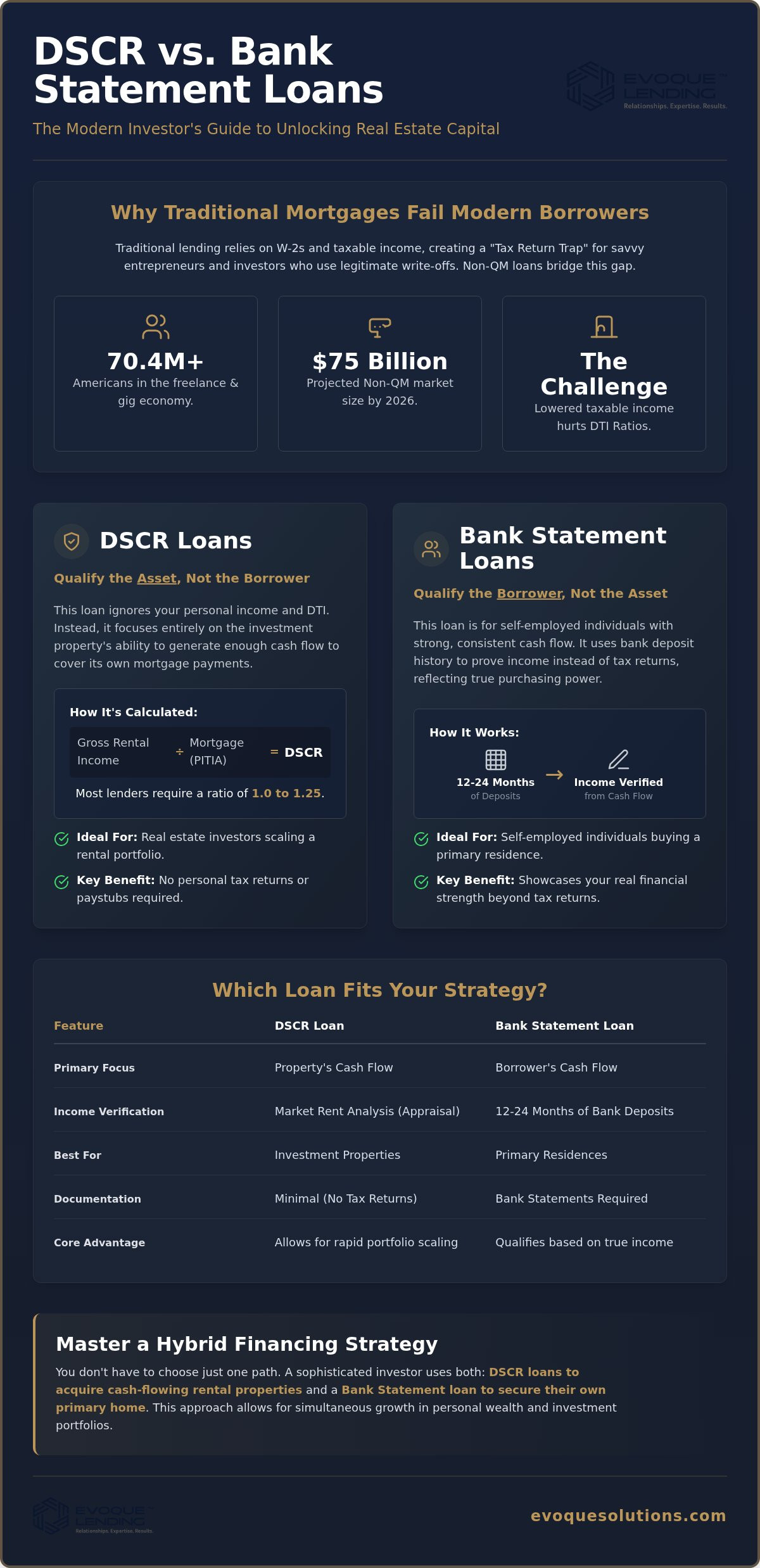
Side-by-Side Comparison: Which Loan Fits Your 2026 Strategy?
Choosing between a dscr vs bank statement loan requires a clear-eyed look at your 2026 financial goals. The primary differentiator is occupancy. DSCR loans are strictly for non-owner-occupied investment properties. If you are looking to buy a primary residence or a vacation home, the bank statement path is your only Non-QM option. While DSCR focuses entirely on the property's performance, bank statement loans qualify the human borrower. This means that for a bank statement loan, your personal debt-to-income (DTI) ratio still matters. For a DSCR loan, your personal DTI is completely ignored in favor of the asset's cash flow.
Title vesting also varies significantly between these two paths. DSCR loans are designed for LLCs, providing the asset protection that modern investors demand. Bank statement loans for primary residences almost always require the title to be in your personal name to comply with standard consumer lending regulations. The threshold of choice rests on whether you are qualifying a business asset to generate cash flow or leveraging your personal entrepreneurial success to secure a residence.
Speed and Documentation: The Practical Reality
If timing is your main concern, DSCR is the clear winner. Because there is no income to verify, these loans often close in 15 to 21 days. The documentation burden is light, usually requiring little more than an appraisal and a lease agreement. Bank statement loans carry a heavier "paperwork touch." Underwriters must meticulously analyze 12 to 24 months of deposit activity to ensure income stability. Both programs require cash reserves after closing. However, DSCR lenders often look for 3 to 6 months of property payments (PITIA) specifically to hedge against potential vacancies.
Rate and Fee Differentiators
Pricing in the Non-QM space is nuanced. DSCR loans typically carry a slight interest rate premium compared to bank statement loans. This spread exists because business-purpose loans are viewed through a different risk lens. However, DSCR often allows for higher leverage, which is a trade-off many investors are willing to make to keep more cash in their pockets. Prepayment penalties are another key difference. They are a standard feature in the DSCR world but are generally prohibited for primary residence bank statement loans. In both scenarios, your credit score remains the most powerful lever for pricing. Since 2005, we have seen that borrowers with scores above 740 consistently secure the most aggressive terms in both categories.
Understanding these mechanics is the first step toward a successful closing. If you are ready to see which path aligns with your current portfolio, you can get a custom loan quote to compare your real-world options.
Scaling Your Portfolio: Integrating Both Solutions with Evoque Lending
Successful entrepreneurs and investors in 2026 rarely rely on a single financing tool. Instead, they employ a "hybrid strategy" to maximize their growth. This approach involves using a bank statement loan to secure a primary residence, leveraging personal business success, while simultaneously using DSCR loans to expand a rental portfolio. This dual-track method ensures that your personal lifestyle and your investment goals don't compete for the same traditional debt-to-income capacity. By diversifying your financing, you can maintain personal liquidity while your properties pay for their own expansion.
As your real estate business matures, your needs will inevitably shift. You might start with bank statement loans during a high-growth business phase and transition toward DSCR once your rental income is robust enough to stand alone. Navigating the dscr vs bank statement loan decision for each specific asset requires a seasoned guide. Matching your unique income story to the right Non-QM program is essential. Since 2005, Evoque Lending has specialized in these non-traditional paths, providing a shortcut to the most competitive national programs across more than 40 states.
Planning for Long-Term Growth
Timing is critical when you operate outside the traditional W-2 box. We recommend consulting a specialist before you file your 2026 tax returns. Certain legal deductions that lower your tax liability could inadvertently impact your qualifying income for specific bank statement programs. Preparation also extends to your bank accounts. You should ensure a clean deposit history and avoid commingling personal and business funds. If you have substantial liquid wealth but lower monthly cash flow, we also serve as an asset depletion mortgage lender. This provides a third alternative for qualifying based on your total net worth rather than monthly deposits or property rents.
Getting Started with Evoque
We've spent over 20 years refining a process that respects your time and your complexity. It starts with a streamlined 2-minute questionnaire. This tool is designed to identify your best loan fit without the typical banking runaround. During your initial consultation, a loan specialist will evaluate your dscr vs bank statement loan options to find the perfect alignment for your 2026 strategy. We prioritize transparency and tangible outcomes over high-pressure tactics. Don't let rigid institutional boxes stall your progress. Leverage your true financial strength today to take immediate action in a competitive market.
Unlocking Your Next Real Estate Move in 2026
The traditional mortgage path is no longer the only way to build wealth or secure a home. By understanding the nuances of the dscr vs bank statement loan choice, you can bypass rigid institutional limits and leverage your true financial strength. Whether you are qualifying an investment property based on its rental potential or using your business deposits to buy a primary residence, these Non-QM solutions provide the flexibility that modern entrepreneurs require. Scaling a portfolio in today's market isn't just about having capital; it's about having the right partner to navigate complex income stories.
Evoque Lending brings over 20 years of specialized experience to your side. We provide national support for investors in 40+ states and offer deep expertise in LLC vesting and 1099 borrower qualifications. Don't let tax deductions or non-traditional income streams stop your progress. Our team is ready to help you match your 2026 strategy with a loan that actually fits your life. See which loan program fits your strategy; get a custom quote from Evoque Lending today. You've done the hard work of building your business. Now it's time to let your income work for you.
Frequently Asked Questions
Can I use a DSCR loan for my primary residence?
No, you cannot use a DSCR loan for a primary residence. These products are strictly for business-purpose investment properties where the rental income covers the mortgage debt. If you are looking to purchase a home to live in, a bank statement loan is the appropriate Non-QM path. It allows you to qualify based on your deposits while meeting the specific consumer protection standards required for personal housing and owner-occupied residences.
Do bank statement loans require any tax returns at all?
Bank statement loans do not require tax returns to verify your qualifying income. The underwriting process focuses on 12 to 24 months of consecutive deposits to determine your true cash flow. This is ideal for self-employed individuals who use legal deductions to reduce their taxable income on IRS filings. While you won't need returns, you will still need to provide proof of business ownership and a consistent, verifiable deposit history to the lender.
Which loan type has a lower interest rate, DSCR or bank statement?
Bank statement loans for primary residences generally carry lower interest rates than DSCR loans. Because DSCR is an investment-focused product, lenders apply a higher risk premium to the rate. However, when evaluating a dscr vs bank statement loan for an investment property, the spread narrows significantly. The choice often depends on whether you prefer to qualify based on your personal income strength or the property's standalone cash flow performance.
Can I get a DSCR loan if the property is currently vacant?
You can absolutely secure a DSCR loan for a vacant property. Lenders do not require a current lease agreement to approve the financing. Instead, an appraiser will complete a Form 1007 market rent survey to determine the projected rental income. As long as the estimated market rent meets the lender's required ratio, you can close on the purchase and place a tenant after the transaction is complete to start generating cash flow.
How many months of bank statements do I need for a self-employed loan?
Most self-employed borrowers need to provide either 12 or 24 months of consecutive bank statements. The 24-month option often yields more favorable terms as it demonstrates long-term business stability and consistent revenue. Lenders look for a steady or increasing trend in deposits during this period. If your business is newer, some specialized programs may consider a 12-month history, provided your credit score and down payment meet the higher requirements for shorter history.
Is a down payment higher for DSCR vs bank statement loans?
Down payment requirements are typically higher for DSCR loans compared to bank statement loans. Most DSCR programs require a minimum of 20% to 25% down to mitigate the risk associated with an investment asset. Bank statement loans for primary residences are more flexible, with some programs allowing down payments as low as 10%. When comparing a dscr vs bank statement loan, your available liquid capital will often dictate which path is most viable.
Can I use 1099s instead of bank statements for qualification?
You can use 1099 forms as a primary qualification tool through specialized 1099 Borrower Loans. This is an excellent alternative for contractors who receive a few large annual payments rather than frequent monthly deposits. While bank statement loans analyze your total cash flow, a 1099-based loan focuses on the gross earnings reported by your clients. This streamlined approach often requires less documentation than a full 24-month bank statement review for busy professionals.
What happens if my business has high expenses but high deposits?
If your business has high expenses, lenders typically apply a standard expense factor, often around 50%, to your gross deposits. This helps them estimate your net qualifying income for the loan. However, if your actual overhead is significantly lower, you can often provide a letter from your CPA to document a more favorable expense ratio. This adjustment allows you to leverage more of your actual deposits to qualify for a higher loan amount.
Reviewed by Eddie Luhrassebi, Founder & CEO, NMLS #337071 | CA DRE #01230650
Last updated: September 4, 2026 · About the reviewer