
Asset Depletion Mortgage Lenders: A 2026 Guide to Qualifying with Wealth
Written by Eddie Luhrassebi · Published August 31, 2026
Our 2026 guide to finding an asset depletion mortgage lender. Learn to leverage your liquid assets to qualify for a home loan without traditional income.
You've spent decades building a multi-million dollar portfolio, yet traditional banks treat you as if you're financially invisible because your tax returns show minimal earned income. It's a frustrating paradox. Having millions in liquid assets should make you a premier borrower, but standard debt-to-income calculations often ignore the reality of your wealth. Working with a specialized asset depletion mortgage lender changes this dynamic by converting your balance sheet into a qualifying income stream.
We understand that your financial strength isn't found in a W-2. You deserve a lending partner who recognizes that liquidity is the modern equivalent of a salary. In this 2026 guide, you'll learn exactly how to leverage your liquid net worth to secure a mortgage without traditional income documentation. We'll explore which assets count at 100% versus 70%, detail the current depletion periods, and show you how to navigate the specialized Non-QM landscape. By the end, you'll have a clear path to approval that aligns with how you actually manage your wealth.
What is an Asset Depletion Mortgage and How Does It Work?
Traditional mortgage underwriting is built on the assumption that every borrower earns a steady, predictable paycheck. For high-net-worth individuals, this rigid framework often creates an unnecessary barrier to homeownership. An asset depletion mortgage is a Non-Qualified Mortgage (Non-QM) solution that solves this by redefining how "income" is measured. Instead of focusing on W-2 stubs or 1099 forms, an asset depletion mortgage lender calculates a qualifying monthly income by amortizing your liquid assets over a set period, typically ranging from 60 to 120 months in 2026. This method satisfies the legal "Ability to Repay" requirements by proving you have the capital to cover the mortgage loan, regardless of your current employment status.
Most retail banks struggle with high-net-worth liquidity because they operate within narrow institutional boxes. They prioritize the source of your money over the actual amount of money you possess. If your tax returns show heavy business reinvestment or complex deductions that hide your true liquidity, a standard bank will likely issue a denial. Asset depletion programs bypass this friction by treating your existing wealth as a reliable stream of future payments. It's a logical shift that recognizes your balance sheet as a more accurate reflection of financial health than a single year's taxable income.
The Shift from Income to Liquidity
Being "rich on paper" shouldn't be a liability. The "qualified mortgage" rules were designed to protect the banking system, but they inadvertently penalize entrepreneurs and retirees who have moved beyond the traditional salary model. By 2026, the lending market has evolved. Specialized lenders now understand that a five million dollar brokerage account is often a safer bet than a six-figure salary. Your investments don't get laid off or experience corporate restructuring. This modern approach allows you to qualify for a residence based on the stability of your accumulated wealth rather than the volatility of a monthly payroll cycle.
Asset Depletion vs. Asset-Based Lending
It's vital to distinguish this program from traditional asset-based lending or margin loans. In those scenarios, your investments are often pledged as direct collateral, which can limit your ability to trade or move funds. With asset depletion, your assets remain entirely in your control and stay within your preferred accounts. You aren't "spending" the money or locking it away; you're simply using its existence to prove your creditworthiness. Working with an asset depletion mortgage lender allows you to maintain full market exposure. You continue earning dividends and capital gains while securing the financing you need for a primary or secondary home.
The Math of Wealth: How Asset Depletion Calculations Work
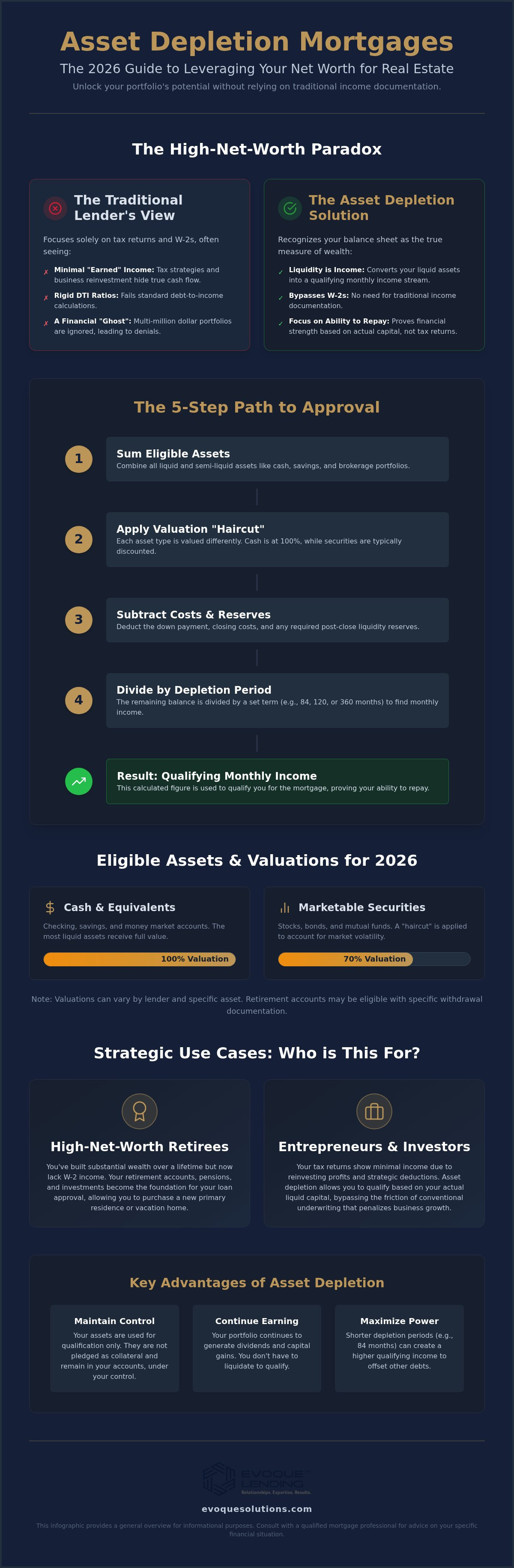
Calculating your qualifying power shouldn't feel like a mystery. While big banks stop at your tax return, an asset depletion mortgage lender looks at the total sum of your liquid potential through a structured five-step formula. This process translates your stagnant wealth into an active income stream that satisfies modern underwriting requirements. It's a methodical approach designed to prove your ability to repay without relying on a traditional payroll cycle.
- Step 1: Identify and sum all eligible liquid and semi-liquid assets, including checking accounts, savings, and brokerage portfolios.
- Step 2: Apply the "haircut" or discount factor based on asset type; cash is usually valued at 100%, while stocks typically receive a 70% valuation.
- Step 3: Subtract the down payment, closing costs, and the required 6 to 12 months of post-close reserves from the total.
- Step 4: Divide the remaining balance by a specific timeframe, such as 84 or 360 months, depending on the specific program guidelines.
- Step 5: Add the resulting monthly figure to any other documented income sources, such as Social Security, pensions, or rental income.
If you're unsure which assets in your portfolio qualify for the highest valuation, you can consult with our specialists to run a custom scenario based on your specific holdings.
Understanding the Divisor
The divisor is the most critical variable in your calculation. Many specialized programs use an 84-month divisor, which represents a seven-year window. This shorter timeframe produces a much higher monthly income figure, making it ideal for borrowers who need to offset a high debt-to-income ratio. Alternatively, some lenders use a 360-month divisor to spread the assets over the full life of the loan. Your choice of divisor directly determines how much home you can afford under current debt-to-income limits.
Sample Calculation for a $1M Portfolio
Consider a borrower with $1,000,000 in a brokerage account consisting of publicly traded stocks. In 2026, most programs apply a 70% discount to these assets, leaving $700,000 for qualification. After subtracting a $150,000 down payment and closing costs, the remaining $550,000 is divided by 84 months. This creates $6,547 in monthly qualifying income. For a retiree or an entrepreneur with complex taxes, this "income" provides a stable, verifiable path to approval that traditional bank statements simply cannot match.
Eligible Assets and Qualification Standards for 2026
In 2026, the criteria for qualifying with an asset depletion mortgage lender have become more defined. Lenders categorize your wealth based on its accessibility and market volatility. Cash and cash equivalents, such as checking, savings, and certificates of deposit, are the gold standard. These are typically valued at 100% of their balance. Marketable securities, including publicly traded stocks and mutual funds, usually receive a 70% valuation to account for potential market fluctuations. This "haircut" ensures the lender is protected against sudden shifts in the equity markets.
Retirement accounts require a more nuanced look. If you're over age 59.5, lenders often value these accounts at 70% to 80% because you can access the funds without penalty. For those under 59.5, the valuation drops to roughly 60% to 70%. Cryptocurrency is now gaining limited acceptance, often capped at a 50% to 60% valuation. It's vital to remember that these assets must be "seasoned," meaning they've sat in your account for at least 30 to 90 days before the application. This prevents "asset stuffing" where funds are borrowed just to qualify for the loan.
What Counts and What Doesn't
Liquidity is the deciding factor. While you might have millions in real estate equity or private equity, these are considered illiquid and are generally excluded from the calculation. Lenders need to see that you can actually draw on these funds if needed. Most programs require a minimum liquid asset threshold of $500,000 to $1 million after your down payment and closing costs are paid. This "post-closing liquidity" ensures you have a safety net, typically requiring 6 to 12 months of principal, interest, taxes, and insurance (PITI) in reserve.
Credit Score and DTI Requirements
High net worth doesn't negate the need for a strong credit profile. In 2026, the minimum credit score for these programs usually sits at 700, though a score of 780 or higher often unlocks the most favorable terms. Debt-to-income (DTI) limits are surprisingly flexible, with many lenders allowing up to 50%. This flexibility is vital for borrowers whose traditional income doesn't match their lifestyle. Finding the right asset depletion mortgage lender is about more than just a rate; it's about finding a partner who understands complex financial structures. Evoque Lending acts as your guide here. We match your specific credit profile and asset mix with the institutional appetites that offer the best fit, ensuring your wealth is recognized at its full potential.
Strategic Use Cases: When to Choose Asset Depletion
Traditional financing often feels like a mismatch for those who've already achieved financial success. For a high-net-worth retiree, the absence of a monthly paycheck shouldn't be an obstacle to buying a primary or secondary home. An asset depletion mortgage lender recognizes that your accumulated wealth is a more stable indicator of repayment ability than a temporary salary. Similarly, an entrepreneur who has recently exited a business may have significant liquidity but lacks the current employment history that retail banks demand. These scenarios are where asset depletion shines, offering a bridge between your past success and your future property goals.
Active real estate investors also find significant value here. If you're looking to acquire more doors but don't want to trigger capital gains by selling stocks, this program allows you to keep your capital working in the market. While bank statement loans for self employed are a powerful tool for those with consistent business deposits, asset depletion provides a simpler path for those whose strength lies in their existing balance sheet.
Asset Depletion vs. DSCR Loans
Choosing between these two programs depends on where your financial strength sits. While dscr loans for real estate investors prioritize the rental income generated by the property itself, asset depletion focuses on your personal liquidity. Using your assets to qualify can be a tactical advantage when purchasing a property that needs renovation or has a temporary vacancy. It provides the flexibility to secure the loan based on your global wealth rather than the immediate performance of a single asset. Choosing the right asset depletion mortgage lender is essential for navigating these complex scenarios where property cash flow and personal wealth overlap.
The Self-Employed Advantage
Asset depletion serves as the ultimate 'Plan B' for business owners whose aggressive tax strategies result in low taxable income on paper. It allows you to bypass the standard requirement for 1040 tax returns entirely by focusing on your total liquid depth. This is particularly useful for those who haven't yet reached the two-year business history mark required by most traditional programs. By using your liquid net worth, you effectively eliminate the need to prove a recurring monthly profit from a young or complex business entity. If you're ready to see how your specific portfolio translates into buying power, speak with an Evoque advisor today.
Choosing the Right Asset Depletion Mortgage Lender
Retail banks are designed for the masses, not the exceptions. If you approach a standard institution with a significant brokerage account but no traditional salary, you'll likely face a cycle of endless questions and eventual rejection. Choosing an asset depletion mortgage lender who understands the nuances of Non-QM finance is the difference between a stalled application and a successful closing. A specialized broker doesn't just offer a product; they provide access to a secondary market of institutional investors who value liquidity over tax returns.
Lender matching is the most critical phase of the process. Every institution has its own "box" for risk. One lender might offer a 100% valuation on cash but require a 360-month divisor, while another might accept a 70% haircut on stocks with a much more aggressive 84-month divisor. We analyze your specific asset mix to find the program that generates the highest qualifying income. This strategic alignment ensures you don't leave borrowing power on the table simply because of an arbitrary institutional rule.
The documentation phase is refreshingly direct. Instead of years of tax transcripts and business profit-and-loss statements, the focus shifts to account verification. You'll provide current statements for your eligible accounts to prove both the balance and the seasoning of the funds. This streamlined approach removes the friction common in high-net-worth lending, allowing you to move with the speed of a cash buyer while maintaining your market positions.
The Evoque Lending Difference
Since 2005, Evoque Lending has served as a seasoned guide for borrowers who don't fit the standard mold. We maintain a national reach across more than 40 states, giving us the scale to negotiate with diverse institutional investors. Our methodical approach ensures that even the most complex wealth profiles are presented in a way that underwriters understand. We aren't just looking for a loan; we're looking for the specific financial instrument that aligns with your long-term wealth strategy.
Your Path to Approval
Getting started is a structured, three-step process designed to respect your time. First, we conduct an initial asset review through a simple questionnaire to identify your eligible holdings. Second, we match your profile to the most competitive asset depletion program in our network. Finally, we provide clear, consistent communication from the initial disclosure through the final funding. This clarity eliminates the guesswork and provides a predictable timeline for your home purchase or refinance.
Ready to leverage your liquidity? Contact Evoque Lending today for a personalized asset depletion analysis.
Securing Your Future with Liquid Wealth
Your balance sheet is more than just a collection of assets; it's a powerful tool for securing your next home. By converting your liquidity into a documented income stream, you bypass the rigid constraints of traditional banking and gain the flexibility your financial success deserves. Success in 2026 relies on understanding the specific math of haircuts and divisors to maximize your borrowing power. It's about making your wealth visible to underwriters who typically only look at tax returns.
Partnering with a specialized asset depletion mortgage lender like Evoque Lending ensures your portfolio is evaluated with the precision it requires. Since 2005, we've focused on complex investment scenarios, offering national reach and access to institutional investors that standard banks often can't match. Our dedicated specialists understand the nuances of non-traditional income and are ready to help you navigate the path to approval. You've done the hard work of building your wealth; now it's time to let that wealth work for you.
Ready to qualify with your assets? Get a custom quote from Evoque Lending.
Frequently Asked Questions
Can I use asset depletion if I am still working?
Yes, you can utilize asset depletion even if you have active employment income. Many high-earning professionals use this program to supplement their documented salary, which helps lower their debt-to-income ratio for larger loan amounts. An asset depletion mortgage lender will simply add the calculated asset-based income to your existing monthly earnings. This dual approach provides a more comprehensive view of your financial strength than looking at a single paycheck alone.
What is the minimum asset amount required for an asset depletion loan?
Most programs in 2026 require a minimum of $500,000 in eligible liquid assets after you have covered the down payment and closing costs. Some institutional investors set this threshold higher, at $1 million, depending on the loan size and the specific divisor used. Having a substantial buffer is essential because lenders need to see that your portfolio can sustain the monthly "income" figure over the life of the loan without being entirely exhausted.
Do I have to spend or 'deplete' my assets to get the loan?
No, you are not required to actually spend or liquidate your accounts to satisfy the lender. The term "depletion" refers to the mathematical formula used to calculate your qualifying income, not an obligation to draw down your principal. Your assets remain in your control and continue to earn interest or dividends. The lender simply uses the existence and liquidity of these funds to verify that you have the long-term ability to repay the mortgage.
Are interest rates higher for asset depletion mortgages?
Rates for these programs are typically higher than those for traditional conforming loans because they fall into the Non-QM category. In 2026, you can expect a spread between 0.75% and 1.75% over conventional rates. However, these rates remain highly competitive when compared to other alternative documentation options. The exact pricing depends on your credit score, with 780 or higher usually unlocking the best terms available through an asset depletion mortgage lender.
Can I use a 401(k) or IRA for asset depletion qualification?
Yes, retirement accounts are eligible, though they are subject to specific valuation discounts. If you are over age 59.5, lenders typically count 70% to 80% of the account balance toward your qualifying assets. For those under 59.5, the valuation is often reduced to 60% or 70% to account for potential early withdrawal penalties and taxes. This ensures the lender has a realistic view of the accessible cash available for your monthly mortgage payments.
Is there a maximum loan amount for asset depletion programs?
These programs are designed for high-net-worth scenarios and offer significantly higher limits than standard agency loans. In 2026, many specialized lenders provide financing up to $7 million for qualified borrowers. The maximum amount you can borrow is ultimately determined by the total value of your eligible assets and the resulting monthly income calculation. This makes asset depletion an ideal choice for luxury home purchases where traditional jumbo loan requirements are too restrictive.
Can I use asset depletion for an investment property purchase?
Yes, asset depletion is an excellent solution for acquiring or refinancing investment properties. While many investors prefer DSCR loans that qualify based on the property's rental income, using your personal wealth can be a strategic alternative. This is particularly useful for properties that are currently vacant or undergoing renovations where the rental cash flow isn't yet established. It allows you to leverage your global liquidity to expand your real estate portfolio without tax return friction.
How long do assets need to be 'seasoned' before they can be used?
Lenders typically require your assets to be "seasoned" in your accounts for a period of 30 to 90 days. This requirement prevents borrowers from temporarily moving funds into an account just to qualify for the loan, a practice known as "asset stuffing." You will need to provide two to three months of consecutive statements to prove the stability of your holdings. This transparency helps build trust with the underwriter and confirms the funds are truly yours to use.
Reviewed by Eddie Luhrassebi, Founder & CEO, NMLS #337071 | CA DRE #01230650
Last updated: August 31, 2026 · About the reviewer