
DSCR Loan for Short-Term Rental: 2026 Investor Guide
Written by Eddie Luhrassebi · Published September 7, 2026
Unlock your portfolio's potential. Our 2026 guide to a DSCR loan for short term rental shows you how to finance properties based on cash flow, not your W-2.
Your personal tax returns shouldn't be the ceiling for your real estate ambitions. Many investors find their growth stalled because traditional banks can't look past debt-to-income ratios or the seasonal income fluctuations that come with a dscr loan for short term rental property. It's a common frustration to see a high-performing property slip away because a conventional lender doesn't understand the nuances of vacation rental revenue. You've likely felt the sting of slow closing times and the mountain of paperwork that comes with institutional financing.
Securing specialized financing allows you to pivot away from personal income constraints and focus entirely on the property's potential. We'll help you master the mechanics of cash-flow based financing so you can scale your portfolio without the burden of traditional verification. This 2026 guide provides a clear roadmap through the current lending environment, explaining how to use AirDNA projections and specific underwriting standards to secure your next investment. You'll learn how to leverage property performance to build a legacy of short-term rental wealth while keeping your personal finances private.
Why DSCR Loans are the Premier Choice for Short-Term Rental Investors
The hospitality market has evolved rapidly, and by 2026, the gap between traditional banking and the needs of agile investors has only widened. For those looking to acquire or refinance a vacation property, the Debt Service Coverage Ratio (DSCR) is the most critical metric in the lending process. Unlike a conventional mortgage that scrutinizes your salary and personal tax returns, a dscr loan for short term rental focuses on the property's ability to generate revenue. This shift in focus means your personal debt-to-income (DTI) ratio is effectively irrelevant. If the asset produces enough cash flow to cover the mortgage, taxes, insurance, and association fees, the deal can move forward.
This "DTI Escape" is a game changer for investors who have hit a wall with Fannie Mae or Freddie Mac limits. Traditional lenders often view multiple mortgages as a liability; however, DSCR lenders view a cash-flowing portfolio as a strength. This allows you to close on multiple properties simultaneously, provided each property meets the minimum coverage requirements. Because the underwriting process doesn't require exhaustive personal income verification, the speed to close is significantly faster. While a big bank might take 45 to 60 days to navigate their bureaucracy, a specialized Non-QM lender can often fund a deal in half that time.
The Shift from Personal to Asset-Based Qualification
Underwriters for these programs prioritize "Debt Service" over "Personal Liability." They aren't interested in your W-2 history or your 1099 fluctuations. Instead, they look at the property as a standalone business entity. This is particularly beneficial for self-employed hosts who often have high gross incomes but significant tax deductions that lower their taxable income on paper. By closing the loan in the name of an LLC, you add a layer of protection between your personal credit and your business assets, ensuring that your investment growth doesn't negatively impact your personal borrowing power for things like a primary residence.
DSCR
as a Tool for National Portfolio Expansion
The 2026 market has seen conventional lenders tighten their standards for short-term rentals due to perceived volatility. Specialized loans fill this void by allowing you to leverage equity from existing long-term rentals to fund new STR acquisitions in high-demand vacation markets. This flexibility is essential for building a diverse, national portfolio. By following the strategies in DSCR Loans: 2026 Guide to Scaling Your Portfolio, you can move beyond your local market. You aren't limited by where you live, but rather by where the data shows the best returns. A dscr loan for short term rental gives you the liquidity to act quickly when a prime property hits the market in another state.
Core Requirements: Qualifying for an STR DSCR Loan in 2026
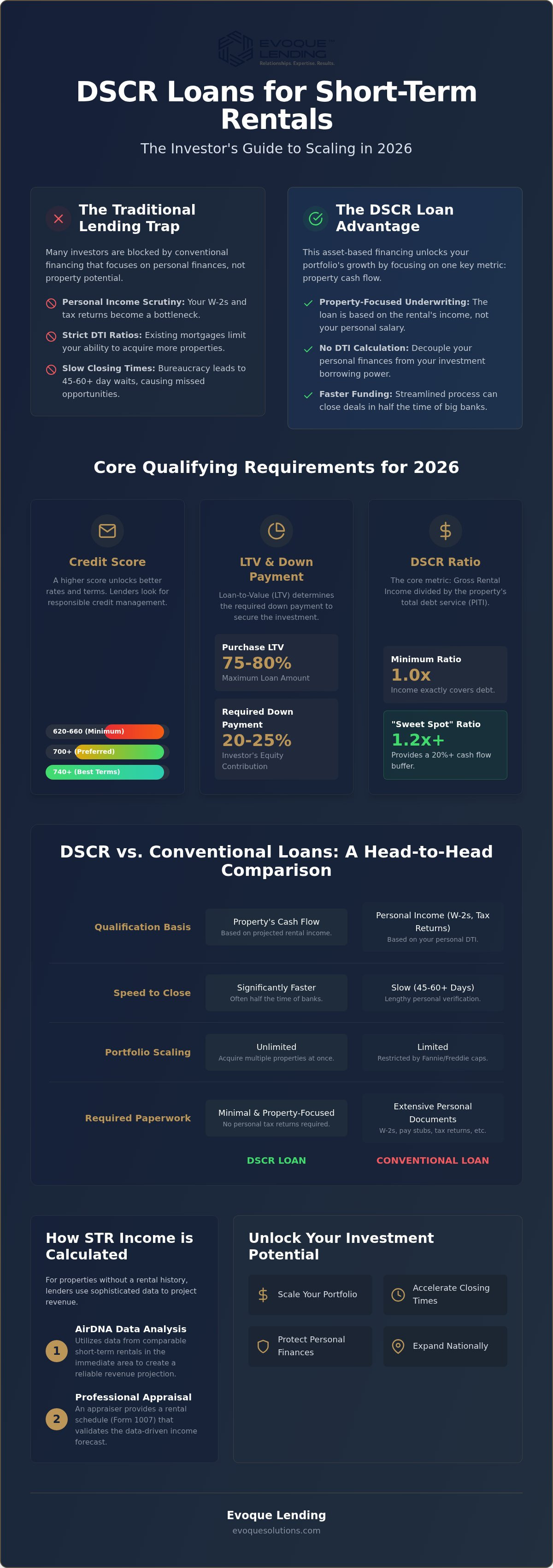
Qualifying for a dscr loan for short term rental is a different experience than applying for a traditional mortgage. In 2026, lenders have refined their criteria to better match the realities of the hospitality market. While personal income isn't the focus, your credit profile and the property's performance are paramount. Most programs require a minimum credit score between 620 and 660. However, to access the most competitive pricing and higher leverage, a score of 700 or above is preferred. Investors with scores of 740 or higher typically see the best terms, often landing in the lower interest rate tiers available for Non-QM products.
Loan-to-Value (LTV) expectations remain steady for 2026. For a purchase, you should prepare for a maximum LTV of 75% to 80%, which necessitates a down payment of 20% to 25%. If you're looking at a cash-out refinance to grow your portfolio, LTVs might be slightly more conservative to account for market fluctuations. Property eligibility is broad, covering everything from standard single-family residences to 2-4 unit properties. Even "condotels" in high-traffic vacation destinations are often eligible, provided they meet specific structural and management criteria.
The "coverage floor" is the final piece of the puzzle. While some lenders accept a ratio as low as 1.0x, meaning the property's income exactly matches its debt obligations, the "sweet spot" for optimal terms is usually 1.2x or higher. A 1.2x ratio provides a 20% buffer, which gives lenders confidence that the investment can withstand the natural ebbs and flows of the short-term rental market.
Documentation and Reserve Standards
When we say "no tax returns," we mean it. Your application won't be weighed down by years of IRS filings or complex 1099 schedules. Instead, the focus shifts to liquidity. Lenders generally require 3 to 6 months of the property's principal, interest, taxes, and insurance (PITI) held in reserves. This ensures you can handle seasonal vacancies without stress. You don't always need to be a seasoned host to qualify; many programs are designed for first-time STR investors who have a solid property management plan in place.
Investor Entity and LLC Requirements
Closing your loan in an LLC is not just a preference for most DSCR lenders; it's often a requirement. This structure keeps the business debt separate from your personal credit report, which preserves your borrowing power for future personal needs. It's a strategic move discussed extensively in our Non-QM Loans for Real Estate Investors: The 2026 Portfolio Growth Guide. If you're wondering how your current entity structure fits these requirements, you can view our specialized loan programs to find the right alignment for your goals.
STR Income Calculation: Navigating AirDNA Data and Expense Factors
Underwriting a dscr loan for short term rental requires a specialized shift from traditional rental math. Lenders understand that vacation rentals produce variable revenue, so they use a mix of historical performance and market projections to determine eligibility. If the property is already active, you'll provide 12 months of platform statements from Airbnb or VRBO to prove its track record. For new acquisitions, the process relies on the Form 1007 Rent Schedule, often enhanced by a Short-Term Rental Supplement to capture the higher daily rates typical of the hospitality sector.
Underwriters don't simply take your gross revenue at face value. They apply what's known as an "expense haircut," typically deducting 20% to 30% from the projected gross income. This reduction accounts for vacancies, cleaning fees, and ongoing maintenance. Most lenders will use approximately 75% to 80% of the projected revenue to calculate your qualifying income, ensuring the loan remains stable even during off-peak seasons. This conservative approach protects both the lender and your long-term portfolio stability.
AirDNA vs. Traditional Appraisals
When historical data isn't available for a new purchase, lenders turn to AirDNA's "MarketMinder" to forecast potential earnings based on occupancy rates and average daily rates (ADR) in the immediate area. While these projections are helpful for initial pre-qualification, they don't replace a formal appraisal. Lenders verify AirDNA projections by cross-referencing the data with at least three active, local short-term rental comparables that share similar bedroom counts and amenities. This verification ensures the numbers are grounded in local reality rather than just algorithmic averages.
Managing the DSCR Ratio for Maximum Leverage
If a property's income doesn't initially "pencil" to meet the 1.2x sweet spot, you have several strategic levers to pull. Choosing an interest-only payment option can significantly lower your monthly debt service, which instantly improves your ratio. You might also consider a larger down payment to reduce the principal balance and interest cost. It's also vital to account for professional property management fees, which underwriters factor into the expense profile. If your projected revenue is tight, providing a detailed management plan or showing a history of high-performance hosting can sometimes provide the qualitative edge needed to secure a dscr loan for short term rental when the numbers are close.
Strategic Evaluation: DSCR vs. Traditional STR Financing Paths
Choosing the right debt structure is as vital as selecting the right property. While a dscr loan for short term rental is often the premier choice for scaling, it's essential to understand how it compares to other financing avenues. Conventional loans often offer the lowest interest rates, but they carry a heavy "opportunity cost." The rigid debt-to-income (DTI) requirements and slow underwriting cycles of big banks can cause you to lose a prime vacation property to a faster competitor. DSCR financing prioritizes the deal's speed and the asset's performance over your personal financial history.
Hard money is another common alternative, though it's typically reserved for short-term "bridge" scenarios or heavy renovations. These loans carry high interest rates and short terms, making them unsuitable for long-term hold strategies. Transitioning from a high-cost bridge loan into a 30-year DSCR product is a standard move for investors who have finished a "refresh" on a property and are ready to lock in stable debt. In the 2026 market, many investors are also utilizing the "Interest-Only" advantage. By paying only the interest for the first 5 to 10 years, you maximize your monthly cash flow, which provides a larger cushion for the higher operational costs of running an Airbnb or VRBO.
When to Choose a Bank Statement Loan Instead
There are specific scenarios where a dscr loan for short term rental might not be the best fit. If you're looking at a property that requires a significant "ramp-up" period where initial cash flow is low, but your personal business income is exceptionally high, a bank statement loan could be more effective. This hybrid approach is common for hosts who want to qualify based on their overall business health rather than a single property's current revenue. You can explore these nuances further in our guide on DSCR vs. Bank Statement Loan: Which Non-QM Path Fits Your 2026 Strategy?
Foreign National STR Financing
The US short-term rental market remains a magnet for international capital. Non-US residents can indeed use DSCR programs to acquire Airbnb properties without a domestic credit score or a Social Security number. These programs typically require an ITIN or a specific foreign credit report, alongside a slightly higher down payment to offset the risk. If you're an international investor, our US Real Estate Financing for Foreign Investors: 2026 Guide details the exact documentation needed to start your US portfolio. To see which of these specialized paths fits your current situation, compare our current STR loan programs with a specialist today.
Optimizing Your Application: Steps to Secure Funding with Evoque Lending
Securing a dscr loan for short term rental requires a structured approach that aligns your investment goals with the current 2026 lending environment. Because these loans are asset-based, the quality of your preparation directly impacts the speed and success of your funding. We've refined our process to move you from initial inquiry to closing without the typical friction found at institutional banks. Our team manages the complexity so you can focus on identifying your next high-yield property.
The journey begins with an initial questionnaire designed to align your specific portfolio goals with our current 2026 programs. Once we understand your strategy, we move into a deep property analysis. This phase involves running the DSCR numbers using both historical platform data and projected STR revenue to ensure the deal pencils. Unlike a single bank that only offers its own products, we then move to the loan matching phase. We identify the specific lender from our network whose underwriting niche best fits your property type, whether it's a coastal condo or a mountain cabin.
The final phases involve specialized underwriting and appraisal. We guide you through the STR-specific valuation process, ensuring the appraiser uses the correct supplements to reflect the property's true earning potential. Once the appraisal is cleared, we move rapidly to closing and funding. This methodical flow is designed to get you to the closing table in weeks, not months, allowing you to transition seamlessly to your next acquisition.
The Evoque Advantage for Complex Borrowers
A brokerage model is inherently superior to a single-bank offer because it provides options rather than "take it or leave it" terms. We specialize in handling the "1099 Investor" scenario with ease, supporting entrepreneurs who have complex income structures that traditional banks simply don't understand. Since we've been operating since 2005, we leverage over 20 years of expertise to troubleshoot potential appraisal issues before they stall a deal. We've seen every market cycle and know how to position your application for success across 40+ states.
Ready to Scale Your STR Portfolio?
Building a vacation rental empire requires a lending partner who understands that speed and flexibility are your greatest assets. Before you submit your next application, ensure you have your LLC documentation ready, your liquidity reserves verified, and your property management plan clearly outlined. Having a reliable partner in a fluctuating 2026 market is the difference between a stalled portfolio and a scalable business. If you're ready to see how the numbers look for your next deal, you can Get a custom DSCR quote for your short-term rental today and take the first step toward decoupling your growth from your personal income.
Scaling Your Portfolio in the 2026 Hospitality Market
The shift toward asset-based lending has redefined how successful hosts expand their reach. By prioritizing property performance over personal tax returns, you unlock the ability to acquire high-yield assets without the constraints of traditional debt-to-income ratios. Mastering the mechanics of a dscr loan for short term rental allows you to leverage market data and professional appraisals to prove a property's worth before the first guest even checks in. This approach effectively decouples your personal financial life from your business growth, providing the flexibility needed to act quickly on prime opportunities.
Finding the right fit requires a partner who understands the unique rhythm of the hospitality sector. Since 2005, Evoque Lending has provided expert loan matching and specialized STR underwriting to help investors navigate complex financial landscapes. With national coverage across more than 40 states, we're ready to help you secure the capital needed for your next acquisition. Your ambition shouldn't be limited by a bank's rigid boxes. Apply for a DSCR Short-Term Rental Loan with Evoque Lending and start building your legacy today.
Frequently Asked Questions
Can I use a DSCR loan for an Airbnb I haven’t bought yet?
Yes, you can secure a dscr loan for short term rental purchase before you take ownership. Lenders evaluate the property's potential income using market projections rather than your personal financial history. This allows you to close on new acquisitions without needing an existing track record for that specific address. It's a primary tool for investors looking to enter high-demand vacation markets quickly and efficiently while maintaining their personal financial privacy.
What is the minimum DSCR ratio required for a vacation rental?
Most lenders require a minimum ratio of 1.0, meaning the property's income equals its debt obligations. However, aiming for a 1.2 ratio is often considered the ideal for securing the most competitive interest rates and terms. Some specialized programs may allow for ratios as low as 0.75 or 0.85, though these typically require a larger down payment or more significant cash reserves to offset the lender's risk in a volatile hospitality market.
Do I need to provide tax returns for a short-term rental DSCR loan?
You don't need to provide personal tax returns or W-2s for this type of financing. Qualification relies entirely on the property’s ability to generate sufficient cash flow to cover its mortgage payments and expenses. This streamlined process is ideal for self-employed investors or those with complex tax deductions that might otherwise disqualify them from conventional bank loans. Instead, you'll provide bank statements, platform reports, or market rent projections to prove the asset's viability.
How does a lender calculate income for a new STR property without history?
Lenders use a combination of the 1007 Appraisal Rent Schedule and AirDNA data to forecast earnings. They typically apply an expense haircut of 20% to 25% to the projected gross revenue to account for vacancies and management costs. This ensures the loan is underwritten based on a realistic net income figure. Using these data-driven projections makes it possible to finance a dscr loan for short term rental even without a documented 12-month historical record.
Can I get a DSCR loan for a short-term rental in an LLC?
Closing in an LLC is not only possible but often required by specialized lenders. This structure protects your personal credit and limits your liability by keeping the investment debt separate from your personal finances. It also allows multiple partners to hold interests in the property more easily. We've helped many investors set up their financing this way to ensure their business growth doesn't hinder their personal borrowing power for future primary residence purchases.
Are DSCR loan rates higher for Airbnbs than long-term rentals?
Interest rates for vacation rentals are typically about 0.25% to 0.50% higher than those for standard long-term rentals. This reflects the increased operational complexity and seasonal revenue fluctuations inherent in the hospitality market. While the rate is slightly higher, the ability to qualify based on the property’s higher daily rates often results in better overall leverage and a stronger cash-on-cash return. It's a strategic trade-off for investors prioritizing rapid portfolio growth and scalability.
What happens if my property’s DSCR falls below 1.0?
If the ratio falls below 1.0, the property is considered negative cash flow in the eyes of the lender. To move forward, you might need to increase your down payment to reduce the loan amount or opt for interest-only payments to lower the monthly debt service. Some lenders will still fund these deals if you have high credit scores and strong cash reserves, though the loan-to-value requirements may be more conservative than a standard purchase deal.
Is there a limit to how many DSCR loans I can have at once?
There is no hard limit on the number of DSCR loans an investor can hold simultaneously. Unlike conventional financing, which often caps a borrower at ten properties, DSCR programs allow you to scale your portfolio as long as each asset meets the coverage requirements. This makes it the premier choice for professional investors who want to build a large-scale national portfolio across 40+ states without hitting the rigid institutional ceilings found at traditional banks.
Reviewed by Eddie Luhrassebi, Founder & CEO, NMLS #337071 | CA DRE #01230650
Last updated: September 7, 2026 · About the reviewer