
Best DSCR Lenders 2026: Guide for Investors
Written by Eddie Luhrassebi · Published September 15, 2026
Unlock portfolio growth in 2026. Our guide reveals the best DSCR lender options, helping you qualify on property cash flow and bypass strict DTI limits.
What if your tax returns were the least important document in your next loan application? Many investors reach a point where traditional debt-to-income requirements become a wall, blocking them from the very deals that would move the needle on their wealth. If you've felt the sting of a slow closing or the limitation of personal income caps, finding the right dscr lender is the strategic shift you need. These specialists focus on the property's ability to pay for itself; this means your personal debt profile no longer dictates the size of your portfolio.
It's frustrating to watch a prime opportunity slip away because a conventional bank couldn't wrap its head around your LLC structure or moved too slowly. We understand that in the 2026 market, agility is just as valuable as interest rates. This guide provides the roadmap to identify, evaluate, and select a dscr lender that aligns with your specific growth goals. We'll break down the current rate environment, explore the flexibility of cash flow-based qualification, and show you exactly how to close quickly so you can keep scaling without hitting an invisible ceiling.
Navigating the 2026 DSCR Lending Landscape
The 2026 real estate market has redefined how investors secure capital. As traditional institutions face tighter capital requirements and increased regulatory scrutiny, they've doubled down on debt-to-income (DTI) ratios. This move effectively sidelines many active investors who have complex tax structures or multiple existing mortgages. A specialized dscr lender, however, looks at the asset's performance rather than your personal pay stubs. This shift from personal income to property cash flow is the defining characteristic of the current lending environment. Economic shifts, including the 10-year Treasury yield hovering around 4.83%, have forced a recalibration of Loan-to-Value (LTV) caps, yet the demand for these flexible instruments continues to expand.
DSCR vs. Traditional Financing: The 2026 Shift
In the post-traditional mortgage world, personal tax returns are becoming a secondary concern for savvy investors. This is especially true for those focused on growing real estate portfolios without tax returns. Instead of dissecting your 1040s, lenders now prioritize market rent projections and actual lease agreements. In 2026, many programs allow for "market rent" appraisals to justify a loan even if a property is currently vacant or under-rented. This is a game changer for the value-add investor. It's no longer about what you earned last year; it's about what the property will earn next month. This approach accommodates entrepreneurs and self-employed individuals who often show lower net income due to legitimate business deductions.
Understanding the 1.0 Threshold in 2026
The core of these specialized loans is the Debt Service Coverage Ratio (DSCR). A ratio of 1.0, often called a "wash," means the property's gross income exactly covers the debt service. While a 1.25 ratio was once the rigid industry standard, the 2026 interest rate environment has created new challenges. With DSCR rates for well-qualified borrowers starting in the mid-6s and averaging up to 8% for higher-risk profiles, hitting that 1.25 mark requires significantly higher rents or larger down payments. Consequently, we've seen the emergence of "no-ratio" loans for high-equity investors. These products rely on strong credit scores, typically 720 or higher, and lower LTVs rather than a specific cash flow multiple. This flexibility allows you to secure a dscr lender even when a property's current cash flow is tight, provided the underlying asset is strong.
Key Criteria for Evaluating a DSCR Mortgage Lender
Selecting a dscr lender involves more than comparing interest rates; it's about understanding the specific underwriting "box" that fits your portfolio. In the 2026 market, credit score requirements have become more nuanced. While some programs accept a minimum score of 620, high-leverage options reaching 80% LTV typically require a 720 FICO or higher. If your score sits in the 680 to 720 range, you'll likely see rates between 7% and 7.75%, whereas well-qualified borrowers with 740+ scores can still find options in the low-to-mid 6s.
Experience and Track Record
A lender's longevity is a proxy for reliability. Seek out partners with specialized Non-QM underwriting teams who have managed capital through various market cycles. This expertise ensures they understand the nuances of investor income, such as LLC vesting or complex asset structures. Closing speed is another critical metric. In a competitive market, you need a team that can move from application to funding in three weeks or less, rather than the 45 to 60 days typical of big-box banks.
Loan-to-Value (LTV) and Equity Requirements
Standard LTVs for a purchase in 2026 generally hover around 75% to 80%. However, cash-out refinances are often capped at 70% to 75% to account for market volatility. The property type also dictates these limits. While single-family homes are straightforward, financing for multi-family investment properties often requires more specialized lenders who can handle the increased complexity of multiple rent rolls and higher debt loads.
Seasoning requirements are another pivotal factor. If you plan to perform a DSCR cash-out refinance, check if the lender requires the property to be held for 6 months or 12 months before tapping into the new appraised value. For short-term rental owners, verify if the dscr lender accepts AirDNA projections or requires a 12-month history of actual Airbnb receipts. Many forward-thinking lenders now use "no-ratio" programs for investors with significant equity, allowing you to bypass cash-flow requirements entirely if you have a 25% to 30% down payment.
Finally, review the prepayment penalty structure. A common "5-4-3-2-1" schedule reduces the penalty by 1% each year. If you plan to sell or refinance quickly, look for shorter 1-year or 2-year penalty terms, even if it means a slightly higher starting rate. Balancing these criteria helps you find a partner that supports long-term scaling. If you're unsure which program fits your current project, speaking with an experienced specialist can clarify your options.
Direct Lenders vs. Specialized Mortgage Brokers
Investors often face a fork in the road: do you work with a direct institutional bank or a specialized mortgage broker? The answer depends on your portfolio's complexity. A direct dscr lender is a single institution that lends its own capital. While this sounds streamlined, it creates a "captive audience" scenario. If your deal doesn't perfectly align with their internal risk appetite, the application ends there. You're left starting from scratch with another institution. This can be a costly delay in a market where timing is everything.
Specialized brokers like Evoque Lending operate differently. We act as a seasoned guide to the wholesale market. Instead of one set of rules, we access dozens of programs across the 40+ states we serve. This variety is crucial because every wholesale dscr lender has different appetites for risk, property types, and borrower profiles. You gain the advantage of a single point of contact who can shop your deal across multiple channels to find the best fit.
The Broker Advantage for Complex Scenarios
Complexity is where the brokerage model shines. If you're a foreign national or an entrepreneur with 1099 income, a standard bank will likely struggle with your documentation. We specialize in these non-traditional scenarios. For example, income verification for self-employed borrowers is significantly more manageable when you can choose a lender that prioritizes bank statements or asset depletion over tax returns. Brokers also leverage these multiple relationships to find the lowest ratio requirements. If one institution demands a 1.25 ratio but your property sits at a 1.05, we know exactly which wholesale partner will accept the lower threshold.
When to Choose a Direct Institutional Lender
Direct lenders can sometimes offer a slight edge on speed for the simplest deals. If you have a high credit score, a standard single-family property, and a large down payment, a direct bank might move you through their internal pipeline quickly. However, this speed often comes at the cost of flexibility. In real estate investing, the ability to close a deal under an LLC or bypass personal income caps is usually more valuable than a marginally lower rate. Flexibility often beats price when it comes to scaling a portfolio.
The cost analysis is also more favorable than many realize. While brokers charge a fee, we access wholesale interest rates that are frequently lower than the retail rates offered by direct banks. This often results in a lower monthly payment even after accounting for the broker's compensation. You're paying for access, expertise, and a partner who can pivot your file to a new lender without requiring a new application. This agility is your greatest asset in a competitive 2026 market.
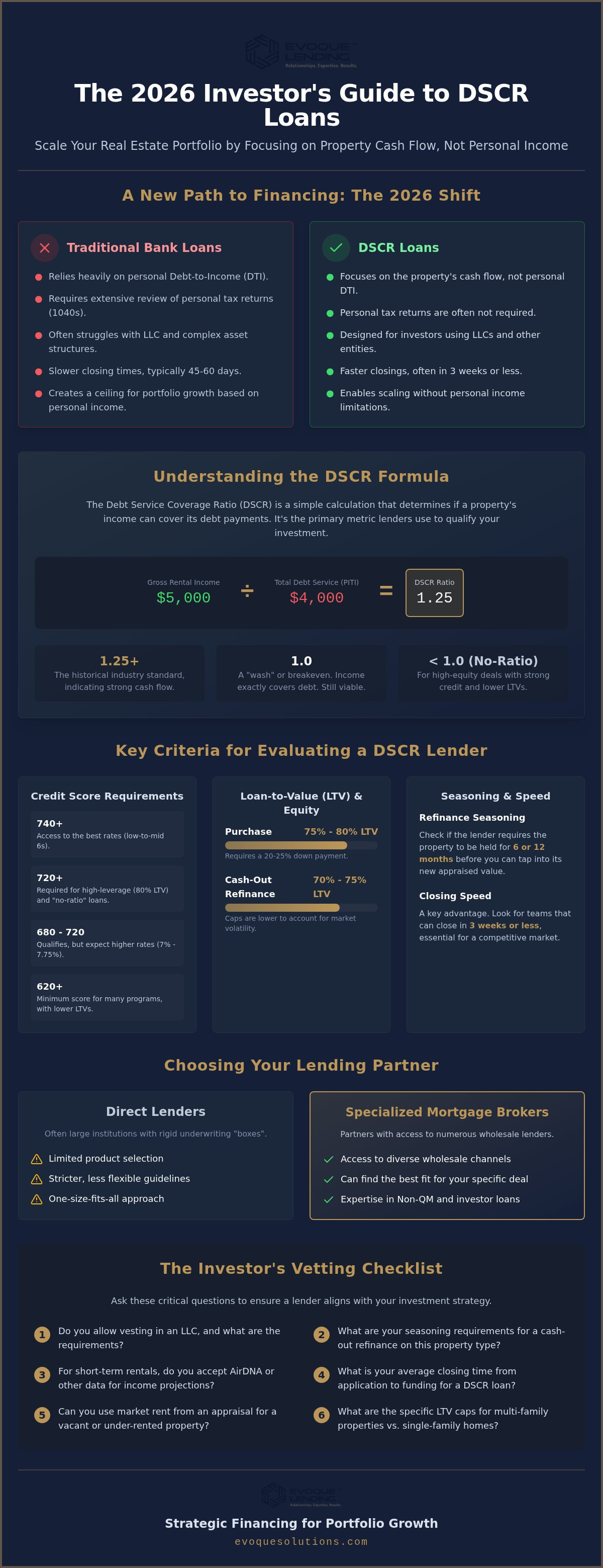
The Investor’s Vetting Checklist: Questions for Your Lender
Before you commit to a term sheet, you must understand how a dscr lender treats the specific nuances of your investment model. Surface-level quotes often hide restrictive clauses that only appear during the underwriting phase. To avoid late-stage denials, you need to ask targeted questions that reveal the lender's true flexibility. This proactive approach ensures your chosen partner can actually execute on the deal they've promised.
Confirm their treatment of vacant properties early in the process. If a unit is currently un-rented, ask if they will accept an appraiser’s market rent estimate or AirDNA projections for short-term rentals. This is vital for securing financing on a property that isn't yet producing income. Additionally, the method used to qualify your debt service coverage ratio mortgage can make or break a deal. You need to know if they use gross rental income or a "net" figure that subtracts taxes, insurance, and a vacancy factor. A gross calculation provides more breathing room, especially when interest rates are higher.
LLC and Entity Vesting Questions
Many investors vest in an LLC to protect personal assets, but not every lender handles these entities the same way. Ask if the lender requires a personal guarantee for the LLC. Some institutional programs allow for non-recourse options, though these typically come with lower LTV caps. You should also confirm if they have a limit on the number of members in the entity; some lenders struggle with operating agreements that involve more than four members or complex trust structures. Understanding these legal requirements upfront prevents delays in the closing process.
Portfolio and Scaling Capacity
Scaling requires a partner that doesn't penalize success. Ask about financed property caps. While many traditional banks stop at ten properties, a specialized dscr lender often has no limit on the size of your portfolio. Inquire about portfolio loans for consolidating multiple assets into a single monthly payment, which can simplify your management. For investors using a renovation strategy, ask how they handle "un-seasoned" properties. If you've significantly increased a property's value through improvements, you want a lender who will allow a refinance based on a new appraisal after ninety days rather than making you wait a full year. If you're ready to see how these criteria apply to your current portfolio, start your online questionnaire today to connect with a specialist.
Scaling Your Portfolio with Evoque Lending’s DSCR Solutions
Since 2005, Evoque Lending has operated as a specialized partner for investors who outgrow the rigid constraints of traditional banking. Our 20-year history in the Non-QM space allows us to act as a bridge between your unique financial scenario and the broader wholesale market. As a dscr lender with a national reach, we provide access to programs in over 40 states. This scale means we don't just offer a loan; we find the specific "match" that aligns your asset's performance with the optimal capital source.
Finding the right dscr lender shouldn't feel like a shot in the dark. We use our deep industry relationships to match your specific asset with a program that rewards its performance. Our process is designed to respect your time. It begins with a streamlined online questionnaire that captures the essential details of your property and goals. From there, you're paired with a dedicated loan specialist who understands the nuances of cash-flow lending. This isn't a call center experience. It's a professional partnership focused on tangible outcomes.
Custom Solutions for Modern Investors
We recognize that the 2026 investor operates across diverse niches. For Airbnb and VRBO hosts, our short-term rental (STR) expertise ensures that projected revenue is accurately weighed during qualification. Global investors also find a home here; our foreign national programs provide a clear pathway for those entering the US market without a domestic credit history. Additionally, high-net-worth individuals can leverage asset-depletion or bank statement options to qualify when traditional W2 documentation isn't an option. This flexibility is essential for maintaining momentum in a competitive market.
Your Next Step in Portfolio Growth
You don't need to risk your credit score just to explore your options. We provide preliminary rate quotes without a hard credit pull, allowing you to run your numbers with confidence. Once we identify the right program, our team guides you through a methodical underwriting and appraisal process. We handle the heavy lifting of coordinating with wholesale partners so you can focus on finding your next acquisition. The goal is to move you from application to funding with transparency and ease. If you're ready to bypass the limitations of personal income caps, start your DSCR loan application with Evoque Lending today.
Secure Your Portfolio's Future in 2026
The 2026 real estate market doesn't wait for traditional banks to update their underwriting manuals. Success this year requires a pivot from personal income restrictions to the performance of the asset itself. By focusing on property cash flow and utilizing specialized vetting strategies, you can bypass the personal debt walls that stall most portfolios. Whether you're navigating complex LLC structures or scaling a short-term rental business, your choice of dscr lender remains the most critical factor in your growth trajectory.
Evoque Lending has been a seasoned guide for real estate investors since 2005. We bring specialized Non-QM and DSCR underwriting expertise along with nationwide lending coverage in over 40 states to every deal. We don't just process applications; we match your specific investment goals with the optimal wholesale programs available. It's time to stop letting tax returns dictate your potential and start leveraging the true value of your real estate assets.
Get Started with a Custom DSCR Loan Quote from Evoque Lending and take the next step in your investment journey. Your portfolio is ready for its next phase of growth.
Frequently Asked Questions
How much down payment do I need for a DSCR loan in 2026?
Most DSCR programs in 2026 require a down payment between 20% and 25%. While some high-leverage options allow for an 80% Loan-to-Value (LTV) ratio, these typically require a strong credit profile and a Debt Service Coverage Ratio of 1.25 or higher. Investors with lower credit scores or those purchasing multi-family units should prepare for a 25% to 30% down payment to secure the most competitive terms available in the current market.
Can I get a DSCR loan under my LLC?
Yes, financing under an LLC is one of the primary advantages of working with a dscr lender. Most specialized programs actually encourage vesting in a business entity to protect personal assets and simplify portfolio management. Evoque Lending has extensive experience coordinating with multi-member LLCs and complex operating agreements. This structure allows you to scale your real estate holdings without the title appearing on your personal credit report or impacting your future borrowing capacity.
What is the minimum credit score for a DSCR lender?
A dscr lender typically looks for a minimum credit score between 620 and 660 to qualify for basic programs. However, your score significantly influences your interest rate and required down payment. Borrowers with scores above 720 often access the lowest rates, which currently start in the low-to-mid 6s for well-qualified profiles. If your score is on the lower end of the spectrum, expect to provide a larger equity stake to offset the lender's perceived risk.
Do DSCR lenders require personal income or tax returns?
No, these specialized programs don't require personal tax returns, W2s, or pay stubs for qualification. The underwriting process focuses entirely on the property’s ability to generate sufficient rental income to cover the debt service. This approach is ideal for self-employed entrepreneurs or investors with complex tax deductions that might show a lower net income on paper. Your eligibility depends on the asset's performance and your credit history rather than your personal income.
How does a DSCR lender calculate the rental income for a vacant property?
When a property is vacant, a lender uses the "market rent" determined by a professional appraiser. This is usually documented on Fannie Mae Form 1007 for long-term rentals. For short-term rental properties, many specialized programs now accept AirDNA projections or historical data from similar units in the area. This allows you to secure financing for a "turnkey" property or a value-add project before a tenant is officially in place and paying rent.
Are DSCR loan rates higher than conventional investment property rates?
Yes, DSCR loan rates are generally 0.5% to 1.5% higher than conventional 30-year fixed mortgages for investment properties. This premium covers the increased flexibility and the lack of personal income verification. In the 2026 landscape, most investors find that the slightly higher interest rate is a fair trade-off for the ability to close quickly, bypass debt-to-income caps, and scale their portfolios much faster than traditional banking channels would ever allow.
What is the typical seasoning period for a DSCR cash-out refinance?
The typical seasoning period for a cash-out refinance is between 6 and 12 months. This is the time you must own the property before a lender allows you to borrow against a new, higher appraised value. However, some flexible programs allow for a shorter 90-day seasoning period if you can document significant capital improvements. This is a vital tool for investors using the "Buy, Rehab, Rent, Refinance, Repeat" (BRRRR) strategy to grow wealth.
Can foreign nationals qualify for a DSCR loan through Evoque Lending?
Yes, foreign nationals can qualify for specialized loan programs through Evoque Lending. These products are specifically designed for global investors who may not have a U.S. credit score or domestic income documentation. We help non-resident borrowers leverage the rental income of their U.S.-based assets to secure purchase or refinance capital. Our team coordinates the unique documentation requirements, such as international passport verification and foreign bank statements, to ensure a smooth closing process across 40+ states.
Reviewed by Eddie Luhrassebi, Founder & CEO, NMLS #337071 | CA DRE #01230650
Last updated: September 15, 2026 · About the reviewer