2026 Non-W2 Mortgage Guide for Self-Employed Borrowers
Written by Eddie Luhrassebi · Published September 14, 2026
Struggling with income verification for self employed borrowers? Our 2026 guide shows how to use bank statements, not tax returns, to get your mortgage appro...
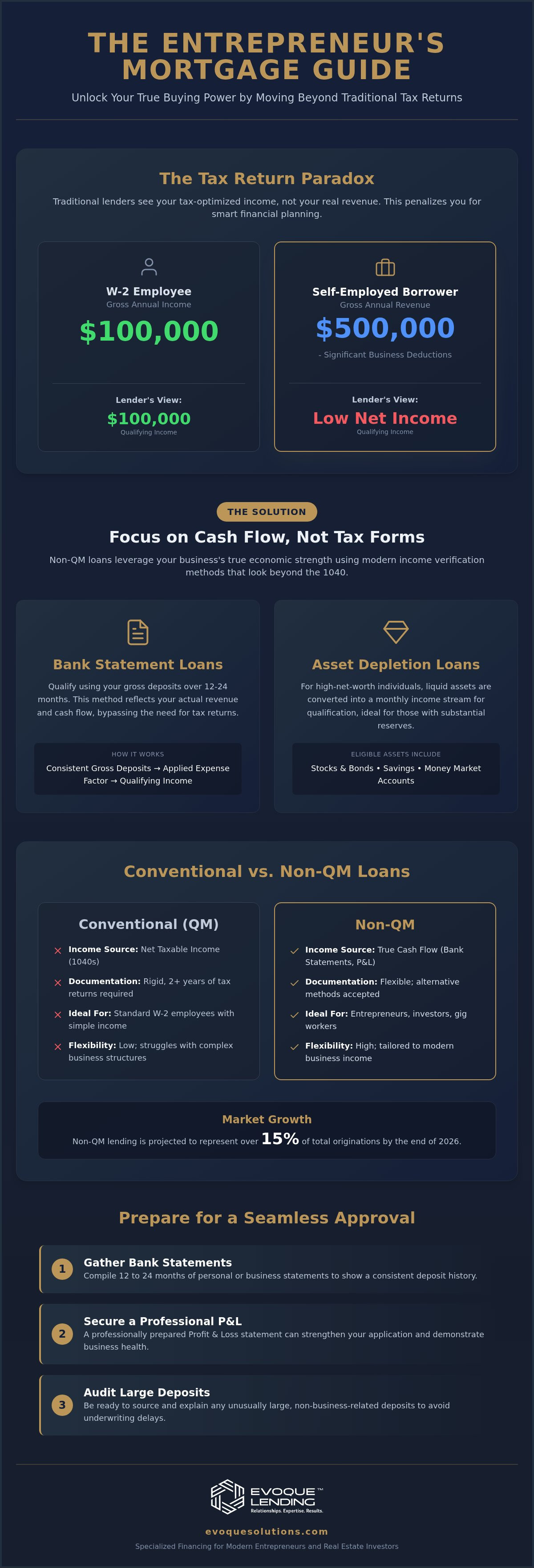
Why does a business generating $500,000 in annual revenue often face rejection for a $434,100 home loan? It's the classic entrepreneur's trap. You've worked hard to maximize legal deductions and lower your tax burden, but traditional lenders only see the low net income on your 1040s. The standard process of income verification for self employed borrowers hasn't kept pace with the way modern businesses operate. You're left feeling penalized for your own financial efficiency while big banks get bogged down in a paperwork nightmare that ignores your actual buying power.
We understand that your tax returns rarely tell the whole story of your creditworthiness or your ability to repay. This 2026 guide shows you exactly how to qualify for a mortgage using alternative methods that prioritize your actual cash flow over net taxable income. You'll discover how bank statement loans and asset depletion programs allow you to secure a home or scale your portfolio without the need for traditional tax documentation. We'll walk through the strategies savvy borrowers are using to bypass rigid debt to income math and find lending partners who finally speak the language of business.
The Self-Employed Mortgage Gap: Why Traditional Verification Fails
The "Tax Return Paradox" is a frustrating reality for many business owners. You spend years building a profitable enterprise and working with accountants to minimize your tax liability through legal deductions. While this strategy is excellent for wealth preservation, it creates a significant hurdle when you apply for a traditional mortgage. The standard process of income verification for self employed borrowers used by big banks typically focuses on your bottom line after all those deductions. This means your "qualifying income" might appear insufficient for the home you can actually afford.
Standard Verification of employment for a W-2 employee is based on gross earnings. If they make $100,000, the lender uses $100,000. If you gross $250,000 but write off $180,000 in business expenses, the bank sees a $70,000 earner. This discrepancy is why traditional Debt-to-Income (DTI) math often fails entrepreneurs. In the 2026 financial environment, where interest rates for a 30-year fixed mortgage hover between 6.76% and 6.968%, these rigid institutional calculations make it even harder to qualify for a median-priced home of $434,100.
Institutional Bias Against Non-Traditional Income
Institutional lenders are bound by Qualified Mortgage (QM) guidelines. These rules are designed for stability but lack the flexibility to account for complex business structures. A rejection from a big bank doesn't mean you can't afford the home. It simply means your financial profile doesn't fit into their pre-defined box. They prioritize taxable income over your actual repayment ability, often ignoring the liquidity and cash flow that truly drive your business operations.
The Rise of the Non-QM Market in 2026
The lending landscape is shifting to accommodate modern entrepreneurs. Non-QM lending is projected to represent over 15% of total originations by the end of 2026. This growth is driven by the need for more nuanced income verification for self employed borrowers. Alternative lenders now use advanced risk assessment tools to look beyond the 1040. They evaluate performance through bank deposits and profit-and-loss statements. This evolution supports the modern economy, where creators, consultants, and gig workers often have inconsistent monthly flows despite reaching high annual revenue targets.
Modern Methods of Income Verification for Self-Employed Borrowers
Traditional lending often hits a wall when it encounters high-revenue businesses with substantial legal deductions. While Fannie Mae self-employed borrower documentation guidelines typically require two years of tax returns, modern non-QM programs offer a more flexible path. These methods focus on actual cash flow rather than net taxable income. This shift in income verification for self employed borrowers allows you to leverage your business's true economic strength. By moving away from the 1040, you can secure financing that aligns with how you actually manage your capital.
Bank Statement Mortgages: Personal vs. Business
Lenders analyze your deposit history over the last 12 to 24 months to establish a reliable average of your monthly revenue. Consistency is the priority. Lenders apply an "expense factor" to your gross deposits to estimate your net earnings; however, service-based businesses with low overhead may qualify for a lower factor. Using personal bank statements can sometimes lead to a higher qualification because they represent the funds already distributed to you, whereas business statements require a more complex analysis of operational costs. If you are unsure which program fits your business structure, exploring a specialized loan matching questionnaire can provide immediate clarity.
Asset-Based Qualification for High Net Worth Individuals
For those with significant liquid reserves, asset depletion is a powerful tool. This method converts your total eligible assets into a monthly income stream for qualification purposes. Lenders use a specific formula to "deplete" these assets over a set term, usually 360 months. Eligible assets include:
- Publicly traded stocks and bonds
- Liquid savings and money market accounts
- Vested portions of 401(k) or IRA accounts
- Certificates of Deposit (CDs)
This approach is ideal for retirees or business owners who maintain high cash reserves but show minimal taxable income on paper. It treats your wealth as a functional source of repayment.
Beyond these methods, 1099-only programs are perfect for independent contractors who receive consistent payments from a few primary clients. If you are an investor, Debt Service Coverage Ratio (DSCR) loans bypass personal income verification for self employed borrowers entirely. Instead, the lender focuses on whether the rental income of the property covers the mortgage payment. This allows you to scale a real estate portfolio without your personal debt to income ratio acting as a bottleneck.
Non-QM vs. Conventional: Comparing Documentation Requirements
Choosing between a conventional mortgage and a Non-QM loan is a strategic decision for any business owner. Conventional lenders follow strict federal guidelines that prioritize two years of personal and business tax returns. For many entrepreneurs, this creates a bottleneck. If your tax returns show significant write-offs, your qualifying income might fall below the threshold for a $434,100 median-priced home. Non-QM programs offer a different path by streamlining income verification for self employed borrowers, focusing on current cash flow rather than historical tax filings.
Documentation needs vary significantly between these two paths. A conventional checklist usually includes two years of 1040s, Schedule Cs, and business returns like 1120-S or 1065 forms. You'll also need to sign a 4506-C form, allowing the lender to pull tax transcripts directly from the IRS. Non-QM lending replaces this mountain of paperwork with 12 to 24 months of bank statements or 1099 forms. While you'll still need to provide a business license or a CPA letter, the focus remains on your ability to generate revenue today.
The 'Stated Income' Myth vs. 2026 Reality
Modern lending has evolved far beyond the "no-doc" era of the past. Every loan issued in 2026 must comply with the Ability to Repay (ATR) rule. This means your income is still verified; the source just changes from the IRS to your bank. We don't rely on guesses or "stated" figures. Instead, we use real-time data from your deposits to prove you can handle the monthly payment. This transparent process protects both the borrower and the lender while providing a path forward for those who don't fit the W-2 mold.
Evaluating the Cost of Flexibility
There is a price for this flexibility. Non-QM interest rates typically carry a premium over conventional 30-year fixed rates, which currently average between 6.76% and 6.968%. However, for business owners, this spread is often a necessary investment. Using bank statement loans for self employed allows you to secure a property now rather than waiting years to adjust your tax strategy. For those looking to grow, non-qm loans for real estate investors eliminate the personal income bottleneck. This allows you to scale your portfolio based on property performance. Speed is also a major factor. Specialized lenders often close in 21 days or less, while big banks may take 45 to 60 days to process complex self-employed files.
How to Prepare Your Financial Records for a Seamless Approval
Success in the Non-QM space requires a proactive approach to your documentation. While you aren't providing tax returns, the scrutiny of your bank statements is intense. Start by auditing your statements for any large, unexplained deposits. Underwriters look for "seasoned" funds and consistent revenue that matches your business profile. If you frequently transfer money between business entities, document these movements clearly to avoid them being flagged as new, unverified debt. This level of preparation ensures that the process of income verification for self employed borrowers remains transparent and efficient.
A professional Profit & Loss (P&L) statement is your next priority. This document serves as a primary tool for verification when bank statements alone don't tell the full story. It provides a snapshot of your business's current health, often covering the year to date period. If you own multiple business entities, consolidating their financial pictures into a single, clear narrative helps the lender understand your total global cash flow. Clear records help avoid the "paperwork nightmare" typical of big banks.
The Role of the CPA and P&L Statements
An unaudited P&L statement often acts as the bridge to a bank statement approval. It allows the lender to verify that your business is currently operational and profitable without waiting for the next tax season. Your CPA plays a vital role here by drafting a letter that confirms your ownership percentage and the length of time your business has existed. This letter shouldn't just state you're self-employed; it should attest to the stability of your enterprise. For those focusing on investment properties, ensuring your debt service coverage ratio mortgage calculations are investor-ready is essential for a smooth underwriting process.
Common Red Flags in Alternative Underwriting
Underwriters are trained to spot inconsistencies that suggest financial instability. Non-sufficient funds (NSF) or frequent overdrafts are major red flags that suggest cash flow mismanagement. If your business has experienced a declining revenue trend over the last 12 months, prepare a written explanation. It's also critical to maintain a clear boundary between personal and business expenses. Mixing these can complicate the calculation of your "expense factor," potentially lowering your qualifying income. Clean records are the fastest path to a clear to close.
To see how your current financials align with today's lending standards, you can complete our rapid loan matching questionnaire for an expert assessment of your options.
Evoque Lending: Your Partner in Specialized Self-Employed Financing
Evoque Lending believes that your ability to build a business should be an asset, not a liability. Traditional retail banks often struggle with the nuances of entrepreneurial income, but we've specialized in these "out-of-the-box" scenarios since 2005. Our national reach spans over 40 states, allowing us to provide specialized Non-QM solutions to a diverse range of borrowers. Whether you're a consultant or a tech founder, we focus on your actual buying power. The traditional process of income verification for self employed borrowers is often broken; we're here to fix it by matching you with a loan product that fits your specific business structure.
One-size-fits-all lending doesn't work for entrepreneurs. We move logically from identifying your unique needs to explaining the mechanism of our solutions, ensuring you feel supported at every step. Our process begins with a streamlined online questionnaire designed for rapid loan matching. This moves you away from the coldness of traditional banking and toward a dedicated specialist who understands complex income. This tailored strategy helps you grow real estate portfolio without tax returns by focusing on property performance and business cash flow.
A Solution-Oriented Approach to Complex Borrowing
We don't just look at a bottom-line number on a tax return. Our team evaluates the full scope of your financial health, including gross bank deposits, 1099 income, and liquid equity. This holistic view allows us to serve as an advocate for those who don't fit into standard institutional boxes. We prioritize transparency and ease, offering you the ability to receive a preliminary quote without a hard credit pull. This protects your score while you explore alternative qualification methods that align with your modern business operations.
The Path Forward: Securing Your 2026 Mortgage
A rejection from a "Big Box" lender is rarely the end of the road. It's often just a sign that you're talking to the wrong partner. As you prepare for your 2026 home purchase or refinance, remember that documentation is about performance, not just paperwork. Maintain clean bank statements and separate your personal and business expenses to ensure a smooth journey. Our dedicated specialists handle the heavy lifting of income verification for self employed borrowers with professional precision. We value professional relationships over quick transactions. If you're ready to move past the frustration of traditional banking, speak with a specialized loan officer today to see how we can turn your business success into homeownership.
Securing Your Financial Future Beyond the Tax Return
Homeownership for entrepreneurs shouldn't be limited by the rigid math of a 1040 form. You've seen how modern income verification for self employed borrowers has evolved to prioritize cash flow, bank deposits, and liquid assets over taxable net income. By auditing your statements and partnering with a lender that understands the complexity of business ownership, you can bypass the institutional bias of big banks. Whether you're looking to buy a primary residence or scale a portfolio, the path forward is built on your actual performance rather than just a bottom line.
Since 2005, Evoque Lending has acted as a specialized guide for borrowers who don't fit into standard boxes. With national coverage in 40+ states, we specialize in Bank-Statement Loans and DSCR lending that values your true economic strength. It's time to stop letting legal tax deductions stand in the way of your next property investment. See which alternative loan program you qualify for today and take the next step with a team that values your resourcefulness. Your business is growing; your real estate goals should grow with it.
Frequently Asked Questions
Can I get a mortgage if my tax returns show a loss due to depreciation?
Yes, you can qualify even if your tax returns show a net loss. Traditional lenders focus on the bottom line of your 1040, but bank statement loans bypass tax returns entirely. We prioritize your actual cash flow by reviewing your gross business deposits. This method of income verification for self employed borrowers recognizes that paper losses from depreciation don't reflect your true ability to repay a mortgage. It's a common solution for high-revenue business owners with significant write-offs.
How many months of bank statements do I need for a self-employed loan?
Most programs require either 12 or 24 months of consecutive bank statements to establish a stable income average. If your business has seasonal fluctuations, a 24-month look-back period often provides a more balanced view of your earning power. Some specialized investor programs may allow for shorter windows if other compensating factors exist. Providing clean, complete statements for the full required period is the most reliable way to ensure a seamless underwriting process and a clear approval.
What is the minimum credit score for a bank statement loan in 2026?
In the 2026 market, most bank statement programs require a minimum credit score between 620 and 660. While conventional loans often offer better terms for those with scores above 740, Non-QM lenders provide more flexibility for borrowers with diverse credit profiles. Your score impacts your required down payment and interest rate. Higher scores generally allow for a lower equity stake, while lower scores may require a larger down payment to offset the lender's risk.
Are interest rates higher for income verification loans for the self-employed?
Yes, interest rates for alternative documentation loans are typically higher than conventional 30-year fixed rates, which currently range from 6.76% to 6.968%. This "Non-QM premium" reflects the additional risk and manual underwriting required for these files. However, for many entrepreneurs, the ability to secure a home without adjusting tax strategies provides a significant return on investment. The cost of a slightly higher rate is often lower than the tax burden of showing higher net income.
Can I use 1099 income to qualify for a mortgage without a co-signer?
You can qualify using 1099 income without a co-signer through specialized 1099 borrower loans. These programs verify your earnings by reviewing your most recent 1099 forms and year-to-date earnings rather than traditional paystubs. This is an ideal solution for independent contractors who have consistent contracts. To qualify, you typically need:
- Two years of 1099 history
- A current business license
- Proof of stable industry experience
This ensures your individual earnings meet modern mortgage requirements.
What is an expense factor, and how does it affect my qualifying income?
An expense factor is a percentage lenders subtract from your gross bank deposits to estimate your net business income. For example, if your business has $200,000 in deposits and the lender applies a 50% expense factor, your qualifying income is $100,000. This is a critical part of income verification for self employed borrowers because it accounts for operational costs. Service-based businesses with low overhead can often negotiate a lower expense factor by providing a CPA letter.
Do I need to be self-employed for a full two years to qualify?
While many programs prefer a two-year history of self-employment, some lenders allow for as little as 12 months. This usually requires proof that you were in a similar line of work as a W-2 employee prior to starting your business. Lenders look for "industry depth" to ensure your income stream is sustainable. If you've recently transitioned to being a business owner, providing a clear narrative of your professional background can help bridge the gap for approval.
Can I get a cash-out refinance using bank statement verification?
Yes, a DSCR Cash-Out Refinance or a bank statement cash-out loan is a common way to access equity. These programs allow you to pull liquidity from your property based on its current value and your verified cash flow. This is a powerful tool for entrepreneurs who want to reinvest in their business or consolidate high-interest debt without providing tax returns. The process follows the same alternative verification steps as a purchase loan, focusing on your recent deposit history.
Reviewed by Eddie Luhrassebi, Founder & CEO, NMLS #337071 | CA DRE #01230650
Last updated: September 14, 2026 · About the reviewer