
Debt Service Coverage Ratio Mortgage: A 2026 Investor’s How-To Guide
Written by Eddie Luhrassebi · Published September 11, 2026
Learn how a debt service coverage ratio mortgage uses property cash flow, not W-2s, to help you qualify. Our 2026 guide shows you how to scale your portfolio.
Your tax professional worked hard to maximize your write-offs, but your traditional lender just used those same deductions to deny your next investment property. It's a frustrating paradox where the more successful you become at reducing your tax liability, the harder it is to secure conventional financing. You've likely felt the sting of being told your personal income looks too low on paper, or perhaps you've hit the dreaded ten-loan limit that stops most portfolios in their tracks. We understand that modern investors need a more sophisticated tool than a standard W-2 loan. That is where a debt service coverage ratio mortgage becomes your most valuable asset.
You shouldn't be penalized for being a savvy business owner. This guide will show you exactly how to break free from the constraints of personal income verification by focusing on what actually matters: the cash flow of the property itself. We'll walk you through the precise 2026 formulas for calculating your ratio, share strategies to optimize your property's performance for better rates, and provide a clear roadmap to qualify. By the end of this article, you'll have a proven strategy to scale your rental portfolio with the confidence of a seasoned guide who knows the path to success.
What is a Debt Service Coverage Ratio Mortgage?
Traditional lenders often view a real estate investor through the lens of a standard employee. They ask for W-2s, pay stubs, and years of personal tax returns. For the modern investor, this approach is outdated and often restrictive. A debt service coverage ratio mortgage flips the script. Instead of scrutinizing your personal salary, this specialized financial tool evaluates the income-generating potential of the property you intend to buy or refinance.
The fundamental metric used is the Debt Service Coverage Ratio (DSCR). This figure represents the relationship between a property's annual net operating income and its annual mortgage debt. If the property's rental income covers the mortgage payment, the asset qualifies on its own merit. This shift in focus allows you to bypass the personal income hurdles that often stall growth.
How DSCR Loans Differ from Conventional Mortgages
Conventional mortgages rely heavily on your Debt-to-Income (DTI) ratio. This measures how much of your personal monthly income goes toward paying debts. In contrast, a DSCR loan focuses entirely on the property’s ability to pay for itself. This distinction is critical for self-employed individuals who use legal tax deductions to lower their taxable income. While those deductions are great for your bottom line, they often make you look unqualified to a traditional bank.
DSCR lending provides several unique advantages for the serious investor:
- Asset-Based Underwriting: The property’s cash flow is the primary qualification factor.
- LLC Protection: You can often close the loan in the name of an entity, which keeps the debt off your personal credit report.
- No Employment Verification: Lenders don't need to call your boss or verify your W-2 history.
The Role of DSCR in a 2026 Investment Strategy
In 2026, savvy investors are using these loans to escape the tax return trap. When you maximize write-offs, your paper income drops. Traditional lenders see this as a risk. We see it as smart business. By using a debt service coverage ratio mortgage, you can continue to acquire properties regardless of what your last tax return says.
This strategy is essential for anyone interested in scaling your real estate portfolio without tax returns. It streamlines the underwriting process, allowing you to move from one closing to the next without the months of paperwork required by institutional banks. It's about portfolio velocity and recognizing that your property's performance is the true measure of your investment's strength.
How to Calculate DSCR: A Step-by-Step Guide for Investors
Securing a debt service coverage ratio mortgage depends on a single, vital calculation. While the math itself is straightforward, the accuracy of your inputs determines whether your application moves forward or hits a dead end. We believe in transparency, so we've broken the process down into three manageable phases.
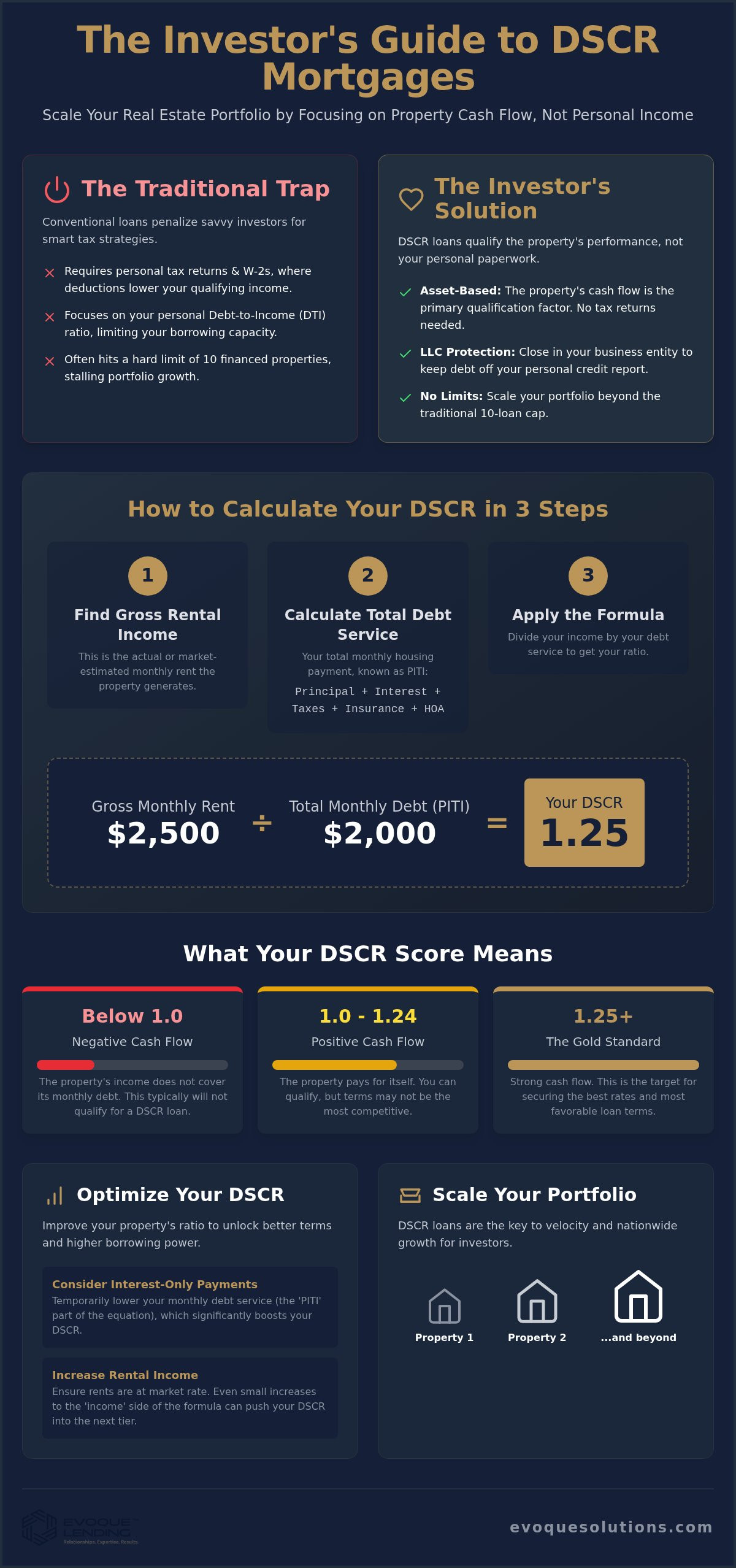
- Step 1: Determine Gross Monthly Rental Income. For properties with existing tenants, this is the actual rent collected. If the property is vacant or you're looking at a purchase, lenders use the "market rent" estimated by an appraiser.
- Step 2: Calculate Total Monthly Debt Service. This is your PITI payment. Total Debt Service is the sum of principal, interest, taxes, insurance, and HOA fees.
- Step 3: Apply the DSCR Formula. Divide your Gross Monthly Rent by your Total Monthly Debt Service.
Consider this example. If your property generates $2,500 in monthly rent and your total PITI payment is $2,000, your calculation is $2,500 divided by $2,000. This results in a DSCR of 1.25. If you are unsure how these variables affect your specific deal, we can help you analyze your property's cash flow to find the best path forward.
The 2026 PITI Breakdown: Taxes and Insurance
The 2026 market presents unique challenges for the "TI" portion of your PITI. Property insurance premiums have seen significant shifts recently, with many regions experiencing higher costs due to updated climate risk assessments. Similarly, property tax assessments in 2026 often reflect the valuation peaks of the last few years. When we calculate your ratio, we use these current figures to ensure your loan is sustainable. Getting these numbers right early prevents surprises during the underwriting process.
Gross Rent vs. Net Operating Income (NOI)
If you've dealt with commercial real estate, you might be used to using Net Operating Income (NOI), which subtracts all operating expenses from the gross income. However, for a residential debt service coverage ratio mortgage, most lenders simplify the process. They typically use Gross Rent. This is a major advantage for investors because it doesn't penalize you for your specific management costs or maintenance schedules. If a property is vacant during the application, we rely on the Form 1007 rent schedule from your appraisal to establish the market-based income potential.
Evaluating DSCR Loan Requirements and Lender Benchmarks
Understanding the math is only half the battle. You also need to know the benchmarks lenders use to grade your deal. In the 2026 lending environment, a debt service coverage ratio mortgage is typically categorized into tiers based on the strength of the property's cash flow. The "magic number" for most prime lenders is 1.25. When your property hits this threshold, it demonstrates that the rental income exceeds the debt service by 25%, providing a comfortable cushion for vacancy and maintenance. This level of performance usually unlocks the most competitive LTV limits and pricing.
While a 1.25 ratio is ideal, it's not the absolute floor. Many programs offer qualification at a 1.0 ratio, which is considered a "break-even" point. At this level, the gross rent exactly matches the PITI payment. However, these loans often require a higher credit score or a larger down payment to offset the perceived risk. In 2026, the best terms are reserved for borrowers with a FICO score of 740 or higher, though options exist down to a 620 minimum. Most purchase loans are capped at an 80% LTV, while cash-out refinances generally reach 70% to 75% depending on the asset's performance and your credit profile.
The 'No Ratio' Loan Exception
Sometimes, a property doesn't cash flow on day one, particularly with value-add or BRRRR strategies. In these cases, a "No Ratio" loan allows you to qualify even if the DSCR is below 1.0. Lenders look for compensating factors to bridge the gap. You'll likely need a higher down payment, significant liquid reserves (typically 3 to 6 months of PITI), or an exceptionally strong credit history. This flexibility is perfect for investors who plan to renovate a property and increase rents quickly, as it prioritizes the long-term potential over the immediate snapshot.
Entity and Property Type Requirements
Closing a loan in the name of an LLC is standard practice for professional investors. It provides a layer of liability protection and keeps the debt off your personal credit report, which is vital for scaling. Requirements can shift depending on the asset type. Financing for Multi-Family Investment Properties often involves more complex appraisal processes than single-family homes. For short-term rentals like Airbnb or VRBO, lenders have become increasingly sophisticated. They now often accept projected income data from sources like AirDNA to verify the property's earning potential, acknowledging the higher revenue these units can generate compared to long-term leases.
Strategies to Optimize Your Property's DSCR
A borderline ratio doesn't mean your deal is dead. Optimization is about fine-tuning the variables that lenders use to judge your asset. When you're seeking a debt service coverage ratio mortgage, even small adjustments to your income or expenses can move you from a standard tier to prime terms. We view this process as a tactical exercise in maximizing your property's potential.
Start with your gross income. If your current leases are below market, an appraisal with a Form 1007 rent schedule can often use projected market rents instead of actual collections. You can also look for ancillary revenue. Charging for storage units, premium parking, or on-site laundry can boost your gross monthly income enough to push a struggling ratio into safe territory. These additions are often overlooked but can be the difference between a rejection and an approval.
Leveraging Interest-Only Periods
One of the most effective ways to improve your DSCR is to lower the denominator. Choosing an interest-only payment structure reduces the Total Debt Service by eliminating the principal component of the monthly payment. While this doesn't build equity as fast as a fully amortizing loan, the short-term cash flow benefits are substantial. By removing the principal portion of the monthly obligation, interest-only options can turn a 1.0 ratio into a 1.2+ ratio instantly. This tactical move is often the key to qualifying for higher leverage without needing to increase the down payment.
Proactive Expense Management
Managing the "T" and "I" in your PITI is equally critical. In 2026, property insurance premiums are a major variable. We recommend shopping for competitive quotes through specialized brokers who understand investment properties. Additionally, don't accept your property tax assessment at face value. Appealing an aggressive assessment can lower your monthly tax escrow, directly improving your debt service coverage. If the property belongs to an HOA, ensure those fees are accurate and that you aren't being overcharged for services the property doesn't use.
If these adjustments still leave you short, increasing your down payment is the final lever. A lower Loan-to-Value (LTV) reduces the principal balance, which in turn lowers your interest and principal payments. This move provides the most stability and is often the quickest path to the best rates. If you're ready to see how these strategies apply to your next acquisition, you can start your DSCR loan application with our team today.
Scaling Your Portfolio with Evoque Lending
Scaling a real estate portfolio requires more than just capital. It requires a partner who understands that your financial profile doesn't always fit into a standard institutional box. Since 2005, Evoque Lending has specialized in alternative income documentation, providing a seasoned guide for investors who prioritize property performance over personal tax returns. Our national reach allows us to facilitate financing in over 40 states, giving you the flexibility to grow your footprint across the country with a single, reliable point of contact.
We don't believe in one-size-fits-all solutions. Instead, we offer personalized loan matching tailored to your specific investment scenario. Whether you're a self-employed entrepreneur or a seasoned 1099 professional, we use our deep expertise in Non-QM lending to find the right debt service coverage ratio mortgage for your needs. Our process starts with a streamlined online questionnaire, designed to respect your time and provide clarity on your options quickly.
From Purchase to Cash-Out Refinance
The beauty of the DSCR model lies in its versatility throughout the investment lifecycle. You can use these loans for initial acquisitions, moving from contract to closing with minimal red tape compared to conventional financing. Once you've added value and increased the property's equity, a DSCR cash-out refinance allows you to pull capital out to fund your next acquisition. It's a repeatable strategy that fuels portfolio velocity. For a deeper look at how this fits into your long-term plan, we recommend reviewing the DSCR loan pros and cons to ensure this path aligns with your financial goals.
The Evoque Advantage for Self-Employed Borrowers
Traditional banks often struggle with complex income structures. Our dedicated loan specialists actually understand the nuances of your business and the practical realities of how modern investors operate. As a specialized brokerage, we have access to multiple niche lenders, which means we can shop for the specific program that fits your property's unique cash flow profile. We act as your advocate, navigating the complexities of the 2026 market to ensure your portfolio never stops growing. If you're ready to move past the limitations of personal income verification, start your 2026 DSCR application today and let us help you unlock your property's full potential.
Mastering Your Investment Future with DSCR Financing
The path to a multi-property portfolio doesn't have to be blocked by personal tax returns or rigid institutional rules. By focusing on the income potential of your assets and mastering the math behind a debt service coverage ratio mortgage, you gain a significant competitive edge in the 2026 market. You now have the roadmap to calculate your ratio, identify lender benchmarks, and implement tactical optimizations to secure prime terms.
Since 2005, Evoque Lending has served as a seasoned guide for investors who don't fit the standard banking box. We understand that your success is measured by your property's performance, not just your taxable income. With our expertise in Non-QM lending and a reach extending to more than 40 states, we provide the flexibility you need to scale without the red tape of traditional verification. Ready to scale? Get a personalized DSCR loan quote from Evoque Lending today. Your next acquisition is closer than you think when you have the right financial tools and a partner committed to your long-term growth.
Frequently Asked Questions
What is a good debt service coverage ratio for a mortgage?
A ratio of 1.25 is generally considered the gold standard for prime terms. This means the property's gross rental income is 25% higher than the monthly debt obligation. While some lenders accept a 1.0 ratio, aiming for 1.25 or higher often unlocks lower interest rates and higher loan-to-value options. This cushion protects you against unexpected vacancies or maintenance costs while signaling to the lender that the asset is highly stable.
Can I get a DSCR loan with a 620 credit score?
Yes, 620 is typically the absolute minimum FICO score required for this type of financing. Qualifying at this level usually comes with trade-offs, such as a higher interest rate or a requirement for a larger down payment. Most lenders prefer scores of 680 or higher to offer standard terms. If your score is exactly 620, having significant cash reserves or a high property cash flow ratio can help strengthen your overall application.
Do DSCR loans require personal tax returns?
No, these loans don't require personal tax returns, W-2s, or pay stubs. This is the primary advantage for self-employed investors or those with high tax write-offs. Qualification is based on the property’s ability to generate sufficient rental income to cover the mortgage payments. This asset-based approach streamlines the underwriting process and allows you to scale your portfolio without the constraints of personal debt-to-income calculations that often stall growth.
How much down payment is required for a DSCR mortgage?
The standard down payment for a debt service coverage ratio mortgage is 20% to 25% of the purchase price. This translates to a maximum Loan-to-Value of 75% to 80%. For cash-out refinances, lenders typically cap the LTV at 70% to 75%. While some niche programs might allow for smaller down payments, a 20% equity stake is the common benchmark for most residential investment property scenarios we see in the 2026 market.
What happens if my property's DSCR is below 1.0?
If your property's ratio is below 1.0, it means the rental income doesn't fully cover the mortgage payment. You can still qualify through "No Ratio" loan programs, though these often require higher down payments or exceptionally strong credit scores. Alternatively, you can optimize the ratio by choosing an interest-only payment option or increasing your down payment to lower the monthly debt service. These strategies help bridge the gap for value-add properties or unique acquisitions.
Can I use a DSCR loan for a short-term rental like Airbnb?
Yes, you can use a debt service coverage ratio mortgage for short-term rentals such as Airbnb or VRBO properties. In the 2026 market, many lenders accept projected income data from specialized providers like AirDNA or the property's actual 12-month rental history. Because short-term rentals often generate higher gross revenue than long-term leases, they can be excellent candidates for this financing model, provided you have a solid management plan in place.
Are DSCR loan rates higher than conventional mortgage rates?
Yes, interest rates for these loans are typically 0.5% to 1.5% higher than conventional investment property mortgage rates. This price difference reflects the increased risk associated with not verifying a borrower's personal income and the specialized nature of the loan. Most investors find that the higher rate is a worthwhile trade-off for the ability to close more loans quickly and maintain personal privacy by using an entity like an LLC.
Can I close a DSCR mortgage in the name of my LLC?
Yes, closing in the name of an LLC or other entity is standard practice and often encouraged. This structure provides valuable liability protection for your personal assets and keeps the mortgage debt off your personal credit report. While you'll still need to provide a personal guarantee in most cases, the loan is technically made to the entity. This helps you scale your portfolio more efficiently without impacting your personal borrowing power.
Reviewed by Eddie Luhrassebi, Founder & CEO, NMLS #337071 | CA DRE #01230650
Last updated: September 11, 2026 · About the reviewer