
2026 Multi-Family Investment Property Financing Guide
Written by Eddie Luhrassebi · Published September 10, 2026
Learn how to get financing for multi family investment properties in 2026 using DSCR loans. Bypass DTI limits & use cash flow to scale your portfolio.
What if your ability to scale a real estate portfolio was measured by the strength of your assets rather than the lines on your personal tax returns? You've likely felt the sting of a traditional lender saying "no" because of rigid debt-to-income ratios or a cap on the number of properties you can own. It's a common hurdle for ambitious investors who have the capital and the deals but lack the "standard" W-2 profile banks demand. Conventional underwriting often moves too slowly, causing you to lose out on competitive multi-family acquisitions while they dissect years of personal financial history.
You don't have to let slow bank processes or personal income limits stall your growth. This guide reveals how to secure financing for multi family investment properties by focusing on rental cash flow and alternative documentation. We'll walk through the specific 2026 requirements for DSCR and Non-QM loans, showing you how to value property performance over personal tax returns. You'll learn the exact steps to scale your portfolio to five or more units efficiently, ensuring you have the tools to act fast when the right opportunity appears. By shifting the focus to property-level income, you can build a sustainable investment strategy that isn't capped by your personal debt profile.
Multi-Family vs. Single-Family Financing: The Strategic Shift for 2026
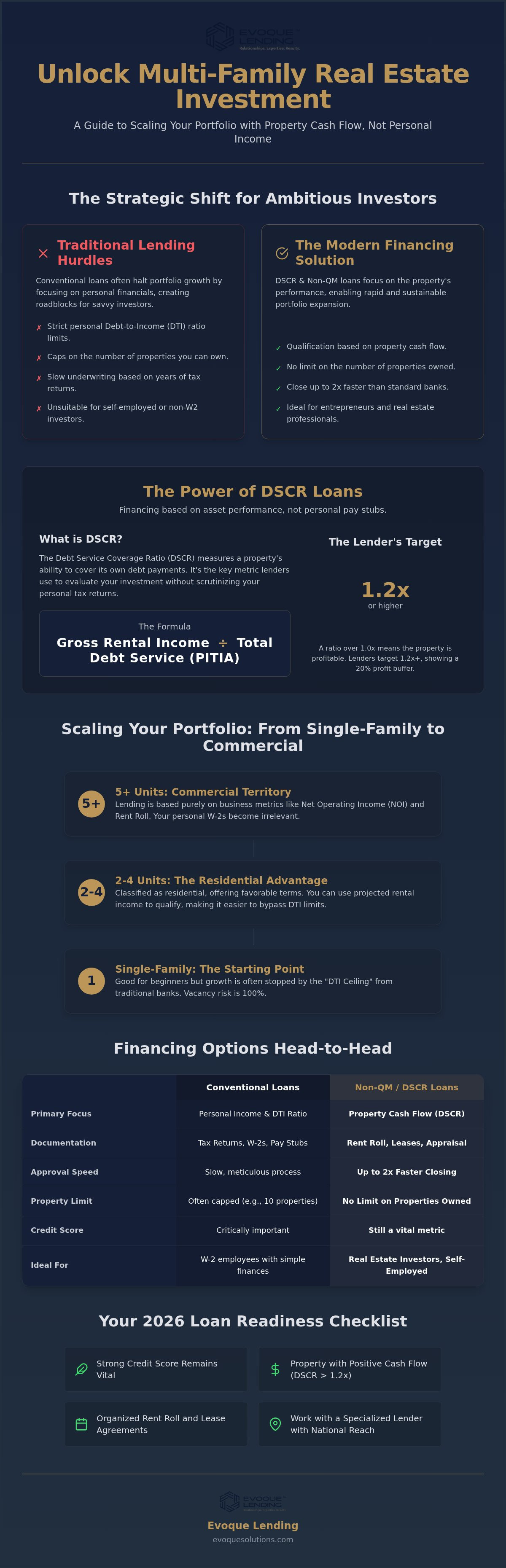
Many investors start their journey with single-family homes only to find their expansion halted by a "DTI Ceiling." Traditional banks eventually stop lending when your personal debt-to-income ratio climbs too high, regardless of how well your properties perform. In 2026, the strategic shift toward multi-family assets is driven by the need for scalability. Financing for multi family investment properties allows you to consolidate units under fewer loans; this reduces the complexity of your portfolio while increasing your overall cash flow potential.
Lenders view multi-family risk through a different lens than single-family homes. If a single-family rental goes vacant, the income drops to zero. In a multi-family property, the risk is distributed across multiple tenants. This inherent stability is why property-focused lenders are often more willing to provide flexible terms. They prioritize the asset's ability to pay for itself, which opens doors for investors who don't fit the rigid boxes of institutional banking.
The 2-4 Unit Residential Advantage
Properties with two to four units occupy a unique space in the lending market. They're technically classified as residential, which often means you can access more favorable terms and lower down payments compared to larger complexes. One of the biggest advantages is the ability to use projected rental income from the units to offset your mortgage payment during the qualification process. This makes it significantly easier to bypass personal income restrictions and secure the funding needed for your next acquisition without needing to show massive personal wealth.
Crossing
into 5+ Unit Commercial Territory
Once you move to five units or more, the property enters the realm of a Commercial mortgage. At this stage, lenders care less about your personal W-2s and more about the "Rent Roll" and the building's operating history. Commercial multi-family lending is purely about the numbers. It's about the Net Operating Income (NOI) and the Debt Service Coverage Ratio. For investors aiming to scale to apartment complexes, these loans offer the flexibility to finance properties based on their actual performance. Working with a specialized partner who understands these nuances across 40+ states ensures you don't get bogged down by local bank limitations when you're ready to secure financing for multi family investment properties at scale.
The Power of DSCR Loans for Multi-Family Acquisitions
Debt Service Coverage Ratio (DSCR) loans have revolutionized the way sophisticated investors approach financing for multi family investment properties. Unlike traditional mortgages that scrutinize your personal debt-to-income ratio, DSCR lending focuses almost exclusively on the property's ability to generate profit. DSCR is the ratio of Net Operating Income to total debt service. This simple calculation shifts the underwriting focus from your personal tax returns to the asset's actual performance, making it a powerful tool for entrepreneurs and self-employed investors who often have complex financial profiles.
Multi-family properties frequently boast superior DSCR profiles compared to single-family rentals. The presence of multiple units provides a diversified income stream that mitigates the risk of total vacancy. While government-backed Multifamily Housing Programs serve specific segments of the market, DSCR loans provide the agility needed for competitive private acquisitions. By removing the tax-return barrier, you can qualify for funding based on the strength of your rent roll rather than the income shown after your business deductions.
Calculating DSCR for Multi-Family Assets
To determine your eligibility, lenders compare the property's gross monthly rents against the PITIA, which includes principal, interest, taxes, insurance, and any association fees. In 2026, underwriters are looking closely at how vacancy factors and professional management fees impact your qualifying ratio. To secure the most competitive rates, you should aim for a DSCR of 1.2x or higher. This means the property's net income is 20% greater than its debt obligations, providing a safety buffer that reassures lenders of the property's stability.
Scaling with DSCR: No Limit on Properties Owned
One of the most significant advantages of using DSCR for multi-family deals is the removal of the 10-property limit found in conventional lending. Traditional banks often stop providing funds once you hit a certain number of active mortgages, which can stall your growth just as you're hitting your stride. DSCR lenders don't impose these caps, allowing you to scale your portfolio to 20, 50, or 100 units without being penalized for your previous success.
Additionally, these loans allow you to close deals under an LLC. This provides a layer of asset protection that is essential when managing larger multi-unit complexes. If you want to dive deeper into the fundamentals, our guide on dscr loans for real estate investors covers the broader mechanics of this lending style. When you're ready to see how your current portfolio stacks up, you can explore our multi-family purchase options to find a fit for your next deal. This approach ensures your financing for multi family investment properties remains as scalable as your ambitions.
Comparing Multi-Family Financing Options: Conventional vs. Non-QM
Choosing the right financing for multi family investment properties often comes down to a choice between the lowest possible interest rate and the highest possible speed of execution. Conventional lenders, often backed by Fannie Mae Multifamily financing, offer attractive pricing but require exhaustive documentation. In 2026, the gap between these options has narrowed, but the underwriting philosophy remains worlds apart. Traditional banks typically demand two years of tax returns and W-2s. For an entrepreneur or active investor, this process can take 45 to 60 days. Non-QM lenders, by contrast, can often close multi-family deals in half that time. When a deal is on the line, speed is more than a convenience; it's a competitive advantage.
In the 2026 market, Loan-to-Value (LTV) expectations for multi-family investments typically range from 75% to 80% for purchase transactions. While conventional rates for a 5-year bank loan might range from 6.79% to 7.79%, top-tier Non-QM files can see rates as low as 6.125% to 6.50% depending on the credit profile and DSCR. The "spread" between these products is often a small price to pay for the ability to scale your portfolio without hitting a debt-to-income wall. You aren't just buying a property; you're buying the ability to move on to the next one without a six-month wait for bank approval.
When to Choose a Conventional Multi-Family Loan
Conventional loans are ideal for W-2 earners with clean financial profiles and low debt loads. These products offer long-term stability and lower interest costs over the life of the loan. However, there's a trade-off. The documentation requirements are significant, and banks often have strict limits on mixed-use multi-family properties. If your target building includes a retail component or doesn't meet rigid agency standards, you may find the conventional path blocked by red tape.
The Non-QM Path: Bank Statements and Asset Depletion
The Non-QM path is built for flexibility. Using bank statement loans for self employed investors allows you to qualify based on actual business deposits rather than the "taxable income" left after your accountant applies every possible deduction. For high-net-worth individuals who may not have a steady paycheck, asset depletion programs provide a way to qualify by using liquid wealth as a proxy for income. This ensures your capital works for you, even if you don't fit the standard institutional box. This level of customization is essential for navigating the complex realities of modern real estate investing.
Qualifying for Multi-Family Investment Loans Without Tax Returns
Securing financing for multi family investment properties in 2026 doesn't require a mountain of tax returns, but it does require a sharp focus on property performance and borrower reliability. While the property's cash flow does the heavy lifting in underwriting, your credit score remains a hard requirement. Most lenders look for a minimum FICO of 620, though scores above 740 are necessary to unlock the most aggressive interest rates. Beyond credit, liquidity is the second pillar of a successful application. You'll typically need to demonstrate at least six months of PITIA (Principal, Interest, Taxes, Insurance, and Association fees) in cash reserves to ensure you can handle unexpected vacancies or repairs.
A professional "Deal Package" is what separates successful investors from those stuck in underwriting limbo. When working with a mortgage broker, your package should present a clear, logical story of the asset's potential. This includes a detailed breakdown of current operations and your history as a landlord. By presenting a complete file from day one, you reduce the back-and-forth that often kills time-sensitive acquisitions. If you're ready to see how your portfolio qualifies, you can get a custom multi-family loan quote across 40+ states today.
Documentation Requirements for DSCR and Bank Statement Loans
The documentation shift for Non-QM loans moves the spotlight from your past income to the property's future revenue. For the asset, you'll need current leases, a certified rent roll, and an appraisal that specifically includes a 1007 rent schedule to verify market rates. On the borrower side, the focus stays on cash flow. You'll provide 12 to 24 months of bank statements or 1099s to prove consistent liquidity. This streamlined approach is the cornerstone of how to grow real estate portfolio without tax returns while maintaining professional credibility with your lending partner.
Evaluating Multi-Family Property Condition
The physical state of the building plays a critical role in your approval. Lenders are increasingly cautious about "C-Class" properties that show signs of significant deferred maintenance. If a roof is at the end of its life or the HVAC systems are failing, it can impact your LTV or even stall the loan entirely. However, savvy investors often use these challenges as opportunities. You can leverage a DSCR cash-out refinance on existing performing assets to fund the necessary renovations on a new acquisition. This allows you to stabilize the property, increase the rent roll, and eventually move into a more permanent financing structure for multi family investment properties once the value is forced upward.
Strategic Portfolio Growth: Selecting Your Multi-Family Lending Partner
Scaling a portfolio requires more than just capital; it requires a partner who understands the mechanics of non-traditional lending. If you've spent years building a single-family portfolio, jumping to a 4-plex or a 20-unit apartment building can feel like entering a different industry. Local banks often hit their limits quickly, leaving you stranded mid-expansion because they lack the flexibility of specialized lenders. Choosing a partner with national reach across 40+ states ensures your growth isn't tethered to a single geographic market. In the 2026 economy, personalized loan matching is the bridge between a rejected application and a funded deal. It's about finding a lender that views your business as a professional entity rather than a standard consumer profile.
The 2026 market shows a convergence of buyer and seller expectations, leading to more frequent transactions. You need a partner who can move at the speed of these new opportunities. Financing for multi family investment properties is complex, and a broker who specializes in Non-QM products can navigate the nuances of rent rolls and property-level income that a retail bank would simply ignore. This expertise allows you to pivot from residential units to larger commercial complexes with a consistent financing strategy.
Leveraging Cash-Out Refinancing to Scale
Equity isn't just a number on a spreadsheet. It's the engine for your next acquisition. By utilizing a DSCR Cash-Out Refinance, you can pull capital from your current performing rentals to fund the down payment on a multi-family asset. This is a refined version of the 'BRRRR' method specifically adapted for the 2026 lending environment. You stabilize the asset, force appreciation through management or renovations, and then refinance based on the new, higher valuation. Before committing, it's wise to weigh the dscr loan pros and cons to ensure the leverage aligns with your long-term cash flow goals. This cycle allows you to grow without constantly injecting new personal capital into every deal.
Why Evoque Lending for Multi-Family Financing?
Experience matters when deal structures get complicated. Since 2005, we've specialized in the "gray areas" where traditional institutional lenders fail to see the value. We understand that self-employed investors and 1099 borrowers often have bank statements that tell a better story than their tax returns. Our streamlined process is built for speed, allowing you to move with the confidence of a cash buyer in a competitive market. We don't just provide loans; we provide the architectural support for your scaling strategy. If you're ready to take the leap into larger assets, start your multi-family loan questionnaire today and see how our alternative documentation programs can accelerate your journey. Financing for multi family investment properties should be a catalyst for your success, not a roadblock.
Scaling Your Multi-Family Portfolio in 2026 and Beyond
The landscape of real estate is shifting toward assets that offer both stability and scale. By choosing specialized financing for multi family investment properties, you move past the limitations of traditional banking and personal debt caps. We've explored how DSCR loans prioritize property performance, allowing you to qualify based on cash flow rather than personal tax returns. This flexibility is vital for investors aiming to grow their portfolios across 40+ states without being slowed down by institutional red tape.
Success in 2026 requires an agile approach to lending. Whether you're targeting a 2-4 unit residential property or a larger commercial complex, the right partner makes the difference. Our specialized DSCR programs for 2-4 unit properties and alternative documentation options ensure that your financing keeps pace with your ambitions. You don't have to navigate these complex markets alone. Ready to take the next step? Secure your multi-family financing with Evoque Lending today and see how our expertise can help you scale. Your next acquisition is within reach when you have a lender that values your vision as much as your assets.
Frequently Asked Questions
Can I get financing for a multi-family property with no job?
Yes, you can secure funding without traditional employment by using a DSCR loan. These programs qualify you based on the property's ability to generate rental income rather than your personal job status or W-2 history. As long as the units produce enough revenue to cover the mortgage and expenses, lenders are often willing to provide capital. This approach is ideal for full-time investors or those with significant liquid assets who don't have a standard paycheck.
What is the minimum down payment for a multi-family investment property in 2026?
In 2026, the standard minimum down payment for a multi-family investment property typically ranges between 20% and 25%. While some residential products for owner-occupants allow for lower entry points, specialized Non-QM and DSCR loans generally require at least a 20% equity stake to offset lender risk. Higher down payments often unlock more competitive interest rates and better terms. Having these funds ready is a key part of securing financing for multi family investment properties.
How many units can I finance with a residential multi-family loan?
You can finance up to four units using a residential multi-family loan. Properties with two, three, or four units fall under residential underwriting guidelines, which often provide more accessible terms for individual investors. Once a property reaches five units or more, it's classified as commercial real estate. Commercial assets require different documentation, such as a formal rent roll and a deeper analysis of the building's operating expenses, moving away from standard residential appraisal formats.
Is a DSCR loan better than a conventional loan for a 4-plex?
The choice between a DSCR and a conventional loan depends on your specific financial goals and documentation profile. A DSCR loan is often superior if you want to close quickly, avoid personal debt-to-income ratio limits, or protect your assets under an LLC. While conventional loans may offer slightly lower interest rates, the intensive paperwork and rigid income requirements can stall your growth. For investors scaling a portfolio, the flexibility of DSCR often outweighs the marginal rate savings.
Can I use bank statements to buy a 5-unit apartment building?
Yes, you can use bank statement loans to acquire a 5-unit apartment building. Since five units move the property into commercial territory, lenders look for consistent business deposits to verify your ability to manage the asset. This program is specifically designed for self-employed investors who may have high gross income but significant tax write-offs. Instead of tax returns, the lender analyzes 12 to 24 months of statements to determine your financial health and loan eligibility.
Do I need landlord experience to qualify for multi-family financing?
Landlord experience is not always a hard requirement for multi-family financing, though it can influence your loan terms. Many DSCR and Non-QM programs are open to first-time investors who can demonstrate strong credit scores and sufficient cash reserves. If you don't have a track record, lenders might look more closely at the property's management plan. Hiring a professional property management company can often satisfy lender concerns about your ability to oversee a multi-unit complex effectively.
What happens if the multi-family property has vacant units at closing?
If a property has vacant units at closing, lenders typically use an appraiser's market rent estimate to calculate the potential income. This is often documented through a 1007 rent schedule. While existing leases provide the most certainty, market projections allow you to finance properties that are being stabilized or renovated. However, significant vacancy might lower your qualifying DSCR ratio, which could require a larger down payment to ensure the loan meets the lender's minimum coverage standards.
Can foreign nationals finance multi-family investment properties in the U.S.?
Foreign nationals can absolutely secure financing for multi family investment properties within the United States. Specialized foreign-national loan programs don't require a U.S. credit history or social security number. Instead, lenders focus on the property's cash flow and the borrower's international assets or credit references. These loans provide a streamlined path for global investors to enter the U.S. real estate market, often with similar LTV limits and competitive terms as domestic Non-QM products.
Reviewed by Eddie Luhrassebi, Founder & CEO, NMLS #337071 | CA DRE #01230650
Last updated: September 10, 2026 · About the reviewer