
DSCR Loan Pros and Cons: A Strategic 2026 Guide for Real Estate Investors
Written by Eddie Luhrassebi · Published September 9, 2026
Explore the DSCR loan pros and cons in our 2026 guide. Learn how to use property cash flow, not DTI, to scale your real estate portfolio beyond 10 properties.
What if your tax returns are the single greatest obstacle to your next acquisition? It's a common frustration for seasoned investors who maximize write-offs only to find themselves locked out of traditional financing due to personal debt-to-income limits. You know the property cash flows, but the bank only sees your adjusted bottom line. We understand this disconnect and recognize that standard institutional boxes often fail to accommodate the practical realities of modern real estate growth. Mastering the dscr loan pros and cons is essential if you want to determine if these specialized instruments are the right engine for your 2026 portfolio strategy.
You likely already suspect that the speed and flexibility of Non-QM lending could solve your immediate bottleneck, yet the higher cost of capital remains a valid concern. This guide promises to help you navigate those trade-offs by providing a clear-eyed look at current 2026 market rates, closing timelines, and strategic mitigation techniques. We will preview the specific advantages of DSCR Purchase and Cash-Out Refinance options, examine the impact of current interest rate shifts on debt coverage ratios, and show you how to align these tools with your long-term wealth goals. By the end, you'll have a roadmap to scale your portfolio with confidence and precision.
The Evolution of DSCR Financing in 2026
The landscape of real estate investment has shifted significantly as we move through 2026. Conventional lending, once the default choice, now presents a maze of restrictive debt-to-income (DTI) requirements that penalize active investors for their very success. This friction has accelerated the transition of the Debt Service Coverage Ratio (DSCR) loan from a niche "alternative" product into a mainstream strategic necessity. Investors are no longer willing to let their personal tax returns dictate their ability to scale. Instead, they are turning to cash-flow-centric financing that prioritizes the performance of the asset over the borrower's personal income history. Understanding the modern dscr loan pros and cons is the first step toward reclaiming your acquisition velocity in a high-rate environment.
How the DSCR Calculation Works
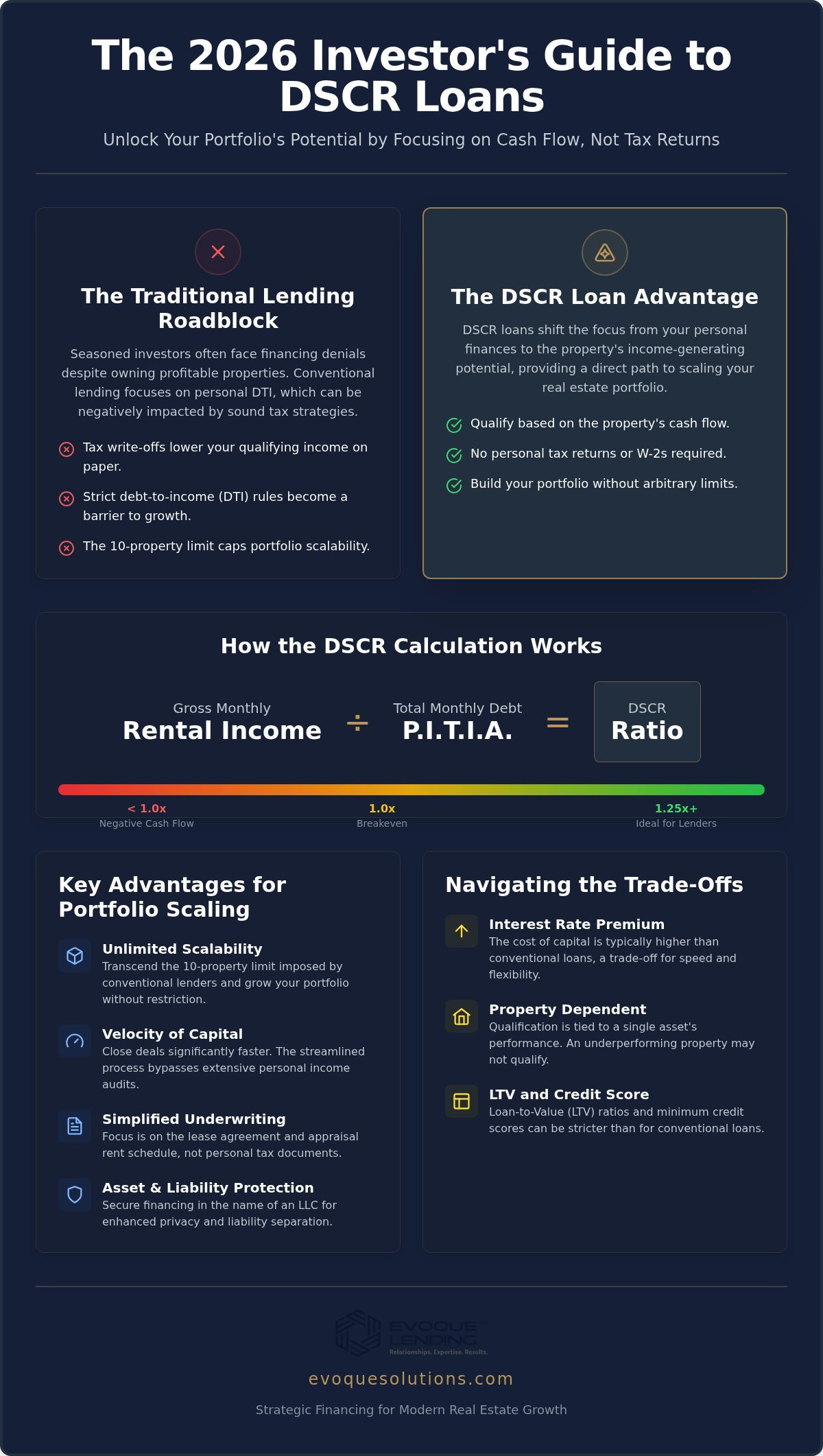
Lenders evaluate a property's viability by comparing its gross monthly rental income against the total monthly debt obligation. This obligation, known as PITIA, encompasses several core components that must be accurately accounted for during the underwriting phase. These include:
- Principal and interest payments based on current market rates.
- Annual property taxes divided into monthly installments.
- Homeowners and hazard insurance premiums.
- Homeowners Association (HOA) dues or other mandatory monthly assessments.
A ratio of 1.0x indicates that the property's income exactly covers its debt. While many programs seek a 1.25x ratio to ensure a safety margin, certain aggressive "no-ratio" programs in 2026 allow for financing even when the property doesn't strictly cash flow on paper. The DSCR formula serves as the primary determinant of loan eligibility.
Why Tax Returns Are No Longer the Barrier
If you are self-employed or a business owner, you likely utilize legal tax write-offs to minimize your liability. While this is sound financial planning, it often results in a lower net income that triggers a rejection from traditional banks. This creates a frustrating paradox where a profitable investor cannot secure a mortgage because they are "too successful" at managing their taxes. DSCR financing removes this hurdle by eliminating the need for W-2s or tax transcripts. The process is streamlined, focusing on the lease agreement and an appraisal-based rent schedule rather than a mountain of personal paperwork. This shift is a key component of scaling your real estate portfolio without tax returns. Evaluating the dscr loan pros and cons reveals that the trade-off of a slightly higher rate is often outweighed by the sheer ease of qualification and the ability to close deals that traditional banks would ignore.
The Benefits: Why Investors Prioritize DSCR for Portfolio Scaling
While interest rates are a primary focus for most borrowers, sophisticated investors recognize that the true value of a loan lies in its ability to facilitate growth. When weighing the dscr loan pros and cons, the most significant "pro" is often the sheer velocity it provides. In a competitive 2026 market where inventory remains tight, the ability to close quickly can be the difference between securing a high-yield asset and losing it to a cash buyer. Because these loans bypass the exhaustive personal income audits required by traditional institutions, the timeline from inquiry to funding is drastically compressed.
Scalability is another area where DSCR financing outshines conventional options. Most traditional lenders impose a strict "10-property limit," effectively capping an investor's growth once they reach a certain portfolio size. DSCR programs remove this ceiling. Since qualification is based on the individual property’s performance, there is no inherent limit to how many properties you can finance. This allows you to build a robust, diversified portfolio across multiple states without hitting a wall of institutional red tape. Additionally, the ability to close in the name of an LLC provides a layer of liability protection and privacy that isn't typically available with standard residential mortgages.
Velocity of Capital and Portfolio Growth
The strategic use of cash-out refinances is a cornerstone of the "velocity of capital" strategy. By extracting equity from a stabilized property based on its current market value and rental income, you can quickly generate the down payment for your next acquisition. This cycle is a powerful catalyst for growth, especially since it doesn't rely on your personal debt-to-income (DTI) ratio. For 1099 contractors and gig-economy entrepreneurs, this flexibility is transformative. You don't have to wait for two years of tax returns to prove your worthiness; the property’s cash flow does the talking for you. If you're ready to see how these tools fit your specific scenario, you can explore our specialized investment options to find a match for your next deal.
Asset-Based Underwriting Advantages
Underwriting for a DSCR loan is inherently logic-based. Lenders view the property itself as the primary source of repayment, which shifts the risk assessment away from your personal financial history. This approach is particularly beneficial for foreign nationals who may have substantial capital but lack a domestic credit history or US-based income. In 2026, we are also seeing increased flexibility for Short-Term Rental (STR) properties. Investors can often use projected Airbnb or VRBO data rather than long-term lease agreements to qualify, acknowledging the higher revenue potential of vacation rentals. This minimal documentation approach, which lacks the need for employment verification, ensures that your time is spent finding deals rather than chasing paperwork. Balancing these benefits against the dscr loan pros and cons helps you determine if speed and scale are worth the premium.
The Trade-offs: Navigating the Costs and Restrictions of DSCR Loans
Every specialized financial instrument involves a compromise. While the flexibility of asset-based lending is transformative, a truly strategic guide must address the higher price of entry. To master the dscr loan pros and cons, you need to look past the streamlined qualification process and calculate the impact of higher capital costs on your long-term yield. These loans are designed for business purposes, meaning they carry different risk profiles and regulatory requirements than a standard primary residence mortgage.
Expect a higher barrier to entry regarding your initial investment. Conventional loans often allow for lower down payments, but DSCR programs typically require a minimum of 20% to 25% equity. This ensures the lender has a significant safety margin if the rental market fluctuates. Additionally, these loans are strictly for non-owner-occupied properties. Attempting to reside in a property financed through a DSCR program is a violation of the loan agreement and can lead to immediate acceleration of the debt. Understanding these boundaries is essential for maintaining a professional relationship with your lending partner.
Analyzing the Cost of Capital in 2026
The interest rate spread between conventional mortgages and DSCR loans generally ranges from 0.5% to 1.5%. This premium exists because the lender is forgoing the safety net of your personal income and employment history. In the 2026 market, where rates have stabilized at a higher baseline, the interest rate is often secondary to the total ROI of the deal itself. If a property offers a double-digit cap rate and rapid appreciation potential, the slight increase in monthly debt service is a manageable trade-off for the ability to secure the asset. DSCR rates are risk-adjusted based on the specific debt coverage ratio and the loan-to-value (LTV) percentage of the deal.
Prepayment Penalties and Exit Strategies
Most DSCR loans include a prepayment penalty, often structured as a "step-down" (such as 5-4-3-2-1 over five years). This means if you sell or refinance in the first year, you may owe 5% of the loan balance as a fee. This structure can complicate exit strategies for investors who plan to "buy, rehab, and refinance" within a short 24-month window. To mitigate this, you can often negotiate or "buy down" the prepayment penalty at the time of origination by accepting a slightly higher interest rate. Balancing the dscr loan pros and cons requires a clear vision of your holding period. If your goal is a long-term hold, the penalty becomes irrelevant; if you seek a quick exit, the cost of the penalty must be factored into your initial pro forma.
Strategic Comparison: Is a DSCR Loan Right for Your Current Deal?
Selecting the optimal financing structure requires more than just chasing the lowest interest rate. It requires a precise alignment between the asset's performance and your personal financial profile. While we have explored the general dscr loan pros and cons, the true test occurs when you compare this tool against other specialized instruments. Conventional mortgages offer the lowest cost of capital but fail once you hit property limits or DTI ceilings. In contrast, hard money provides the speed needed for heavy renovations but lacks the 30-year stability required for long-term wealth preservation. For investors seeking to move from the acquisition phase into a permanent hold, DSCR acts as the essential bridge.
We also see scenarios where a "no-ratio" option becomes the primary choice. This is particularly relevant in 2026 for properties in high-appreciation markets where current rents may not yet fully cover the debt service. If you are betting on the long-term value of a prime location rather than immediate monthly yield, a no-ratio program allows you to secure the asset without being disqualified by a temporary cash-flow deficit. This flexibility ensures that your portfolio growth isn't dictated by current market volatility but by your strategic vision.
DSCR vs. Bank Statement Loans
For self-employed investors with significant business revenue, the choice often narrows down to a DSCR vs. Bank Statement Loan. If a property is in a market where rents haven't yet caught up to prices, your personal business deposits might be the stronger qualifying factor. Bank statement programs typically require 12 to 24 months of deposits to verify income. DSCR, however, relies solely on the property’s lease agreement or a market rent schedule from an appraiser. This makes DSCR the faster path when the property is already stabilized and performing well.
The Decision Framework for 2026 Investors
To determine the best loan product for your specific acquisition, consider this three-point checklist. First, identify your holding period. If it's over five years, the stability of a DSCR fixed rate is superior. Second, evaluate your personal tax returns. If write-offs have lowered your qualifying income, a Non-QM solution is mandatory. Third, analyze the source of your wealth. High-net-worth retirees or those with significant liquid holdings can use asset depletion to supplement their qualification if the property's DSCR is borderline. If you are ready to match your current deal with a specific term sheet, you can submit your scenario to our specialists for a personalized analysis of your options.
Securing Your Next Property: The Evoque Lending Approach to DSCR
Understanding the dscr loan pros and cons is a critical first step, but the execution of a complex Non-QM file requires a partner who understands the nuances of the 2026 market. At Evoque Lending, we recognize that every investor's journey is unique. Whether you're a 1099 contractor, a self-employed entrepreneur, or a foreign national looking to enter the US market, your financial structure shouldn't be a barrier to entry. We specialize in finding the precise alignment between your property's cash flow and the lending programs available across more than 40 states. Our goal is to move you from deal inquiry to a firm term sheet with minimal friction.
We leverage a streamlined online questionnaire designed to capture the essential data of your deal quickly. This allows our specialists to bypass the generic institutional filters that often stall traditional applications. By focusing on the asset's performance and your specific entity structure, we can handle the complexities of LLC vesting and high-volume scaling. We don't just process transactions; we act as a long-term resource for your entire portfolio journey, ensuring you have the right engine for sustained growth.
The Evoque Advantage for Modern Investors
Since our founding in 2005, we've focused exclusively on specialized lending solutions that fall outside the institutional box. This 20+ years of experience means we've seen every market cycle and understand how to position a file for success during the underwriting phase. Our team provides dedicated support throughout the coordination of appraisals and title work, ensuring that deadlines are met. Beyond new acquisitions, we help investors optimize their existing portfolios through a DSCR Cash-Out Refinance, allowing you to harvest equity for your next strategic move.
Getting Started with a DSCR Quote
Preparing for a successful application involves gathering a few key pieces of documentation. Having these items ready will significantly accelerate your timeline:
- Current rent rolls and active lease agreements for the subject property.
- Entity documentation if you're closing in the name of an LLC or corporation.
- A clear summary of the property's PITIA (Principal, Interest, Taxes, Insurance, and HOA).
You can use our online tools to evaluate the potential of a deal before you even submit a full file. This transparency ensures you understand the dscr loan pros and cons specific to your scenario before committing capital. When you're ready to move forward, get a personalized DSCR loan quote from Evoque Lending today to see how we can help you scale your portfolio with confidence.
Accelerate Your Portfolio Growth in 2026
The decision to utilize asset-based financing is a strategic pivot from traditional banking to a model built for scale. By balancing the dscr loan pros and cons, you can move past the limitations of personal debt-to-income ratios and focus entirely on the performance of your acquisitions. Success in the current market requires recognizing that the cost of interest is often secondary to the speed of execution and the ability to close in an LLC. We've seen how these tools allow you to bypass tax return hurdles and unlock equity through cash-out refinancing.
Evoque Lending has been serving real estate investors since 2005. We specialize in Non-QM and alternative income solutions, providing a streamlined process for both purchase and cash-out refinancing. Our team understands the complexities of 1099 borrowers and foreign national files, ensuring your deal doesn't get stuck in a standard institutional box. It's time to leverage your property's cash flow to its full potential.
Match your deal with a DSCR specialist at Evoque Lending and take the next step in your investment journey. Your portfolio's next phase of growth starts with the right financial partner.
Frequently Asked Questions
What is the minimum credit score for a DSCR loan in 2026?
Most DSCR programs in 2026 require a minimum FICO score of 640. However, your credit score directly impacts your leverage and pricing tier. To access the most competitive rates and higher loan-to-value (LTV) options, you'll generally need a score of 680 or above. The most aggressive pricing and maximum leverage are typically reserved for borrowers with a top-tier score of 740 or higher.
Can I get a DSCR loan for a short-term rental like an Airbnb?
Yes, you can secure a DSCR loan for short-term rental properties like Airbnb or VRBO. Lenders often use specialized data from sources like AirDNA or the property’s actual short-term rental history to estimate income rather than a traditional long-term lease. This flexibility allows you to qualify based on the higher revenue potential typical of vacation rentals compared to standard annual residential leases.
Do DSCR loans require personal income verification or tax returns?
No, these loans don't require tax returns, W-2s, or any form of personal income verification. Underwriting focuses exclusively on the property’s ability to generate sufficient rental income to cover the monthly debt service. This is a central advantage when evaluating the dscr loan pros and cons, as it removes personal debt-to-income limits that often block active investors from acquiring new assets.
What is a "no-ratio" DSCR loan and how does it work?
A "no-ratio" DSCR loan is a program where the lender does not require the property’s income to meet a specific coverage threshold. While standard loans look for a ratio of 1.0 or higher, no-ratio options allow you to qualify even if the property has negative cash flow on paper. These are often used for high-appreciation plays where long-term value outweighs immediate monthly yield.
Are DSCR loan interest rates higher than traditional mortgages?
Yes, interest rates for DSCR loans are typically 0.5% to 1.5% higher than traditional primary residence mortgages. This premium accounts for the increased risk to the lender, as they aren't verifying your personal employment or debt-to-income ratio. In late 2026, rates generally range from 6.125% to 7.375% depending on your credit score and the property’s specific debt coverage ratio and leverage.
Can I buy a property in the name of my LLC with a DSCR loan?
You can absolutely close a DSCR loan in the name of an LLC, corporation, or partnership. In fact, many investors prefer this method for the added liability protection and privacy it provides. While closing in a business entity requires an additional document review step during underwriting, it doesn't typically increase your interest rate or closing costs compared to a personal name close.
What happens if the property’s DSCR falls below 1.0?
If a property’s ratio falls below 1.0, it means the rental income is not fully covering the debt service. While many standard programs require a 1.0 or 1.25 ratio, you may still qualify through specialized "low-ratio" or "no-ratio" programs. These programs often require a higher down payment or a higher credit score to offset the risk of the property's monthly cash-flow deficit.
How much down payment is required for a DSCR purchase?
For a DSCR purchase, you should expect to provide a down payment of 15% to 20% of the property value. This corresponds to a maximum loan-to-value (LTV) of 80% to 85%. While conventional loans might offer lower down payments for primary homes, investment-focused lenders require this equity cushion to mitigate risk. Your credit score and the property's ratio will determine your final leverage limit.
Reviewed by Eddie Luhrassebi, Founder & CEO, NMLS #337071 | CA DRE #01230650
Last updated: September 9, 2026 · About the reviewer