Best 2026 Bank Statement Mortgages for Self-Employed
Written by Eddie Luhrassebi · Published August 25, 2026
Find the best bank statement mortgage lenders for 2026. This guide helps self-employed borrowers use cash flow, not tax returns, to qualify for a home loan.
Did you know that over 70 million Americans are now part of the freelance workforce, yet many of the best bank statement mortgage lenders are still overlooked by borrowers who think they can't qualify? It's incredibly frustrating to build a thriving business only to have a traditional loan officer claim you're "unqualified" because your tax deductions are too effective. You have the cash flow and the stability, but rigid W-2 documentation requirements simply don't account for how modern entrepreneurs operate.
You deserve a lending partner that understands your financial structure. This guide identifies the top-tier programs for the 2026 market, focusing on institutions that prioritize your actual bank deposits over the bottom line of your tax returns. We'll help you find a streamlined path to approval by explaining the exact LTV and FICO criteria used by specialized programs today. You'll learn how to leverage 12 to 24 months of statements to secure a home without the fear of predatory rates or unnecessary red tape. We've vetted the national options to ensure you find a solution that aligns with your specific industry profit margins and long-term investment goals.
The Evolution of Self-Employed Financing: Why Bank Statement Lenders Matter in 2026
A bank statement mortgage represents a fundamental shift in how lenders evaluate financial stability. Instead of relying on the net profit reported to the IRS, these programs qualify borrowers based on the total gross deposits flowing into their bank accounts over 12 to 24 months. While you may already understand mortgage loan basics, the 2026 market has introduced new levels of flexibility. Non-QM securitizations are expected to exceed $75 billion this year; this surge in liquidity has made alternative products more competitive than ever. For many business owners, finding the best bank statement mortgage lenders is now the most practical way to secure a high-value property without sacrificing tax efficiency. A specialized mortgage broker plays a critical role here, acting as a guide through a national landscape of niche programs. They vet lenders based on their specific appetite for certain industries to ensure you don't waste time with institutions that don't understand your business model.
The Problem with Traditional W-2 Underwriting
Standard institutional lenders are bound by rigid "Ability to Repay" regulations that primarily cater to salaried employees. These rules often penalize entrepreneurs who utilize significant legal tax deductions to reinvest in their companies. There is a persistent disconnect between what your tax return says you earned and the actual liquid cash flow available to cover monthly payments. The Self-Employed Trap occurs when a business owner's successful effort to maximize tax efficiency through legal deductions simultaneously destroys their eligibility for a traditional mortgage. This leaves many high-earning individuals in a paradox where they have the capital but lack the specific paperwork traditional banks demand. It's a systemic hurdle that requires a specialized approach to overcome.
The Non-QM Solution for Modern Business Owners
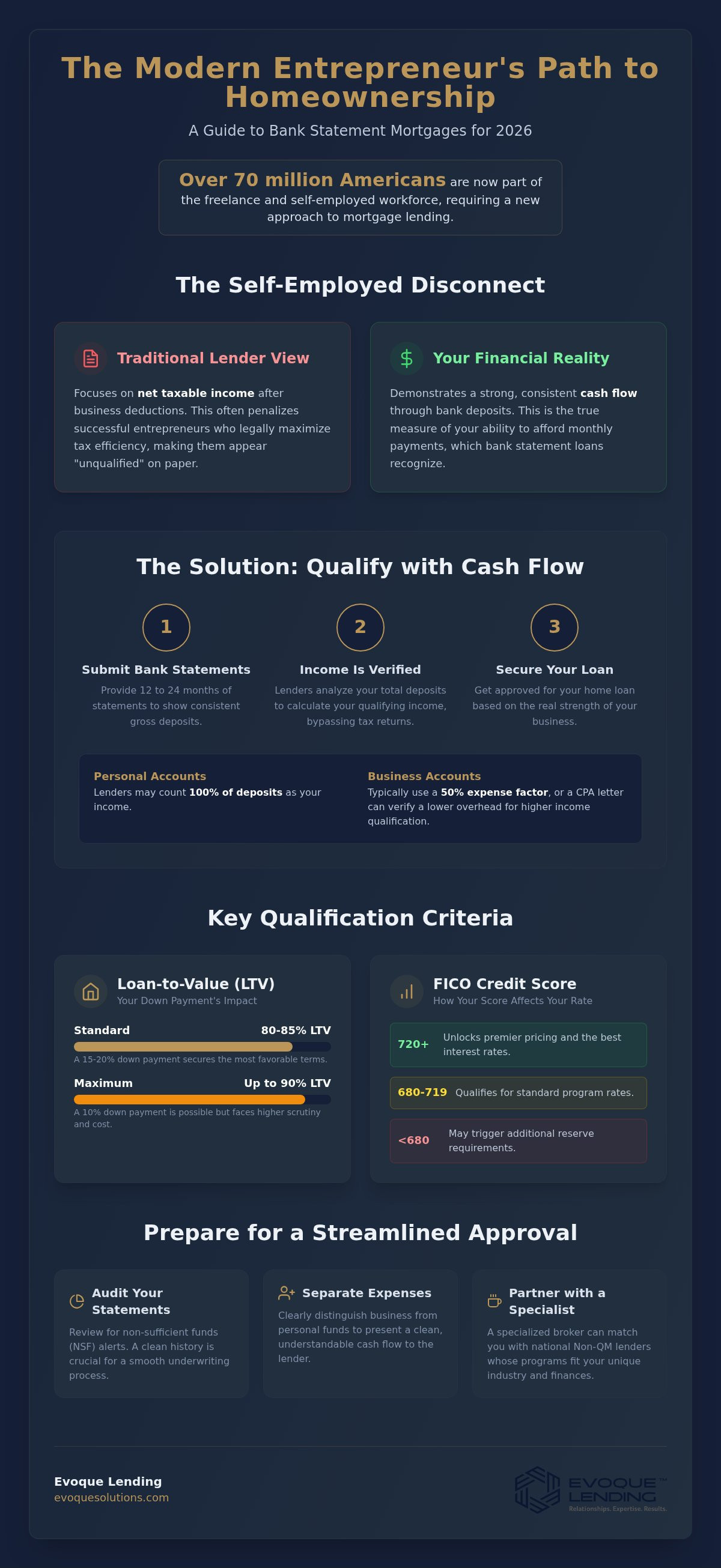
Bank statement programs provide a legitimate, regulated path to homeownership that bypasses the need for 1040 tax returns. These loans are essential bank statement loans for self employed professionals who need to maintain their investment momentum. When evaluating your options, it's vital to distinguish between personal and business statement qualification. Personal bank statements often allow for 100% of deposits to be counted as income, while business accounts typically involve a 50% expense factor unless a CPA provides a letter verifying a lower overhead. Working with specialized brokers allows you to scan the national market for the best bank statement mortgage lenders whose specific expense-ratio formulas align with your industry's reality. This tailored fit is what makes the difference between a rejection and a clear path to closing.
Key Criteria for Evaluating the Best Bank Statement Mortgage Lenders
Identifying the best bank statement mortgage lenders requires looking beyond the surface level interest rate. You must understand the specific risk metrics that drive a final approval. In the 2026 market, Loan-to-Value (LTV) thresholds remain a primary filter. Most high-tier programs operate at 80% to 85% LTV, which means a 15% to 20% down payment is the standard for securing the most favorable terms. While some lenders push to 90% LTV, these files face much higher scrutiny and cost. Credit score sensitivity is another major factor. In the Non-QM space, FICO tiers are often segmented every 20 points. A score of 720 or higher usually unlocks the premier pricing tier, while scores below 680 may trigger additional reserve requirements. Understanding these types of mortgage loans and how they differ from traditional products is the first step in preparing your file.
Seasoning requirements also play a quiet but significant role in your eligibility. If you've faced a major credit event like a bankruptcy or foreclosure, most lenders require a waiting period of two to four years. However, the most flexible lenders in the market may offer "day one" programs for borrowers with significant equity. Finding a lender whose internal guidelines align with your specific credit history and available capital is essential for a smooth closing.
12-Month vs. 24-Month Statement Requirements
Lenders generally offer two main paths for income documentation: 12-month or 24-month statement reviews. Providing 24 months of data often results in more aggressive interest rates. It gives the underwriter a broader view of your business stability and helps smooth out any seasonal income fluctuations that might appear in a shorter window. On the other hand, a 12-month program is often the superior choice if your business has experienced a significant revenue surge. By focusing only on the last year, you can qualify for a higher loan amount based on your current trajectory rather than an average that includes a slower previous year. It's about choosing the documentation period that paints your business in the strongest financial light.
Expense Factors: The Hidden Ranking Metric
The "expense factor" is a metric that can make or break your loan amount. Many national lenders apply a default 50% expense ratio to business bank statements. This means if your business deposits $30,000 a month, the lender only recognizes $15,000 as qualifying income. You can often lower this factor by providing a CPA letter that verifies your actual overhead is lower than the default. Service-based professionals, such as consultants or software engineers, typically secure better terms because their inherent overhead is minimal compared to a retail or manufacturing business. If you're unsure how your specific industry's margins will be calculated, you can connect with an expert to run a preliminary analysis of your cash flow. This proactive step ensures you don't face a last-minute reduction in your approved loan amount.
Top Categories of Bank Statement Lenders in the 2026 Market
Choosing the right institution is just as important as the loan program itself. The 2026 lending landscape is divided into four distinct categories, each offering different levels of flexibility for self-employed professionals. Portfolio lenders are often the first choice for those with truly unique financial footprints. These banks keep the debt on their own balance sheets rather than selling it to the secondary market. This independence allows them to create custom underwriting rules that can accommodate scenarios traditional institutions won't touch. In contrast, institutional credit unions might offer slightly lower rates, but they often impose rigid membership requirements and strict debt-to-income caps that negate the benefits of a bank statement approach. Direct lenders provide a streamlined, digital-first experience, yet they are typically limited to a single set of internal guidelines. If your file doesn't fit their specific box, you're out of luck. While you may already understand what is a bank statement mortgage, the source of the capital determines the ultimate flexibility of the deal.
For most entrepreneurs, the search for the best bank statement mortgage lenders leads to the wholesale market. These high-volume entities don't work with the public directly. Instead, they partner with specialized brokers to fund complex deals that require a nuanced touch. This structure is often the most efficient way to secure a competitive offer because it allows for a matchmaking process where your specific business model is paired with the underwriter most likely to approve it.
Wholesale Lenders: The Power of Choice
Wholesale programs often outperform retail bank offers because of their inherent competition. When you work with a broker like Evoque Lending, your financial profile is presented to multiple wholesale underwriters simultaneously. This creates an environment where the best bank statement mortgage lenders must compete for your business. It also provides the ability to shop a file based on industry specialization. Some wholesale lenders prefer the steady cash flow of medical professionals, while others have built specific models for the variable income of real estate investors or e-commerce founders. This granular focus ensures that your income is calculated by someone who understands your sector's specific profit margins and seasonal cycles.
Portfolio Lenders for Complex Business Structures
Portfolio lenders excel when your financial life involves multiple business entities or complicated ownership structures. If you own three different LLCs and need to pull deposits from all of them to qualify, a portfolio lender is often the only viable path. They are also uniquely equipped to handle asset-rich scenarios where your monthly deposits might be modest, but your overall liquidity is high. These institutions often have more inclusive bank statement loan requirements, such as allowing non-occupant co-borrowers or using asset depletion to bridge income gaps. This level of customization is a hallmark of the 2026 market, where the ability to look beyond a simple spreadsheet is the key to closing complex deals.
How to Secure the Best Rates from Top-Tier Lenders
Securing a competitive interest rate in the Non-QM market requires more than just high revenue; it demands a polished financial presentation. The best bank statement mortgage lenders use sophisticated algorithms to scan your files for "non-sufficient funds" (NSF) alerts or overdrafts. Even a single NSF in the last 12 months can disqualify you from the premier pricing tiers or lead to a flat rejection. You should also focus on clearly separating your personal and business expenses at least three to six months before applying. When an underwriter sees personal rent or grocery bills paid out of a business account, they often apply a higher expense factor, which directly reduces your qualifying income and increases the perceived risk of the loan.
Timing is equally critical for your submission. Underwriters place the heaviest weight on your most recent three months of deposits to gauge the current health of your business. If you've recently received large, non-business deposits, such as a tax refund or a personal gift, be prepared to document the source immediately. Unexplained "lump sum" deposits are often backed out of the qualifying total, which could leave you short of the income needed for your desired loan amount. Proactive preparation ensures your cash flow looks stable and predictable from day one.
The Importance of the Bank Statement Package
Lenders prefer a "clean" digital trail that allows them to verify income quickly and accurately. You should provide full PDF statements for all pages, even the blank ones, to avoid delays in the review process. If your business experienced a one-time large expense, such as a major equipment upgrade or a legal settlement, include a concise narrative letter of explanation. This context helps the underwriter understand that the dip in liquidity was a strategic choice rather than a sign of financial distress. Providing a meticulously organized documentation package effectively reduces the risk-based pricing add-ons that often inflate interest rates for disorganized borrowers.
Leveraging Credit and Assets for Better Pricing
You can often lower your debt-to-income (DTI) ratio by layering "Asset Depletion" with your bank statement income. This technique allows the lender to count a portion of your liquid wealth, such as brokerage accounts or retirement funds, as supplemental monthly income. Furthermore, maintaining significant cash reserves, typically 6 to 12 months of mortgage payments, is one of the most effective ways to secure the lowest tier of interest rates. If your credit score is on the edge of a pricing tier, consider paying down revolving credit card balances to under 10% utilization at least 30 days before the lender pulls your report. To ensure your file is optimized for the current market, you can request a pre-submission statement audit to identify potential red flags before they reach an underwriter.
Why Evoque Lending is Your Strategic Partner for Bank Statement Loans
Traditional banks often treat self-employed income like a square peg in a round hole. At Evoque Lending, we've spent nearly two decades refining the art of the Non-QM approval. We act as your strategic advocate, leveraging a nationwide network to match your unique financial profile with the best bank statement mortgage lenders in the country. Our reach extends across more than 40 states, ensuring that regardless of where you're buying, you have access to the most competitive programs in the 2026 market. We don't just submit your files to an automated system. Instead, we build a comprehensive case for your approval by highlighting the strength of your actual cash flow. This personalized advocacy is essential for business owners with complex structures that generalist banks often misunderstand.
Our team understands what is a bank statement loan better than the loan officers at large retail institutions. We know which underwriters value consistency and which ones are more flexible with seasonal fluctuations. By positioning your business in the best possible light, we reduce the friction that typically stalls alternative documentation loans. We prioritize efficiency because we know that for a busy entrepreneur, time is the most valuable asset you own.
The Evoque Advantage: Beyond the Automated Desktop Underwriter
Standard lenders rely on automated systems that often trigger immediate rejections for non-traditional income. Our specialists identify program niches that these systems miss, such as specific expense ratio allowances for niche service industries. For example, we recently helped a self-employed investor secure a bank statement cash-out refinance to fund their next property acquisition. By analyzing 24 months of deposits, we proved a stability that their local bank simply ignored. If you're looking to scale your portfolio even further, our dscr loans for real estate investors guide offers additional strategies for leveraging property income without personal tax returns.
Starting Your Journey with a Specialized Consultant
We value your time as much as you do. Our process begins with a simple 5-minute questionnaire designed to clear the path to funding. During your first consultation, an Evoque loan specialist will perform a preliminary review of your deposit history and credit profile. We'll identify the best bank statement mortgage lenders for your specific situation and provide a clear roadmap for your documentation package. This transparency eliminates the guesswork and allows you to focus on running your business while we handle the intricacies of the lending market. Get a personalized bank statement loan quote from Evoque Lending today.
Take Control of Your 2026 Home Financing Journey
You've seen how the 2026 mortgage market has evolved to favor liquid cash flow over net taxable income. By carefully auditing your deposits and choosing the documentation window that highlights your growth, you can bypass the rigid hurdles of traditional underwriting. Finding the best bank statement mortgage lenders is no longer about fitting into a standard box; it's about matching your business's unique financial rhythm with the right wholesale underwriter.
Evoque Lending serves as your specialized guide in this complex landscape. With over 20 years of Non-QM experience and access to programs in 40+ states, we provide direct entry to wholesale-only lender niches that generalist banks can't reach. We take the time to build a compelling case for your approval so you can focus on scaling your business. Your hard work has built a thriving enterprise, and your home loan should reflect that success. Match with a Top Bank Statement Lender Now and clear your path to funding today.
Frequently Asked Questions
Can I get a mortgage with only 12 months of bank statements?
Yes. Many of the best bank statement mortgage lenders offer 12-month programs for entrepreneurs with strong recent growth. While 24-month programs often provide slightly better interest rates by averaging income over a longer period, 12-month reviews allow you to qualify based on your most recent, higher earning trajectory. This is a powerful tool for rapidly expanding businesses. You'll still need to meet standard credit and down payment requirements to secure an approval.
Do bank statement lenders require a higher down payment than traditional lenders?
Yes, typically. Traditional loans often allow for very low down payments, but bank statement programs usually require 10% to 20% down. In the 2026 market, an 80% to 85% Loan-to-Value (LTV) ratio is the standard for well-qualified borrowers. High-tier programs offering 10% down exist but often come with stricter credit requirements and higher costs. This larger equity stake helps the lender offset the risk of using alternative income documentation.
What is the minimum credit score for a bank statement mortgage in 2026?
Most lenders require a minimum FICO score between 620 and 680 for these programs. However, the most competitive terms from the best bank statement mortgage lenders are usually reserved for those with scores of 720 or higher. If your score is on the lower end, you might face higher interest rates or be required to provide more months of bank statements. Some specialized portfolio programs may consider lower scores if you have significant cash reserves.
Can I use personal bank statements if I do not have a separate business account?
Yes, you can use personal statements to qualify for your loan. Lenders treat personal and business accounts differently during the underwriting process. When using personal statements, underwriters often count 100% of the deposits as qualifying income. If you use business accounts, they apply an expense factor, usually 50%, unless a CPA verifies a lower overhead. It's important to show that the personal account is used consistently for your primary business deposits and revenue.
How do lenders handle large, one-time deposits in my bank statements?
Lenders generally scrutinize large deposits that fall outside your normal business revenue cycles. If a deposit isn't clearly related to your business operations, such as a tax refund, inheritance, or personal gift, it will likely be backed out of your qualifying income total. You should be prepared to provide a narrative letter of explanation and documentation for any "lump sum" deposits. This ensures these one-time events don't negatively impact your calculated monthly average.
Are interest rates significantly higher for bank statement loans?
Rates for bank statement loans are generally 0.50% to 1.50% higher than conventional mortgage rates. This premium reflects the increased risk associated with non-qualified mortgages. In 2026, increased market liquidity has kept these rates competitive, often ranging from 7.0% to 9.0% for well-qualified borrowers. Your specific rate depends on your credit score, down payment amount, and the number of months of documentation you provide. Higher equity often leads to more favorable pricing tiers.
Can I use a bank statement loan to buy an investment property or a second home?
Yes, these programs are highly versatile and aren't limited to primary residences. You can use bank statement loans for second homes and investment properties. For investment properties, lenders often require a slightly higher down payment, usually 20% to 25%, compared to owner-occupied homes. Many self-employed investors use these loans to scale their portfolios because they don't have to worry about the rigid debt-to-income limitations found in traditional institutional lending guidelines.
What is an "expense factor" and how does it affect my loan amount?
An expense factor is a percentage lenders subtract from your gross business deposits to estimate your net income. The default is often 50%, meaning only half of your deposits count toward qualifying. You can often lower this factor by providing a letter from your CPA verifying that your actual business overhead is lower. Service-based entrepreneurs often benefit from lower factors, which increases their qualifying income and allows for a significantly larger total loan amount.
Reviewed by Eddie Luhrassebi, Founder & CEO, NMLS #337071 | CA DRE #01230650
Last updated: August 25, 2026 · About the reviewer