Bank Statement Loans: 2026 Guide for Self-Employed
Written by Eddie Luhrassebi · Published August 24, 2026
Wondering what is a bank statement loan? This 2026 guide shows self-employed buyers how to use cash flow, not tax returns, to qualify for a mortgage.
Why should a strategic tax deduction, designed to help your business grow, be the very thing that prevents you from buying a home? If you've been turned away by traditional lenders because your adjusted gross income doesn't reflect your actual buying power, you're likely asking: what is a bank statement loan and how does it change the math for entrepreneurs? This specialized mortgage solution bypasses the standard tax return requirement. It focuses instead on the actual cash flowing through your personal or business accounts every month.
It's a common frustration for the self-employed. You have the capital and the consistency, but rigid debt-to-income rules at big banks treat your legitimate business write-offs as a lack of income. This guide will show you how bank statement loans allow entrepreneurs and investors to qualify for a mortgage using real-world cash flow rather than a tax transcript. We'll break down the mechanics of 2026 underwriting standards, clarify the exact documents you need to prepare, and help you find a lender who values your business success. By the end of this article, the confusion surrounding non-QM terminology will be gone, replaced by a clear path to your next property acquisition.
Understanding Bank Statement Loans: The Modern Solution for Self-Employed Borrowers
You've built a successful business. Your revenue is strong. Yet, when you walk into a traditional bank, they only see the net income on page one of your tax returns. This figure often fails to reflect your true purchasing power because it's reduced by the very write-offs that keep your business competitive. If you've encountered this roadblock, you're likely asking: what is a bank statement loan? It's a specialized mortgage solution that verifies income through actual cash flow rather than tax transcripts.
These are not the risky subprime products of the past. Modern bank statement programs are fully amortized, safe financial instruments that require rigorous documentation of your business's health. They provide a vital bridge for the modern workforce, including freelancers, gig workers, business owners, and consultants. These borrowers often fall through the cracks of institutional banking despite having excellent credit and significant liquidity.
How Bank Statement Loans Differ from Traditional Mortgages
Traditional lenders follow rigid paths when evaluating a mortgage loan application. They focus on W-2s and paystubs to confirm stability. For a self-employed borrower, this approach is often flawed. Bank statement underwriting shifts the focus. Instead of looking at your net profit after deductions, an underwriter reviews your total eligible deposits. This allows the lender to see the real-time movement of capital and your actual ability to service a debt.
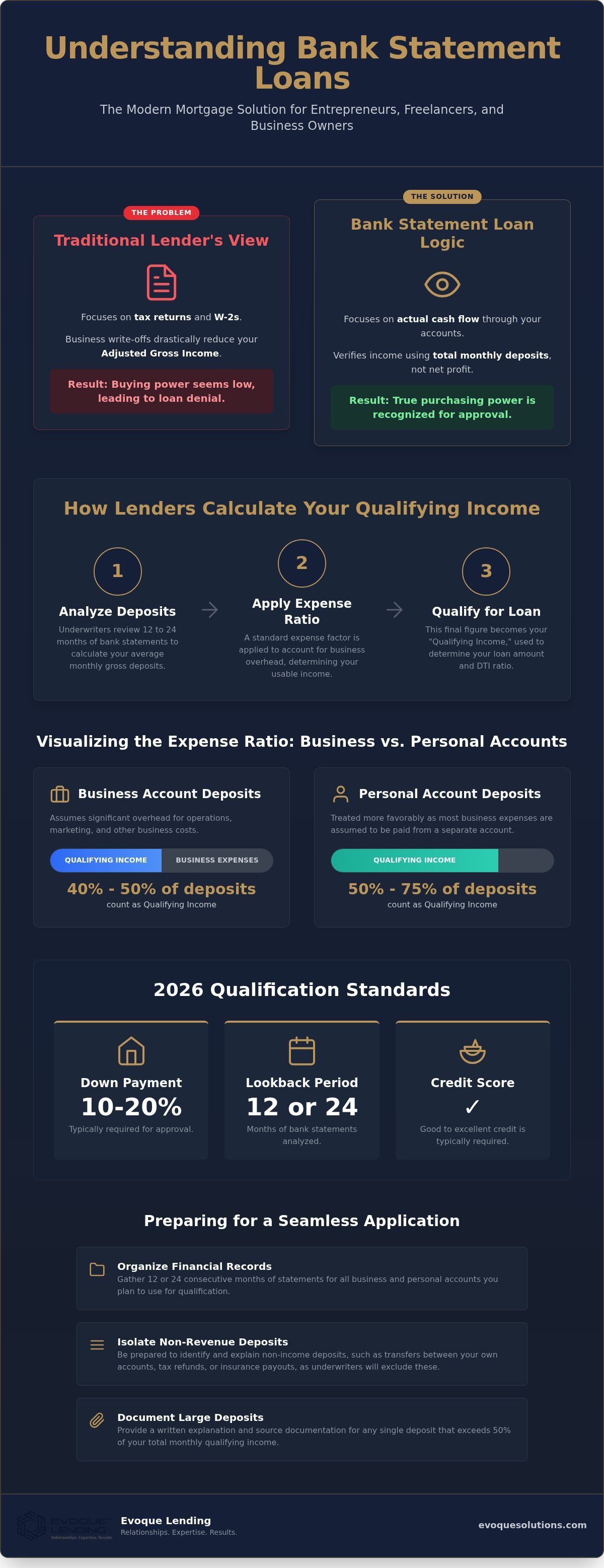
This method allows for greater flexibility in debt-to-income (DTI) ratios. By analyzing your gross deposits over a 12 or 24-month period, lenders can apply a realistic expense ratio to determine your qualifying income. It's a more accurate reflection of what you can actually afford to pay each month. It honors the reality of how modern entrepreneurs manage their wealth.
The Rise of Non-QM Lending in 2026
The economy has shifted toward a 1099-heavy model. More professionals than ever are choosing independence over traditional employment. As this trend accelerates, the mortgage industry has had to adapt. A Non-QM (Non-Qualified Mortgage) is a category for borrowers who fall outside the restrictive guidelines set by Fannie Mae or Freddie Mac. Understanding what is a bank statement loan is the first step toward homeownership within this flexible category.
Evoque Lending has specialized in this niche since 2005. We understand that entrepreneurial finances are complex and require a human touch in underwriting. While high-street banks struggle with non-traditional income, specialized lenders see the value in your cash flow. We provide the expertise needed to match your unique financial profile with a program that aligns with your long-term investment goals.
Underwriting Logic: How Lenders Calculate Your Qualifying Income
Lenders don't just glance at your balance; they perform a deep dive into your cash flow history. The primary method used is the Gross Deposit calculation. Underwriters add up all qualifying deposits over a specific timeframe to find your monthly average. This is the fundamental answer to what is a bank statement loan in practice. It's a shift from taxable net profit to gross liquidity.
Lookback periods typically span 12 or 24 months. A 12-month review is often faster, but a 24-month history provides a more stable average for seasonal businesses. If your revenue has grown significantly in the last year, a shorter lookback might be more advantageous. Conversely, if you had one outlier month of low revenue two years ago, a longer history helps smooth out that dip.
Underwriters apply an "Expense Ratio" to these deposits. For business accounts, qualifying income is often calculated as 40% to 50% of total deposits to account for overhead. Personal accounts are treated more favorably. Lenders sometimes allow 50% to 75% of personal account deposits to count toward your qualifying income because these accounts generally lack business-related expenses.
Accuracy is vital during this manual review. Underwriters are eagle-eyed. They strip out "noise" such as transfers between your own accounts, tax refunds, or insurance payouts. Any single deposit exceeding 50% of your total monthly qualifying income is flagged as a "large deposit." You must provide a written explanation for these items to ensure they aren't counted as one-time windfalls rather than recurring revenue.
Personal vs. Business Bank Statements: Choosing the Right Path
Personal statements are often the gold standard for high-earning consultants or freelancers. Since these accounts typically lack business overhead, lenders may allow a higher percentage of deposits to count as income. Business statements require proof of ownership. If you own 100% of the company, the full deposit history is considered. Owning only 50% means only half of those deposits can be attributed to your personal income for the application.
The Importance of the CPA Letter
A CPA letter is a powerful tool to override the default expense ratio. If your business is service-based with low overhead, your CPA can verify a lower ratio, such as 10% or 20%. This adjustment significantly boosts your qualifying income. When you are evaluating what is a bank statement loan for your specific business model, this one document can be the difference between a denial and an approval. Reviewing the bank statement loan requirements early helps ensure your professional team is prepared. Finding a partner like Evoque Lending ensures your specific cash flow pattern is presented accurately to underwriters.
Comparing Your Options: Bank Statement Loans vs. Conventional and DSCR
Choosing a mortgage is not just about finding the lowest interest rate. It's about finding the program that actually closes. While conventional loans often offer the most competitive rates, they are built on a rigid framework designed for W-2 employees. For the self-employed, bank statement loans represent a strategic pivot. They are a primary tool in the Non-QM toolbox, allowing you to trade a slightly higher interest rate for a significantly higher probability of approval.
The rate trade-off is a reality of specialized lending. In 2026, bank statement mortgage rates typically range from 0.5% to 2% higher than conventional products. However, the cost of a slightly higher rate is often far lower than the cost of missing out on a prime real estate opportunity. Speed is another critical factor. Conventional underwriting for complex business owners can drag on for months as auditors pick apart every schedule of your tax returns. Bank statement programs move faster, focusing on clear cash flow patterns that can be verified in a fraction of the time.
Bank Statement Loans vs. DSCR: Which Fits Your Investment Strategy?
Investors often confuse these two Non-QM products. A bank statement loan qualifies you based on your personal or business income. In contrast, a DSCR (Debt Service Coverage Ratio) loan ignores your personal income entirely. It focuses solely on whether the property's rental income can cover its own debt obligations. If you are purchasing a primary residence, a bank statement loan is your only path. If you are an investor looking to scale a portfolio without providing any personal income documentation, you should explore DSCR loans for real estate investors.
Why Conventional Underwriting Often Fails Entrepreneurs
The "paper loss" problem is the most common reason entrepreneurs are denied by big banks. Your CPA's job is to maximize deductions, such as depreciation and equipment costs, to lower your tax liability. While this is smart business, it kills your qualifying income under Fannie Mae and Freddie Mac guidelines. These traditional rules are too rigid for multi-entity business owners or those with fluctuating seasonal revenue.
When asking what is a bank statement loan in the context of your broader strategy, think of it as the "common sense" alternative. It looks at the money you actually have available to pay your bills rather than the taxable figure you report to the IRS. This flexibility allows you to maintain your tax-efficient business structure while still securing the financing you need to grow your personal assets.
Key Requirements and Qualification Standards for 2026
While the underwriting logic focuses on your cash flow, the qualification standards involve a holistic view of your financial stability. If you are evaluating what is a bank statement loan for your 2026 purchase, start by reviewing your FICO score. Most specialized lenders require a minimum credit score between 620 and 640. However, to unlock the most favorable interest rates and higher leverage, a score of 700 or higher is recommended. Borrowers with a 740 plus score often access the most competitive pricing tiers available in the Non-QM market.
Loan-to-Value (LTV) ratios are stricter here than with government-backed products. You should expect to provide a down payment of 10% to 20%. For investment properties, this requirement often shifts to 20% or 30%. Beyond the down payment, lenders look for "liquid reserves." This means having enough cash in the bank to cover three to six months of your Principal, Interest, Taxes, and Insurance (PITI). Your housing history must also be pristine. Lenders typically require a "0x30x12" history, which means you've had zero late mortgage or rent payments over the last 12 months.
Documenting Your Business: Beyond the Statements
Lenders need to confirm that your business is a legitimate, ongoing concern. You must provide a business license or a Secretary of State filing to prove your entity's existence. A "Business Narrative" is also a standard requirement. This is a brief, professional summary explaining your revenue model, how you acquire clients, and your typical expense structure. It helps the underwriter understand the story behind the deposits.
Two years of self-employment history remains the industry gold standard. It proves that your income isn't a one-time fluke but a sustainable career path. If you have a complex business structure, you should contact an expert at Evoque Lending to review your documentation before you start your home search. Having your business filings and narrative ready can shave weeks off the approval timeline.
The 2026 Interest Rate Environment for Non-QM
Interest rates for these programs are naturally higher than traditional mortgages due to the manual nature of the underwriting. As of August 2026, well-qualified borrowers might see rates starting around 6.25% for a 75% LTV. The broader market typically ranges from 7.0% to 9.0% depending on your credit profile and down payment. You can often use "points" to buy down your rate at closing, which is a strategic move if you plan to hold the property long-term. While the rate is higher, the tax savings you retain by using legal write-offs often far outweigh the additional interest cost.
Navigating the Application: How to Secure a Bank Statement Loan with Evoque Lending
Success in specialized lending depends on the quality of your submission. Unlike traditional applications where a computer does most of the work, bank statement files require a methodical manual review by an experienced underwriter. To streamline this process, start by organizing your statements into clean, chronological PDF files. You must ensure every single page is included, even the ones that appear blank. Missing pages are the primary cause of delays in the initial review phase because they trigger concerns about undisclosed transfers or accounts.
Next, perform a self-audit of your history. Identify any large deposits that are not revenue, such as transfers between your own accounts, tax refunds, or one-time credits. Flagging these early prevents the underwriter from questioning your revenue consistency later. Once your records are organized, consult with a specialist at Evoque Lending to run a preliminary income calculation. This step ensures your expectations align with the 2026 underwriting standards before you commit to a property. Finally, secure a pre-approval letter that explicitly states you've been qualified through a bank statement program. This gives sellers confidence that your financing is tailored to your specific entrepreneurial profile.
Preparing Your Financial Narrative for Approval
Every business has a story, and underwriters need to hear it. If your revenue shows seasonality or a one-time dip due to a major equipment purchase, you should be prepared to explain it in writing. Transparency builds trust. A clear narrative that provides context for your cash flow patterns can turn a complex file into an approval. Additionally, keep your personal and business finances strictly separated. Commingling funds makes the income verification process significantly more difficult and can extend your days to close. Clean records are the fastest way to cross the finish line in a competitive real estate market.
The Evoque Advantage: Personalized Matching for Non-QM Loans
Choosing the right partner is just as important as choosing the right loan. Since 2005, Evoque Lending has acted as a bridge between the complex world of 1099 finances and specialized Non-QM markets. We don't just process files; we match your unique cash flow pattern with the specific program that offers the best alignment. We understand what is a bank statement loan from the perspective of both the underwriter and the entrepreneur. With national coverage in 40 plus states and two decades of experience, we provide the seasoned guidance you need to succeed. Get your personalized bank statement loan quote from Evoque Lending today.
Securing Your Future Through Flexible Financing
Traditional mortgage markets are often out of sync with the reality of modern entrepreneurship. By moving beyond tax returns and focusing on real-world cash flow, you can finally align your homeownership goals with your business success. You now understand what is a bank statement loan and how it utilizes your gross deposits to bypass rigid institutional barriers. Whether you are choosing between personal or business accounts or deciding if a bank statement program beats a DSCR alternative, the path forward is defined by transparency and strategic preparation.
Evoque Lending has specialized in Non-QM solutions since 2005. We provide national coverage in over 40 states and offer customized income analysis specifically designed for the self-employed. You don't have to navigate these complex financial structures alone. Our team acts as your seasoned guide to ensure your unique income story is presented accurately to underwriters. We value the depth of professional relationships and focus on tangible outcomes for every borrower.
Qualify for your home loan using bank statements—Get started with Evoque Lending.
The property you want is within reach when you use the right financial tools. Your business growth should be an asset, not a hurdle, on your journey to your next home.
Frequently Asked Questions
Can I get a bank statement loan with only 12 months of statements?
Yes, you can qualify with just 12 months of statements. This is often the preferred choice for business owners who have seen significant revenue growth in the last year. While a 12-month lookback is faster to document, providing 24 months of history can sometimes secure a lower interest rate or a higher loan-to-value ratio. Your specialist will help you determine which timeframe presents your business in the most stable light for the underwriter.
Is a bank statement loan the same as a 'stated income' loan?
No, these are distinct financial products. Unlike the "stated income" loans of the mid-2000s that required no verification, bank statement programs are fully documented. When asking what is a bank statement loan, it's vital to understand that every deposit is scrutinized and verified against your business narrative. These are safe, fully amortized loans that replace tax transcripts with verifiable cash flow records to ensure you truly have the capacity to repay.
What is the minimum credit score for a bank statement mortgage?
Most lenders require a minimum credit score of 620 to 640 for approval. While some niche programs may consider scores as low as 600, you'll typically need a 680 or higher to qualify for competitive terms. For the most favorable interest rates and a lower down payment in 2026, a score of 700 to 740 is the industry target. Higher scores provide underwriters with the confidence to offer more flexible debt-to-income ratios.
Do bank statement loans have higher interest rates?
Yes, interest rates for these programs are typically 0.5% to 2% higher than conventional mortgages. This premium accounts for the manual underwriting process and the specialized nature of the risk. However, many entrepreneurs find the higher rate is a small price to pay compared to the tax savings they retain through business write-offs. It's often the most cost-effective way to secure a property when traditional institutional rules would otherwise result in a denial.
Can I use business bank statements if I have a business partner?
Yes, you can use business statements, but the income calculation will be adjusted based on your ownership percentage. If you own 50% of the company, the underwriter will only count 50% of the eligible deposits as your qualifying income. You'll need to provide an operating agreement or a CPA letter to verify your stake in the business. This ensures the income attributed to you is accurate and reflects your actual share of the company's cash flow.
Can I get a bank statement loan for an investment property?
Yes, bank statement programs are available for primary residences, second homes, and investment properties. They are particularly useful for investors who have significant rental income that is largely "erased" on tax returns due to depreciation and expenses. While a DSCR loan is another option for investments, a bank statement loan is often better if the property doesn't yet generate enough rent to cover the mortgage but your overall business cash flow is strong.
What happens if I have a few overdrafts on my bank statements?
A few isolated overdrafts aren't necessarily a deal-breaker, but frequency matters. Most underwriters allow up to three non-sufficient funds (NSF) occurrences or overdrafts within a 12-month period. If your statements show a pattern of frequent overdrafts, it suggests poor cash flow management and increases the perceived risk. If you have recent overdrafts, be prepared to provide a written explanation or wait a few months until your statements show a cleaner history of account management.
Are bank statement loans available for first-time homebuyers?
Yes, first-time homebuyers can absolutely utilize these programs. The primary hurdle isn't your history as a homeowner, but your history as an entrepreneur. You still need to demonstrate at least two years of self-employment in the same industry to qualify. For first-time buyers who have transitioned from a W-2 job to a successful business, this is a powerful tool to enter the real estate market without waiting years for their tax returns to catch up.
Reviewed by Eddie Luhrassebi, Founder & CEO, NMLS #337071 | CA DRE #01230650
Last updated: August 24, 2026 · About the reviewer