Bank Statement Loan Requirements: Your 2026 Checklist for Approval
Written by Eddie Luhrassebi · Published August 23, 2026
Learn the 2026 bank statement loan requirements for self-employed pros. Our checklist helps you use cash flow, not tax returns, to get your mortgage approved.
Why should a successful business owner be penalized for being smart with their taxes? If your "paper losses" have led to a rejection from a traditional bank, you aren't alone. You've worked hard to build a profitable enterprise, yet traditional lenders often struggle to see past the bottom line of your tax returns. It's frustrating when a steady cash flow doesn't translate into a "qualified" status in the eyes of a big-box institution. Understanding the specific bank statement loan requirements is the first step toward bypassing these rigid standards and securing the home you deserve.
We know that your bank deposits tell a much more accurate story of your financial health than a tax transcript ever could. This guide will help you master the documentation and qualification standards needed to secure a mortgage using your actual cash flow. We'll provide a clear checklist of required documents, explain the "expense ratio" math that lenders use to calculate your income, and show you how to align with a specialized Non-QM expert who understands the practical realities of how modern entrepreneurs operate in 2026.
Beyond Tax Returns: Why Bank Statement Loans Are the Standard for Entrepreneurs
Bank Statement Loans represent a sophisticated Non-QM (Non-Qualified Mortgage) solution specifically engineered for the self-employed professional. In an era where the nature of work has evolved, these products serve as a strategic financial tool rather than a last resort. Business owners, freelancers, and real estate investors often find themselves locked out of traditional financing because their income doesn't fit into a standard box. By focusing on average monthly deposits, lenders can establish a "qualifying income" that reflects your actual cash flow rather than just your net profit after deductions.
This approach shifts the focus from what you owe the IRS to what you actually earn. It is a fundamental departure from the way Mortgage underwriting standards for self-employed individuals usually operate. Instead of providing years of tax transcripts, you provide proof of revenue. This allows the lender to verify your ability to repay based on the health of your business today, not your tax strategy from two years ago. For those who manage their own payroll or receive 1099 income, this flexibility is the difference between a rejection and an approval.
The Conflict Between Tax Efficiency and Loan Eligibility
A high-performing business owner often works with a CPA to maximize legal tax write-offs. This strategy is vital for business growth and wealth preservation, yet it inadvertently lowers your borrowing power in the eyes of a conventional bank. Traditional lenders view "paper losses" as a literal lack of funds, often leading to a quick rejection regardless of your actual bank balance. Bank statement loans bridge the gap between your tax strategy and your homeownership goals by validating your income through liquid cash flow.
Non-QM vs. Conventional: A Strategic Comparison
Conventional underwriting is rigid. It relies on IRS filings and W-2 logic that simply doesn't apply to an entrepreneur. Non-QM loans offer a more nuanced perspective, prioritizing personal or business cash flow over tax returns. While you might see interest rates that are 0.50% to 1.50% higher than conventional options, the trade-off is the ability to secure a mortgage that would otherwise be impossible. Meeting the 2026 bank statement loan requirements involves demonstrating a consistent deposit history, which provides the stability lenders need to approve your application. For those ready to dive into the details, our guide on bank statement loans for self employed outlines exactly how to prepare your profile for success.
The Essential Documentation Checklist: 12 vs. 24 Months of Statements
Preparation is the bedrock of a successful mortgage application. While traditional loans follow the strict "Qualified Mortgage" rules defined by the Consumer Financial Protection Bureau, Non-QM solutions offer a more adaptable path for the self-employed. However, this flexibility requires a precise approach to bank statement loan requirements regarding the depth of your financial history. Lenders generally offer two primary paths: a 12-month or a 24-month review of your deposits.
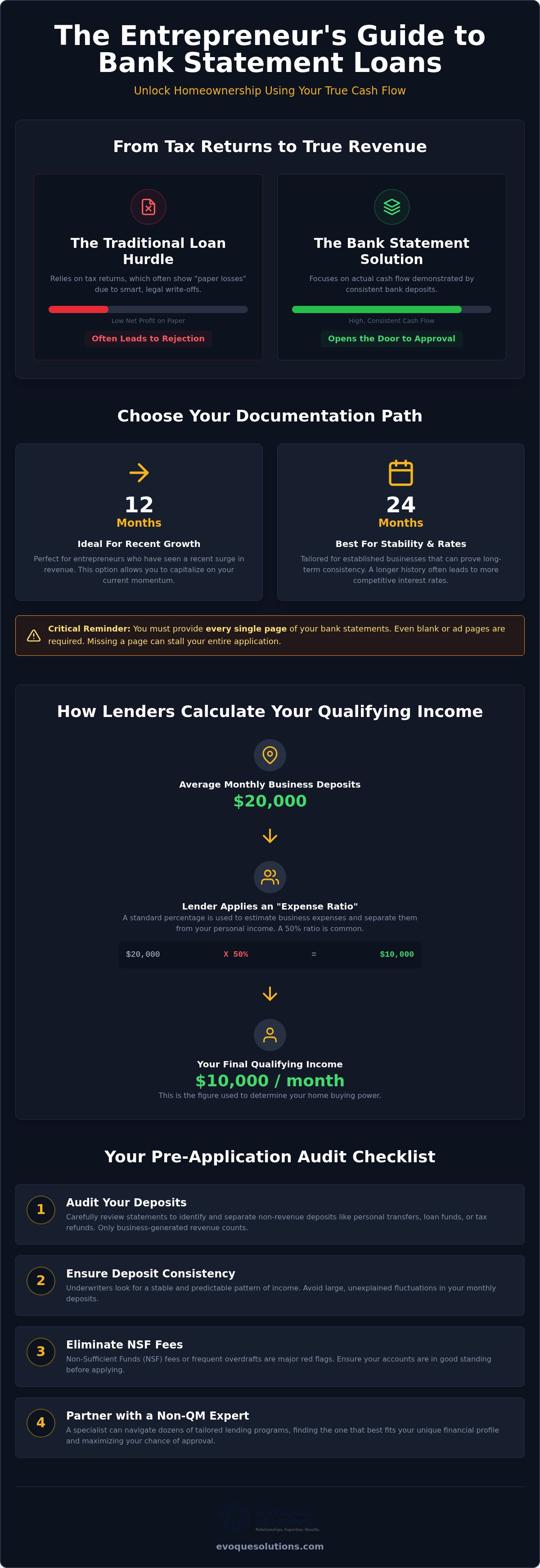
The 12-month bank statement loan is ideal for entrepreneurs who have seen a recent surge in revenue or have expanded their operations within the last year. It allows you to capitalize on your current momentum. Conversely, the 24-month bank statement loan is tailored for established businesses that can demonstrate long-term stability. Providing a longer history often results in more competitive interest rates because it reduces the perceived risk for the underwriter. Regardless of the timeline you choose, you must provide every single page of your statements. This includes pages that appear blank or those containing only bank advertisements. If a statement says "Page 1 of 10," the lender expects to see all ten pages. Missing a single page can stall your approval process for days.
Choosing the Right Timeline for Your Application
Underwriters look for a narrative of consistency. For a 12-month application, they average your total eligible deposits over a one-year period. This is beneficial if your current revenue trends are significantly higher than the previous year. If you choose the 24-month route, they average that longer window to smooth out any seasonal dips. If your income is steady and you want to secure the most favorable terms, the 24-month option is usually the superior choice. You'll also need to prove your business is active through LLC filings, a current business license, or a formal letter from your CPA.
Supporting Documents You Cannot Forget
Beyond the statements themselves, you must verify that you've owned your business for at least two years. This is a standard benchmark for most bank statement loan requirements in 2026. You will also need to provide a valid government ID and authorize a credit report pull. Finally, be prepared to show liquid assets for your down payment and "reserves." Most programs require three to six months of mortgage payments held in reserve to ensure you can handle unexpected business fluctuations. If you're unsure which timeline fits your profile, you can explore your options through a quick preliminary review of your cash flow.
Business vs. Personal Statements: Navigating Expense Ratios
Not all deposits are treated equally. When you apply for a mortgage using non-traditional income, the lender must determine how much of your revenue is actually available to pay a mortgage. This is where the "Expense Factor" comes into play. It is a calculated haircut on your gross deposits that accounts for the cost of doing business. Understanding how this ratio applies to your specific account type is one of the most vital bank statement loan requirements to master before you submit your file.
The distinction between business and personal accounts is significant. For personal bank statements, lenders typically count 100% of eligible deposits as qualifying income. This assumes that your business expenses are already handled elsewhere. For business bank statements, the default assumption is that 50% of your deposits go toward overhead, such as rent, payroll, and supplies. This means only half of your revenue counts toward your loan eligibility unless you can prove your business is more efficient.
How Lenders Calculate Your Qualifying Income
Underwriters use a specific, methodical formula to find your monthly average. They take your total deposits and subtract "disallowed transfers" before dividing by the number of months in the review period. This total is then multiplied by your expense factor. Disallowed transfers include moving money between your own accounts, tax refunds, or insurance payouts. These are not considered recurring revenue. If your business has low overhead, a letter from a CPA can be a powerful tool. A professional verification that your actual expense ratio is only 20% or 30% can effectively double your qualifying income in the eyes of an underwriter.
Qualifying with Personal Statements
Personal statements are often the path of least resistance for high-margin service providers. Consultants, designers, and freelancers who don't carry significant inventory often prefer this route. To qualify this way, you must demonstrate that your business expenses are paid from a separate, dedicated business account. This separation proves to the lender that the money entering your personal account is "net" pay. Underwriters will scrutinize these accounts for large, irregular deposits. If you cannot clearly tie a deposit to business revenue, it will likely be excluded from the calculation.
Beware the "Mixed Account" trap. Using a single account for both your grocery runs and your client invoices complicates the approval process. It forces the underwriter to manually parse every transaction, which increases the likelihood of a denial. Maintaining a clean separation between your personal life and your business operations ensures your cash flow narrative is stable and transparent.
The Pre-Application Checklist: 5 Steps to Audit Your Statements
Success in the Non-QM market isn't about having a perfect financial history; it's about having a transparent one. Before you hand over your documents, you must view your transactions through the eyes of a skeptical underwriter. Conducting a self-audit ensures you meet the bank statement loan requirements before a single credit pull occurs. This proactive approach saves time and prevents unnecessary rejections.
- Step 1: Identify Non-Revenue Deposits. Underwriters will flag any large deposits that don't look like business income. Loans, internal transfers between your own accounts, and personal gifts must be documented and explained to avoid being excluded from your income total.
- Step 2: Check for NSF Fees. Non-Sufficient Funds (NSF) fees are a major red flag. Most lenders allow no more than one or two in a 12-month period. If you have more, you may need to wait until those months fall off your history before applying.
- Step 3: Verify Business Standing. Ensure your LLC or corporation is in "Good Standing" with your Secretary of State. An inactive or dissolved status will halt your application immediately.
- Step 4: Season Your Funds. Any money used for a down payment or reserves should be "seasoned" in your account for at least 60 to 90 days. Large, unverified deposits appearing right before closing are often disallowed.
- Step 5: Review Your Credit Score. While flexibility is high, the floor is usually a 620 FICO score. To secure the most favorable rates, aim for a score of 700 or higher.
Scrubbing Your Statements for Red Flags
Underwriters search for patterns of risk. Declined transactions and frequent overdrafts suggest that a business is struggling with cash flow, even if the total monthly deposits are high. If you have minor inconsistencies, such as a one-time late payment due to a technical error, prepare a Letter of Explanation (LOE). A clear, concise LOE provides the context an underwriter needs to overlook a small blemish. Consistent deposit patterns carry more weight than one-time windfalls, as they prove your income is sustainable over the long term.
The CPA Letter: Your Secret Weapon
We previously discussed how the "expense factor" can reduce your qualifying income. A CPA letter is the most effective way to fight this. By having a professional verify that your business overhead is lower than the 50% default, you can significantly increase your buying power. This third-party verification adds massive credibility to your file. For those who are also looking to expand their investment holdings, understanding dscr loans for real estate investors can help you scale your portfolio alongside your primary residence purchase. If you're ready to see where you stand, you can start your online questionnaire to get a preliminary assessment of your unique financial profile.
Securing Your Non-QM Mortgage with Evoque Lending
Finding a lender who understands the nuances of entrepreneurship is often the final hurdle in the home-buying journey. Since 2005, Evoque Lending has specialized in bridging the gap between complex income profiles and specialized Non-QM investors. We recognize that your tax returns rarely reflect your true purchasing power. Instead of trying to force your business into a standard institutional box, we act as a seasoned guide to help you navigate the bank statement loan requirements that lead to a successful closing.
Working with a specialized broker offers a distinct advantage over traditional retail banks. Rather than being limited to a single set of internal guidelines, you gain access to dozens of bank statement programs across 40+ states with just one application. We understand that every industry has different overhead costs. Our role is to advocate for your specific situation, ensuring that your cash flow is presented to the underwriter in the most favorable light possible. We value depth of knowledge and professional relationships over quick transactions, positioning ourselves as a long-term partner in your financial success.
Our Streamlined Path to Approval
We've refined our process to respect your time and provide transparency from day one. It begins with a thorough initial review. We analyze your bank statements before you ever pay for an appraisal or commit to a specific property. This upfront diligence allows us to identify potential red flags and address them early. Once we've established your qualifying income, we move into program matching. We search for the investor with the most favorable expense ratio for your specific business type. Finally, we handle the expert coordination required to close the deal. This includes working closely with your CPA to verify business stability and ensuring the underwriter has every piece of data needed for a final approval.
Ready to Stop Letting Tax Returns Hold You Back?
Securing a mortgage shouldn't require you to compromise your tax strategy or downplay your business success. Bank statement qualifying offers the freedom to use your actual revenue to reach your homeownership goals. Whether you're a first-time buyer or a seasoned investor scaling a portfolio, our team is ready to help you find the right fit. We invite you to start our streamlined online questionnaire to see how your cash flow translates into buying power. You've built a successful business; let us help you build the narrative that gets you into your next home. Get started with your bank statement loan evaluation today.
Take the Next Step Toward Homeownership
Mastering the bank statement loan requirements is about more than just gathering paperwork; it's about presenting a clear narrative of your financial success. By understanding how expense ratios impact your qualifying income and conducting a thorough pre-application audit, you remove the barriers that traditional lenders often impose on entrepreneurs. You've worked hard to build a profitable business, and your mortgage should reflect the reality of your cash flow rather than a simplified tax transcript.
With over 20 years of specialized Non-QM expertise, Evoque Lending provides the stability and national reach you need to navigate this process. We operate in 40+ states, offering direct access to loan specialists who understand the practicalities of modern business ownership. We're here to ensure your unique income profile is matched with the right funding solution without the frustration of big-box banking logic. Start your bank statement loan qualification now and move forward with the confidence that your financial achievements are finally being recognized. Your new home is within reach, and we're ready to help you secure it.
Frequently Asked Questions
Can I get a bank statement loan with a 600 credit score?
Most lenders set a hard floor at 620 for these programs. While a 600 score might qualify for some government backed options we don't offer, bank statement loan requirements typically demand a slightly higher threshold to offset the risk of non-traditional income. Aiming for a 700 or higher will significantly improve your terms. If your score is currently at 600, focusing on credit repair before applying is a strategic move to secure better rates.
Do I need a business license for a bank statement mortgage?
Yes, you generally need a business license or equivalent documentation to prove your business is active. Lenders must verify that your business has been legal and operational for at least two years. If your specific industry doesn't require a formal license, you can usually substitute this with LLC filing articles or a professional letter from your CPA. This documentation proves the stability of your revenue source and ensures you meet regulatory standards.
How do lenders handle large, one-time deposits in my bank statements?
Lenders treat large, irregular deposits with significant scrutiny during the underwriting process. Any deposit that isn't clearly identifiable as recurring business revenue, such as a personal loan, a tax refund, or an internal transfer, is typically backed out of the income calculation. You'll likely need to provide a Letter of Explanation for any windfall that exceeds your monthly average. Consistency is the goal; underwriters want to see a steady stream of revenue.
Can I use personal bank statements if I am a 1099 contractor?
Yes, personal bank statements are a common choice for 1099 contractors and high-margin service providers. In many cases, lenders count 100% of the deposits as qualifying income, provided you can prove that your business expenses are paid from a separate account. This setup is often the most efficient path to approval because it avoids the 50% default expense ratio haircut that is usually applied to business-specific accounts during the qualification phase.
What is the maximum debt-to-income (DTI) ratio for these loans?
The maximum debt-to-income ratio generally caps at 50% for most bank statement programs. However, if your loan-to-value ratio is 80% or lower, some specialized lenders may allow a DTI of up to 55%. This calculation includes your new mortgage payment plus all other monthly obligations like car loans and credit cards. Maintaining a lower DTI ensures your business cash flow can support the debt while meeting the specific bank statement loan requirements for 2026.
Are interest rates significantly higher for bank statement loans?
Interest rates for bank statement loans are typically 0.50% to 1.50% higher than those for conventional mortgages. This premium reflects the additional risk and manual underwriting required for Non-QM products. While the rate is higher, the trade-off is the ability to qualify for a home that would be out of reach using traditional tax return logic. Many borrowers use these loans to secure a property now and plan to refinance later once their transcripts align.
How long do I need to be self-employed to qualify?
Most lenders require you to be self-employed in the same industry for at least two full years. This timeline provides a sufficient history to prove that your income is stable and likely to continue. In some cases, a lender might consider a borrower with only 12 to 23 months of self-employment if they have a long, documented history in the exact same field as a W-2 employee prior to launching their own business venture.
Can I use a bank statement loan for an investment property?
You can absolutely use a bank statement loan to purchase or refinance an investment property. These programs are highly popular with real estate investors who maximize deductions on their tax returns to reduce their taxable income. Keep in mind that investment properties typically require a higher down payment than primary residences, often ranging from 20% to 25%. This ensures you have significant skin in the game while benefiting from the flexibility of cash-flow-based qualifying.
Reviewed by Eddie Luhrassebi, Founder & CEO, NMLS #337071 | CA DRE #01230650
Last updated: August 23, 2026 · About the reviewer