
7 Best DSCR Lenders for Beginners in 2026: Top National Picks
Written by Eddie Luhrassebi · Published September 12, 2026
Find the best DSCR loan for first time investors in 2026. Our guide reviews 7 top lenders that use property cash flow, not your W-2, to get you approved.
Last Tuesday, an aspiring investor named Sarah discovered that her dream duplex was out of reach because a traditional bank rejected her debt-to-income ratio. This rejection is a common hurdle when seeking a dscr loan for first time investors, especially when banks ignore the property's actual earning potential. You've likely felt the same frustration of being told your successful career or self-employed status makes you a risk in the eyes of an outdated institutional system.
We believe that your personal tax returns shouldn't dictate your ability to build a real estate portfolio. You deserve a financing partner that values the cash flow of the asset over your W-2 history. This guide identifies the seven most accessible DSCR lenders for beginners in 2026 and explains how to qualify for your first rental loan without traditional paperwork. We'll preview the specific requirements for 30-year fixed rates and quick closing times so you can start scaling your portfolio with confidence.
Navigating the 2026 DSCR Landscape as a First-Time Investor
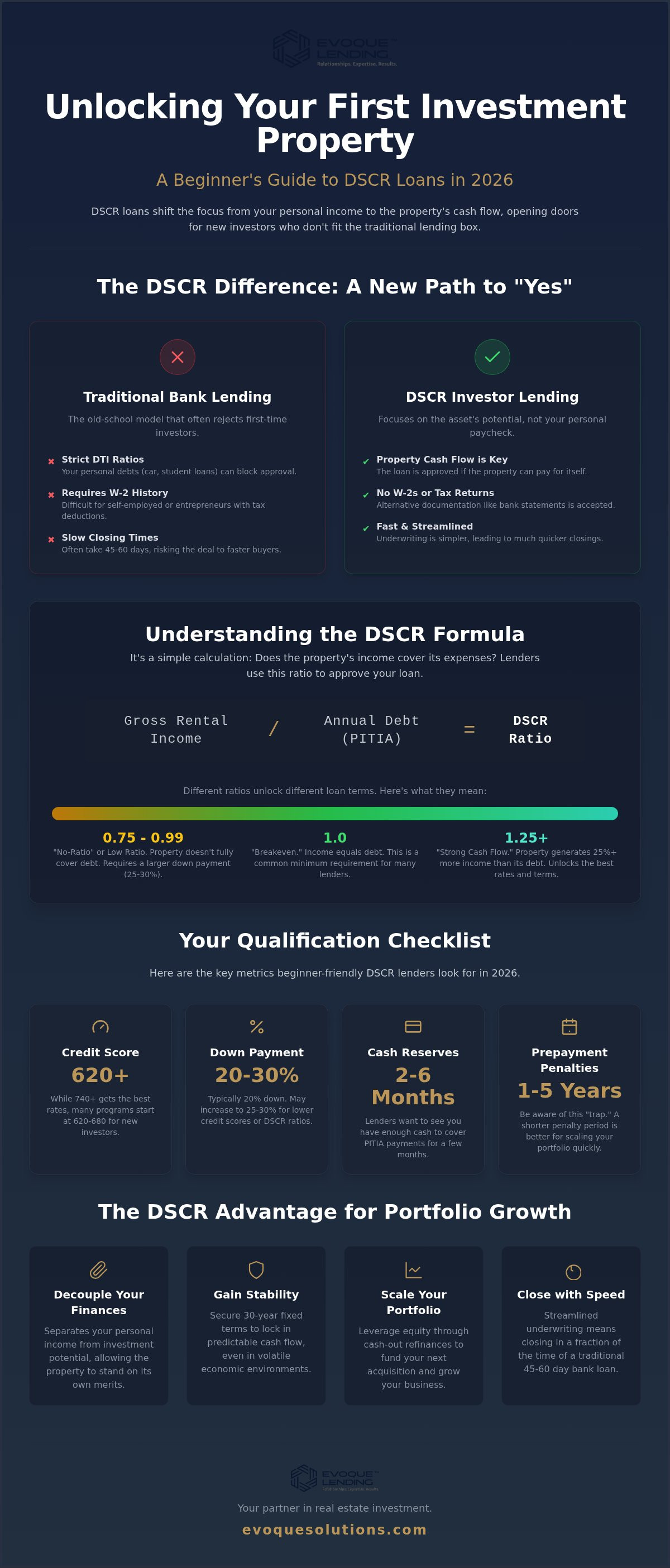
The 2026 rental market requires more than just capital; it requires the right financial architecture. For many, a dscr loan for first time investors is the bridge between a dream and a deed. Unlike traditional mortgages that scrutinize your personal paycheck, these specialized loans focus on the property's ability to pay for itself. Lenders calculate the Debt Service Coverage Ratio by comparing the property's gross rental income to its annual debt obligations. If the numbers align, the loan moves forward. This shift in perspective allows you to qualify based on property potential rather than your personal history.
Success in this environment isn't just about finding the lowest rate. It's about finding a partner who understands that you're building a business, not just buying a house. Beginners often need more than a transaction; they need a guide to help them understand how a 1.0 ratio or a 1.25 ratio impacts their long-term growth. Choosing a lender with a "matchmaker" approach ensures you're paired with a program that fits your specific financial profile.
Why Traditional Banks Say 'No' to Beginners
Traditional lenders are often stuck in an outdated mindset. They rely heavily on Debt-to-Income (DTI) ratios, which count your car payments, student loans, and primary mortgage against your ability to buy an investment property. This "DTI Trap" can stop your portfolio growth before it starts. If you're a modern entrepreneur or a self-employed professional, your tax returns might show heavy deductions that lower your "on-paper" income. While this is great for tax season, it's a deal-breaker for big banks that require two years of consistent W-2 history. DSCR loans are the standard for 2026 because they are Non-QM (Non-Qualified Mortgage) products, meaning they bypass these rigid institutional barriers to serve real-world investors.
The 2026 Advantage: Why Now
is the Time for DSCR
Speed is the primary currency in today's competitive national markets. Traditional bank loans can take 45 to 60 days to close, often causing investors to lose out to cash buyers. A dscr loan for first time investors can often close in a fraction of that time because the underwriting process is streamlined. You aren't digging through years of personal financial records; you're verifying the property's rent potential and your own credit stability. DSCR serves as a financial firewall that decouples your personal income from your investment potential, allowing the property to stand on its own merits. This allows you to secure 30-year fixed terms and lock in your cash flow even when the broader economic environment feels volatile.
Key Criteria for Choosing a Beginner-Friendly DSCR Lender
For a new investor, the fine print often matters more than the headline interest rate. While many lenders advertise aggressive terms, a dscr loan for first time investors requires a specific set of guidelines that prioritize accessibility. You need to look beyond the surface to find a partner that understands the nuances of entry-level investing. This means evaluating the credit floor, the ratio requirements, and the long-term flexibility of the loan structure.
Credit scores are the first gatekeeper. While the most competitive pricing is reserved for those with a 740 FICO or higher, many beginner-friendly programs accept scores as low as 620 to 680. Similarly, you must identify the lender's "ratio floor." Most national providers require a minimum DSCR of 1.0, meaning the property's income at least covers the debt. However, some specialized lenders allow for a 0.75 ratio or even a "no-ratio" option if you provide a larger down payment, typically in the 25 to 30 percent range. You should also expect to hold 2 to 6 months of PITIA (Principal, Interest, Taxes, Insurance, and Association dues) in cash reserves to demonstrate financial stability.
Prepayment penalties are another critical factor. These are common in the DSCR world and can last from one to five years. If you plan to scale quickly by refinancing your equity, a long prepayment penalty can become an expensive trap. Always ask for a clear breakdown of these terms before signing your disclosures.
Guidance vs. Automation: The Support Factor
Beginners often make the mistake of choosing a pure robo-lender platform for its sleek interface. While automation is fast, it lacks the human expertise needed when an appraisal comes in lower than expected or a lease agreement is missing a key clause. A dedicated loan specialist acts as your advocate during the underwriting process, providing transparent communication that a software algorithm cannot replicate. Many top lenders now offer specific "First-Time Landlord" programs that provide extra oversight for those who don't yet have a track record of managing rental units.
Flexibility in Property Types
Your strategy might involve more than just single-family homes. Some lenders excel at financing for multi family investment properties, which can offer better cash flow through scale. If you're eyeing the vacation rental market, ensure the lender is Short-Term Rental (STR) friendly and willing to use AirDNA data to qualify the property's income potential. Property-specific underwriting allows borrowers with significant liquid assets but low W-2 income to qualify by focusing on the collateral's revenue rather than personal salary. Finding the right fit requires a personalized loan matching service that looks at your unique investment goals.
The 7 Best DSCR Lenders for Beginners: 2026 Roundup
Identifying the right dscr loan for first time investors requires comparing those who prioritize volume against those who prioritize borrower alignment. In 2026, the market is split between tech-heavy platforms and relationship-driven brokers. For a beginner, the best lender is often the one that offers the most flexibility rather than the one with the flashiest marketing. You need a partner that will look at the property's income potential and your credit profile as a complete story.
Evoque Lending stands out as the best overall choice because of its matchmaker advantage. Operating since 2005, they bring over 20 years of experience to the table, helping beginners navigate the complexities of dscr loans for real estate investors. By accessing dozens of programs across more than 40 states with a single credit pull, they eliminate the need for you to shop around manually. This personalized matching ensures you land with a lender that actually accepts your specific credit and ratio profile.
Other top national picks offer specialized benefits for different strategies. Visio Lending remains a staple for long-term buy-and-hold investors, offering reliable 30-year fixed terms that provide predictable cash flow. If speed is your primary metric, Kiavi (now Figure) uses a highly automated tech platform to move through the pipeline quickly. Lima One Capital provides specific draws and project oversight for those focused on the "BRRRR" method or small multi-family deals. Additionally, the market in 2026 includes specialized providers for short-term rentals using AirDNA data, foreign national programs for international buyers, and no-ratio lenders who prioritize high-equity positions over monthly cash flow.
Evoque Lending: The Beginner's 'Matchmaker' Advantage
The primary hurdle when securing a dscr loan for first time investors is the fear of rejection from a single-source lender. If you apply directly to a bank and don't fit their narrow box, your deal is dead. Evoque Lending solves this by acting as a specialized guide. Their broker-led approach means they do the legwork to find which of their many partners is currently hungry for beginner deals. This advocacy is crucial when you're still learning the ropes of appraisal reviews and title requirements.
Institutional vs. Boutique Lenders
Large institutional players offer efficiency but often have rigid underwriting. If your deal falls slightly outside their parameters, you're out of luck. Boutique brokers and specialized firms often provide higher approval rates for outside-the-box deals because they can advocate for the property's specific merits. This human touch is often the difference between a closed loan and a missed opportunity in a competitive market.
Lender Type
Min Credit
Max LTV
Experience Needed
Evoque Lending (Broker)
620
80%
None Required
Visio Lending (Direct)
680
75%
None Required
Figure/Kiavi (Tech)
660
80%
Preferred
Lima One (Specialty)
660
75%
None Required
STR Specialists
680
75%
None Required
How to Qualify for Your First DSCR Loan: A Step-by-Step Strategy
Qualifying for a dscr loan for first time investors is a methodical process that prioritizes property performance over your personal paycheck. Because these loans are underwritten based on the asset, your preparation should focus on data rather than tax returns. Success begins with understanding the specific hurdles of the 2026 market and organizing your documentation to meet institutional standards.
- Step 1: Run the Math. Calculate your projected debt service coverage ratio mortgage using current market rents. You must ensure the gross income covers the principal, interest, taxes, insurance, and any HOA fees.
- Step 2: Gather Alternative Documentation. Since you aren't using W-2s, you'll need two to six months of bank statements to verify reserves. 1099s or asset statements can also support your overall financial profile.
- Step 3: Form your LLC. Most lenders require or strongly prefer lending to a business entity. This protects your personal assets and aligns with the business purpose nature of the loan.
- Step 4: Order the Appraisal. The lender will request a Form 1007, which is a specialized report where an appraiser confirms the fair market rent for the area.
- Step 5: Finalize Reserves and Close. Be prepared to show liquid cash for closing costs and the required reserve period, which typically ranges from 3 to 12 months of payments depending on the loan size.
The Secret to a '1.0+' Ratio
A ratio of 1.0 means the property breaks even. To secure the best terms, you should target properties where the rental income comfortably exceeds the PITI. If a property falls below this threshold, lenders may still approve the deal, but they'll likely require a higher down payment to reduce the debt service. The 1007 Rent Schedule is the single most important document in your loan file because it provides the independent appraiser's verification of the property's fair market rental value. If you're unsure where your property stands, get pre-qualified for your first deal to see your realistic ratio options.
Requirements for LLC Borrowers
DSCR loans are classified as business purpose loans, which is why borrowing through an LLC is the industry standard. You'll need to provide your Articles of Organization, an EIN from the IRS, and a formal Operating Agreement. Even though the loan is in the name of the business, you'll still provide a personal guarantee. This means the lender looks at your personal credit score as a measure of your reliability, even if they don't look at your personal income. This structure allows you to build a commercial credit profile while keeping your personal debt-to-income ratio clear for future purchases.
Scaling Your Portfolio with Evoque Lending’s Specialized Support
Securing your first dscr loan for first time investors is a significant milestone, but it's only the starting line. Real wealth in real estate is built through repetition and strategic equity management. Once your initial property begins generating consistent cash flow, you can leverage that success to acquire additional assets. Many investors use a cash-out refinance to pull equity from their first property, providing the down payment for their second or third deal without needing to save from their primary salary.
As you grow, you'll need to decide between maintaining individual DSCR loans or consolidating into a portfolio loan. Individual loans offer flexibility and can be easier to manage on a property-by-property basis. Conversely, a portfolio loan allows you to cross-collateralize multiple properties under a single debt instrument, which can sometimes provide more favorable terms as your total loan volume increases. Evoque Lending specializes in growing a real estate portfolio without tax returns, ensuring that your expansion isn't stalled by personal income caps.
The Evoque Process: From Questionnaire to Funding
The journey with Evoque begins with a simplified online questionnaire designed for speed and transparency. We don't require an initial hard credit pull to provide a quote, which protects your score while you're exploring your options. You'll be paired with a dedicated loan specialist who understands the specific dynamics of the 2026 rental market. This expert guide helps you navigate specialized programs, whether you're looking for Short-Term Rental loans for a vacation property or Foreign National loans for international investors. This personalized attention ensures your financing strategy aligns with your long-term business goals.
Strategic Growth: The 2026 Investor’s Path
The first dscr loan for first time investors is often the most challenging because you're establishing your track record. However, the process becomes significantly smoother once you've demonstrated your ability to identify and manage a cash-flowing asset. Before you scale, it's vital to weigh the dscr loan pros and cons to ensure you're using the right leverage for each specific deal. To prepare for your next move, review this final checklist:
- Confirm your LLC is in good standing with the secretary of state.
- Verify your liquid cash reserves meet the required PITIA thresholds for your loan size.
- Review the current market rents for your target zip code to ensure a healthy ratio.
- Ensure your credit score remains above the 620 to 680 floor for entry-level programs.
Ready to see what you qualify for? Start your journey by filling out our quick pre-qualification questionnaire today and connect with a specialist who can help you build your portfolio.
Start Building Your Real Estate Legacy Today
The 2026 market offers a unique opportunity for those who move beyond the constraints of traditional banking. By focusing on a property's cash flow rather than your personal tax returns, you unlock a path to rapid portfolio growth. Securing a dscr loan for first time investors is the first step toward financial independence; it allows the asset's performance to speak louder than your personal debt-to-income ratio.
Evoque Lending provides the specialized support you need to succeed in this competitive landscape. Our team brings over 20 years of expert guidance in the Non-QM space and offers national reach across more than 40 states. We act as a dedicated advocate for your investment goals, providing specialized matching for beginners, 1099 earners, and self-employed individuals. We understand that your financial situation is unique, and we're here to help you find the perfect alignment for your first deal.
Get a Personalized DSCR Loan Match in Minutes to see which programs fit your investment strategy. Your journey toward a scalable rental portfolio starts with a single, well-placed loan.
Frequently Asked Questions
Is a DSCR loan good for beginners with no experience?
A DSCR loan is an excellent tool for beginners because it allows you to qualify based on the property's income potential rather than your personal landlord history. While some institutional lenders prefer a track record, many specialized programs are designed specifically to help you secure a dscr loan for first time investors. You simply need to demonstrate that the rental market supports the debt service and that you have the required cash reserves to manage the asset.
What is the minimum credit score for a DSCR loan in 2026?
In 2026, the minimum credit score for most DSCR programs typically ranges between 620 and 680. While you can secure financing with a lower score, the most competitive interest rates and highest loan-to-value ratios are reserved for borrowers with a FICO of 740 or higher. Lenders use your credit history as a measure of financial reliability, even though they aren't scrutinizing your personal debt-to-income ratio or annual tax returns during the underwriting process.
Can I get a DSCR loan for a primary residence?
No, you cannot use a DSCR loan for a primary residence or any property you intend to occupy. These are strictly business purpose loans intended for investment properties that generate rental income. Using this type of financing for a home you live in would violate the loan agreement and federal lending regulations. If you're looking to purchase a home for yourself, you'll need to explore traditional mortgage products or alternative documentation loans like bank statement programs.
How much down payment do I need for my first DSCR property?
Most beginners should expect to provide a down payment of 20% to 25% of the property's purchase price. While some aggressive programs may allow for 15% under specific conditions, a 20% stake is the industry standard for maintaining a healthy debt service coverage ratio. This larger equity position reduces the lender's risk and helps ensure the property's rental income is sufficient to cover the monthly principal, interest, taxes, insurance, and association dues.
Do DSCR lenders require an LLC to be formed?
Many DSCR lenders require you to close the loan in the name of an LLC or other business entity, though some boutique firms allow for personal names. Borrowing through an LLC is standard practice for a dscr loan for first time investors because it provides a layer of asset protection and reinforces the business nature of the transaction. You'll need to provide your Articles of Organization, an EIN, and an Operating Agreement to satisfy these requirements during the closing process.
What happens if the rental income is less than the mortgage payment?
If a property's rental income doesn't fully cover the mortgage payment, you may still qualify for a no-ratio or low-ratio DSCR loan. These programs typically require a lower loan-to-value ratio, meaning you'll need to provide a larger down payment, often 30% or more. This structure mitigates the lender's risk when the property's cash flow is tight. It's a common solution for properties in high-growth areas where current rents haven't yet caught up to property values.
Are DSCR loan interest rates higher than traditional mortgages?
Yes, interest rates for DSCR loans are typically 0.5% to 1.5% higher than those for conventional W-2 mortgages. This price difference reflects the increased flexibility of the loan and the fact that the lender is not verifying your personal income or debt-to-income ratio. Most investors find the slightly higher rate is a fair trade-off for the ability to close deals quickly and scale their portfolios without the restrictive documentation requirements of a traditional bank.
How long does it take to close a DSCR loan compared to a bank loan?
Closing a DSCR loan is significantly faster than a traditional bank loan, often taking just 21 to 30 days. Traditional mortgages frequently require 45 to 60 days because of the extensive personal financial underwriting involved. Since DSCR lenders focus primarily on the property's appraisal and rent schedule, the process is streamlined. This speed allows you to compete with cash buyers and secure properties in hot markets where sellers prioritize a quick and certain closing timeline.
Reviewed by Eddie Luhrassebi, Founder & CEO, NMLS #337071 | CA DRE #01230650
Last updated: September 12, 2026 · About the reviewer