1099 Mortgage Loans for Contractors: 2026 Non-QM Guide
Written by Eddie Luhrassebi · Published September 2, 2026
Qualify for 1099 mortgage loans for contractors using gross income instead of tax returns. Our 2026 non-QM guide helps you secure your dream home.
Why should your accountant's success in lowering your tax liability be the very thing that prevents you from owning a home? It's a frustrating irony that many professionals exploring 1099 mortgage loans for contractors face. You've built a thriving career with high gross revenue, yet conventional lenders only look at the bottom line of your tax returns after every legal deduction has been applied. Being rejected because your net income looks too low on paper feels like a penalty for being a savvy business owner.
You deserve a lending partner that understands the practical realities of how modern entrepreneurs operate. We're going to show you how to qualify for a mortgage using your gross 1099 earnings rather than your tax-deducted profit. This guide breaks down the transition from traditional rejection to non-QM approval for the 16.5 million self-employed individuals currently powering the U.S. economy. We'll explain how to bypass years of tax returns, clarify the difference between 1099 and bank statement programs, and secure a competitive interest rate in the 2026 market. Your homeownership goals shouldn't be sidelined by your business's tax efficiency.
The Evolution of 1099 Mortgage Loans for Modern Contractors
The workforce has evolved, but most big banks are still stuck in a rigid 1990s mindset. If you're an independent professional, you've likely hit the "Tax Deduction Paradox." You work hard to maximize business write-offs to keep your tax bill low. While your accountant is happy, your loan officer at a traditional bank sees a borrower who doesn't earn enough. This disconnect is why 1099 mortgage loans for contractors have become a staple for the modern workforce in 2026.
These aren't standard government-backed products. Instead, they're specialized Non-Qualified Mortgage (Non-QM) solutions. By focusing on your gross revenue rather than your net taxable profit, these loans solve the documentation gap. They allow you to prove your creditworthiness without sacrificing the tax benefits of self-employment.
Why Traditional Banks Struggle with 1099 Income
Standard underwriting is built for W-2 employees with fixed paychecks. When a contractor applies, the lender looks at the "Schedule C" on their tax returns. They focus on the net profit after every deduction for equipment, travel, and home office expenses has been subtracted. This rigid reliance on debt-to-income (DTI) ratios based on net profit often makes high earners look unqualified on paper. Gross income is the superior metric for contractor stability in 2026 because it reflects total cash flow before elective accounting strategies reduce your taxable bottom line.
The Rise of Non-QM Lending for the Gig Economy
The lending market has finally adjusted to the reality of the 16.5 million self-employed Americans currently in the workforce. As of July 2026, non-QM loans account for roughly 10% of total mortgage volume. Lenders in this space assess your ability to repay using logic-based underwriting and alternative data points such as:
- Total gross earnings from 1099-NEC and 1099-MISC forms.
- Consistency of contract renewals and industry experience.
- Year-to-date profit and loss statements.
This shift accommodates diverse needs, from freelancers to those seeking non-qm loans for real estate investors. By analyzing 1099 forms instead of personal tax returns, 1099 mortgage loans for contractors provide a streamlined path to approval. It's a strategic move that treats your independent career as a professional asset rather than a risk factor.
Decoding Qualification: How Lenders Calculate 1099 Income in 2026
Qualification for 1099 mortgage loans for contractors doesn't follow the same rigid path as a W-2 application. Traditional banks look at your net profit after all business expenses are deducted, which often leaves your qualifying income too low. Non-QM lenders take a more logical approach. They focus on your gross earnings as reported on IRS Form 1099-NEC or 1099-MISC. When reviewing the Best Mortgage Lenders For Self-Employed, it becomes clear that specialized documentation is the key to unlocking higher loan amounts. By applying a standard expense factor, lenders can verify your ability to repay without requiring years of personal tax returns.
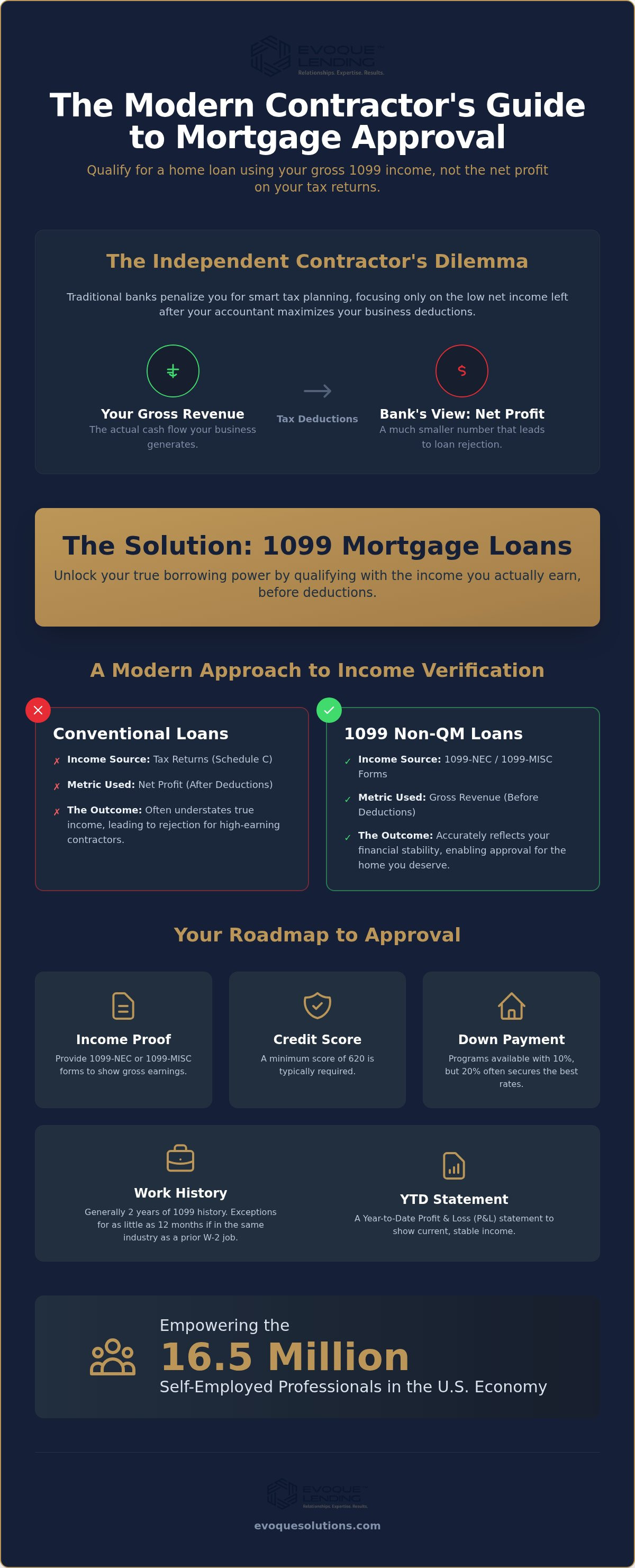
Beyond the 1099 forms themselves, you'll need to provide a Year-to-Date (YTD) earning statement. This document bridges the gap between your last tax year and your current financial status, proving that your income is stable or growing. For most specialized programs in 2026, you should expect a minimum credit score requirement of 620. While some programs allow for a 10% down payment, bringing 20% to the table often secures the most competitive terms in the current market.
The 2-Year History Rule and Its Modern Exceptions
Lenders generally prefer to see a two-year history of 1099 income to establish a reliable average. However, exceptions exist for professionals who can prove "industry continuity." If you recently transitioned from a W-2 role to a 1099 contractor position within the same field, you may qualify with as little as 12 months of self-employment history. The goal is to demonstrate that your client base is consistent and your earning potential is sustainable. Lenders look for a clear pattern of payments from reputable clients to validate the strength of your business.
Calculating Your Maximum Loan Amount
The math behind these loans is where the real advantage lies for independent earners. Instead of using the deduction-heavy net profit from your tax returns, lenders apply a standard expense ratio, which typically ranges from 10% to 25%. For example, if you gross $200,000 and the lender applies a 20% expense factor, they'll qualify you based on $160,000 in annual income. This is a massive improvement over a conventional lender who might only see $60,000 in net profit after your legal write-offs. Your purchasing power can often double when switching from conventional to 1099-based qualification. Evaluating your specific income structure is the best way to start. You can explore your eligibility through a quick assessment of your current 1099 earnings.
1099 Loans vs. Bank Statement Programs: Choosing Your Best Path
Comparing these two paths requires a look at your specific business structure. While both options bypass the need for traditional tax returns, the documentation burden varies significantly. For most professionals, the choice comes down to how your income is distributed across your client base. Understanding the nuances of each program allows you to maximize your borrowing power without getting bogged down in unnecessary paperwork.
1099 mortgage loans for contractors are designed for those with a concentrated source of income. If you have one or two major contracts, the 1099-NEC forms you receive act as a clear, verified record of your gross earnings. This approach often leads to a higher debt-to-income (DTI) ratio because lenders focus on the total figures shown on these forms rather than the granular details of your monthly spending. It's a streamlined way to prove your financial strength by leveraging the reputation of the companies that pay you.
When to Choose a 1099 Mortgage
This program is ideal if you've maintained 1-3 long-term, stable contracts over the last two years. The primary benefit is simplicity. You won't need to provide dozens of monthly bank statements or explain every large deposit. It's a cleaner underwriting process that relies on the strength of your primary clients. It's particularly effective for consultants or tech professionals who work on a project basis for large firms. If your business involves high transaction volume from many sources, you might find more flexibility in bank statement loans for self employed professionals.
When a Bank Statement Loan Wins
A bank statement loan is often the superior choice for business owners with hundreds of small clients or cash-heavy operations. If you don't receive 1099 forms from every customer, your bank deposits are the only way to prove your true liquidity. These programs allow you to use either personal or business bank statements to qualify. Lenders typically average 12 to 24 months of deposits to determine your monthly income, which provides a holistic view of your business health.
Another advantage of the bank statement route is the ability to include asset-based components. If you have significant savings or liquid investments, these can be used to strengthen your application and offset a higher DTI. While 1099 mortgage loans for contractors offer a more streamlined document list, bank statement loans provide the flexibility needed for complex, high-volume business models. Selecting the right path ensures you maximize your purchasing power while keeping the interest rate as competitive as possible. Your goal is to align the documentation with the way you actually earn your money.
The Contractor’s Roadmap to Mortgage Approval Without Tax Returns
Securing 1099 mortgage loans for contractors requires a shift in perspective. You are no longer presenting your business to the IRS; you are presenting its strength to a lender. Instead of focusing on how to minimize your taxable income, the goal is to demonstrate a consistent, high-velocity cash flow. Underwriting for these specialized products is methodical. It follows a logical path that rewards transparency and organization over traditional tax-return net profit.
The process starts with four critical steps. First, you must organize your 1099-MISC or 1099-NEC forms for the last two full calendar years. This provides the historical baseline for your earnings. Second, you will need a professional Year-to-Date (YTD) profit and loss statement. This bridges the gap between your last filing and your current financial health. Third, audit your credit profile specifically for Non-QM readiness. While 620 is a common minimum score for entry, higher mid-scores often unlock more favorable terms. Finally, you must source your down payment and prove you have liquid reserves. Lenders typically look for 3 to 6 months of mortgage payments in your accounts to ensure you can weather any temporary gaps between contracts.
Organizing Your 1099 Paperwork
Consistency is the primary metric lenders use to gauge risk. You must ensure that the income reported on your YTD statements aligns with the trajectory shown in your previous 1099 forms. Gaps between contracts are a common reality for independent professionals and don't have to be a deal-breaker. A simple letter of explanation can clarify why a specific month was slow or why you had a one-time business expense that temporarily lowered your cash flow. This narrative helps the underwriter see the person behind the numbers.
Setting Up Your Professional Profile
Operating as a formal business entity like an LLC or S-Corp can add a layer of corporate credibility to your file. Lenders will often verify that your business is still active through third-party sources, such as a business license or a letter from your CPA. If you have significant liquid savings but your monthly cash flow is currently uneven, you might consider working with an asset depletion mortgage lender to use your overall wealth as a qualifying factor. This flexibility is what makes specialized lending so effective for the modern contractor. You can start your online assessment today to see which documentation path fits your current business structure best.
Why Specialized Non-QM Lending is the Strategic Choice for 1099 Earners
Choosing the right partner for 1099 mortgage loans for contractors is just as critical as the documentation itself. Many traditional institutions treat non-QM borrowers as an afterthought, forcing them through a W-2 underwriting engine that isn't designed to handle contractor income. Evoque Lending operates differently by providing personalized loan matching that aligns with your specific financial footprint. Since 2005, we've focused on the practical realities of independent work, ensuring that your gross revenue is recognized as the strength it truly is.
Our national reach extends to 40+ states, providing a consistent solution whether you're purchasing a primary residence or seeking a cash-out refinance. We've replaced the slow, manual bureaucracy of big banks with a streamlined online questionnaire. This technology allows our specialists to quickly identify the best program for your needs, even in complex scenarios involving multiple income streams or significant liquid assets. We advocate for you throughout the process, ensuring the underwriter understands the stability of your business model.
Beyond 1099: Scaling
into Real Estate Investment
Once you've secured your primary residence, your 1099 status can become a powerful tool for wealth building. Many contractors find that their business structure is perfectly suited for transitioning into rental property ownership. By leveraging dscr loans for real estate investors, you can qualify for financing based on the property's potential income rather than your personal tax returns. This strategy allows you to scale a portfolio without the documentation hurdles often found in traditional investment lending.
Taking the First Step Toward Your 2026 Home Purchase
Preparation is the foundation of a successful 2026 home purchase. A pre-qualification from a specialist who understands Non-QM guidelines is worth more than a standard letter from a retail bank. Our team works to ensure your file is underwriter-ready before you even make an offer. We believe that independent professionals are the backbone of the economy and deserve a mortgage experience that reflects their success. When you're ready to move forward, we're here to provide the expertise and advocacy you need to secure your future home. Your path to homeownership doesn't have to be blocked by traditional banking rules.
Securing Your Homeownership Future in 2026
The path to homeownership for independent earners has fundamentally changed. You no longer need to fear the "Tax Deduction Paradox" that often leads to rejection at traditional banks. By focusing on your gross revenue and utilizing specialized 1099 mortgage loans for contractors, you can unlock the purchasing power your hard work has earned. Whether you choose a 1099-specific program or a bank statement loan, the key is aligning your documentation with your business's unique cash flow structure.
Since 2005, Evoque Lending has provided expert Non-QM guidance to help self-employed professionals bridge the gap between business success and personal stability. With national lending capabilities across 40+ states, we offer the specialized solutions and advocacy needed to navigate the 2026 market. Don't let conservative banking rules stall your progress. It's time to leverage your actual earnings rather than your taxable bottom line.
See if you qualify for a 1099 mortgage with our quick questionnaire and take the first step toward your new home today. You've built a successful career; it's time your mortgage reflected that achievement.
Frequently Asked Questions
Can I get a mortgage with 1099 income alone?
Yes, you can secure a mortgage using only your 1099 income through specialized Non-QM programs. These loans are specifically designed for independent contractors who don't have traditional W-2 earnings. Instead of tax returns, lenders verify your ability to repay by looking at your gross earnings from 1099-NEC or 1099-MISC forms. This approach allows you to qualify based on your top-line revenue rather than your net profit after business expenses.
Is it harder to buy a house with a 1099 vs a W-2?
Buying a house with 1099 income isn't necessarily harder, but it requires a different documentation strategy. Traditional lenders often struggle with contractor income because they rely on net profit from tax returns. However, 1099 mortgage loans for contractors simplify the process by using alternative verification methods. While you'll need to stay organized with your paperwork, specialized lenders provide a more logical path to approval than big banks that only understand standard paystubs.
What is the minimum credit score for a 1099 mortgage loan?
Most 1099 mortgage programs require a minimum credit score of 620 to qualify. While this is the baseline, having a higher score often leads to better terms and more flexible debt-to-income ratios. Lenders use your mid-score to determine your risk profile and interest rate tier. It's helpful to audit your credit report before applying to ensure there are no errors that could negatively impact your borrowing costs or final loan approval.
How much down payment do I need as a 1099 contractor?
You will typically need a down payment between 10% and 20% for a 1099 mortgage program. While some specialized lenders allow for a 10% down payment, a 20% down payment is common and often helps you secure a more competitive interest rate. Lenders also look for "reserves," which are liquid assets that can cover three to six months of mortgage payments. This extra layer of security helps offset the perceived risk of variable income.
Can I use 1099 income if I've been self-employed for less than two years?
Yes, it's possible to qualify with less than two years of self-employment history if you can prove industry continuity. Lenders look for a transition from a W-2 role to a 1099 position in the same field. If you have at least 12 months of 1099 history and a solid track record in your previous employment, many Non-QM programs will consider your application. This flexibility is essential for professionals who recently launched their own consultancy business.
What is the difference between a 1099 loan and a bank statement loan?
The primary difference lies in the source of income verification. A 1099 loan uses your annual 1099-NEC or 1099-MISC forms to calculate gross earnings, making it ideal for contractors with a few major clients. A bank statement loan averages 12 to 24 months of total deposits from your bank accounts. This is better for business owners with high transaction volumes or many small customers where 1099 forms might not cover their entire revenue stream.
Do 1099 mortgage loans have higher interest rates than conventional loans?
Yes, 1099 mortgage loans generally carry interest rates that are 1.25 to 3.00 percentage points higher than conventional 30-year fixed rates. This premium accounts for the alternative documentation and the perceived risk of non-traditional income. Many borrowers view these loans as a strategic bridge. They use the Non-QM product to purchase their home now and then refinance into a conventional loan once they meet the two-year tax return requirements or market conditions shift.
How do lenders calculate 1099 income if I have many write-offs?
Lenders calculate your qualifying income for 1099 mortgage loans for contractors by applying a standard expense factor to your gross earnings, typically ranging from 10% to 25%. This means they ignore your actual tax write-offs and instead assume a fixed percentage for business costs. If you gross $150,000, the lender might qualify you on $120,000 even if your tax returns show a much lower net profit. This method preserves your borrowing power.
Reviewed by Eddie Luhrassebi, Founder & CEO, NMLS #337071 | CA DRE #01230650
Last updated: September 2, 2026 · About the reviewer