
Purchase Investment Property DSCR Financing: The 2026 Investor Guide
Written by Eddie Luhrassebi · Published September 19, 2026
Master how to purchase investment property DSCR financing. Qualify via rental cash flow, bypass tax return hurdles, and scale your real estate portfolio today.
What if your tax professional's most brilliant strategies were actually the primary reason your bank just denied your latest mortgage application? It's a common frustration for seasoned investors who use legal write-offs to minimize their tax liability, only to have traditional lenders use those same numbers to disqualify them. If you're looking to grow your portfolio, purchase investment property DSCR financing offers a sophisticated alternative that ignores your personal tax returns entirely. By shifting the focus from your personal income to the property's projected rental cash flow, you can bypass the traditional debt-to-income hurdles that often stall professional growth.
You've probably felt the sting of being told you're "over-leveraged" simply because you're a successful business owner with a complex financial profile. We've designed this 2026 guide to help you reclaim your momentum by treating your rental properties as the standalone businesses they truly are. You'll learn exactly how to leverage these specialized instruments to scale past the typical 10-property limit and close deals with significantly less paperwork. From understanding current rate benchmarks to mastering the DSCR calculation, this is your blueprint for building a resilient, high-performance real estate portfolio on your own terms.
The Tax Return Trap: Why Conventional Financing Fails Investors
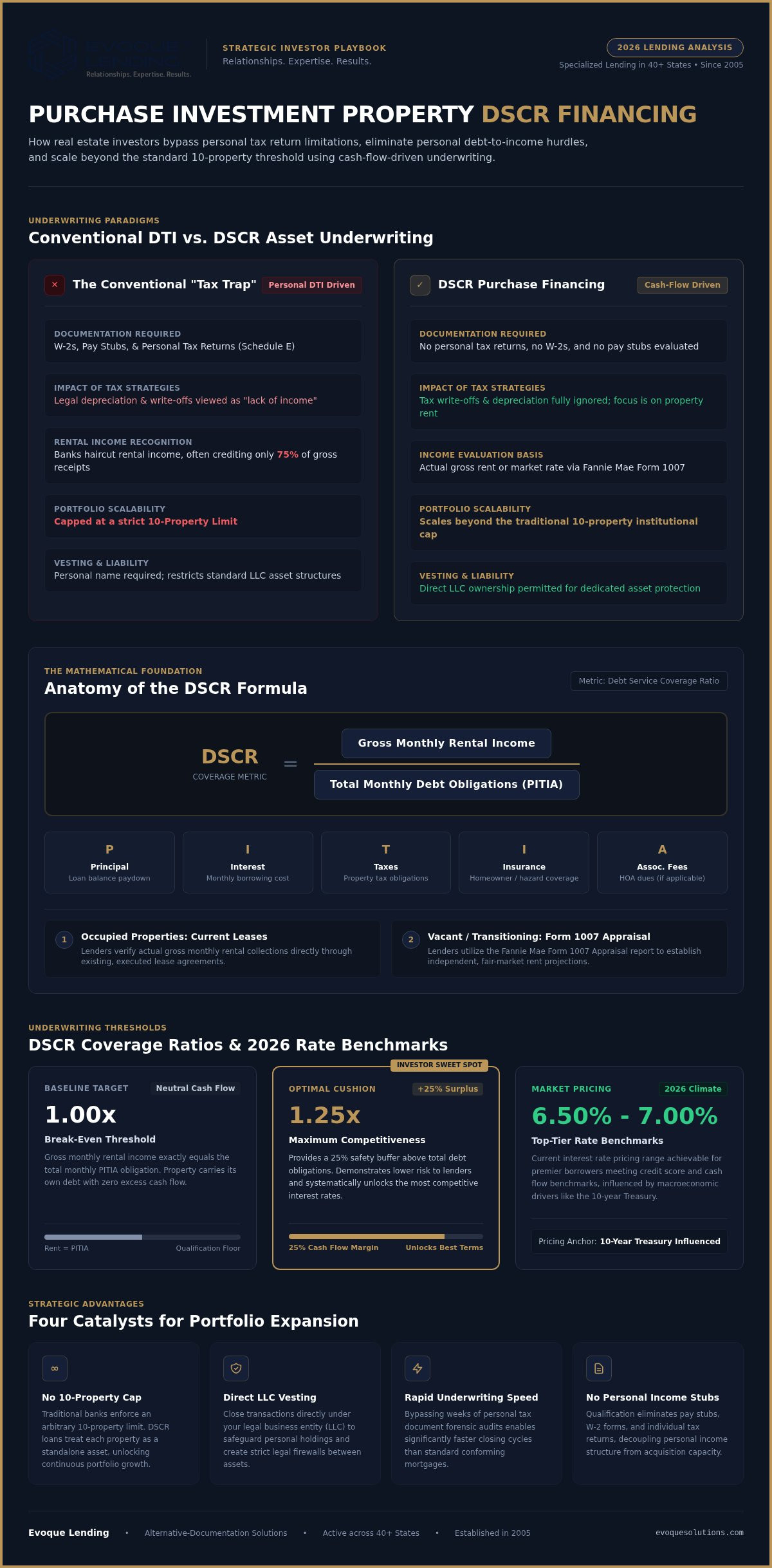
For most active investors, the annual tax season is a double-edged sword. You work with specialized professionals to maximize depreciation and cost segregation, effectively lowering your taxable income to keep more of your hard-earned capital. However, traditional banks view these legal "paper losses" as a lack of earning power. This conflict creates a frustrating barrier when you try to purchase investment property DSCR financing, as conventional lenders rely on outdated Debt-to-Income (DTI) ratios. These ratios calculate your personal ability to pay, ignoring the fact that a high-performing rental property is essentially a standalone business. By 2026, the gap between tax-optimized income and mortgage eligibility has only widened, making traditional financing a ceiling rather than a tool for growth.
The Limitations of W-2 Centric Lending
Traditional mortgage underwriting was designed for salaried employees, not entrepreneurs or serial investors. Banks often struggle to interpret complex Schedule E filings, and they frequently apply "haircuts" to existing rental income, sometimes counting only 75% of your gross receipts. In the 2026 market, where interest rate benchmarks like the 10-year Treasury influence pricing, these rigid DTI ceilings act as an artificial cap on your expansion. Lenders focused on W-2 income view any personal debt as a direct threat to your mortgage eligibility. This approach fails to recognize the inherent value of the real estate itself, often stalling portfolios just as they gain momentum.
DSCR
as a Strategic Growth Bypass
To break free from these constraints, sophisticated investors have shifted toward a more logical metric: the debt service coverage ratio. This formula measures the property’s gross monthly rent against its total debt obligations, including principal, interest, taxes, insurance, and HOA fees. When you purchase investment property DSCR financing, the property’s performance takes center stage. This allows you to grow real estate portfolio without tax returns, pay stubs, or W-2s. Since 2005, Evoque Lending has specialized in these alternative-documentation solutions, helping investors across 40+ states scale their holdings. By decoupling your personal finances from the property’s potential, you can hold title in an LLC and treat each acquisition as a strategic business move rather than a personal liability. This shift is essential for anyone aiming to move past the typical 10-property limit often imposed by institutional banks.
How Purchase Investment Property DSCR Financing Works
Understanding the mechanics of specialized lending starts with a single calculation. While a traditional mortgage underwriter spends weeks scrutinizing your personal bank statements, a DSCR lender focuses almost exclusively on the property's ability to pay for itself. To purchase investment property DSCR financing, you must demonstrate that the gross monthly rental income meets or exceeds the monthly debt obligations. This debt obligation, known as PITIA, includes the mortgage principal, interest, property taxes, homeowner’s insurance, and any applicable HOA fees. It’s a transparent, business-first approach that prioritizes the asset’s viability over your personal debt-to-income ratio.
The Anatomy of a DSCR Calculation
Lenders verify a property's income potential using two primary methods. For properties with existing tenants, they review the current lease agreements. For vacant properties or those transitioning into the rental market, lenders rely on the Fannie Mae Form 1007 Appraisal, which provides a professional estimate of fair-market rent. In the 2026 lending environment, a ratio of 1.0 means the property breaks even. However, achieving a ratio of 1.25 is often the "sweet spot" for investors. This 25% cushion over the monthly PITIA signals lower risk and typically unlocks the most competitive interest rates, which currently benchmark between 6.50% and 7.00% for top-tier borrowers. If you are unsure how your target property stacks up, you can explore customized rate scenarios based on your specific cash flow projections.
LLC Ownership and Asset Protection
One of the most significant advantages of this financing model is the ability to close in the name of a corporate entity. Conventional agency loans usually require you to hold the deed in your personal name, which exposes your private assets to potential litigation. Because DSCR loans treat the property as a standalone business, lenders often prefer or even require title to be held in an LLC. This structure aligns perfectly with IRS rental expense and depreciation rules, allowing you to manage your portfolio with professional-grade liability insulation. To move forward, you'll simply need to provide your LLC’s Articles of Organization and an Operating Agreement. This streamlined approach ensures your personal privacy remains intact while you scale your holdings across multiple states. It’s a cleaner, more secure way to build a real estate legacy without the administrative friction of traditional institutional banking.
DSCR vs. Conventional Loans: A 2026 Comparison
Choosing between a conventional mortgage and specialized financing often depends on your long-term scaling strategy. Conventional loans are strictly governed by the CFPB ability-to-repay rule, which mandates that lenders verify your personal income through rigorous documentation. This regulatory framework was designed to protect consumer borrowers, but it frequently creates bottlenecks for investors who operate through corporate entities. When you purchase investment property DSCR financing, you move into the realm of business-purpose lending. Here, the focus shifts from your personal tax liabilities to the property's income potential, offering a level of flexibility that traditional institutional banks simply cannot match.
Documentation and Friction Comparison
The documentation gap between these two paths is significant. A conventional loan application typically requires two years of full tax returns, W-2s, and 4506-C forms to verify every cent of your personal earnings. In contrast, the DSCR path is streamlined for speed and efficiency. You'll generally only need to provide:
- A professional appraisal including a Fannie Mae Form 1007 rent schedule.
- A standard credit report to verify your FICO score.
- Proof of liquid reserves to cover a designated number of monthly payments.
This reduced friction allows DSCR purchase loans to close 14 to 21 days faster than their conventional counterparts. In a competitive 2026 market, the ability to close in three weeks instead of six can be the difference between winning a bid and losing it to a cash buyer.
The Opportunity Cost of Conventional Lending
While conventional loans often boast lower initial interest rates, they carry a hidden cost: the 10-property wall. Fannie Mae limits individual borrowers to a maximum of 10 financed properties, often imposing even stricter LTV caps once you move past property number four. DSCR financing carries no such cap. This allows you to scale your portfolio to 20, 50, or 100 units without hitting an artificial ceiling. The "Non-QM Premium" typically results in a rate spread of 0.50% to 1.50% over conforming rates, but this is a small price for unlimited growth. If you're a self-employed buyer, it's also worth exploring the dscr vs bank statement loan debate to see which alternative documentation path aligns best with your 2026 acquisition goals. Ultimately, the slightly higher note rate is an investment in your ability to move quickly and scale without limits.
Strategic Steps to Secure DSCR Purchase Financing
Securing purchase investment property DSCR financing requires a tactical shift from personal income documentation to asset preparation. You aren't proving your personal ability to pay; you're proving the property's ability to perform as a standalone business. This process starts with a meticulous analysis of the property’s current or projected cash flow. In the 2026 market, where 1-unit conforming loan limits have reached $832,750, many investors find themselves pushed into high-cost tiers where traditional DTI limits are most restrictive. By following a structured acquisition plan, you can navigate these hurdles and secure the leverage needed to scale.
Mastering the DSCR Appraisal Process
The appraisal is often the most critical stage of the transaction. Unlike a standard residential appraisal, a DSCR appraisal includes Fannie Mae Form 1007 to establish "fair market rent." Appraisers look at comparable rental properties within a tight radius to determine what the unit should earn. If you're targeting a short-term rental (STR), professional lenders often accept projections from platforms like AirDNA to justify the higher income potential of an Airbnb or VRBO. If the appraised rent comes in slightly lower than your target ratio, don't panic. You can often "fix" a borderline ratio by opting for an interest-only payment structure, which reduces the monthly PITIA and brings the calculation back into alignment. If you're ready to see how your target property's numbers pencil out, you can request a custom DSCR quote to compare different leverage options.
Reserve Requirements and Liquidity
While your tax returns are off the table, your liquid assets are not. Lenders want to see a safety net to ensure the mortgage stays current during tenant turnovers or unexpected repairs. Most programs require between 3 and 12 months of PITIA reserves, depending on your total portfolio size and the loan-to-value (LTV) ratio. A significant advantage of DSCR lending is the flexibility of these reserve sources. You can typically use funds from:
- Personal checking and savings accounts.
- Brokerage accounts and stocks.
- Vested retirement accounts like a 401k or IRA.
Your liquid net worth directly impacts your tier pricing and maximum LTV. In 2026, well-qualified borrowers with a 740+ FICO score and ample reserves can still secure up to 80% LTV on purchase transactions. Finally, you'll need to choose between a 30-year fixed-rate structure for long-term stability or an interest-only period to maximize your immediate monthly cash flow. Each choice serves a different phase of the investor journey, and alignment with your five-year exit strategy is essential.
Scaling Your Portfolio with Evoque Lending
Evoque Lending isn't just another mortgage broker; it's a dedicated partner for the modern real estate entrepreneur. Since 2005, we've focused on solving the specific roadblocks that traditional banks create for high-growth investors. Whether you're navigating high-cost markets or managing a complex portfolio across multiple states, our team provides the specialized expertise needed to purchase investment property DSCR financing without the administrative friction of institutional lending. With national coverage in over 40 states, we provide a consistent, reliable funding source that scales alongside your ambitions.
Expert Support for Professional Investors
Our loan specialists don't just look at credit scores. They understand real estate ROI and the strategic importance of leverage. We recognize that your time is your most valuable asset, which is why we've refined our internal processes to prioritize speed and transparency. By accessing dscr loans for real estate investors, you're choosing a path designed for professional growth. We help you move beyond the "10-property wall" by utilizing your property's cash flow as the primary qualification tool. This approach ensures that your ability to acquire new assets isn't limited by your personal income or tax-optimization strategies.
Your Next Move: Pre-Qualification for 2026
The 2026 real estate market moves fast, and your financing needs to move faster. We've streamlined our entry process to remove unnecessary hurdles, starting with a simple online questionnaire that identifies the best program fit for your specific scenario. If a property's cash flow is tight but your overall net worth is strong, we can pivot to our role as an asset depletion mortgage lender. This flexibility allows us to use your liquid wealth to bridge qualification gaps that would stop a traditional bank in its tracks.
Our commitment is to transparency and tangible outcomes. We don't rely on high-pressure tactics; instead, we offer a steady, methodical path toward closing. If you're ready to purchase investment property DSCR financing and take full control of your portfolio's future, the first step is a conversation with a specialist who understands your business. Start your purchase journey today and experience the difference that 20 years of specialized lending experience makes.
Take Control of Your Real Estate Legacy in 2026
The path to a massive portfolio shouldn't be blocked by your own success at tax time. By shifting the focus to property cash flow, you gain the freedom to scale without the artificial ceilings of debt-to-income ratios or restrictive property limits. We've explored how purchase investment property DSCR financing functions as a business-first tool, offering faster closing times and the strategic protection of LLC ownership.
Since 2005, Evoque Lending has operated as a national Non-QM specialist, helping investors navigate complex acquisition scenarios with quiet confidence. We provide dedicated support for portfolio buyers and those seeking the privacy of corporate vesting. Your next acquisition doesn't have to wait for a bank's slow approval process or outdated documentation requirements. Get Started with Your DSCR Purchase Pre-Qualification today and see how a specialized partner can accelerate your growth. The 2026 market is full of opportunity; it's time you had the financing to match it.
Frequently Asked Questions
What is the minimum DSCR ratio for a purchase loan in 2026?
The standard minimum DSCR ratio for a purchase loan in 2026 typically starts at 1.0, meaning the property's gross rental income exactly covers the debt service. However, many lenders offer "no-ratio" programs for borrowers with larger down payments of 25% or 30%. Aiming for a ratio of 1.20 or higher often unlocks the most competitive interest rates and terms. This provides a safety cushion that lenders prefer for long-term stability and easier approval.
Can I use a DSCR loan to purchase a property through my LLC?
Yes, you can and often should purchase investment property DSCR financing through an LLC. Most specialized lenders prefer or even require title to be held in a corporate entity to separate personal liability from the business asset. This structure allows for enhanced privacy and asset protection across your entire portfolio. You will typically need to provide your LLC’s Articles of Organization and an Operating Agreement during the underwriting process to confirm the entity's standing.
Do I need to be employed or have a W-2 to qualify for DSCR financing?
You don't need traditional employment, W-2s, or pay stubs to qualify for this type of financing. DSCR loans are specifically designed for investors and self-employed individuals whose personal tax returns might not reflect their true purchasing power due to legal write-offs. Qualification relies almost entirely on the property’s rental income potential and your personal credit score. This allows entrepreneurs to scale their holdings without the friction of standard debt-to-income verification requirements.
What is the typical down payment requirement for a DSCR purchase?
Most purchase transactions require a minimum down payment of 20%, which equates to an 80% loan-to-value (LTV) ratio. For borrowers with lower credit scores or those seeking "no-ratio" options, the requirement might increase to 25% or 30%. Having ample liquid reserves can sometimes help secure higher leverage. These requirements ensure that the investor has sufficient equity in the deal, reducing the overall risk for the specialized lender in the 2026 real estate market.
Are DSCR loan interest rates higher than conventional investment loans?
DSCR interest rates are generally 0.50% to 1.50% higher than conventional conforming investment loans. This "Non-QM premium" accounts for the increased flexibility and reduced documentation requirements of the program. While the note rate is higher, many investors find the trade-off worthwhile due to the speed of closing and the ability to scale beyond the 10-property limit. It's an investment in acquisition speed and portfolio scalability that traditional institutional banks simply cannot provide today.
Can I use DSCR financing for short-term rentals like Airbnb?
Yes, DSCR financing is an excellent fit for short-term rentals such as Airbnb or VRBO properties. Lenders often use projections from specialized data providers like AirDNA to estimate the property's income potential if a traditional lease isn't in place. This allows you to leverage the higher cash flow typically associated with vacation rentals to meet the required coverage ratios. It is a strategic way to fund high-yield assets that traditional banks often struggle to underwrite.
Is there a limit to how many properties I can finance with DSCR loans?
There is no hard cap on the number of properties you can finance using DSCR loans. Unlike Fannie Mae and Freddie Mac, which strictly limit individual borrowers to 10 financed properties, DSCR lenders focus on the performance of each individual asset. This allows professional investors to scale their portfolios to dozens or even hundreds of units. As long as each property meets the minimum cash flow requirements, you can continue to expand your holdings indefinitely.
What happens if the property is vacant at the time of purchase?
If a property is vacant at the time of purchase, the lender will use the Fannie Mae Form 1007 Appraisal to determine the fair market rent. This professional estimate serves as the income figure for your DSCR calculation instead of an active lease agreement. This is a common scenario for turnkey purchases or properties transitioning between tenants. It ensures that you can still secure purchase investment property DSCR financing even without immediate rental receipts on day one.
Reviewed by Eddie Luhrassebi, Founder & CEO, NMLS #337071 | CA DRE #01230650
Last updated: September 19, 2026 · About the reviewer