
No Income Rental Property Mortgages: 2026 Investor Guide
Written by Eddie Luhrassebi · Published September 18, 2026
Get a no personal income mortgage for rental property. Learn how DSCR loans let you scale your portfolio without tax returns, strict DTIs, or payroll limits.
Why should your personal debt-to-income ratio dictate the growth of your real estate business when the property itself is the one generating the revenue? If you're an active investor, you've likely hit a "DTI ceiling" where traditional banks refuse to look past your tax returns. This frustration is common for those who maximize legitimate write-offs, only to be told they don't earn enough to qualify for their next acquisition. Securing a no personal income mortgage for rental property isn't just an alternative; it's a strategic shift that prioritizes the asset's performance over the individual's payroll.
We understand that your tax returns rarely tell the full story of your financial strength. This 2026 guide will show you how to secure long-term, 30-year financing by leveraging property cash flow instead of personal debt ratios. You'll learn the mechanics of Debt Service Coverage Ratio (DSCR) loans, from standard 1.20 benchmarks to the "no-ratio" programs gaining traction in high-appreciation markets. We will also cover how to streamline your closings and protect your personal credit by vesting directly into an LLC, allowing you to scale your portfolio without the invasive documentation of conventional lenders.
Beyond DTI: Why Investors Seek No Personal Income Mortgages
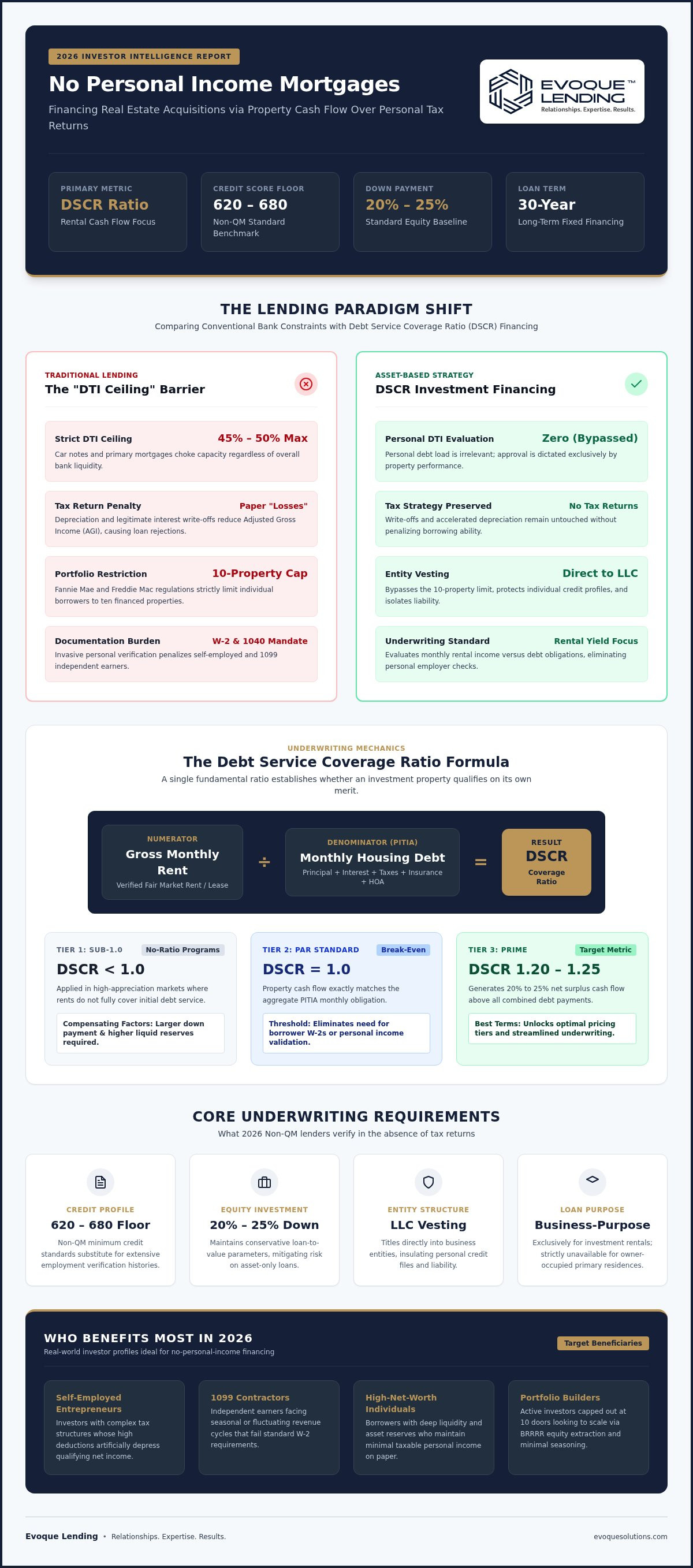
Traditional banking wasn't built for entrepreneurs. It relies on a narrow view of financial health called Debt-to-Income (DTI). For an investor, this creates a "DTI ceiling." Your personal car payment or primary mortgage shouldn't stop you from buying a profitable fourplex. A no personal income mortgage for rental property solves this by shifting the focus from your paycheck to the property's potential. Most conventional lenders enforce a strict DTI cap between 45% and 50%. Once your personal debt hits that threshold, your growth stops, regardless of how much cash you have in the bank.
You work hard to reduce your tax liability. Depreciation and interest write-offs are essential tools for wealth preservation. However, conventional lenders see these as "losses" that lower your qualifying income. It's a catch-22; the better you manage your taxes, the harder it is to get a bank loan. Asset-based lending removes this barrier by using the debt service coverage ratio (DSCR) to measure success. This metric ensures the property pays for itself, which is a far more accurate predictor of loan performance than your personal 1040. This approach specifically benefits:
- Self-employed entrepreneurs with complex tax structures.
- 1099 contractors who experience seasonal income shifts.
- High-net-worth individuals with significant assets but low taxable income.
- Investors who have reached the 10-property limit imposed by Fannie Mae and Freddie Mac.
The Flaw in Traditional Rental Financing
Big banks want W-2 stability. They don't understand that a self-employed investor's liquidity is often tied up in assets rather than a monthly salary. In the 2026 market, Non-QM (Non-Qualified Mortgage) lending has become the standard for professionals who don't fit the "standard" box. These loans acknowledge that paper losses on a tax return don't equal a lack of cash. While a bank might deny you because of a low Adjusted Gross Income, a specialized lender looks at your liquid reserves and the asset's yield. This shift allows you to maintain your tax strategy without sacrificing your ability to acquire new doors.
Qualifying Without Personal Employment Verification
A no-income mortgage for rental properties is a specialized tool. It doesn't mean the lender doesn't care about income; it means they care about the right income. They verify the property's rent instead of your employment history. This program is strictly for investment properties. You cannot use it for a primary residence because it falls under business-purpose lending. If you're looking for a deeper dive into strategy, read about Scaling Your Real Estate Portfolio Without Tax Returns. By removing the need for tax returns, a no personal income mortgage for rental property allows 1099 contractors and business owners to compete with institutional buyers. It levels the playing field for those who have the capital but don't have a traditional boss.
The DSCR Loan: The Gold Standard for No-Income Qualification
A no personal income mortgage for rental property relies almost exclusively on the Debt Service Coverage Ratio (DSCR). This metric is the primary tool for lenders who prioritize asset performance over personal wealth. Unlike conventional loans that scrutinize your personal debt-to-income ratio, a DSCR loan evaluates whether the property can pay for itself. Lenders calculate this by dividing the gross monthly rental income by the monthly PITIA, which includes principal, interest, taxes, insurance, and any HOA fees. If the result is 1.0 or higher, the property is breaking even or cash-flowing, effectively removing the need for a borrower’s W-2 or tax returns.
While a 1.20 or 1.25 ratio is often the target for prime pricing, 2026 has seen a rise in "no-ratio" or sub-1.0 programs. These are designed for high-appreciation markets where rents might not fully cover the mortgage initially. In these cases, lenders may require a larger down payment or higher liquid reserves to offset the risk. This flexibility ensures that your personal employment history or current DTI stays out of the underwriting process entirely, allowing you to move forward based on the property's merit alone.
How DSCR Lenders Evaluate Your Rental Property
Lenders determine the income side of the equation through an appraisal that includes a Fannie Mae Form 1007 Rent Schedule. This document establishes the market rent for the area based on comparable local listings. If the property is currently vacant, lenders use this market estimate to qualify the loan. If it’s already occupied, they typically use the lower of the actual lease agreement or the market rent. DSCR is the ratio of a property's annual net operating income to its annual mortgage debt service. This focus on the asset allows you to qualify for a no personal income mortgage for rental property even if your personal tax returns show high write-offs that would disqualify you at a traditional bank.
Key Benefits of DSCR Financing in 2026
Speed is a major advantage. Because there’s no invasive employment verification, these loans often close in 14 to 21 days compared to the 45-day cycle of a big bank. Additionally, there’s no limit on the number of financed properties you can own. Conventional guidelines usually cap investors at 10 properties, but DSCR lenders allow for unlimited growth. This makes it the ideal vehicle for DSCR Loans: 2026 Guide to Scaling Your Portfolio. If you’re ready to bypass traditional banking hurdles, you can explore specialized financing tailored to your cash-flow goals.
Comparing Your Options: DSCR vs. Bank Statement vs. Conventional
Choosing the right financing is about alignment. A no personal income mortgage for rental property comes in several forms, each tailored to a specific financial profile. While conventional loans offer the lowest interest rates, they require the most invasive documentation. Following Fannie Mae rental income guidelines means providing two years of tax returns and proving your personal income can support the debt. This is often impossible for professional investors who use legal deductions to minimize taxable income. The table below highlights how these options differ in the 2026 market.
Loan Type
Income Proof
Interest Rates (2026)
Down Payment
Conventional
Tax Returns / W-2
7.00% – 7.14%
15% – 25%
DSCR
Property Cash Flow
6.25% – 8.00%
20% – 25%
Bank Statement
Business Deposits
Non-QM Competitive
10% – 20%
Asset Depletion
Liquid Assets
Non-QM Competitive
20% – 30%
Conventional loans are built for consumers; professional scaling requires the flexibility of non-QM instruments. Once you hit the 10-property limit or your personal debt-to-income ratio maxes out, these products become a bottleneck. Asset-based lending allows you to move past these institutional barriers by focusing on the strength of your investments rather than your personal payroll.
Bank Statement Loans for Self-Employed Investors
Sometimes, a property doesn't cash flow perfectly on its own, but your business is thriving. This is where you might choose a Bank Statement loan. Instead of tax returns, lenders analyze 12 or 24 months of deposits to calculate your qualifying income. This path is ideal for investors who want to use their personal or business success to secure a no personal income mortgage for rental property. You can find more details in our Self-Employed Bank Statement Loans: Ultimate 2026 Guide.
Asset Depletion: Qualifying with Wealth, Not Work
What if you have wealth but no active job? Asset depletion converts your liquid holdings into a monthly income stream for qualification purposes. Lenders look at your stocks, bonds, and cash reserves, dividing the total by a set term to create a qualifying figure. It's a powerful tool for retirees or high-net-worth individuals with significant cash reserves. Learn more in our guide to Asset Depletion Mortgage Lenders: A 2026 Guide. This approach ensures your capital works for you, even without a traditional paycheck.
Requirements and Documentation for No-Personal-Income Loans
Qualifying for a no personal income mortgage for rental property is a streamlined process compared to the exhaustive audits of a traditional bank. Because the lender's risk is mitigated by the property’s cash flow, they focus on a few key pillars of stability rather than your personal paycheck. First, your credit score sets the foundation. While prime rates typically require a 720 or higher, the floor for most Non-QM programs starts between 620 and 680. Second, you should expect a down payment in the 20% to 25% range. Higher equity positions often allow for lower DSCR thresholds, providing a path forward even if a property's initial yield is tight.
These loans are versatile, covering single-family homes, 2-4 unit multi-family properties, and even short-term rentals. For Airbnb or VRBO properties, 2026 underwriting standards have evolved significantly. Specialized lenders now accept third-party market data from sources like AirDNA to project income, rather than relying solely on traditional long-term lease comparisons. You don't necessarily need to be a seasoned landlord to qualify; many programs are open to first-time investors who can demonstrate sufficient capital and a solid asset.
The Minimalist Document Checklist
The beauty of this financing model lies in what you don't have to provide. You can set aside your tax returns, W-2s, and pay stubs. Instead, the documentation focuses on the business side of the transaction. You'll need your entity documents if you're closing in an LLC, a credit report, and either a current lease agreement or a 1007 rent schedule from an appraiser. Lenders also require proof of liquidity reserves, typically showing 3 to 6 months of PITIA payments in a bank or brokerage account to ensure you can handle temporary vacancies without financial strain.
Borrowing
as an LLC or Entity
Vesting your property in an LLC is a strategic move that most DSCR lenders actually prefer. Unlike conventional loans, which often require you to close in your personal name, a no personal income mortgage for rental property is designed for business entities from day one. This structure provides a vital layer of liability protection, separating your personal assets from your real estate business. It also bypasses the "due-on-sale" risks associated with transferring a deed into an LLC after closing a personal loan. Closing in an entity name is the standard for professional scaling, as it keeps your personal credit report cleaner and simplifies the management of a growing portfolio. If you're ready to see how your entity qualifies, you can apply for a DSCR loan today and start the approval process based on your property's performance.
Strategic Scaling: How to Build Your Portfolio in 2026
Scaling a real estate business requires a fundamental shift in how you view and recycle capital. In the 2026 market, the most successful investors rely on the "BRRRR" method (Buy, Rehab, Rent, Refinance, Repeat) to grow their holdings without leaving their own cash trapped in a single deal. A no personal income mortgage for rental property is the primary engine for this strategy. While conventional lenders often enforce a 12-month title seasoning period before allowing a cash-out refinance, many specialized DSCR lenders allow you to access your equity in as little as 90 to 180 days. This velocity allows you to move capital from a stabilized asset into your next acquisition with minimal downtime.
National lending provides another layer of strategic flexibility. You aren't restricted to your local geography, where high entry prices might compress your yields. Because these loans prioritize the asset's performance, you can secure financing in any of the 40+ states where specialized capital is available. This allows you to target high-yield emerging markets while maintaining a consistent, streamlined closing process with a single partner who understands your long-term goals. Evoque Lending streamlines this process for national investors by focusing on the property's cash flow, ensuring that your personal location never limits your portfolio's potential.
From One Rental to Ten: The Velocity of Capital
Removing personal income constraints changes the trajectory of your growth. When your personal debt-to-income ratio is no longer a factor, your acquisition speed is limited only by your ability to identify cash-flowing deals. You can easily move past the 10-property ceiling that typically halts conventional borrowers. Evoque Lending has a 20-year history of matching investors with specialized capital, providing the expertise needed to navigate complex portfolio structures. This longevity ensures that your financing is built for durability across different market cycles.
Next Steps: Getting Your Pre-Approval
Successful scaling requires a partner who understands the nuances of Non-QM underwriting. A specialized guide helps you structure each deal to maximize your loan-to-value ratio and preserve your liquid reserves. You don't need to start with a hard credit pull; most professional lenders can provide a preliminary quote based on the property's estimated cash flow and your general credit profile. This transparency allows you to make offers with confidence. To begin the process, you can start your investment property questionnaire with Evoque Lending today. Having a clear understanding of your borrowing power is the first step toward building a resilient, high-yield portfolio.
Mastering Your Real Estate Growth in 2026
The path to a larger portfolio doesn't have to lead through the invasive documentation of a traditional bank. By shifting your focus to asset performance, you can bypass personal debt constraints and unlock the true velocity of your capital. Whether you're leveraging the BRRRR method or looking to acquire your first multi-unit property, a no personal income mortgage for rental property provides the flexibility needed to compete in today's market. You've seen how DSCR loans prioritize cash flow and how closing in an LLC name can safeguard your personal credit while allowing for unlimited growth.
Since 2005, Evoque Lending has specialized in these Non-QM solutions for investors who don't fit the standard institutional box. We provide expertise in 40+ states, ensuring you can scale your business without the need for tax returns or W-2s. It's time to stop letting your personal debt-to-income ratio dictate your professional potential. You can scale your rental portfolio with a DSCR loan from Evoque Lending and secure the financing your property has already earned. Your next acquisition is within reach when you have a partner who understands the modern investor's journey.
Frequently Asked Questions
Can I really get a mortgage without showing any personal income?
Yes, you can secure a mortgage based solely on property cash flow. Lenders prioritize the asset's yield over your personal earnings, allowing you to bypass tax returns and W-2s. This is the core of a no personal income mortgage for rental property, where the focus remains on the debt service coverage ratio. It's an ideal solution for entrepreneurs who utilize significant tax write-offs that might otherwise disqualify them at a traditional bank.
Are interest rates higher for no-personal-income rental loans?
Interest rates for these loans typically carry a premium of 0.50% to 1.50% over standard conventional investment mortgages. This spread accounts for the non-Qualified Mortgage (non-QM) documentation risk. In 2026, well-qualified borrowers often see rates between 6.25% and 8.00%. While the cost is slightly higher, the trade-off is the ability to scale your portfolio without the restrictive debt-to-income limits of traditional financing.
Do I need a specific credit score for a DSCR loan?
Most specialized lenders look for a minimum credit score between 620 and 660 to qualify for a DSCR loan. However, prime pricing tiers usually begin at 720 or higher. Your credit score directly impacts your required down payment and interest rate. While the property's income is the primary qualifier, your credit history serves as a secondary indicator of financial reliability and helps determine the overall risk profile of the transaction.
Is a 20% down payment required for no-income verification mortgages?
A 20% to 25% down payment is the standard requirement for most no-income verification mortgages. This equity position protects the lender and ensures the property has a healthy debt-to-value ratio. If a property has a DSCR below 1.0, lenders might require 30% or more to offset the risk. These requirements are higher than some primary residence programs because investment properties are viewed as higher-risk assets by financial institutions.
Can I use a DSCR loan for a short-term rental like an Airbnb?
Yes, you can use a DSCR loan for short-term rentals like Airbnb or VRBO properties. In 2026, many non-QM lenders accept specialized underwriting that uses third-party data from AirDNA or actual trailing 12-month receipts. This is a significant advantage over traditional lenders, who often only consider long-term lease rates. This flexibility allows you to qualify based on the true revenue potential of a high-yield vacation rental.
What is the minimum DSCR ratio most lenders require in 2026?
The industry standard for prime pricing in 2026 is a DSCR of 1.20 to 1.25. This means the rental income is 20% to 25% higher than the mortgage payment. However, "no-ratio" or sub-1.0 programs are available for investors in high-appreciation markets. These programs often require compensating factors, such as a 35% down payment or 12 months of liquid reserves, to account for the monthly cash-flow deficit.
How long does it take to close a no-income mortgage compared to a bank loan?
Closing a no-income mortgage typically takes 14 to 21 days, which is significantly faster than the 30 to 45 days required by traditional banks. This speed is possible because the underwriting process skips the invasive personal income verification and tax return audits. By focusing on property appraisal and title work, specialized lenders can move quickly, giving you a competitive edge when making offers in fast-moving real estate markets.
Can I get a no-income mortgage if I am a first-time investor?
Yes, first-time investors can qualify for a no personal income mortgage for rental property. While some lenders prefer experienced landlords, many programs are open to newcomers who have a strong credit profile and a 20% to 25% down payment. Starting with an asset-based loan allows new investors to build their business on a professional foundation from day one, often closing in an LLC name to protect their personal assets.
Reviewed by Eddie Luhrassebi, Founder & CEO, NMLS #337071 | CA DRE #01230650
Last updated: September 18, 2026 · About the reviewer