
Asset Depletion for Investment Property: Retiree Case Study
Written by Eddie Luhrassebi · Published September 1, 2026
Unlock financing with an asset depletion for investment property purchase. See how retirees can leverage their net worth to qualify for loans without a W-2.
Last month, a retired executive with a three million dollar brokerage account was rejected for a mortgage because he lacked a steady paycheck. It’s a common frustration for high net worth individuals who have spent decades building wealth only to find themselves locked out of the credit markets. You’ve done the hard work of accumulating assets, yet traditional lenders often ignore your liquid strength in favor of a W-2 that you no longer need. This disconnect can feel like a barrier to your next move.
We understand that your financial picture is more complex than a simple pay stub. This article explains how an asset depletion for investment property purchase allows you to convert your stocks, bonds, and retirement accounts into qualifying monthly income. You’ll discover how to leverage your liquid wealth to qualify for investment property financing without traditional employment income. We will break down the exact math lenders use to approve these loans, from Freddie Mac’s updated 180 month divisor to the more aggressive 60 month windows found in specialized Non-QM programs. You can secure a loan for a lucrative property and maintain your asset growth while leveraging debt effectively.
Understanding Asset Based Home Loans for Retirees and Investors
Asset depletion is a specialized underwriting method that treats a borrower's liquid wealth as a recurring stream of income. While traditional mortgages rely on tax returns and pay stubs, this approach looks at what you own rather than what you earn through a job. It is a subset of the broader category of Asset-Based Lending Explained, which focuses on the intrinsic value of your holdings to secure financing. By dividing your total eligible assets by a set number of months, lenders create a "monthly income" that satisfies debt-to-income requirements.
Most institutional banks use a strict Debt-to-Income (DTI) ratio. If your documented monthly income is low, your borrowing power vanishes, regardless of how many millions you have in the bank. For an investor seeking an asset depletion for investment property purchase, this creates a frustrating paradox. You have the capital to cover the acquisition, but you'd rather use leverage to keep your cash working in the market. While some programs used to limit this to primary residences, modern guidelines have expanded to include investment properties, allowing retirees to scale rental portfolios without draining their liquidity.
The Problem: Wealthy
but Income-Poor
Consider a retiree with a $2 million portfolio consisting of stocks and mutual funds. Their only official income might be a $2,500 monthly Social Security check. On paper, a traditional bank sees a borrower who cannot afford a $3,000 mortgage payment. These institutions often reject such applications immediately, ignoring the massive safety net of the brokerage account. This rejection often creates a psychological barrier, making successful investors feel "unqualified" simply because they no longer fit into a standard corporate box. It is a common pain point for those who have spent a lifetime accumulating wealth only to be told their "income" is insufficient.
The Solution: Converting Assets to Qualifying Income
Specialized lenders solve this by mathematically converting those assets into a monthly figure. Instead of requiring you to sell your shares and trigger capital gains taxes, the lender applies a formula to your accounts. This "depletion" is theoretical; you aren't actually forced to spend the money. It simply provides the lender with a verifiable income stream. Recent updates in 2026 have made this even more accessible by removing old age restrictions on certain account types.
Eligible assets typically include:
- Checking and savings accounts
- Stocks, bonds, and mutual funds
- Vested retirement accounts like 401(k)s and IRAs
- Certificates of deposit (CDs) and money market accounts
This method is gaining significant traction because it allows you to maintain your market positions while still securing the debt needed for property acquisition. It aligns with the practical realities of how modern high-net-worth individuals manage their wealth.
The Math Behind Asset Depletion: How Lenders Convert Wealth into Income
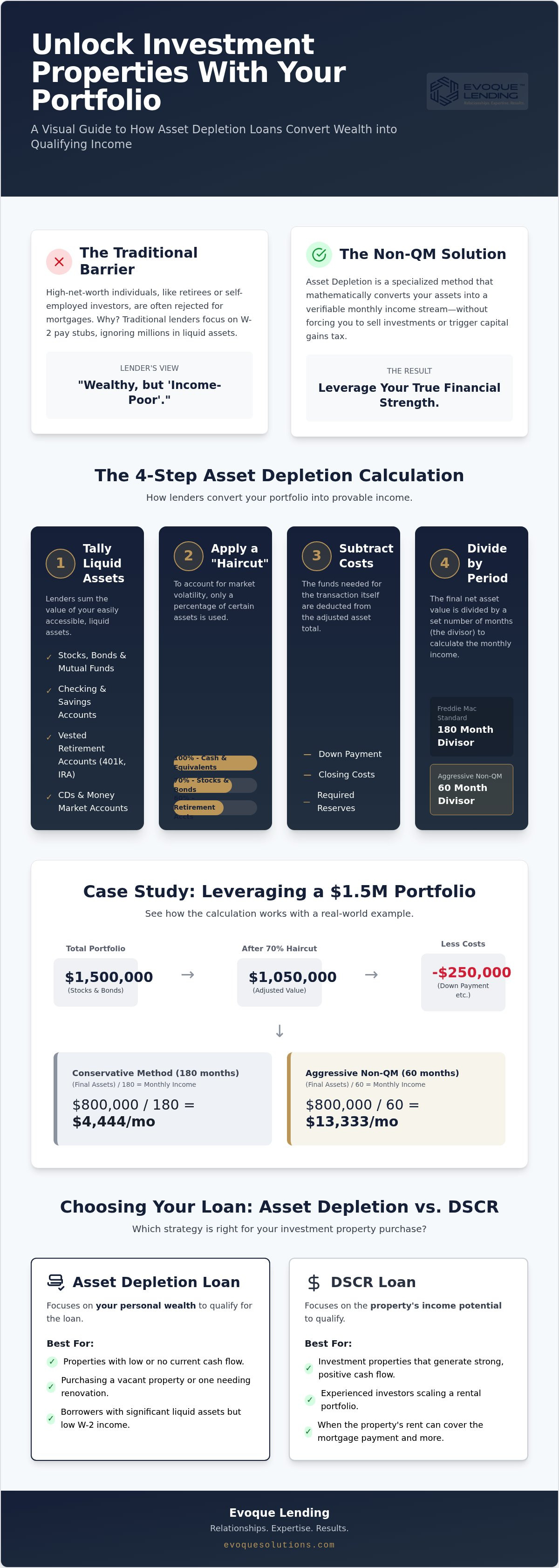
Qualifying for an asset depletion for investment property purchase requires a specific four step calculation. Lenders don't simply look at your total net worth; they follow a structured process to determine how much "income" those assets can safely generate over time. First, the lender identifies your eligible liquid assets. Second, they apply a "haircut" to those values to account for market volatility. Cash and savings are typically valued at 100%, while stocks, bonds, and mutual funds are often valued at 70% to 80%. Retirement accounts may see a valuation of 60% to 70% depending on your age and the specific program guidelines.
Once the adjusted asset value is established, the lender moves to the third step: subtracting the transaction costs. This includes your down payment, closing costs, and the required reserves, which usually range from three to six months of mortgage payments. The final step is the most critical. The lender divides the remaining balance by a specific "depletion period" or divisor to arrive at your monthly qualifying income. This math allows you to demonstrate repayment ability without needing a traditional salary.
Eligible Assets vs. Ineligible Assets
Not every asset is treated equally in the eyes of an underwriter. Lenders prioritize liquidity. Publicly traded stocks, mutual funds, and cash equivalents are the gold standard because they can be converted to currency quickly. Conversely, private equity, restricted stock, and physical real estate holdings are generally ineligible for depletion calculations because their value is harder to verify and liquidate. Recent updates from Freddie Mac in 2026 have removed previous age restrictions for using retirement accounts, though Non-QM programs often provide even greater latitude for younger investors who haven't reached 59.5 yet.
Non-QM Flexibility: The 360-Month vs. 84-Month Window
The divisor used in the final step of the calculation determines your borrowing power. Traditional agency guidelines often use a 360 month divisor, mirroring a 30 year mortgage term. While Freddie Mac recently improved their competitiveness by allowing a 180 month divisor for certain scenarios, Non-QM programs remain the most flexible option for high net worth individuals. Some specialized programs allow for a divisor as short as 84 or 120 months.
The impact of a shorter divisor is transformative. For example, $1,000,000 in qualifying assets divided by 360 months yields only $2,777 in monthly income. That same $1,000,000 divided by an 84 month window generates $11,904 in qualifying income. This massive boost in debt-to-income capacity is why many retirees prefer working with a specialized Non-QM partner to secure their financing. Choosing the right divisor is often the difference between a loan rejection and a successful property acquisition.
Case Study: Leveraging a $1.5M Portfolio for Investment Property Purchase
Consider the scenario of "Investor Bob," a retired engineer who built a $1.5 million brokerage account over three decades. Bob identified a prime rental property priced at $500,000. He planned to put 25% down, requiring a $375,000 mortgage. Despite his significant net worth, Bob faced an immediate roadblock at his local bank. His only recurring income was a $2,500 monthly pension. While this covered his daily expenses, it wasn't enough to satisfy the debt-to-income (DTI) requirements for a new investment loan. The bank saw a borrower with high wealth but insufficient "paper" income to guarantee repayment.
Bob's situation is typical for retirees who want to diversify into real estate without liquidating their market positions. Traditional lenders often ignore the safety net provided by a seven-figure portfolio. By utilizing an asset depletion for investment property purchase, Bob was able to bypass the pension limitation and use his existing wealth as the primary qualification tool. This approach transformed his idle brokerage balance into a robust, verifiable income stream that satisfied the underwriter's requirements.
The Calculation Breakdown
The lender began by applying a 30% "haircut" to Bob’s $1.5 million stock portfolio to account for potential market fluctuations. This left a qualifying balance of $1,050,000. From this amount, the lender subtracted Bob's $125,000 down payment and another $25,000 to cover closing costs and required reserves. This resulted in a net eligible asset base of $900,000.
Using a specialized Non-QM divisor of 225 months, the lender converted that $900,000 into $4,000 of monthly qualifying income. When combined with his $2,500 pension, Bob’s total qualifying income rose to $6,500. This nearly tripled his documented earnings on paper, bringing his DTI ratio well within the acceptable range for approval. The math provided a clear path forward that traditional tax returns simply couldn't offer.
Outcome and Strategic Benefits
The most significant advantage for Bob was the preservation of his capital. He closed the loan without being forced to sell a single share of his portfolio beyond the down payment. This meant his remaining $1.375 million continued to benefit from compound interest and market growth. He also avoided a massive capital gains tax hit that would've been triggered by a forced liquidation.
By opting for a Non-QM loan, Bob secured a competitive interest rate while maintaining his long-term investment strategy. He successfully added a $500,000 asset to his net worth, creating a new source of monthly rental cash flow. This case study demonstrates that for high-net-worth retirees, liquidity is just as valuable as a paycheck when the right lending formula is applied.
Strategic Comparison: Asset Depletion vs. DSCR for High-Net-Worth Borrowers
Choosing the right financing vehicle depends on where your financial strength lies. While an asset depletion for investment property purchase relies on your personal balance sheet, Debt Service Coverage Ratio (DSCR) loans shift the focus to the property’s cash flow. Both are powerful Non-QM tools, but they serve different strategic purposes. If you’re eyeing a high-value property in an emerging market where current rents are still catching up to the mortgage payment, your liquid assets provide the necessary qualification bridge.
A hybrid strategy often yields the best results for seasoned investors. You can use your liquid assets to provide a larger down payment, which lowers the Loan-to-Value (LTV) ratio. A lower LTV often unlocks better interest rates and improves the DSCR ratio simultaneously. This dual-path approach ensures you aren't over-reliant on a single qualification metric, providing a safety net if the appraisal's rental schedule comes in lower than expected.
Qualification Differences
Asset depletion requires a deep dive into your brokerage and retirement accounts to establish your personal repayment ability. In contrast, DSCR lenders primarily care if the property’s gross rent covers the monthly debt obligations. This makes DSCR loans for real estate investors an ideal choice for those who want to keep their personal financial details private or have already leveraged their liquid assets elsewhere. DSCR programs typically look for a ratio of 1.0 to 1.25 to offer the most competitive pricing, whereas asset depletion ignores the rent and focuses on your "haircut" adjusted wealth.
Interest Rates and Terms
Interest rates for these products generally track higher than conventional primary mortgages but have become more competitive throughout 2026. DSCR rates currently range between 6.5% and 8%, with well-qualified borrowers occasionally seeing 1-year ARMs starting as low as 5.375%. Asset depletion loans offer similar terms but may provide more flexibility regarding title vesting. Many investors prefer closing in an LLC for liability protection. This is a standard feature in Non-QM lending but is often restricted by traditional banks. You should also consider prepayment penalties. These are common in investment property loans but can often be shortened for a slightly higher initial rate.
Ready to see which program fits your portfolio? Contact our specialists for a side-by-side comparison.
Securing Your Investment Property Loan with Evoque Lending
Traditional banking models often struggle with the non-linear financial profiles of retirees and high-net-worth investors. Since 2005, Evoque Lending has positioned itself as a specialized partner for those who need more than a standard mortgage checklist. We understand that an asset depletion for investment property purchase requires a deep understanding of market volatility and asset liquidity. A specialized broker is essential because we have access to a broader range of Non-QM programs than a single retail bank. We facilitate loans in over 40 states, ensuring that your geographic investment goals align with our national reach and technical expertise.
Expert Guidance for Non-QM Solutions
Lenders use a variety of internal formulas to calculate income from wealth. Some might use a 360 month divisor while others offer the more aggressive 84 month window we discussed earlier. Choosing the wrong program can result in a lower qualifying income and a rejected application. By working with an asset depletion mortgage lender, you ensure your specific portfolio structure is matched to the program that maximizes your borrowing power. We analyze your mix of stocks, bonds, and retirement accounts to find the most favorable "haircut" and divisor combination for your scenario.
Next Steps for Retirees and Investors
Preparation is the key to a seamless approval process. You don't need years of tax returns, but you do need a clear paper trail of your liquid wealth. Start by gathering your most recent two months of full brokerage and retirement account statements. If you've made large deposits recently, ensure you have documentation to prove the source of those funds. Most Non-QM programs require assets to be seasoned in your account for at least 60 days.
Before you commit to a property, it's wise to calculate your estimated qualifying income. We provide a personalized scenario analysis to help you understand your exact numbers. This proactive step allows you to shop for properties with the confidence of a cash buyer while maintaining the strategic benefits of leverage. Our process moves methodically from an initial asset review to a structured funding phase, keeping you informed at every milestone. Your wealth is a tool for growth; we help you use it effectively to secure your next investment.
Unlock Your Next Investment with Strategic Wealth Leverage
Retirement should be a season of growth, not a period of financial restriction. By converting your portfolio into a qualifying income stream, you bypass the limitations of traditional debt-to-income ratios. You've seen how the right math can transform a brokerage account into a powerful tool for acquisition without triggering capital gains taxes or sacrificing compound interest. Whether you choose a property-centric DSCR path or an asset depletion for investment property purchase, the goal remains the same: scaling your portfolio with precision and confidence.
Success in this niche market requires a partner who understands the nuances of complex wealth structures. Since 2005, Evoque Lending has specialized in high-net-worth investor financing with a national reach across more than 40 states. We provide the technical expertise needed to navigate alternative documentation and secure competitive terms for your unique scenario. Don't let a lack of traditional employment income stall your momentum. Get a Custom Asset Depletion Loan Quote from Evoque Lending and take the first step toward your next lucrative acquisition. Your wealth is ready to work for you.
Frequently Asked Questions
Can I use a 401(k) for asset depletion if I am not yet 59.5 years old?
Yes, you can certainly use these funds for qualification. While traditional banks might be restrictive, Non-QM programs often allow the use of vested retirement accounts regardless of your age. Lenders typically apply a larger valuation reduction, or "haircut," of 60% to 70% to these funds. This accounts for potential early withdrawal penalties and market fluctuations, allowing you to leverage long-term savings for an asset depletion for investment property purchase.
Do I have to actually withdraw the money every month to qualify?
No, you don't need to make any actual withdrawals from your accounts to satisfy the lender. Asset depletion is a theoretical calculation used strictly for loan qualification purposes. The lender mathematically converts your liquid wealth into an income stream on paper to satisfy debt-to-income requirements. Your assets remain in your accounts; they continue to grow or earn interest according to your personal investment strategy throughout the life of the loan.
What is the typical "haircut" lenders apply to stock market investments?
Lenders typically value publicly traded stocks and mutual funds at 70% to 80% of their current market balance. This reduction provides a safety buffer against market volatility. Cash and savings accounts generally receive a 100% valuation. By applying these standard industry percentages, lenders determine a stable asset base. This base is then divided by the depletion divisor to create the qualifying monthly income needed to secure your investment property financing.
Can I use asset depletion for a multi-family investment property purchase?
Yes, asset depletion programs are highly effective for purchasing multi-family properties, including duplexes, triplexes, and four-unit buildings. As long as the property meets the lender's investment criteria, you can use your liquid wealth to qualify. This is particularly useful when the projected rental income alone doesn't quite meet the necessary debt service coverage but your personal balance sheet shows significant liquid strength that can bridge the gap.
Is there a minimum asset requirement to use this loan program?
While requirements vary by program, most specialized lenders look for a minimum of $150,000 to $1,000,000 in eligible liquid assets. The exact floor depends on the loan amount you're seeking and the specific divisor the lender uses. Higher net worth individuals generally find more flexibility and better terms. A larger asset base generates the higher qualifying income needed for jumbo investment property loans that traditional institutions often reject.
How does asset depletion affect my taxes compared to liquidating assets?
Asset depletion is generally more tax-efficient than liquidation because it doesn't involve selling your investments. When you liquidate stocks or mutual funds to buy a property, you often trigger capital gains taxes. Since an asset depletion for investment property purchase uses a theoretical income calculation, you avoid these tax events entirely. You maintain your market positions and compound growth while using the lender’s capital to expand your real estate portfolio.
Can I combine asset depletion with 1099 income or bank statement income?
Yes, many Non-QM programs allow you to stack different income sources to reach the required debt-to-income ratio. You can combine the calculated income from your assets with documented 1099 earnings, Social Security, pensions, or bank statement averages. This holistic approach is a hallmark of specialized lending. It provides a comprehensive view of your financial strength that traditional institutional banks often overlook during their rigid and outdated underwriting processes.
Are interest rates higher for asset depletion loans than traditional mortgages?
Interest rates for asset-based loans are typically slightly higher than traditional conventional mortgages, reflecting the specialized nature of the underwriting. However, the gap has narrowed significantly throughout 2026. For many investors, the slightly higher rate is offset by the ability to secure financing without liquidating assets or providing tax returns. Well-qualified borrowers often find competitive pricing that aligns with other specialized investment products, such as DSCR loans.
Reviewed by Eddie Luhrassebi, Founder & CEO, NMLS #337071 | CA DRE #01230650
Last updated: September 1, 2026 · About the reviewer