How to Get a House with Bank Statements: A 2026 Guide for Real Estate Investors
Written by Eddie Luhrassebi · Published August 26, 2026
Learn how to get a bank statement loan for investment property in 2026. Use your cash flow, not tax returns, to qualify and scale your real estate portfolio.
Why should a successful year of business growth actually make it harder for you to buy real estate? It is a frustrating irony that the aggressive tax deductions which signal a smart business strategy often lead to a mortgage denial from traditional banks. You understand that your liquid cash flow is more than sufficient, yet institutional lenders remain fixated on the bottom line of your tax returns. Securing a bank statement loan for investment property is the most effective way to bypass these rigid institutional hurdles and turn your actual revenue into purchasing power.
We believe your monthly deposits are a far more accurate reflection of your ability to invest than a tax document designed for the IRS. This 2026 guide explores how to leverage your cash flow to secure financing without the need for traditional tax returns. You'll learn the specific documentation needed for 12 or 24-month statement programs, see how current interest rates compare to other non-QM options, and discover how this specialized lending path provides the flexibility you need to scale your portfolio without the paperwork headache.
Understanding Bank Statement Loans for Investment Properties
A bank statement loan is a specialized Non-Qualified Mortgage (Non-QM) product designed to evaluate your true purchasing power. Instead of relying on the adjusted gross income found on tax returns, these programs analyze your actual cash flow through consecutive monthly deposits. Bank statement loans allow lenders to see the health of your business in real time; they don't force you to rely on a historical tax document that might be eighteen months old. For real estate investors in 2026, this flexibility is essential. As market conditions shift, the ability to secure a bank statement loan for investment property quickly can be the difference between closing a deal or losing it to a cash buyer. These loans are versatile tools. They are available for property purchases, rate-and-term refinances, or cash-out refinances to fund your next acquisition.
The Self-Employed Advantage
Traditional lending often penalizes the very people who drive the economy. Business owners and 1099 contractors frequently face rejection because Fannie Mae and Freddie Mac typically require a rigid two-year history of tax returns. If you have significant depreciation or legitimate business expenses, your income on paper might look far lower than what you actually take home. Bank statement programs bypass this hurdle entirely. Lenders qualify you based on the gross deposits into your personal or business accounts. This approach is a game-changer for gig-economy entrepreneurs and seasoned investors who use strategic write-offs to manage their tax liability. You don't have to choose between a lower tax bill and your next investment property.
Property Types Covered
These programs aren't limited to standard houses. You can use a bank statement loan for investment property to acquire single-family rentals (SFR), 2-4 unit multi-family buildings, or warrantable condos. The underwriting for investment properties focuses heavily on your ability to manage the debt through your proven cash flow. Loan limits for non-QM bank statement products often exceed the standard conforming limits set by the FHFA. This allows you to target high-value markets or luxury short-term rentals that would otherwise require a massive down payment or complex commercial financing. While owner-occupied bank statement loans have stricter debt-to-income requirements, investment property versions offer the latitude needed to scale a diverse portfolio efficiently.
How Lenders Calculate Your Qualifying Income
Lenders don't just look at the total amount in your account on a single day. They want to see a consistent pattern of cash flow over a 12 or 24-month period. This long-term view helps underwriters mitigate the risk associated with Non-qualified mortgages by ensuring your revenue is stable rather than a one-time windfall. Unlike traditional loans where the tax return is the final word, a bank statement loan for investment property relies on a calculation of your gross monthly deposits minus a predetermined expense factor. Underwriters use this data to determine your debt-to-income (DTI) ratio, which typically caps at 50% for these programs.
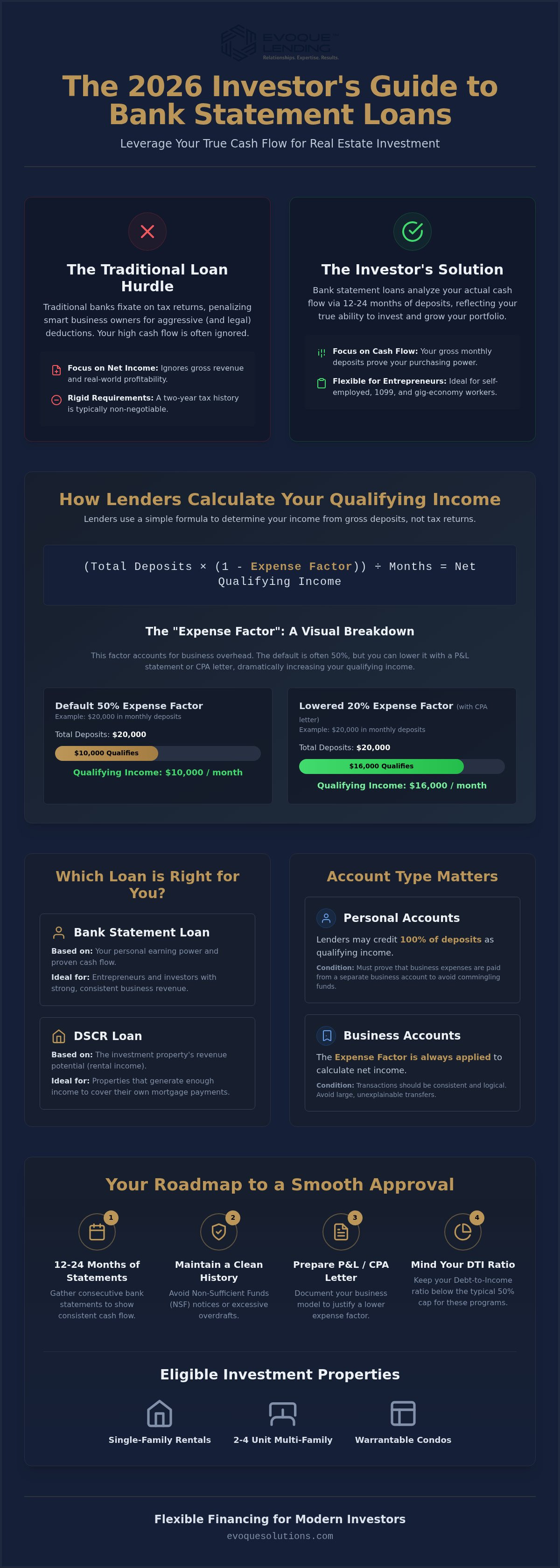
The formula for your monthly income is: (Total Eligible Deposits x (1 - Expense Factor)) ÷ Number of Months = Net Qualifying Income.
The Expense Factor and P&L Statements
Underwriters know that every dollar entering a business account isn't profit. To account for overhead, they apply an "Expense Factor." By default, many lenders assume a 50% expense ratio. If you deposit $20,000 a month, they may only count $10,000 as qualifying income. However, this isn't set in stone. Service-based professionals like consultants or software developers often have much lower overhead than a retail business with physical inventory. You can often lower this factor by providing a letter from your CPA or a Profit and Loss (P&L) statement. If you're unsure how your specific business model will be viewed, you can explore your qualification options with an expert who understands these nuances.
Personal vs. Business Account Underwriting
The type of account you use significantly impacts the math. If you use personal bank statements, many lenders will credit 100% of the deposits as income, provided you can prove the business expenses are paid from a separate business account. For business accounts, the expense factor always applies. Lenders look for consistency and logic in the transactions.
- Commingled Funds: If you're a sole proprietor who mixes personal and business funds, underwriters will usually treat the account as a business account, applying the full expense factor.
- Large Deposits: Lenders scrutinize any single deposit that exceeds 50% of your average monthly income. You'll need to source these to prove they aren't borrowed funds or non-recurring gifts.
- NSF Notices: A single non-sufficient funds notice in a 12-month period can jeopardize your approval, as it suggests a lack of cash reserves.
Understanding these calculations before you apply for a bank statement loan for investment property prevents surprises during the underwriting phase. It allows you to present your financial health in the most favorable light to a non-QM lender.
Bank Statement Loans vs. DSCR: Which is Better for Investors?
Investors often find themselves at a crossroads between two primary non-QM tools: bank statement programs and Debt Service Coverage Ratio (DSCR) loans. While both offer a path away from tax-return-based underwriting, they serve different strategic purposes. A DSCR loan prioritizes the property’s ability to generate rent that covers the mortgage payment. In contrast, a bank statement loan for investment property relies on your personal or business earning power. This distinction is vital when you are eyeing a property that is currently underperforming or vacant. If the current rent doesn't meet the DSCR threshold but you have the cash flow to support the debt, the bank statement option becomes your strongest lever.
Choosing Based on Your Portfolio Strategy
Your choice should align with your specific investment goals. If you are a "fix and hold" investor, you might target properties that need significant management or cosmetic improvements. These units often have low current rents that would disqualify them for a DSCR loan. By qualifying through your bank statements, you can secure the asset based on your business strength and then refinance once the property is stabilized. This path is also ideal for investors with a high personal Debt-to-Income (DTI) ratio. While traditional banks might flag your existing mortgages as a risk, a bank statement lender focuses on the liquidity shown in your deposits. For a deeper look at property-centric financing, see our DSCR Loans: 2026 Guide to Scaling Your Portfolio.
Rate and Down Payment Differences
Non-QM loans carry an interest rate premium compared to conventional products. In the 2026 market, these rates typically sit 0.25% to 1.50% higher than conventional mortgage rates, depending on your credit profile. For a bank statement loan for investment property, you should expect a down payment in the 20% to 25% range. Your credit score plays a massive role here. A score above 740 often unlocks the most competitive rate buy-down options, allowing you to lower your monthly overhead. Lenders also look closely at your "reserves," which is the liquid cash left in your account after closing. Having 6 to 12 months of mortgage payments in reserve can often be the deciding factor for an underwriter, as it proves you can weather a vacancy or an unexpected repair without stress.
How to Get a House with Bank Statements: A Step-by-Step Roadmap
Traditional banks operate on automation; they don't like complexity. If your business structure doesn't fit their standard algorithm, they'll simply say no. Securing a bank statement loan for investment property requires a different approach. You need a specialized partner who understands how to package your cash flow for an underwriter's manual review. Retail banks often lack the infrastructure to handle non-QM products, whereas a specialized broker acts as your advocate, matching your LLC or S-Corp structure to the specific lender most likely to approve your unique financial scenario.
Step 1: Audit Your Own Statements
Start by gathering every single page of your last 12 or 24 months of bank statements. Missing pages are the number one cause of a "declined" status during the initial document review. Underwriters look for consistency and transparency. You should look for any non-sufficient funds (NSF) notices; in the non-QM world, a clean 12-month history is usually a prerequisite for approval. You should also identify and document large deposits that aren't business revenue, such as personal transfers, tax refunds, or insurance settlements. Calculate your estimated income by applying a 50% expense factor to your gross deposits to set realistic expectations before the underwriter performs their own analysis.
Step 2: Secure Your CPA Letter or P&L
A CPA letter confirming your business ownership and typical expense ratio is often the "golden ticket" to a lower expense factor. This documentation proves to the lender that your overhead is manageable, which can significantly increase your qualifying income compared to the default 50% ratio. For more details on what you'll need to prepare, review our Bank Statement Loan Requirements: Your 2026 Checklist for Approval. If your business is more complex, you'll need a 12-month Profit and Loss (P&L) statement. This document must align perfectly with your bank deposits to avoid red flags during the auditing phase.
Step 3: The Application and Appraisal
Once your file is packaged, the appraisal process begins. For an investment property, the appraiser will also complete a "Comparable Rent Schedule" to estimate the property's income potential. This is crucial for verifying the asset's value in a competitive 2026 market. If there are any anomalies in your credit or income history, be prepared to write a "Letter of Explanation." This is your chance to provide professional context for a one-time business dip or a specific credit inquiry. With the right preparation, you can move toward a successful closing with confidence. If you're ready to start, connect with our lending experts to review your statements and explore your funding options today.
Scaling Your Portfolio with Evoque Lending’s Solutions
Evoque Lending has spent the last 20 years as a seasoned guide for investors who don't fit the rigid institutional box. Since 2005, our focus has remained on evaluating actual cash flow rather than just tax returns. We provide access to a broad network of non-QM investors, ensuring you receive the most competitive terms for a bank statement loan for investment property. Our team understands the practical realities of how modern investors operate; we specialize in navigating the complexities of multi-entity business owners and high-net-worth individuals with diverse income streams.
The Evoque Advantage for Investors
We've streamlined our online intake process to respect the time of busy entrepreneurs. You shouldn't have to wait weeks for a basic "no" from a retail bank. Our expertise extends beyond bank statements to include 1099 loans, asset depletion, and foreign national programs across 40+ states. We're committed to finding a path to "yes" when traditional lenders get stuck on a tax deduction. If your income structure is unique, we have the specialized financial instruments to match it. For a detailed comparison of current products, explore our guide on the Best 2026 Bank Statement Mortgages for Self-Employed.
Ready to Expand Your Portfolio?
The 2026 real estate market moves fast, and your financing needs to move faster. Locking in a rate for a bank statement loan for investment property allows you to project your ROI with certainty. We invite you to take the first step by completing our specialized questionnaire. This tool is designed to match your unique financial profile with the lending instrument that offers the best fit and alignment for your goals. Don't let a complex tax return stop your growth. Connect with us for a consultation today and let our two decades of experience work for your portfolio.
Turning Your Cash Flow Into Real Estate Growth
You shouldn't let a complex tax return stand between you and your next acquisition. We've explored how a bank statement loan for investment property allows you to leverage your actual revenue and bypass the limitations of traditional institutional underwriting. By understanding the "Expense Factor" math and choosing the right documentation path, you can maintain your tax efficiency while scaling your portfolio. It is about matching your business structure with a lender that values your true liquidity over a line on a tax form.
Since 2005, Evoque Lending has specialized in these non-QM solutions, helping self-employed and 1099 investors across more than 40 states find a path to "yes." Whether you're navigating a multi-entity business structure or a unique 1099 income scenario, our expertise ensures your cash flow is accurately represented. See if you qualify for a bank statement loan with our quick online questionnaire. It is time to stop worrying about rigid bank rules and start focusing on your next investment opportunity. Your business's success is your greatest asset; let's use it to build your real estate legacy.
Frequently Asked Questions
Can I get a bank statement loan for an investment property with only 12 months of statements?
Yes, you can qualify for a bank statement loan for investment property using just 12 months of consecutive statements. While some lenders prefer 24 months to see long-term stability, the 12-month program is highly popular for investors who've seen a recent spike in revenue. These shorter-term reviews allow you to capitalize on your current business growth without waiting another year. Keep in mind that 24-month programs sometimes offer slightly more competitive interest rates.
What is the minimum credit score required for a bank statement mortgage in 2026?
The minimum credit score for most bank statement programs typically ranges between 620 and 680. However, your score significantly impacts your loan-to-value (LTV) limits and interest rate. To secure the most favorable terms in 2026, a score of 740 or higher is ideal. If your score is on the lower end of the spectrum, you might be required to provide a larger down payment to offset the lender's perceived risk during underwriting.
Do bank statement loans require a higher down payment for rental properties?
Yes, expect to provide a down payment of 20% to 25% for a bank statement loan for investment property. Traditional owner-occupied loans sometimes allow for lower entry points, but investment properties are viewed as higher risk. By putting more equity down, you demonstrate your commitment to the asset. This higher down payment often helps you qualify for better interest rates and more flexible underwriting terms during the manual document review process.
Can I use a bank statement loan if I have an LLC?
Absolutely. Most bank statement borrowers operate through an LLC, S-Corp, or as a sole proprietorship. Lenders will review your business bank statements to verify the entity's cash flow and your percentage of ownership. You'll simply need to provide your business license or articles of incorporation to prove the business has been active for at least two years. This structure is actually preferred by many non-QM underwriters for its professional clarity and documentation.
How do interest rates for bank statement loans compare to conventional investment loans?
Interest rates for these programs are generally 0.25% to 1.50% higher than conventional mortgage rates. This premium exists because the lender is taking on more risk by not using traditional tax-return verification. While the rate is higher, the trade-off is the ability to secure a loan that a traditional bank would decline. Many investors find the slightly higher monthly payment is a small price for the opportunity to acquire a high-yield asset.
What happens if I have non-sufficient funds (NSF) on my bank statements?
Non-sufficient funds (NSF) notices are a major red flag for non-QM underwriters. A single NSF in a 12-month period might be overlooked if you provide a strong letter of explanation, but multiple occurrences often lead to an immediate denial. Lenders view these as a sign of poor cash management or financial instability. It's best to wait until you have a clean 12-month history before submitting your statements for a formal lending review.
Do I need a Profit and Loss (P&L) statement if I provide bank statements?
You don't always need a Profit and Loss statement, but it's a powerful tool to lower your expense factor. If you don't provide a P&L, lenders often apply a default 50% expense ratio to your deposits. By providing a CPA-prepared P&L, you can prove that your actual overhead is lower, which increases your qualifying income. This is especially beneficial for service-based businesses with minimal physical costs, staff, or inventory requirements.
Can I use bank statements from multiple businesses to qualify?
Yes, you can combine deposits from multiple businesses as long as you can document your ownership interest in each entity. Underwriters will review the statements for each business and apply the appropriate expense factors to determine your total aggregate income. This is a common strategy for serial entrepreneurs who manage several LLCs. You'll just need to ensure all entities have been operational for the required time frame, which is usually two years.
Reviewed by Eddie Luhrassebi, Founder & CEO, NMLS #337071 | CA DRE #01230650
Last updated: August 26, 2026 · About the reviewer