
Rental Income Mortgages: 2026 Guide to DSCR Loans
Written by Eddie Luhrassebi · Published September 16, 2026
Qualify for a rental income based mortgage for investors using DSCR loans. Skip tax return hurdles, close in an LLC, and scale your portfolio in 2026.
What if the tax write-offs that save you thousands every year are the exact reason a traditional bank just denied your next loan? It's a frustrating paradox where being a savvy business owner makes you look like a risky borrower to institutional lenders. If your personal debt-to-income ratio is hitting a ceiling or your tax returns show a low net income due to depreciation, you aren't alone. Many sophisticated borrowers find that a rental income based mortgage for investors is the only logical way to bypass these artificial barriers.
You deserve a financing partner that understands investor math and values property performance over personal salary. This 2026 guide to Debt Service Coverage Ratio (DSCR) loans shows you how to qualify for financing based on the cash flow a property generates. We'll explore how you can streamline your path to purchase or refinance, protect your personal assets by closing in an LLC name, and ultimately scale your portfolio without the invasive underwriting of big banks. Property performance is a more reliable indicator of loan safety than a personal paycheck, and it's time your lender recognized that reality.
What is a Rental Income Based Mortgage? The DSCR Revolution
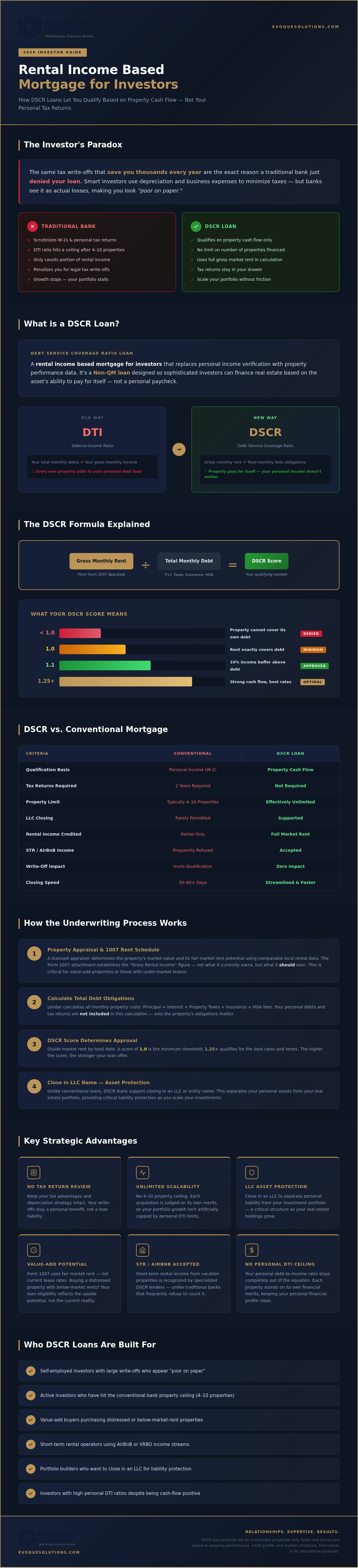
A rental income based mortgage for investors is more than just a niche financial product; it's a fundamental shift in how real estate growth is funded. Known in the industry as a Debt Service Coverage Ratio (DSCR) loan, this financing method replaces personal income verification with property performance data. Instead of scrutinizing your W-2s or personal bank statements, lenders focus on the gross monthly rent the property generates compared to its debt obligations. This approach allows you to secure financing based on the property's potential rather than your personal salary. It's the ultimate tool for those who want to treat their real estate portfolio as a business rather than a personal liability.
The Shift from DTI to DSCR Qualification
Traditional lenders use Debt-to-Income (DTI) ratios to determine your eligibility. This works for a primary residence, but it's a massive bottleneck for active investors. Every new acquisition adds to your personal debt load, and most banks only credit a portion of the rental income toward your qualification. Eventually, your DTI hits a ceiling, and your growth stops. DSCR loans solve this by focusing entirely on the asset's ability to pay for itself. Because the loan is tied to the property's cash flow, there's effectively no limit on the number of properties you can finance. This flexibility is why seasoned investors prefer this route when scaling past the typical four-to-ten property limit imposed by institutional banks.
Why Traditional Lenders Struggle with Investor Math
Smart investors use depreciation and business expenses to minimize their tax burden. While this is excellent for your bottom line, it's disastrous for traditional mortgage applications. Big banks look at your net taxable income; they see the write-offs as actual losses. You might be cash-flow positive and rich in assets, yet you appear "poor on paper" to an institutional underwriter. This misalignment is why Non-QM loans have become the standard for modern real estate portfolios. By using a rental income based mortgage for investors, you bypass the invasive tax return review entirely. You're judged on the math that actually matters: the property's ability to sustain its own debt. This allows you to keep your tax advantages while continuing to acquire new assets without the friction of traditional underwriting.
How Rental Income Mortgages Work: The Mechanics of Cash Flow
Underwriting a rental income based mortgage for investors is a streamlined experience compared to the invasive nature of traditional banking. Instead of verifying your personal employment history or salary, the lender focuses on the property's ability to generate revenue. This means your personal debt-to-income ratio stays out of the equation. The process centers on a specialized appraisal that determines both the property's value and its income potential. Your personal tax returns remain in your drawer because the property's cash flow is the primary security for the loan. It's a logic-based approach that prioritizes asset performance over personal paychecks.
The core of this process is the "Fair Market Rent" assessment. Lenders don't just look at what a property is currently renting for; they look at what it should rent for based on comparable local data. This is a game changer for investors who specialize in value-add projects or properties with long-term tenants currently paying under-market rates. If you're looking to expand, you can explore your options with a partner that values your investment strategy over your W-2 status.
The 1007 Rent Schedule: Your Most Important Document
The Form 1007 is a specific attachment to the appraisal report that focuses entirely on rental data. The appraiser analyzes similar properties in the immediate area to establish a baseline for market rent. This document is vital because it provides the "Gross Rental Income" figure used in the DSCR calculation. For investors buying distressed properties with significant "upside," the 1007 allows the lender to recognize the potential rent after renovations. It ensures that your loan eligibility isn't capped by a previous owner's poor management or outdated lease agreements.
Qualifying with Short-Term Rental (STR) Income
Traditional banks often struggle with the volatility of AirBnB or VRBO revenue, frequently refusing to count it as stable income. Specialized DSCR lenders take a different approach by using projected revenue data from industry leaders like AirDNA. This allows you to qualify for a loan based on the high-yield potential of vacation markets rather than being limited to lower long-term lease rates. Understanding the nuances of DSCR Loans for Short Term Rental Acquisitions is essential for anyone targeting the hospitality sector. By leveraging professional revenue projections, you can secure financing that matches the actual earning power of your short-term assets.
Comparing Investor Financing: Rental-Based vs. Conventional Mortgages
Conventional mortgages are often the first stop for new investors because of their lower interest rates. However, these loans come with a significant documentation burden. You're required to provide years of tax returns, W-2s, and personal financial statements. For a seasoned professional, this paperwork is a hurdle; for a self-employed investor with heavy write-offs, it's often a wall. This is where the "Investor Gap" appears. Once you reach 10 properties, or when your personal debt-to-income ratio is maxed out, conventional banks simply stop lending to you. They see risk where an investor sees an opportunity.
A rental income based mortgage for investors solves this by shifting the focus from your personal history to the asset's performance. While interest rates for DSCR loans are typically slightly higher than conventional rates, and down payments usually start at 20% to 25%, the trade-off is unparalleled flexibility. You aren't limited by the number of properties you own, and your personal income doesn't dictate your growth. You're trading a slightly higher cost of capital for the ability to scale without artificial limits.
Borrowing
as an LLC or Corporate Entity
One of the most significant drawbacks of conventional financing is the requirement to borrow in your personal name. This exposes your personal assets to liability and makes it harder to manage a growing business. DSCR lenders, conversely, encourage borrowing through an LLC or corporate entity. This structure provides a layer of asset protection that's vital for long-term security. It allows you to keep your personal and business finances separate. This is a standard practice for professional real estate operations but a rare option in the world of traditional retail banking.
Speed to Close: A Competitive Edge in 2026
In a competitive market, speed is a currency. Conventional loans typically take 45 to 60 days to close because of the intensive personal underwriting involved. A rental income based mortgage for investors can often close in 21 to 30 days. This accelerated timeline allows you to win deals over other buyers who are tied up in bank bureaucracy. If you're weighing your options between different financing paths, it's helpful to understand the nuances of a DSCR vs. Bank Statement Loan. Choosing the right Non-QM instrument ensures your financing matches your specific acquisition strategy, giving you the agility to move when the right opportunity arises.
Requirements and Calculations for Rental Income Mortgages
Qualifying for a rental income based mortgage for investors requires a shift in how you view affordability. Instead of your personal monthly budget, the focus is on the property's balance sheet. Lenders use a specific set of benchmarks to ensure the asset is self-sustaining. While the criteria are different from traditional loans, they are often more transparent and predictable. You can often determine if a deal works before you even submit an application by running the numbers yourself. This clarity allows you to move with confidence in a fast-paced market.
The DSCR Formula: Calculating Your Ratio
The Debt Service Coverage Ratio is the mathematical heart of the loan. DSCR is the ratio of cash flow to debt service. To find this number, lenders take the Gross Rental Income and divide it by the PITIA, which includes Principal, Interest, Taxes, Insurance, and any Association fees. For example, if a property generates $2,000 in monthly rent and the total PITIA is $1,600, your calculation is $2,000 / $1,600. This results in a 1.25 DSCR.
A ratio of 1.0 means the property breaks even. Most lenders look for a 1.2x to 1.25x ratio to provide the most competitive interest rates. However, "no-ratio" or "unrated" loans are available for properties that don't quite hit that mark. These options allow you to close on properties with high appreciation potential even if the current cash flow is tight. It provides a path forward for properties in high-growth areas where rents haven't yet caught up to property values.
Credit and Asset Requirements for 2026
While your personal income isn't verified, your credit history still plays a role in the terms you receive. A credit score of 620 to 660 is typically the entry point for most programs. Higher scores generally unlock lower interest rates and allow for higher loan-to-value limits. You should also prepare for a down payment in the range of 20% to 25%. The source of these funds is often more flexible than traditional bank requirements. You might use business capital, a HELOC from another property, or even gift funds to cover your acquisition costs.
Lenders also require a liquid "reserve" of three to six months of mortgage payments. This cushion ensures you can handle the debt during a vacancy or an unexpected maintenance issue. This requirement protects both you and the lender from short-term market fluctuations. Understanding these benchmarks is the first step toward Scaling Your Real Estate Portfolio Without Tax Returns. If you are ready to see how your specific property numbers look, you can get a custom DSCR quote to see your eligible rates and terms.
Scale Your Portfolio with Evoque Lending's Rental Solutions
Finding a lender that understands the nuances of professional real estate is the final piece of your scaling puzzle. Evoque Lending has specialized in this niche since 2005, positioning ourselves as a seasoned guide for those who don't fit into traditional banking boxes. With coverage in 40+ states, we provide a national platform for investors looking to diversify across different markets. Our team doesn't just process applications; we act as long-term partners who prioritize your tangible outcomes over standard institutional rigidness. Using a rental income based mortgage for investors allows you to treat your portfolio as the growing business it is.
The transition from a single property to a robust portfolio requires a financing partner that values depth of knowledge and professional relationships. We understand that your goals change as you grow. Whether you're looking for your first DSCR Purchase Loan or need to restructure existing debt, our loan specialists provide the personalized support necessary to navigate complex investment scenarios. We focus on the practical realities of how modern investors operate, ensuring your financing is always aligned with your long-term strategy.
Cash-Out Refinancing for Portfolio Growth
Equity isn't useful if it's trapped in a property. A DSCR Cash-Out Refinance allows you to extract that value based on current appraisal figures, providing a streamlined path to reinvest in new opportunities. This is the engine behind the "Buy, Rehab, Rent, Refinance, Repeat" (BRRRR) strategy. You buy a property, improve its value, and then use a rental income based mortgage for investors to pull your capital back out. This rapid equity extraction provides the down payment for your next acquisition without waiting years for personal savings to accumulate. It's a methodical way to turn one successful deal into a self-funding growth cycle.
Solutions for Foreign Nationals and 1099 Earners
We also bridge the gap for those the traditional system often ignores. Foreign national investors can build a US-based portfolio without a domestic credit history by focusing entirely on the property's performance. Similarly, 1099 contractors and self-employed entrepreneurs often face grueling audits from big banks that fail to understand their income structures. Our specialized programs allow these borrowers to bypass complex tax return reviews and qualify based on the cash flow of their assets. This approach creates a sense of transparency and ease that traditional retail lending cannot match. If you're ready to see how these specialized instruments can work for you, get a custom DSCR quote from Evoque Lending today to begin your next phase of growth.
Take Control of Your Real Estate Growth
The traditional banking model often penalizes success by capping your portfolio based on personal debt-to-income limits. You've seen how a rental income based mortgage for investors shifts the focus to where it belongs: the property's performance. By qualifying based on cash flow rather than tax returns, you unlock the ability to scale your portfolio faster and protect your personal assets through corporate borrowing structures. Whether you're pursuing a BRRRR strategy or acquiring your first short-term rental, property-level math is the most reliable path to financial independence.
Evoque Lending has specialized in Non-QM and DSCR solutions since 2005, helping borrowers in 40+ states bypass the red tape of institutional lending. We don't require tax returns for qualification because we understand that your property's potential is your strongest asset. It's time to work with a partner that values your investment goals as much as you do. Start your DSCR loan application with Evoque Lending today and secure the financing you need to build your legacy. Your next acquisition is waiting for a lender that understands the modern market. Let's get to work on your next deal.
Frequently Asked Questions
Can I get a rental income based mortgage with no job?
Yes, you can qualify for a rental income based mortgage for investors without traditional employment. Because these loans are underwritten based on the property's ability to generate cash flow, your personal job status is not the primary factor. Lenders look at the projected rent compared to the mortgage payment. This makes it an ideal solution for retirees, full-time investors, or those between career moves who have the necessary capital for a down payment.
How much rental income do I need to qualify for a DSCR loan?
Most lenders prefer a Debt Service Coverage Ratio of at least 1.20 to 1.25 to offer the most competitive terms. This means the gross monthly rent should be 20% to 25% higher than the total monthly payment, including taxes and insurance. However, some programs allow for a 1.0 ratio, where the rent simply equals the debt. There are even "no-ratio" options for properties with high appreciation potential but lower current yields.
Are interest rates higher for rental income based mortgages?
Yes, interest rates for DSCR loans are generally 0.75% to 2% higher than those for conventional mortgages. This price difference accounts for the increased risk the lender takes by not verifying your personal income or employment history. Investors often view this as a necessary trade-off for the ability to close quickly and scale their portfolios without the restrictive debt-to-income limits found at traditional big banks.
Can I use a DSCR loan for my primary residence?
No, you cannot use a DSCR loan for a primary residence. These financial instruments are specifically designed for investment properties that generate rental revenue. Regulatory requirements for primary home loans are much stricter and require personal income verification like W-2s or tax returns. If you are looking to finance a home you plan to live in, you'll need to explore traditional mortgage products rather than investor-focused cash flow loans.
What is the minimum credit score for a rental-based mortgage?
Most programs require a minimum credit score between 620 and 660 to qualify for a rental income based mortgage for investors. While your personal income isn't the focus, your credit history serves as a proxy for your financial reliability. A higher score often unlocks better interest rates and allows for a lower down payment. If your score is below 620, you may need to provide a larger equity stake to offset the perceived risk.
Do I need to show tax returns for a DSCR loan?
No, you don't need to provide personal tax returns when applying for a DSCR loan. This is one of the primary benefits for self-employed individuals who have significant tax write-offs that lower their reported net income. Instead of analyzing your IRS filings, the lender reviews the appraisal report and the 1007 Rent Schedule. This streamlined process focuses entirely on the property's financial performance rather than your personal accounting history.
Can I buy a multi-family property with a rental income based loan?
Yes, you can use these loans to purchase or refinance multi-family properties, typically up to four units. Financing a duplex, triplex, or fourplex with a DSCR loan is a popular strategy because the combined income from multiple units often results in a stronger coverage ratio. This makes it easier to meet the 1.25 threshold. For properties with five or more units, you would transition into commercial DSCR programs with slightly different requirements.
What happens if my rental property is currently vacant?
If a property is vacant, the lender uses the "Fair Market Rent" established by the appraiser on Form 1007. You don't need a signed lease agreement in place to qualify for a purchase loan. The appraiser looks at comparable rentals in the immediate area to determine what the property could realistically earn. This allows you to acquire distressed assets or newly renovated homes that haven't yet secured a long-term tenant.
Reviewed by Eddie Luhrassebi, Founder & CEO, NMLS #337071 | CA DRE #01230650
Last updated: September 16, 2026 · About the reviewer