
DSCR Loan for Mixed-Use: 2026 Investor's Guide
Written by Eddie Luhrassebi · Published September 13, 2026
Get a DSCR loan for mixed-use property based on rental income, not tax returns. Our 2026 guide covers LTV, the 51% rule, and faster closing times.
Why should your personal tax returns from three years ago dictate your ability to acquire a cash-flowing asset today? For many investors, the dream of owning a versatile asset is often stalled by traditional banks that demand excessive documentation and high down payments. It's a common frustration to see a prime opportunity slip away because a commercial lender's underwriting process moves at a glacial pace. Securing a dscr loan for mixed-use property changes the math entirely by focusing on the building's performance rather than your personal income history.
You deserve a financing partner that understands the practical realities of modern real estate. This 2026 guide will show you how to leverage DSCR financing to bypass rigid institutional boxes and scale your portfolio with confidence. We'll explore specific LTV requirements, the critical 51% residential square footage rule, and how these specialized instruments compare to traditional commercial options. By the end of this article, you'll have a clear roadmap to qualify based on property income alone and secure the faster closing times necessary to win in a competitive market.
What is a DSCR Loan for Mixed-Use Property?
Traditional commercial lending often feels like an interrogation. You provide three years of tax returns, personal financial statements, and endless proof of employment. If you're an entrepreneur or a self-employed investor, those documents might not always reflect your true buying power or the actual value of your investments. A dscr loan for mixed-use property bypasses these hurdles by prioritizing the asset's performance over your personal income history. It functions as a specialized financial instrument that bridges the gap between residential simplicity and the heavy documentation requirements of traditional commercial lending.
These loans fall under the Non-QM (Non-Qualified Mortgage) umbrella, offering a level of flexibility that institutional banks simply can't match. Instead of checking your W-2 or debt-to-income ratio, lenders focus on the Debt Service Coverage Ratio (DSCR). This metric measures whether the property's gross rental income covers its debt obligations, including principal, interest, taxes, insurance, and association fees. If the building's cash flow is strong enough to pay for itself, you're already halfway to an approval. This allows you to qualify based on the property's potential rather than your taxable income.
Eligible Property Types for Mixed-Use DSCR
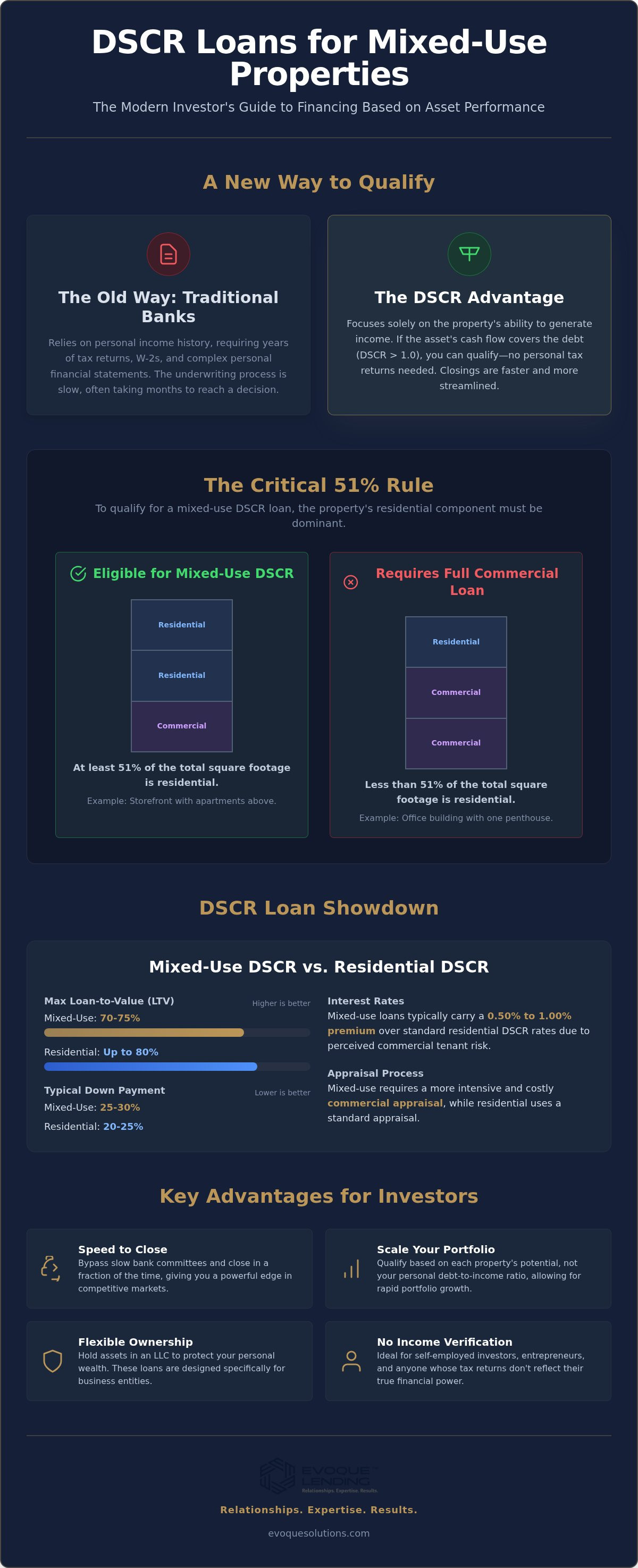
Not every building fits this specialized mold, but many versatile assets do. To qualify for a dscr loan for mixed-use property, the asset must combine residential units with a commercial component. The most common example is the classic "mom and pop" storefront with apartments located on the floors above. Other eligible assets include professional office spaces, such as a law firm or medical suite, paired with residential dwellings. Generally, these programs are designed for properties where the residential portion is significant, typically requiring that at least 51% of the total square footage is dedicated to living space.
Why Investors Choose DSCR for Mixed-Use Assets
Speed is a major factor for modern investors. Traditional commercial banks can take months to underwrite a complex loan, often requiring multiple committee approvals. In a competitive market, that delay can cost you a prime acquisition. DSCR lenders operate with a streamlined approach that mirrors residential timelines, often closing in a fraction of the time required by commercial-only platforms.
Flexibility in ownership is another significant advantage. Many investors prefer to hold their assets in an LLC to protect their personal wealth and separate their business interests. While some conventional lenders resist this structure, mixed-use DSCR programs are built specifically for it. You don't have to worry about employment verification or personal income ratios. The focus remains entirely on the cash flow and the equity you bring to the table, making it a reliable solution for scaling a portfolio quickly.
Mixed-Use DSCR vs. Residential DSCR: Key Differences
Transitioning from residential investing to mixed-use assets is a significant step that requires a shift in how you view risk and leverage. While both products rely on the foundational debt service coverage ratio mortgage formula, the underwriting standards for mixed-use properties are naturally more conservative. Lenders view commercial tenants as more volatile than residential renters. If a storefront goes dark, it can take months to find a suitable replacement, whereas a vacant apartment usually fills quickly. This perceived risk is why you'll see different thresholds for these two loan types.
Interest rates for a dscr loan for mixed-use property typically carry a small premium, often ranging from 0.50% to 1.00% higher than standard 1-4 unit residential DSCR options. Additionally, the appraisal process is more intensive. You won't be using a standard residential appraiser; instead, a commercial specialist must evaluate the property. They look at business components, market rents for retail or office space, and the overall stability of the local commercial corridor. This adds a layer of complexity and cost to the closing process, but it provides a much more accurate picture of the asset's true value.
LTV and Down Payment Requirements
The most immediate difference you'll notice is the maximum Loan-to-Value (LTV). While you can often secure 80% LTV on a single-family rental, a dscr loan for mixed-use property usually caps at 70% or 75%. This means your down payment will typically start between 25% and 30%. Your credit score remains a vital factor; a FICO score above 740 is often required to hit the highest LTV tiers. In the Non-QM space, equity is the primary driver for approval. The more "skin in the game" you have, the more flexible lenders can be with other aspects of the loan. If you're looking to maximize your leverage, you can check your specific LTV eligibility based on your property's current rent roll.
DSCR Ratio Thresholds
Qualification hinges on the ratio itself. Most lenders look for a minimum DSCR of 1.20x, meaning the property's gross income is 20% higher than the total debt service. This buffer protects both you and the lender against unexpected vacancies or maintenance costs. However, if you have significant equity, some programs offer "no-ratio" options at 60% or 65% LTV. These are ideal for properties with high potential but currently low documented income. The terms of your commercial leases also matter. Lenders prefer long-term leases with established businesses, as these provide the most stable cash flow for the overall calculation.
Qualification Metrics: The 51% Rule and Cash Flow
Underwriting a mixed-use asset requires a precise analysis of how the physical space is utilized. To qualify for a dscr loan for mixed-use property, most lenders require that at least 51% of the total square footage is dedicated to residential units. This threshold isn't arbitrary; it allows the loan to be categorized under specific residential-hybrid guidelines which often offer more favorable terms than pure commercial lending. If your property is commercial-heavy, such as a building with 70% retail space and only one apartment, it will likely require a full commercial DSCR program instead. The 51% rule serves as the primary benchmark that determines whether a property is underwritten as a residential investment with a commercial component or as a full commercial asset.
Income from the commercial tenant is vetted through the lease agreement and a verified history of payment. Unlike residential units where market rent can sometimes be used to fill gaps, lenders want to see that the commercial portion is actively contributing to the cash flow. This verification process ensures that the building's income is stable enough to support the debt without relying on your personal assets.
Calculating the Residential-to-Commercial Ratio
Lenders verify these ratios through a professional appraisal report that details the gross leasable area of each unit. If a property sits at exactly 50/50, the classification often depends on the lender's internal risk appetite or which component generates more income. The appraiser also evaluates the "highest and best use" of the site to ensure the current configuration makes sense for the local market. If the residential units are undersized or the commercial space is obsolete, it could trigger a request for a higher down payment to offset the risk.
Vetting Commercial Lease Agreements
The stability of your cash flow depends heavily on the quality of your commercial tenants. Lenders prefer seeing long-term commercial agreements of three years or more to ensure continuity. A vacant commercial storefront can be a significant hurdle during the application process. Most lenders won't give credit for "market rent" on a vacant commercial unit like they might for a vacant apartment; they want to see an executed lease and a history of on-time payments.
Triple Net (NNN) leases are particularly attractive in this space. In these agreements, the tenant covers property taxes, insurance, and maintenance costs. This structure strengthens the property’s cash flow profile by removing variable expenses from your plate. When the income is predictable and the expenses are covered by the tenant, your ratio improves, making your application much more competitive.
Mixed-Use DSCR vs. Traditional Commercial Mortgages
Banks love tax returns. They want to see every penny you've earned and spent over the last three years before they even consider a commercial application. For an active investor, this "full doc" approach is often a deal-breaker. A dscr loan for mixed-use property offers a different path. It allows you to grow real estate portfolio without tax returns by focusing on the building's income rather than your personal financial history. While a bank might spend weeks dissecting your personal debt-to-income ratio, a Non-QM lender is already looking at the property's rent roll and lease agreements.
Documentation and Underwriting Speed
Time is the most expensive commodity in real estate. Standard commercial banks often operate on a 60 to 90 day closing cycle. They require multiple layers of committee approval and exhaustive background checks on the borrower. In contrast, DSCR programs are built for speed, frequently reaching the closing table in just 21 to 30 days. This "Property First" underwriting philosophy means that as long as the asset is strong and your credit is solid, the loan moves forward. The absence of personal DTI checks removes the most common bottleneck in the lending process. To hit a 30-day close on a mixed-use asset, you simply need a clean appraisal, an executed lease for the commercial space, and a clear title. You can get a custom rate quote to see how quickly your specific asset can be funded.
Prepayment Penalties and Exit Strategies
Traditional commercial loans often include "yield maintenance" clauses. These are complex, expensive penalties designed to ensure the lender gets their full interest even if you pay off the loan early. They can make selling or refinancing a property prohibitively expensive. DSCR loans for mixed-use properties typically use a much simpler "step-down" structure, such as a 5-4-3-2-1 format. In this scenario, the penalty decreases by 1% each year. If you plan to add value to the property and refinance in three years, you'll know exactly what the cost will be. This transparency is vital for investors who need an agile exit strategy and want to avoid the rigid constraints of institutional commercial lending. Understanding these terms upfront helps you align your financing with your long-term investment goals.
Building a Mixed-Use Portfolio with Evoque Lending
Scaling a real estate portfolio requires more than just finding the right deal. It requires a lending partner that can grow with you across different asset classes and geographic boundaries. Evoque Lending specializes in matching investors with the right dscr loan for commercial property scenarios, specifically those that involve the complex interplay of residential and retail spaces. Since 2005, we've positioned ourselves as an advocate for "outside-the-box" borrowers who are often overlooked by institutional banks. We understand the dscr loan pros and cons for mixed-use assets and provide the technical guidance needed to navigate strict ratio requirements and appraisal nuances.
Streamlined National Financing
Why let state lines limit your investment strategy? Many traditional lenders are restricted by local footprints or state-specific licensing that complicates multi-state growth. Our national reach allows you to finance mixed-use assets in 40+ states while maintaining a single, reliable point of contact. This consistency is vital for investors targeting emerging markets or diversifying their holdings across different economic regions. When you use our streamlined online questionnaire, we match you with a dedicated loan specialist who understands the specific regulations and market conditions of your target area. This eliminates the need to vet new lenders every time you find a property in a different state. We focus on the cash flow and equity of your dscr loan for mixed-use property, allowing you to move from one acquisition to the next without the friction of traditional bank underwriting.
Next Steps for Your Mixed-Use Acquisition
Preparation is the key to a fast closing. If you're eyeing a new storefront-plus-residential project, the first step is to organize your property-level documentation. We evaluate loans based on the tangible performance of the asset. To move forward with a scenario review, you'll want to have the following items ready for our team:
- A detailed rent roll: This should include all current residential and commercial tenants, their monthly lease amounts, and lease expiration dates.
- Executed commercial leases: We review these to understand the stability of the business component and the expense structure, such as Triple Net (NNN) terms.
- Property expense history: Clear records of taxes, insurance, and maintenance help us calculate an accurate Debt Service Coverage Ratio quickly.
You can get a custom quote for a dscr loan for mixed-use property without a hard credit pull, allowing you to explore your options risk-free. Our team is ready to provide a preliminary scenario review to ensure your next acquisition fits the necessary LTV and DSCR thresholds for a 2026 market. We don't just process files; we partner with you to build a sustainable, cash-flowing portfolio that operates independently of your personal tax returns.
Scale Your Portfolio with Specialized Mixed-Use Financing
Success in the 2026 real estate market requires moving faster than traditional banking permits. By leveraging a dscr loan for mixed-use property, you decouple your investment potential from your personal tax returns. You've learned that focusing on the property's cash flow and maintaining the 51% residential threshold opens doors to streamlined underwriting and predictable exit strategies. It's about finding a partner that looks at the asset's strength first rather than your personal debt-to-income ratio.
Evoque Lending has been a seasoned guide for "outside-the-box" investors since 2005. With national coverage across 40+ states, we specialize in Non-QM solutions that prioritize your growth over rigid institutional boxes. You don't need to navigate complex appraisals or lease reviews alone. Our team is ready to match your scenario with a financing structure that fits your long-term vision. See Your Mixed-Use DSCR Loan Options Today and take the next step toward a more versatile, high-performing portfolio. Your next acquisition is within reach, and we're here to help you secure it with confidence.
Frequently Asked Questions
Can I get a DSCR loan for a property that is 100% commercial?
No, a standard residential-hybrid DSCR program requires a residential component to qualify. For a building that is 100% commercial, you would typically need to move into a full commercial lending program rather than the hybrid products discussed here. These specialized loans are designed for properties that blend living space with business use, ensuring the asset fits within specific risk parameters that allow for more flexible underwriting.
What is the minimum DSCR ratio required for a mixed-use property?
Most lenders require a minimum ratio of 1.20x to ensure the property generates 20% more income than the total debt service. This buffer protects you from market fluctuations and maintenance costs. While some programs offer flexibility down to a 1.0 ratio or even no-ratio options for borrowers with significant equity, the most competitive rates for a dscr loan for mixed-use property generally start at the 1.20x threshold.
Does the commercial tenant need to have a signed lease for me to qualify?
Yes, an executed lease for the commercial component is almost always mandatory for loan approval. Lenders rely on this document to verify the property's cash flow and determine the overall debt service coverage ratio. While residential units can sometimes be qualified using market rent estimates, the commercial portion requires a signed agreement to prove the income is stable and the tenant is committed to the space long-term.
How much of the property must be residential for a mixed-use DSCR loan?
To qualify under most residential-hybrid guidelines, at least 51% of the property's total square footage must be dedicated to residential units. This allocation ensures the asset is treated as a residential investment with a commercial component rather than a pure commercial building. If the commercial space exceeds this limit, the loan may need to be underwritten through a different program with potentially more rigid documentation requirements or lower leverage.
Are interest rates higher for mixed-use DSCR loans than for standard rentals?
Yes, interest rates for mixed-use assets typically carry a small premium compared to standard 1-4 unit residential rentals. This increase reflects the higher perceived risk associated with commercial vacancies and the complexity of the appraisal process. You can generally expect rates to be between 0.50% and 1.00% higher, though this varies based on your credit score, the property's specific cash flow, and the amount of equity you're bringing to the closing table.
Can I use a DSCR loan to refinance and pull cash out of a mixed-use building?
You can certainly use a DSCR Cash-Out Refinance to unlock equity from your mixed-use asset. This program allows you to leverage the property's value to fund new acquisitions or improve your existing portfolio without providing personal tax returns. As long as the building maintains a healthy debt service coverage ratio and meets the residential square footage requirements, you can access capital based on the property’s appraised value and current rental income.
What documents are required if I don't have to provide tax returns?
Qualification focuses on the asset rather than your personal income history. You'll need to provide documentation that proves the property's performance, including:
- A current rent roll and executed lease agreements
- A professional appraisal report from a commercial specialist
- Proof of property insurance and your latest credit report
This streamlined process is ideal for investors who want a dscr loan for mixed-use property without providing three years of personal tax returns.
How long does it take to close a DSCR loan on a mixed-use asset?
Closing times typically range between 21 and 30 days, which is significantly faster than traditional commercial banks. The speed is possible because the underwriting process skips the exhaustive personal income verification required for conventional loans. Once the appraisal is completed and the leases are vetted, the file can move to funding quickly. This rapid timeline allows you to remain competitive when acquiring high-demand assets in a fast-moving real estate market.
Reviewed by Eddie Luhrassebi, Founder & CEO, NMLS #337071 | CA DRE #01230650
Last updated: September 13, 2026 · About the reviewer