
DSCR Loan for Duplex: 2026 Investor’s Buying Guide
Written by Eddie Luhrassebi · Published August 21, 2026
Get a DSCR loan for duplex investment using its cash flow, not your W-2. Our 2026 guide covers rates, LTV, and how to qualify without personal income.
Your tax returns shouldn't be the gatekeeper to your real estate ambitions. For many self-employed investors, conventional debt-to-income caps feel like a ceiling that’s impossible to break through. You know the property has the cash flow to pay for itself, but the bank only sees your personal deductions and complex filings. It’s a frustrating cycle that keeps many portfolios smaller than they should be.
A DSCR loan for duplex investment changes that equation by shifting the focus from your personal paycheck to the asset's performance. You can secure a multi-unit property with 20% to 25% down while completely avoiding personal income scrutiny. This guide explains how to leverage the double income stream of a duplex to qualify for financing in the 2026 market. We’ll cover everything from current interest rates to reserve requirements, giving you a clear path to scale your portfolio using rental cash flow alone. You'll discover how to navigate the latest regulations and use the "efficiency engine" of two units to outpace single-family returns.
The Strategic Advantage of DSCR Loans for Duplex Investments in 2026
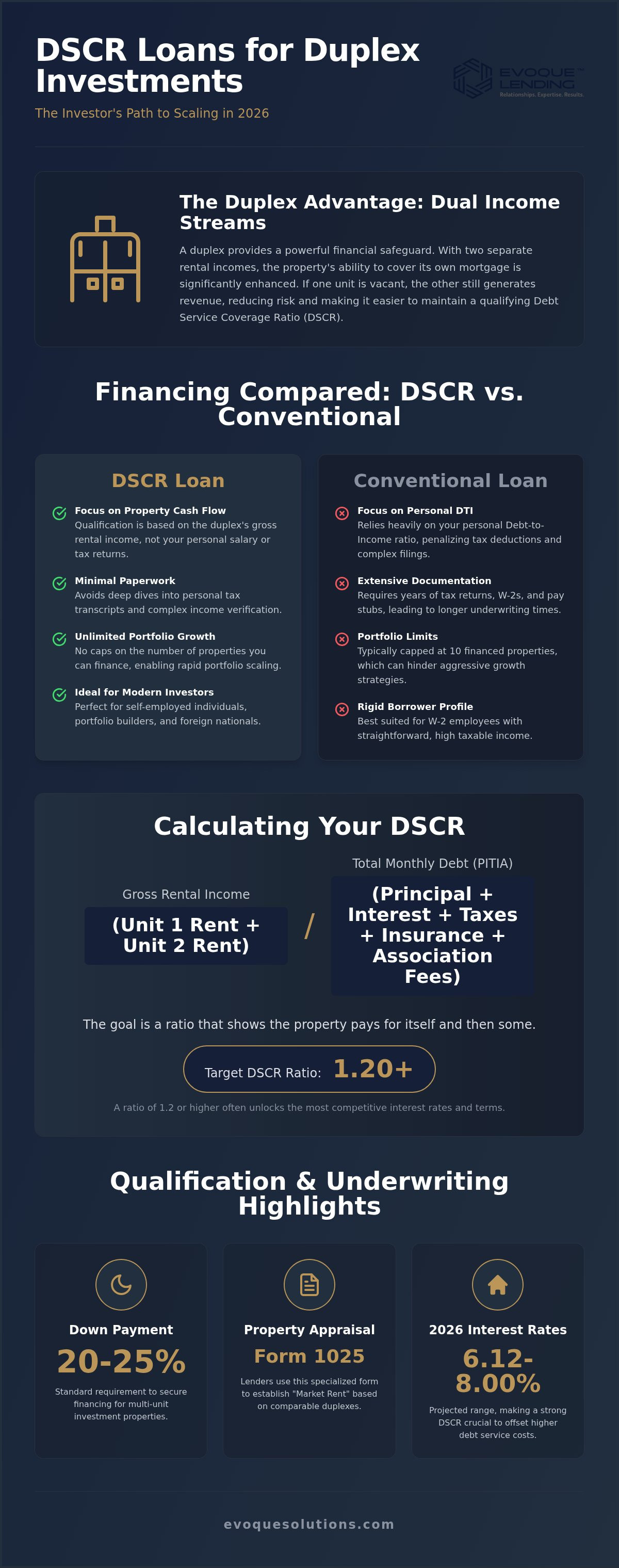
The 2026 real estate market demands agility. Traditional banks often lean on rigid Debt-to-Income (DTI) ratios that don't account for the unique cash flow potential of a multi-unit property. A Debt Service Coverage Ratio (DSCR) loan provides a streamlined alternative. It measures the ability of a property to pay for itself. For a duplex, this calculation is particularly robust. You aren't relying on a single tenant to cover the mortgage, taxes, and insurance. Instead, you have two distinct income streams working in tandem.
This income diversification is the primary "efficiency engine" for a DSCR loan for duplex investment. If one unit becomes vacant, the property still generates revenue from the second unit. This safety net reduces the risk of the ratio falling below the critical 1.0 mark. In 2026, where market stability is paramount, lenders value this redundancy. Qualification hinges on the property’s gross potential rent rather than your personal salary or W-2 history. It’s a shift from looking at who you are to looking at what the property can do.
DSCR vs. Traditional Multi-Unit Financing
Standard financing often requires a mountain of paperwork. Self-employed borrowers frequently hit a wall because their tax deductions lower their taxable income too much for a conventional underwriter. DSCR eliminates this hurdle entirely. While "house hacking" usually requires a conventional loan due to primary residence rules, pure investment properties thrive under DSCR. You trade personal income scrutiny for property-level performance. This process slashes underwriting time and removes the need for years of tax transcripts. It’s about fit and alignment with how modern investors actually operate.
Who is the Ideal Duplex DSCR Borrower?
This path is perfect for entrepreneurs with complex tax filings. If your business has high expenses, your income on paper might look low. A DSCR loan for duplex investment ignores those deductions. It's also the go-to choice for portfolio investors. Conventional loans often cap you at 10 properties. DSCR has no such limit. It allows you to scale your portfolio as fast as you can find profitable deals. Finally, foreign nationals find this attractive. They can invest in US duplexes without a domestic credit history, as the loan is secured by the property's projected cash flow and equity.
Calculating DSCR for 2-Unit Properties: Understanding the Math
The math behind a DSCR loan for duplex investment is direct, yet it requires a nuanced understanding of how lenders view multi-unit volatility. To find your ratio, lenders take the Gross Rental Income and divide it by the PITIA. This acronym stands for your total monthly payment: Principal, Interest, Taxes, Insurance, and Association fees. While a single-family home relies on one lease, a duplex combines both units to create a stronger, more resilient income figure. If you're unsure how your projected rents align with current market par rates, you can explore customized DSCR scenarios to see the exact impact on your debt coverage.
Lenders don't just take your word for what the units will earn. They rely on the 1025 Appraisal Form, specifically designed for small residential income properties. Unlike the standard 1007 form used for single-family rentals, the 1025 form provides a detailed analysis of comparable duplexes in the area to establish "Market Rent." If one unit is currently vacant, the lender will typically use this appraised market rent to complete the calculation. Aiming for a ratio of 1.2 or higher is the strategic goal in 2026. Hitting this threshold often unlocks the most competitive interest rates and reduced origination fees.
The Duplex Cash Flow Formula
Underwriting for two units involves calculating the Net Operating Income (NOI) with a safety margin. Lenders often apply "haircuts" to the gross potential rent, which is a percentage reduction to account for future vacancy and maintenance. This ensures the property remains viable even during tenant turnover. A "No-Ratio" DSCR loan is a specialized option for investors with high equity who don't want the lender to scrutinize the property's immediate cash flow at all.
Impact of the 2026 Interest Rate Environment
With August 2026 interest rates ranging from 6.12% to 8.00%, the "Debt Service" side of the equation has become more expensive. This makes the DSCR loan for duplex investment a balancing act. If a property barely clears a 1.0 ratio, many investors opt for interest-only payment structures. This reduces the monthly PITIA, effectively raising the DSCR on paper without requiring more rental income. You can also navigate these tighter margins by opting for a lower Loan-to-Value (LTV) ratio. By putting more money down, you decrease the debt service and improve your chances of qualifying for top-tier pricing even if rents are stagnant.
DSCR vs. Conventional Financing: Which is Right for Your Duplex?
Choosing between a conventional mortgage and a DSCR program often comes down to the trade-off between cost and flexibility. Conventional loans for investment duplexes typically cap the Loan-to-Value (LTV) at 75%. This requires a significant 25% down payment, which can drain your liquidity. In contrast, a DSCR loan for duplex investment often allows for 80% or even 85% LTV. This lower entry cost keeps more capital in your pocket for renovations or your next acquisition. While conventional loans offer lower interest rates, the "opportunity cost" of a high down payment and rigid underwriting often outweighs the savings for active investors.
Speed is another critical differentiator. Conventional underwriting is a slow, document-heavy process. Lenders will scrutinize your 4506-C tax transcripts and W-2s, a process that can easily stretch to 60 days. DSCR underwriting skips the personal income verification entirely. By focusing on the property's cash flow and your credit score, these loans can close in half the time. Both options generally require 6 to 12 months of PITIA reserves, but only DSCR allows you to scale indefinitely. Conventional lenders often stop once you hit 10 financed properties, creating a hard ceiling for your growth.
Interest Rate and Fee Analysis
You should expect a 1% to 2% interest rate premium when choosing DSCR over conventional financing. This premium covers the lender's risk for not verifying your personal income. Most DSCR products also include prepayment penalties, typically structured as 3-2-1 or 5-4-3-2-1 schedules. You must factor these into your exit strategy, especially if you plan to flip or refinance quickly. Understanding these nuances is essential for dscr loans for real estate investors who want to scale without traditional banking friction.
The Underwriting Experience
The conventional experience is a deep dive into your past, requiring years of tax returns and proof of stable employment. DSCR is a forward-looking process. The lender cares about the appraisal, the lease agreements, and your ability to manage the asset. If your tax returns show significant business write-offs that lower your qualifying income, you might find that bank statement loans for self employed or DSCR products are your only viable paths to a multi-unit closing. It’s a matter of choosing the tool that fits your specific financial structure rather than forcing yourself into a "bank box" that doesn't fit.
Qualification Requirements and Underwriting for Duplex DSCR Loans
Qualifying for a DSCR loan for duplex investment involves a specific set of benchmarks that differ from the standard residential box. In the 2026 lending environment, your credit score remains a primary pillar of the underwriting process. Most programs require a minimum middle FICO score between 660 and 700. However, pushing your score above 740 often unlocks the most aggressive leverage and lower interest rates. While some single-family programs might allow for 15% down, duplexes typically require a 20% to 25% down payment. This higher equity stake reflects the lender's need for a safety margin on multi-unit assets.
Experience is another factor that underwriters weigh carefully. You don't necessarily need to be a seasoned landlord to secure a DSCR loan for duplex investment, but having a history of managing rental properties can sometimes lead to better terms. If you are a first-time investor, lenders will look closer at your liquid reserves. You should be prepared to show 6 to 12 months of PITIA in a verifiable account. The appraisal process is also more rigorous for 2-unit properties. The appraiser must find appropriate duplex comps rather than using single-family homes with accessory dwelling units. This ensures the "Market Rent" established on the 1025 appraisal form is accurate and defensible.
Documenting the Duplex Income
Underwriters use a "lesser of" approach when documenting income. They will look at your current executed leases or the market rent estimates provided by the appraiser. If a unit is vacant, the appraiser’s 1025 form becomes the source of truth. A significant trend in 2026 is the use of Short-Term Rental (STR) income for qualification. If one unit of your duplex operates as a vacation rental, many lenders now accept data from platforms like AirDNA to project potential gross rent. This flexibility allows investors to capitalize on high-tourism markets where traditional long-term leases might not reflect the property's true earning power.
The Closing Checklist
The final steps toward funding involve specific structural requirements. Most duplex DSCR loans require you to close in the name of a business entity, such as an LLC. This protects your personal assets and aligns with the commercial nature of the loan. You will also need a landlord insurance policy specifically rated for a 2-unit property, which is different from a standard homeowner’s policy. Before you head to the closing table, the lender will perform a final verification of your liquid reserves. Gift funds are rarely permitted in the DSCR space; the down payment must typically be your own "skin in the game."
If you're ready to see how your specific duplex deal pencils out under these guidelines, you can submit your scenario for a rapid DSCR review to get a clear picture of your qualifying terms.
Scaling Your Portfolio: Leveraging Duplex Equity with Evoque Lending
Scaling a real estate portfolio requires a reliable source of liquidity. Once you've stabilized your first property, a DSCR loan for duplex investment becomes a powerful tool for capital extraction. A DSCR Cash-Out Refinance allows you to tap into the built-up equity of your duplex without the tax return scrutiny that often stalls conventional refinances. In the 2026 market, where agility is a competitive advantage, being able to pull capital based on property performance alone means you can fund your next down payment in weeks instead of months. It’s a strategic move for those who want their assets to work harder.
For investors who prefer to buy with cash to win a bidding war, the "Delayed Financing" strategy is an essential 2026 tactic. This allows you to finance the property immediately after closing, recapturing your initial investment to move onto the next deal without waiting for a traditional seasoning period. Evoque Lending’s national reach across 40+ states means you aren't limited to your local market. You can diversify your portfolio by acquiring duplexes in high-growth regions while maintaining a single, specialized relationship with a lender that understands the nuances of 2-4 unit underwriting. Working with a dedicated specialist ensures your financing is aligned with your long-term wealth goals.
Beyond the First Duplex
The transition from a duplex to a triplex or 4-plex is a natural progression. The same DSCR framework applies, though the income streams become even more resilient as you add units. For seasoned investors, cross-collateralization options may be available to leverage multiple properties under a single loan structure, maximizing your borrowing power. Utilizing Evoque’s streamlined online questionnaire is the most efficient way to find a loan match that aligns with your specific portfolio trajectory. It simplifies a complex process into manageable steps.
The Evoque Lending Advantage
We position ourselves as a long-term partner for those who don't fit into standard institutional boxes. Beyond our specialized DSCR products, we offer a suite of alternative solutions including 1099 borrower loans, bank-statement programs, and asset-depletion loans. This breadth of choice ensures that whether you are an entrepreneur with complex filings or a foreign national, there is a path forward. Our specialists provide personalized support, acting as seasoned guides through the intricate world of investor-grade real estate. We value depth of knowledge and professional relationships over quick transactions, ensuring you have the resources to succeed in a competitive market.
Ready to finance your next duplex? Start your Evoque Lending questionnaire today.
Secure Your Next Multi-Unit Asset with Confidence
The 2026 real estate market rewards investors who prioritize property performance over personal income documentation. By choosing a DSCR loan for duplex investment, you bypass the restrictive debt-to-income caps that often stall portfolio growth. You've seen how dual rental streams provide a built-in safeguard for your debt coverage ratio, and how specialized underwriting allows for rapid closings without the tax return hurdle. Whether you're acquiring your first 2-unit property or leveraging equity for a tenth, the path to scaling is now grounded in the asset's own cash flow.
Since 2005, we've helped investors navigate the complexities of 2-4 unit financing across more than 40 states. We specialize in solutions that require no tax returns or DTI checks, positioning ourselves as the expert guide for those who don't fit the standard bank box. You can Get a Custom DSCR Quote for Your Duplex Investment today to see how your property's potential aligns with current 2026 rates. Your next acquisition is within reach when you have the right financial partner by your side.
Frequently Asked Questions
Can I get a DSCR loan for a duplex if I plan to live in one of the units?
No, you cannot use this program for a primary residence. These loans are strictly for investment properties where both units are rented to third parties. If you plan to live in one of the units, it's considered an owner-occupied property. That scenario requires conventional or government-backed financing. DSCR underwriting relies on the business purpose of the asset and the revenue it generates from all units.
What is the minimum down payment for a duplex DSCR loan in 2026?
Most lenders require a minimum down payment of 20% to 25% for a duplex. While single-family homes sometimes allow for slightly lower entry points, the multi-unit nature of a duplex carries a higher perceived risk for lenders. In the 2026 market, maintaining a 25% equity stake often helps you secure a lower interest rate and avoids the need for private mortgage insurance on your investment.
How does a lender calculate rental income for a vacant duplex unit?
Lenders use the market rent estimate provided by a professional appraiser on the 1025 appraisal form. They don't require an active lease to count the potential income. The appraiser analyzes comparable 2-unit rentals in the immediate area to determine what the vacant unit could realistically earn. This projected figure is then used to calculate the debt coverage ratio for your DSCR loan for duplex investment.
Do I need to show tax returns for a DSCR loan on a 2-unit property?
No, tax returns are never required for this type of financing. Qualification is based entirely on the property’s cash flow and your personal credit score. This makes it an ideal solution for self-employed investors who have significant business write-offs that might disqualify them from conventional bank loans. The lender focuses on the asset's ability to generate revenue rather than your personal taxable income or employment history.
Are DSCR loan interest rates higher for duplexes than single-family homes?
Yes, you can typically expect a small interest rate premium for duplexes compared to single-family rentals. Multi-unit properties involve more complex management and higher vacancy risks, which lenders price into the loan. In August 2026, this spread is usually between 0.125% and 0.250%. However, the higher gross rental income from two units often offsets this slightly higher rate by improving your overall monthly cash flow and debt coverage.
Can I close a duplex DSCR loan in the name of my LLC?
Yes, closing in the name of an LLC is actually encouraged and often required by specialized lenders. Since these are business-purpose loans, using an entity provides a layer of liability protection for your personal assets. You'll need to provide the lender with your LLC's articles of organization and an operating agreement during the underwriting process to verify the entity's standing and ownership structure before you head to closing.
What is the minimum DSCR ratio required for a duplex investment?
The standard minimum is 1.0, meaning the rental income exactly covers the mortgage, taxes, and insurance. Some aggressive programs in 2026 allow for ratios as low as 0.75 if you have a high credit score or a larger down payment. However, hitting a 1.2 ratio is the strategic goal that typically unlocks the most favorable terms and lower origination fees for your DSCR loan for duplex investment.
How long do I need to own a duplex before doing a DSCR cash-out refinance?
Most lenders require a seasoning period of 6 months before you can pull cash out based on a new appraised value. If you try to refinance sooner, the lender may limit the loan amount to your original purchase price plus documented renovation costs. After the 180-day mark, you can typically access up to 75% or 80% of the current market equity to fund your next acquisition or property improvement project.
Reviewed by Eddie Luhrassebi, Founder & CEO, NMLS #337071 | CA DRE #01230650
Last updated: August 21, 2026 · About the reviewer