
Bank Statement Loans for Vacation Rentals: 2026 Guide
Written by Eddie Luhrassebi · Published August 22, 2026
Our 2026 guide to a bank statement loan for vacation rental properties shows how to use cash flow to secure financing, bypassing traditional underwriting.
Tax returns often tell a story of tax efficiency rather than real financial strength, and for the modern investor, that distinction is frequently the barrier between a closed deal and a missed opportunity. You have built a profitable business, yet traditional lenders often penalize you for the very deductions that keep your operation lean. It's exhausting to watch high-yield properties slip away because a rigid debt-to-income calculation ignores the actual cash flow hitting your accounts every month. Utilizing a bank statement loan for vacation rental properties allows you to bypass these institutional hurdles by focusing on your true liquidity rather than a bottom-line figure on an IRS form.
We understand that self-employed entrepreneurs operate differently than W-2 employees, and your financing should reflect that reality. In this 2026 guide, you'll discover how to leverage 12 or 24 months of deposits to secure a 30-year fixed mortgage for your next high-performing short-term rental. We will clarify the specific documentation you need to succeed, compare bank statement programs against DSCR alternatives, and provide the technical insights required to maximize your ROI. By the end of this article, you will have a clear, actionable roadmap to financing your vacation home without the stress of traditional underwriting.
Why Traditional Mortgages Often Fail Vacation Rental Investors
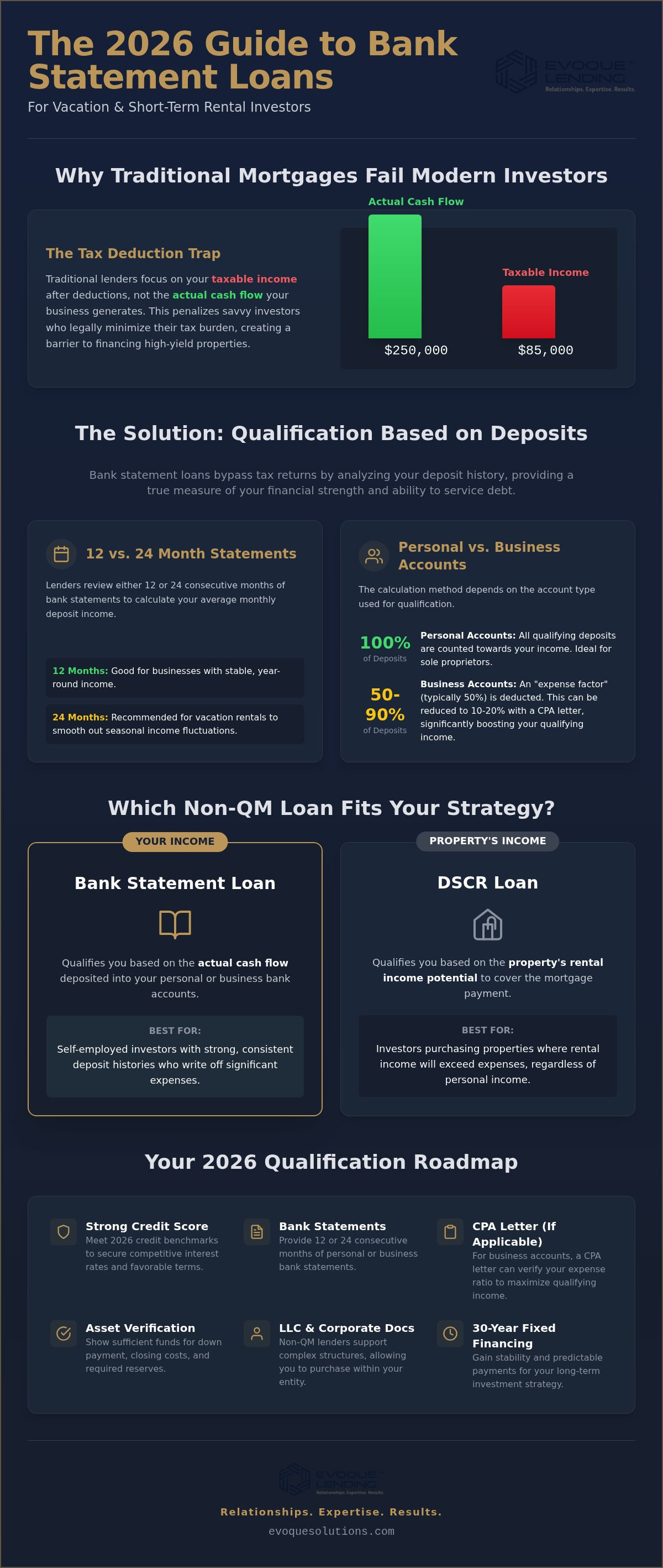
Traditional mortgage loans are built for the W-2 worker with a predictable paycheck. For the vacation rental investor, this model is fundamentally flawed. You might be generating six figures in revenue, but your tax professional ensures that your taxable income remains as low as possible. This "Tax Deduction Trap" is a legal strategy for wealth preservation that inadvertently disqualifies you from institutional financing. When you apply for a standard loan, the underwriter sees your net income after deductions, not the gross cash flow you actually use to run your life and grow your portfolio.
Institutional lenders often struggle with the 1099 economy. They prefer stability over scalability. If your income is "lumpy" because you own a seasonal business or a high-performing rental in a tourist destination, traditional debt-to-income (DTI) calculations will likely fail you. This is why a bank statement loan for vacation rental properties has become the 2026 standard for modern investors. It replaces the IRS's narrow view of your wealth with a comprehensive look at your actual bank deposits.
The Disconnect Between Tax Returns and Real Liquidity
Depreciation is a primary culprit here. It's a non-cash expense that lowers your net income on a tax return without reducing your available cash. Conventional underwriters rarely add these paper losses back into your qualifying income at a 100% rate. Additionally, business expenses like marketing, maintenance, and property management fees further erode the income figure used for qualification. A bank statement loan for vacation rental investments bypasses this by averaging your total monthly deposits, providing a much more accurate reflection of your ability to service a 30-year fixed mortgage.
Vacation Rentals
as a Specialized Investment Category
Secondary market demand in 2026 has shifted toward Non-QM products because they offer more realistic risk assessments for self-employed borrowers. Short-term rentals carry a different risk profile than long-term leases, and institutional lenders often shy away from this perceived volatility. Flexibility in financing is crucial when you're competing for high-yield properties in markets with tight inventory. Bank statement loans provide that edge. They allow you to:
- Qualify based on real-time cash flow rather than two-year-old tax data.
- Utilize personal or business statements to prove liquidity.
- Secure funding for LLCs and complex investment structures that traditional banks won't touch.
- Navigate 2026 market shifts with a lender that understands the hospitality niche.
By focusing on your actual deposit history, lenders can see the consistency of your business operations regardless of how much you write off at the end of the year. This approach aligns the loan qualification process with the practical realities of how modern real estate entrepreneurs operate.
The Mechanics of Bank Statement Loans for Short-Term Rentals
Bank statement lending operates on a simple premise: your bank deposits are a more accurate reflection of your debt-service capacity than your taxable income. Because these products fall outside the federal definition of a Qualified Mortgage, lenders have the flexibility to design underwriting criteria that fit the specific needs of entrepreneurs. Most programs require either 12 or 24 months of consecutive bank statements. For those seeking a bank statement loan for vacation rental properties, the 24-month option is frequently the better choice. It accounts for the seasonal nature of tourism, ensuring that a slow winter doesn't disqualify you based on a short-term snapshot.
Personal vs. Business Account Analysis
Lenders treat personal and business accounts differently. If you use personal bank statements, underwriters generally provide 100% credit for all qualifying deposits. This is ideal for freelancers or sole proprietors who don't separate their finances. Business accounts, however, are subject to an "expense factor." Lenders assume that a portion of your gross deposits goes toward operating costs. While a standard 50% expense ratio is common, specialized lenders can often lower this to 20% or even 10% if your CPA provides a letter verifying your actual overhead. Managing co-mingled funds or multiple entities requires a seasoned guide to ensure your income is calculated correctly. You can explore customized income analysis to see how your specific structure impacts your qualifying power.
Underwriting for the Vacation Rental Use Case
The 2026 credit environment places a high value on liquidity. Beyond your income, lenders look for "reserves," which are liquid assets remaining after your down payment and closing costs. For investment properties, you might need three to six months of mortgage payments in the bank. Property eligibility is also broader in the Non-QM space. You can often finance non-warrantable condos or unique short-term rental units that traditional banks reject. It's a level of flexibility that standard institutional boxes simply can't provide.
Underwriters also consider the property's intended use. While the loan is based on your personal or business income, the property must meet investment or second-home criteria. In some cases, projected revenue from platforms like Airbnb can support the application, though the primary qualification remains your historical deposit record. This dual-layered approach ensures that your bank statement loan for vacation rental acquisition is both sustainable and profitable. It aligns your financing with the actual cash flow of your business rather than a theoretical number on a tax form.
Bank Statement vs. DSCR: Which Non-QM Loan Fits Your Strategy?
Investors often find themselves at a crossroads between two primary Non-QM instruments. While both offer a path around the institutional hurdles mentioned earlier, they solve the problem from opposite directions. A bank statement loan for vacation rental acquisition evaluates your total business health by looking at your liquid cash flow. In contrast, a Debt Service Coverage Ratio (DSCR) loan ignores your personal income entirely. It focuses strictly on the property’s ability to pay for itself. Choosing the right one requires a clear understanding of your current tax strategy and your long-term portfolio goals.
When to Choose a Bank Statement Loan
This is the ideal route if you have a robust business but the specific property you’re eyeing hasn't reached its full potential yet. Perhaps it’s a new build or a property in a developing market without a documented Airbnb history. Because the lender qualifies you based on your personal or business deposits, the property’s current lack of rental history won't stop the deal. This approach offers a natural alignment with self-employed bank statement loans, providing a holistic view of your financial strength. It's particularly useful for those who want to use their total business success to secure the most competitive terms possible.
When a DSCR Loan
is the Superior Option
If your goal is rapid expansion, the DSCR model is often the better fit. Lenders calculate the ratio of the property’s annual gross rental income against its annual debt, including taxes, insurance, and HOA fees. If the property "covers" its own costs, your personal debt-to-income ratio becomes irrelevant. This is perfect for high-yield vacation rentals in prime markets where the revenue far exceeds the mortgage payment. For investors managing multiple assets across different states, this is the fastest way to grow without hitting personal borrowing limits. You can find more on this in our 2026 DSCR guide for scaling portfolios.
The decision often hinges on your tax strategy. If you have high deposits but paper-thin net income due to aggressive write-offs, a bank statement loan for vacation rental properties allows you to use that gross cash flow to your advantage. However, if you already own several properties and don't want your personal income scrutinized every time you add a new door, DSCR provides the cleanest path to scaling. Both options bypass the rigid requirements of institutional banking. The right choice depends on whether you want the loan to be backed by your personal business success or the property’s individual performance.
Qualifying for a Bank Statement Loan: A 2026 Checklist
Securing a bank statement loan for vacation rental properties in 2026 requires more than just a healthy balance sheet. It demands a strategic presentation of your liquidity. Unlike traditional underwriting that looks for a static net income figure, Non-QM lenders analyze the movement of money through your accounts. They want to see that your business is consistent, even if it's seasonal. Preparation is the difference between a seamless approval and a request for more documentation. If you're ready to move forward, you can apply for a bank statement loan review to see where your current deposits place you.
Audit Your Deposits Before Applying
Reviewing your last 12 to 24 months of deposit history is the first step in your audit. Lenders are specifically looking for "lumpy" income patterns. For vacation rental owners, this is common; you might see a surge in summer deposits followed by a quieter winter. The key is to ensure that these fluctuations don't result in overdrafts or non-sufficient funds (NSF) notices. In the 2026 credit environment, even one or two NSFs in a 12-month period can significantly impact your approval chances. You should also be prepared to explain any large, non-recurring deposits that don't align with your typical business revenue. Transfers between your own accounts must be clearly documented to avoid being miscounted as income.
Required Documentation for Vacation Rental Financing
Documentation in the Non-QM space is streamlined but specific. You won't need tax returns, but you will need to prove you've been in business for at least two years. A CPA letter, a valid business license, or an active LLC filing usually satisfies this requirement. Additionally, lenders will verify your credit score. As of August 2026, the minimum credit score for most bank statement programs is 620. However, to secure the most competitive interest rates (which currently range from 6.250% for well-qualified borrowers), you should aim for a FICO score of 740 or higher.
Your down payment and reserves are the final pieces of the puzzle. While some lenders offer up to 90% loan-to-value (LTV) for borrowers with high credit scores, a 10% to 20% down payment is the industry standard. You must also show proof of liquid reserves. This typically includes three to 12 months of mortgage payments held in a liquid account. If you're using "gift" funds for your down payment, these must be documented with a signed gift letter and proof of the donor's ability to provide the funds. Having these items organized before you submit your application ensures that you can move quickly when the right property hits the market.
Scaling Your Vacation Rental Portfolio with Evoque Lending
Scaling a portfolio requires more than just capital; it requires a partner who understands the intricacies of non-traditional income. Since 2005, Evoque Lending has specialized in matching investors with programs that reward entrepreneurial success. By utilizing a bank statement loan for vacation rental acquisitions, you can grow your footprint across 40+ states without the limitations of local bank underwriting. Our national coverage ensures that whether you're eyeing a mountain retreat or a coastal unit, your financing remains centralized and consistent. This specialized approach is essential for investors who operate through LLCs or complex investment structures that traditional institutions often find too difficult to vet.
The transition from a single property to a multi-state portfolio is often hindered by the underwriting black box. We streamline this by starting with a simple online questionnaire that identifies the most efficient path for your specific financial structure. From there, we navigate the technical requirements of 1099-based borrowing and alternative income verification. If you already own assets, a DSCR Cash-Out Refinance can be a strategic tool to unlock equity for your next down payment, keeping your momentum steady without requiring new tax returns.
The Advantage of a Specialized Mortgage Broker
Working with a specialized broker provides access to wholesale rates and niche programs that aren't available at retail institutions. We don't just process applications; we advocate for your unique scenario. For 1099 earners and self-employed investors, this means having a guide who knows how to present seasonal income or significant business write-offs to underwriters in a way that highlights your stability. We understand that your actual cash flow is the best indicator of your creditworthiness, and we ensure the lenders we work with see that same value.
Next Steps: Securing Your 2026 Vacation Property
Timing is everything in the short-term rental market. Securing a bank statement loan for vacation rental properties before peak seasonal shifts allows you to have your listing live and optimized when traveler demand is highest. We provide a preliminary look at your qualifying income so you can shop with the confidence of a cash buyer. When you're ready to move beyond the constraints of traditional banking, our team is prepared to facilitate your growth. Start your loan questionnaire today and take the first step toward a more flexible financial future.
Securing Your Future in the Short-Term Rental Market
The 2026 vacation rental market continues to reward investors who prioritize financial flexibility over institutional conformity. You've seen how traditional debt-to-income models fail to account for the reality of self-employment, and you now have the tools to bridge that gap using your actual cash flow. Whether you choose the income-based approach of a bank statement program or the property-focused metrics of a DSCR loan, the path to scaling your portfolio is now clear. Success starts with a partner who understands that your tax returns don't define your potential.
Evoque Lending has specialized in these Non-QM solutions since 2005, providing national coverage across more than 40 states for investors who need a sophisticated guide. Our dedicated experts are ready to help you navigate the audit process and secure the funding you need to close on your next high-yield property. Don't let rigid underwriting hold back your growth. You can Get Pre-Qualified for Your Vacation Rental Loan today and leverage a bank statement loan for vacation rental acquisitions to build a lasting legacy. We're here to ensure your financing is as resilient as your business strategy.
Frequently Asked Questions
How many months of bank statements do I need for a vacation rental loan?
You typically need 12 or 24 months of consecutive statements to qualify. A 24-month review is often preferred for a bank statement loan for vacation rental properties because it captures a full two-year cycle of seasonal peaks and troughs. This longer window provides a more stable income average, especially if your rental market experiences significant volatility between summer and winter months. Providing more data often leads to a more favorable underwriting decision.
Can I use a bank statement loan for an Airbnb or VRBO property?
Yes, bank statement loans are perfectly suited for Airbnb and VRBO properties. Lenders recognize these as valid investment assets, provided you can demonstrate the necessary personal or business cash flow to support the mortgage. While traditional banks might struggle with the hospitality nature of short-term rentals, Non-QM programs embrace this model. They focus on your ability to manage the asset's cash flow rather than rigid institutional guidelines that favor long-term leases.
Are interest rates higher for bank statement loans than conventional mortgages?
Interest rates for these programs are generally 0.50% to 1.50% higher than conventional mortgage rates. As of August 2026, well-qualified borrowers with high credit scores might see rates starting around 6.250%. This premium reflects the increased flexibility of the underwriting process. Most investors find the slightly higher rate is a small price to pay for the ability to secure a 30-year fixed loan without providing tax returns or W-2s.
Do I need to be self-employed for at least two years to qualify?
Most lenders require at least two years of self-employment history to verify income stability. You can document this through a business license, a letter from your CPA, or active LLC filings. If you've been in business for slightly less than two years but have a strong prior background in the same industry, some specialized programs may offer exceptions. Consistency is the primary factor underwriters look for when assessing your long-term ability to repay.
What is the minimum down payment for a bank statement loan on a vacation home?
Minimum down payments typically range from 10% to 20% of the purchase price. For borrowers with credit scores of 700 or higher, some lenders offer up to 90% loan-to-value (LTV) options. If your score is closer to the 620 minimum, you should expect to bring at least 20% to the closing table. These requirements ensure you have sufficient equity in the property, which balances the risk for the lender in a Non-QM scenario.
Can I close a bank statement loan in the name of an LLC?
Closing in the name of an LLC is not only allowed but often encouraged for vacation rental investors. This structure provides a layer of liability protection and aligns with professional asset management strategies. When you use a bank statement loan for vacation rental acquisitions through an LLC, the lender will still vet the individual members' credit and income. It's a seamless process that allows you to maintain your business's legal and tax benefits.
Will the lender look at my tax returns at any point in the process?
No, the lender will not require or review your tax returns during the qualification process. The core benefit of a bank statement program is the total bypass of IRS documentation. Underwriters rely entirely on your bank deposits, credit score, and liquid reserves to determine your eligibility. This allows you to maintain your legal tax deductions without those write-offs impacting your ability to secure a competitive mortgage for a new investment property.
How does the lender calculate my income from business bank statements?
Lenders calculate qualifying income by averaging your total monthly deposits and then applying an expense factor. For business accounts, a standard 50% expense ratio is common, meaning only half of your gross deposits count as income. However, if your business has low overhead, a CPA letter can often reduce this factor to 10% or 20%. This adjustment significantly increases your qualifying power, allowing you to leverage more of your actual gross revenue.
Reviewed by Eddie Luhrassebi, Founder & CEO, NMLS #337071 | CA DRE #01230650
Last updated: August 22, 2026 · About the reviewer