
Investment Property Loan Based on Property Cash Flow: The 2026 Investor Guide
Written by Eddie Luhrassebi · Published September 18, 2026
Secure an investment property loan based on property cash flow in 2026. Bypass tax returns, master DSCR ratios, and scale your real estate portfolio fast.
What if your tax returns were actually the biggest obstacle to growing your real estate wealth? For many sophisticated investors, the aggressive write-offs that make sense at tax time become a liability when sitting across from a traditional loan officer. You've built a profitable portfolio, yet you're told you don't earn enough to qualify for another mortgage. It's a common frustration to feel stuck at the ten-property limit or silenced by invasive requests for years of personal financial history.
We understand that your personal income doesn't tell the whole story of your investment success. This guide explores how to secure an investment property loan based on property cash flow to break through those institutional barriers. By focusing on the rental income of the asset rather than your W-2 or 1040s, you can maintain your privacy and keep your momentum. We will detail the 2026 requirements for Debt Service Coverage Ratio (DSCR) loans, explain how to leverage property equity for new acquisitions, and provide a clear roadmap for scaling your portfolio without the friction of conventional banking.
The Shift Toward Property Cash Flow Loans in 2026
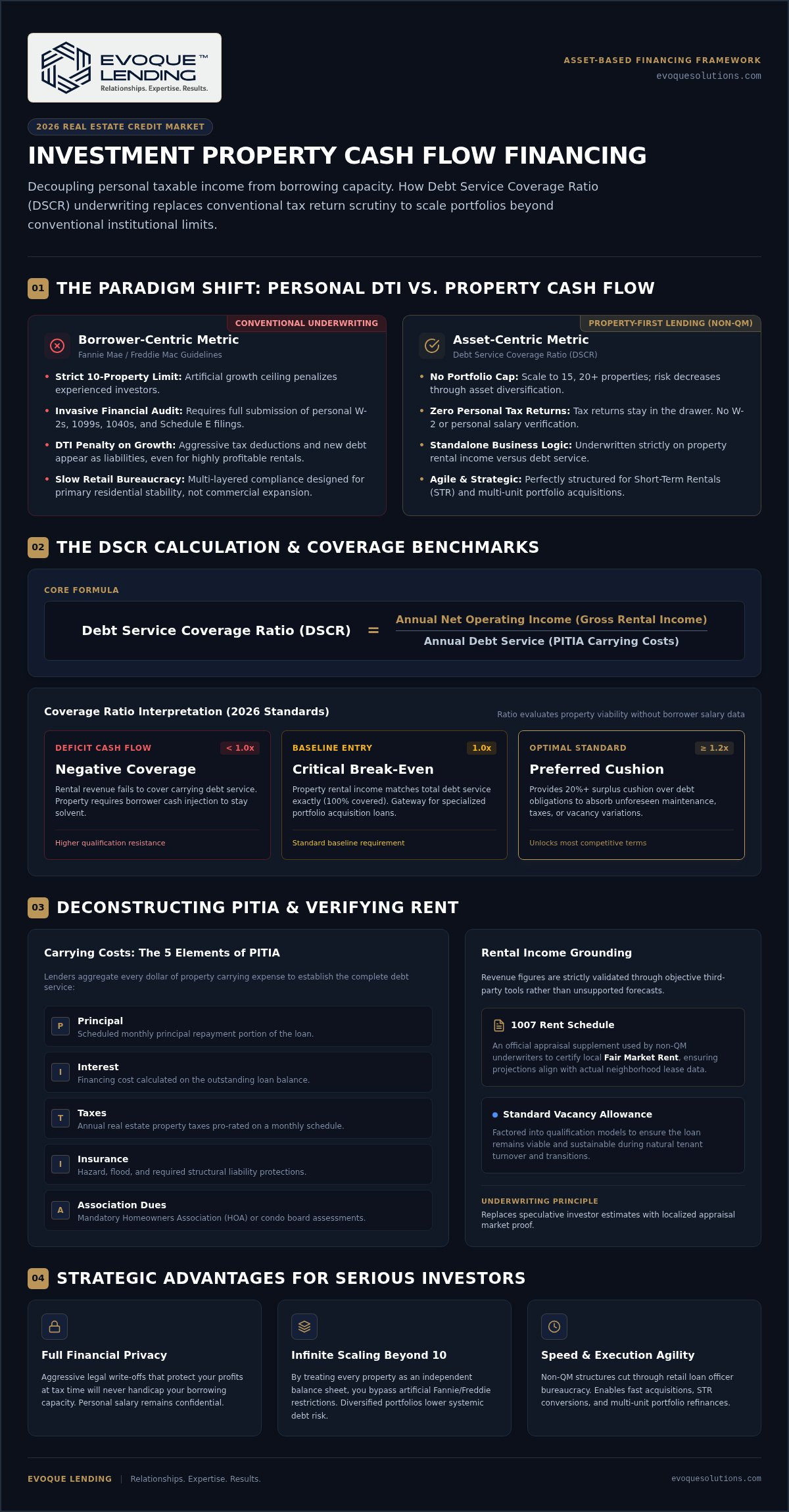
Traditional banking often feels like a relic of a different era. In 2026, the credit market has finally evolved to recognize that an investor's personal tax return rarely reflects their true business potential. Traditional Debt-to-Income (DTI) metrics fail because they penalize growth. Every time you add a property, your personal debt load appears to increase, even if the asset is highly profitable. This creates a ceiling for even the most successful entrepreneurs. Non-QM lenders have stepped in to bridge this gap, prioritizing the debt service coverage ratio (DSCR) over personal salary. This property-first mentality decouples your personal wealth from your investment potential, allowing the asset to stand on its own merits. The 2026 market demands this level of agility. With interest rates stabilizing after years of volatility, investors need speed and certainty. Traditional retail banks are often too slow, bogged down by layers of compliance that don't apply to commercial-minded real estate.
Breaking the Conventional 10-Property Limit
Conventional financing through Fannie Mae or Freddie Mac often hits a hard wall once you reach ten financed properties. For a serious investor, this limit is a growth killer. These guidelines are designed for residential stability, not portfolio expansion. An investment property loan based on property cash flow removes these artificial caps entirely. Scaling requires a partner who understands that 15 or 20 properties represent lower risk through diversification, not higher risk through debt. Conventional lenders don't see it that way; they see complexity and potential default. By shifting from a borrower mindset, where your job defines your creditworthiness, to an investor mindset, where the property's performance is king, you can scale indefinitely. There is no limit to how many cash-flow-positive assets you can acquire when each loan is treated as a standalone business decision.
The Advantage of No Personal Income Verification
Privacy is a luxury that traditional banks rarely afford you. They want to see every 1099, W-2, and Schedule E in your file. For the self-employed, aggressive tax write-offs are a smart business move, but they often destroy your borrowing power in the eyes of a retail bank. Cash flow lending solves this by ignoring your personal income history. Your tax returns stay in your drawer. Instead, the lender focuses on the property's ability to generate revenue. This is particularly vital for those using Short-Term Rental (STR) strategies or multi-unit acquisitions. When you use an investment property loan based on property cash flow, the lender is looking at the market rent potential rather than your personal financial background. This approach ensures that your strategic deductions don't hinder your next acquisition. It places the emphasis back on what matters: the actual performance of the real estate.
Understanding the DSCR Mechanism: How Cash Flow Loans Work
Traditional lenders often obsess over your personal debt-to-income ratio, which frequently ignores the actual revenue potential of the asset you're buying. An investment property loan based on property cash flow operates on a different logic. It relies on the Debt Service Coverage Ratio (DSCR) as the primary metric for approval. Specifically, DSCR is the ratio of a property's annual net operating income to its annual mortgage debt service. In the 2026 lending environment, a 1.0x ratio serves as the critical break-even threshold. This means the property's income exactly covers its debt obligations. While many lenders prefer a cushion of 1.2x or higher to account for unexpected costs, the 1.0x mark remains the entry point for many specialized portfolio-building programs.
Calculating the Ratio: PITIA Explained
To determine the "debt service" portion of the formula, lenders calculate the PITIA. This includes the Principal, Interest, Taxes, Insurance, and any Association dues like HOA fees. Every dollar of these carrying costs is weighed against the gross rental income. Lenders verify these income figures through a 1007 Rent Schedule, which is an appraisal supplement that establishes the fair market rent for the area. This ensures the numbers are grounded in local reality rather than optimistic projections. Some programs also factor in a standard vacancy allowance to ensure the loan remains viable even during tenant transitions. If you're ready to move forward, you can analyze your property's cash flow potential to see how it aligns with these specific PITIA requirements.
Minimum Requirements for Property-Based Financing
Even though the property's income is the focal point, your personal financial profile still provides the foundation for the loan. Most cash flow programs require a solid credit score, typically starting at 660 or 680. Loan-to-Value (LTV) expectations generally range from 75% to 80% for purchases, meaning a 20% to 25% down payment is standard. For a cash-out refinance, LTVs might be slightly lower to ensure enough equity remains in the deal. Liquidity is the final piece of the puzzle. Lenders usually require "reserves," which is liquid cash set aside to cover 3 to 6 months of PITIA payments. This safety net ensures that a single repair or a temporary vacancy doesn't jeopardize the investment. Securing an investment property loan based on property cash flow is a structured process that rewards investors who maintain strong credit and healthy cash reserves.
Cash Flow Loans vs. Bank Statement Loans: Comparing Your Options
Choosing the right financing path in 2026 requires understanding the nuance between different Non-QM products. For many self-employed individuals, the choice boils down to how they prefer to demonstrate their creditworthiness. An DSCR vs. Bank Statement Loan comparison is often the first step in a strategic acquisition. While both products bypass the need for traditional tax returns, their underlying mechanics serve different purposes. Bank statement loans rely on your personal or business cash flow, whereas an investment property loan based on property cash flow looks exclusively at the rental income generated by the subject asset. This distinction is critical for investors who want to keep their personal finances entirely separate from their real estate business.
The Documentation Showdown
The paperwork gap between these two options is significant. Cash flow loans represent the pinnacle of streamlined documentation. You typically provide the purchase contract, an appraisal with a rent schedule, and proof of liquid reserves. There's no deep dive into your personal spending habits or business overhead. In contrast, bank statement programs require an underwriter to analyze 12 to 24 months of deposits to calculate a qualifying income average. For seasoned investors, debt service coverage ratio (DSCR) loans are often the faster route to the closing table. They minimize personal scrutiny and focus on the business case for the property itself. This speed is a major competitive advantage in a fast-moving market where sellers value certainty and quick timelines.
Investment Strategy Alignment
Your exit strategy and property type should dictate your loan choice. Cash flow loans are the gold standard for long-term buy-and-hold strategies, especially when you prefer to close in the name of an LLC. However, if you're pursuing a "house hacking" scenario where you intend to live in one unit of a multi-family property, a bank statement loan is usually the correct path. Primary residences don't qualify for property-based cash flow metrics. Matching the loan terms to your goals is equally vital. Many investors using an investment property loan based on property cash flow opt for interest-only periods. This choice maximizes monthly liquidity during the initial years of an acquisition. It allows you to reinvest capital into your next deal rather than tying it up in principal pay-down. While interest rates for DSCR products may carry a slight premium over bank statement loans, the trade-off in privacy and scalability often justifies the cost for growth-minded investors.
Actionable Steps to Qualify for a Cash Flow Loan
Qualifying for an investment property loan based on property cash flow is a strategic exercise in asset valuation. Unlike traditional mortgages that focus on your past earnings, these loans prioritize the property's future revenue. Your first step should always be a rigorous pre-acquisition rental market analysis. You need to verify that the local market supports the rent required to cover your projected debt. If the numbers are tight, consider a larger down payment to optimize the debt service. Reducing the principal amount lowers your monthly obligation, which instantly strengthens your ratio. For a deeper look at specific criteria, review the DSCR Loan Requirements for Investment Properties to understand how your credit and reserves impact the final terms.
The Appraisal and Rent Schedule
The Form 1007 is the finish line for your loan approval. This appraisal supplement establishes the fair market rent that the lender will use for qualification. You can't leave this to chance. Prepare a "rent packet" for the appraiser that includes recent rental comparables and a list of property upgrades that justify a premium price. If the property under-covers, meaning the DSCR falls below 1.0, you aren't necessarily out of options. Some 2026 programs allow for "no-ratio" or low-ratio approvals, though these often come with higher down payment requirements. Proactive communication with the appraiser about the property's unique value can make the difference between a rejection and a clear-to-close.
Vesting in an LLC for Asset Protection
Most specialized lenders prefer that you close your loan in the name of an LLC. This structure reinforces the commercial nature of the deal and provides essential asset protection for your personal wealth. The process is efficient. You'll need to provide your business formation documents and an operating agreement during the underwriting phase. While you'll still provide a personal guarantee, holding the title in a business entity keeps your investment activities separate from your personal life. This is a hallmark of a professional investor mindset. It allows you to scale your portfolio while maintaining a clear boundary between your business assets and your home. If you're ready to secure your next acquisition, you can start your application today to see how your entity structure fits our current programs.
Scaling Your Portfolio with Evoque Lending’s Solutions
Scaling a real estate business requires more than just capital; it requires a partner who understands the nuances of asset-based lending. Evoque Lending has operated at the forefront of the Non-QM market since 2005, providing the expertise needed to navigate complex investment scenarios. When you seek an investment property loan based on property cash flow, you aren't just looking for a transaction. You're looking for a way to maximize your property's equity to fuel your next acquisition. By moving beyond the limitations of traditional retail banks, you can implement the strategies found in our guide on Scaling Your Real Estate Portfolio Without Tax Returns: The 2026 Investor’s Playbook.
Our role as a national mortgage broker gives you a distinct advantage. We have access to specialized products that aren't available through standard consumer channels. Whether you're focusing on Short-Term Rentals (STRs) like Airbnb or expanding into multi-family units, our team customizes loan structures to align with your specific exit strategy. We understand that the income profile of a vacation rental differs from a long-term lease. Our experience allows us to present your property's cash flow in the most favorable light to ensure approval.
Streamlined National Financing
Managing properties across different regions can be a logistical challenge. We simplify this by offering financing in over 40 states through a single point of contact. This national reach means you don't have to build new banking relationships every time you enter a new market. Evoque Lending excels at matching investors with the specific lender appetite that best fits their unique property type and investment goals. This personalized approach ensures you aren't forced into a "one-size-fits-all" product that doesn't serve your long-term interests.
Ready to Leverage Your Property’s Cash Flow?
The path to your next acquisition starts with a simple conversation. Our online questionnaire is designed to capture the essential details of your property and your goals without the need for invasive personal documentation. During your initial consultation, a loan specialist will review your property's DSCR and discuss the best leverage options for your scenario. We focus on transparency and speed, ensuring you have the data you need to make informed decisions. If you're ready to break free from traditional banking constraints, Get a custom DSCR loan quote today and see how property-first lending can transform your growth trajectory.
Take Control of Your Real Estate Growth
Scaling a real estate portfolio shouldn't be limited by the rigid standards of traditional banks. You've learned how an investment property loan based on property cash flow prioritizes the asset's performance, allowing you to bypass invasive personal income checks. By mastering the DSCR formula and preparing your property for the rent schedule, you can break through artificial growth ceilings. Whether you're focusing on short-term rentals or multi-family units, the right financing structure is the engine of your expansion.
Since 2005, Evoque Lending has served as a specialized partner for non-traditional borrowers. Our team offers dedicated expertise in Non-QM lending, ensuring that self-employed investors have access to capital without the friction of personal tax returns. We provide seamless LLC vesting options to help you maintain professional asset protection across your entire portfolio. Scale your portfolio with a DSCR loan from Evoque Lending and start your next acquisition with confidence. Your property's potential is the key to your success.
Frequently Asked Questions
Can I get an investment property loan based on rental income only?
Yes, this is the primary feature of the DSCR program. Qualification depends on the property's gross rental income compared to its annual debt obligations. Unlike traditional mortgages, the lender doesn't require personal tax returns or W-2s to verify your ability to pay. This approach focuses entirely on the asset's ability to generate its own profit. It's an ideal path for investors who have high tax deductions that make conventional mortgage qualification difficult.
What is a good DSCR ratio for a loan in 2026?
A ratio of 1.20x or higher is generally considered strong in the 2026 credit market. This means the property generates 20% more income than its total debt obligations, including taxes and insurance. While some specialized programs offer approvals for "no-ratio" or 1.0x coverage, a higher ratio often unlocks more competitive interest rates and better leverage. Maintaining a healthy cushion ensures the investment remains viable even during periods of minor vacancy or maintenance.
Do I need a job or W-2 income to qualify for a cash flow loan?
No, personal employment status isn't a primary factor for this type of approval. An investment property loan based on property cash flow is designed specifically for borrowers who don't have traditional W-2 documentation. Whether you're a full-time investor or self-employed, the lender evaluates the property’s revenue rather than your personal salary. You simply need to demonstrate that the asset produces enough income to cover the mortgage, taxes, insurance, and any association dues.
Can I use a cash flow loan for a short-term rental like an Airbnb?
Yes, short-term rentals are eligible for specialized cash flow financing. Lenders often use the 1007 rent schedule or third-party data services to estimate the daily or monthly revenue potential of the property. Because Airbnb and VRBO properties often generate higher gross income than long-term leases, they can frequently meet DSCR requirements more easily. We provide flexible options specifically tailored to the unique income volatility and management needs of the short-term rental market.
Are interest rates higher for property cash flow loans than conventional mortgages?
Yes, interest rates for DSCR and Non-QM loans are typically slightly higher than those for conventional Fannie Mae or Freddie Mac mortgages. This premium reflects the increased flexibility and reduced documentation requirements of the program. Many investors find the cost is justified by the ability to scale their portfolios quickly without the friction of personal income verification. It's a strategic trade-off between a lower rate and the ability to acquire more assets faster.
Can I close a cash flow loan in the name of an LLC?
Yes, closing in the name of an LLC is actually preferred by most cash flow lenders. This structure provides a layer of asset protection and keeps your investment activities separate from your personal finances. You'll need to provide your articles of organization and an operating agreement during the underwriting process. While a personal guarantee is usually required, the title remains in the business entity name to support your professional growth and corporate liability protection.
What is the minimum down payment for a property cash flow loan?
Most programs require a minimum down payment of 20% to 25%. This ensures that the investor has meaningful equity in the deal and that the property has a better chance of meeting debt coverage requirements. Higher down payments can often lead to more favorable interest rates and lower monthly carrying costs. While some niche programs might offer slightly lower entry points, maintaining a 75% to 80% loan-to-value ratio is the standard for the 2026 market.
How many properties can I finance using cash flow lending?
There's technically no limit to the number of properties you can finance with these specialized programs. Conventional loans often cap a single borrower at ten properties, but cash flow lending treats each asset as an independent business decision. As long as each new property meets the required debt service coverage ratio, you can continue to expand. This makes an investment property loan based on property cash flow the most efficient tool for scaling a large-scale, national portfolio.
Reviewed by Eddie Luhrassebi, Founder & CEO, NMLS #337071 | CA DRE #01230650
Last updated: September 18, 2026 · About the reviewer