
DSCR Loans for Single Family Rentals: 2026 Investor Guide
Written by Eddie Luhrassebi · Published August 20, 2026
Unlock your portfolio's potential with a DSCR loan for single family rental property. Our 2026 guide shows you how to bypass DTI limits & scale past 10 loans.
What if your ability to grow your real estate empire had nothing to do with your personal salary or the stack of tax returns on your desk? You've likely hit the "DTI wall" where traditional banks see your growing portfolio as a liability rather than an asset. It's frustrating when a high-performing property is rejected because a lender won't look past your personal debt-to-income ratio. A DSCR loan for single family rental property changes that equation entirely.
We believe your success shouldn't be limited by rigid institutional boxes. This guide will show you how to bypass personal income constraints and scale your portfolio by qualifying based on the property’s own cash flow. We'll break down the 2026 market landscape; we will explain how to close in an LLC for maximum asset protection and provide the roadmap to move well beyond the 10-loan conventional limit. Whether you're looking to leverage the competitive rates available in August 2026 or execute a cash-out refinance to fund your next acquisition, you'll find the technical expertise and strategic insights needed to grow with confidence.
The Debt-to-Income Wall: Why Conventional Loans Fail SFR Investors
For many investors, the journey toward a robust portfolio stops abruptly at the desk of a conventional loan officer. Traditional banks prioritize your personal debt-to-income (DTI) ratio. They look at your monthly obligations versus your gross income. As you acquire more single-family rentals, these banks often count the mortgages against you while only crediting a fraction of the rental income. Eventually, you hit a "cap." This usually happens around the 10-property mark, or even sooner if your personal debt levels are high. It's a fundamental mismatch between your professional growth and their rigid underwriting standards.
Traditional banks often view single-family rentals through a narrow lens. They see a residential mortgage rather than a business asset. This perspective leads to the inevitable rejection of seasoned investors who have reached their personal borrowing capacity. Since 2005, we've seen how these institutional boxes stifle growth, especially for those who treat real estate as a primary business rather than a side hobby.
The Limitations of Tax-Return-Based Qualifying
Investors utilize depreciation and legal write-offs to reduce their tax liability. It's a smart strategy. However, conventional lenders use these same tax returns to calculate your "ability to repay." On paper, you might look like you're losing money even if your properties are cash-flow positive. In the 2026 market, where agility is paramount, waiting for two years of tax history to prove income is a major bottleneck. These "paper losses" effectively lock high-equity investors out of new opportunities because the bank cannot reconcile your tax strategy with their risk models. You shouldn't be penalized for being tax-efficient.
Shifting the Focus from Borrower to Property
Business-purpose lending operates on a different philosophy. Instead of scrutinizing your W2 or your personal debt, the focus shifts to the asset itself. Using a DSCR loan for single family rental property allows the lender to evaluate the deal based on the home's ability to cover its own debt service. This approach prioritizes the property's performance over your personal financial history. It creates a path for scaling that isn't tied to your salary. A DSCR loan for single family rental property bridges the gap between your ambition and the capital required to achieve it.
The benefits of this shift include:
- No personal income verification: Qualification doesn't require tax returns or W2s.
- Streamlined documentation: Underwriting focuses on the lease agreement and appraisal.
- Unlimited scaling: You aren't restricted by the 10-loan conventional limit.
- Asset protection: You can close in the name of an LLC, which is a standard feature of these programs.
Lenders care about the rental house’s performance. If the numbers work, the loan works. This shift provides the privacy and speed that modern entrepreneurs demand to stay competitive in a fast-moving market.
How DSCR Loans for Single Family Rental Properties Work
A DSCR loan for single family rental property operates on a transparent premise: the asset must pay for itself. Unlike a traditional mortgage that scrutinizes your personal paystubs, this financing model focuses on the property's ability to generate cash flow. It's a business-purpose loan designed specifically for investors who prioritize scalability and speed over rigid personal income verification.
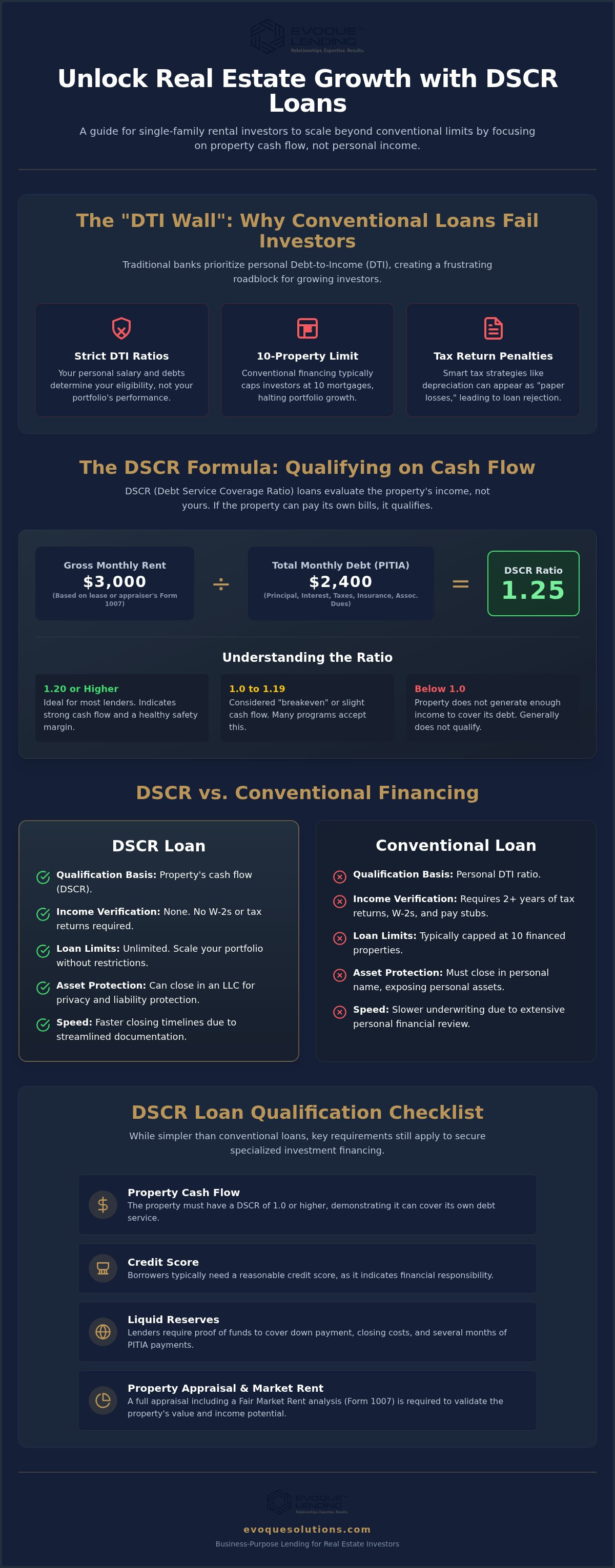
The qualification hinges on the Debt Service Coverage Ratio. This is a simple calculation that compares the property’s income against its monthly obligations. Lenders use a standardized formula to determine this figure:
- Gross Monthly Rent: The total income the property generates.
- PITIA: The sum of Principal, Interest, Taxes, Insurance, and any Association (HOA) dues.
- The Ratio: [Gross Monthly Rent] / [PITIA] = DSCR.
A ratio of 1.0 is considered the "breakeven" point. It means every dollar of debt is covered by a dollar of rent. Most national lenders prefer a ratio of 1.20 or higher to ensure a safety margin, but 1.0 remains a common floor for many programs. If you're looking to acquire a new asset, our specialized DSCR purchase programs can help you determine the exact ratio needed for your specific target property.
The SFR Appraisal: Understanding Form 1007
For a single-family home, the appraisal includes a specific document known as Form 1007. This is where the appraiser identifies the "fair market rent" by analyzing comparable rentals in the immediate area. It's a critical step. If your actual lease is higher than the market rent, lenders often use the lower of the two figures to remain conservative. Conversely, if the property is currently vacant, the 1007 Rent Schedule provides the primary data point for qualification. Property condition also plays a role; a home in disrepair may receive a lower market rent estimate, which directly impacts your final DSCR calculation and borrowing power.
DSCR Thresholds: 1.0 vs. 1.25 and "No Ratio" Loans
Your ratio dictates your terms. Properties with strong positive cash flow, typically a 1.25 ratio or higher, often qualify for higher leverage and better pricing. However, in high-appreciation markets where property values outpace rental yields, achieving a 1.25 ratio can be difficult. This is where "No Ratio" programs become invaluable. These allow you to qualify even if the property doesn't meet the standard 1.0 threshold, provided you have a strong credit score and sufficient cash reserves. Your FICO score remains a major influence; a higher score can often offset a lower DSCR ratio, giving you the flexibility to secure a DSCR loan for single family rental property in competitive, low-yield markets.
Comparing DSCR vs. Conventional Financing for SFR
Choosing between a conventional loan and a DSCR loan for single family rental property often feels like a choice between the lowest interest rate and the highest level of growth potential. Conventional loans, backed by Fannie Mae or Freddie Mac, provide the lowest cost of capital. However, they demand a level of personal transparency and a low debt-to-income ratio that many professional investors find impossible to maintain as they scale. It's a trade-off between the "cost of money" and the "cost of lost opportunity."
Speed of execution is a decisive advantage in the 2026 market. A conventional loan often takes 45 to 60 days to close because of the exhaustive review of your personal financial history. A DSCR loan focuses on the property. This streamlined process allows you to close much faster, often in 30 days or less. In competitive bidding wars for high-demand single homes, the ability to close quickly and with fewer personal contingencies makes your offer significantly more attractive to sellers.
The most significant differentiator is the lack of a portfolio ceiling. Conventional lenders impose a strict 10-property limit. Once you hit that cap, your growth stops. A DSCR program has no such limit. You can own 10, 50, or 100 properties, provided each asset meets the required cash flow criteria. This allows you to build a true real estate empire without the artificial constraints of traditional banking.
Interest Rates and Terms: The Cost of Flexibility
DSCR rates are typically 1% to 2% higher than conventional investment rates. This premium covers the increased risk the lender takes by not verifying your personal income. You have access to various structures, including 30-year fixed terms, adjustable-rate mortgages (ARMs), and interest-only periods that can maximize your monthly cash flow. Most of these loans include a prepayment penalty (PPP), usually ranging from one to five years. It's vital to align the PPP term with your exit strategy, whether you plan to hold long-term or refinance as equity grows.
LLC and Entity Vesting
Conventional loans usually require you to hold the title in your own name. This personal vesting exposes your personal assets to property-level liabilities and keeps the debt visible on your personal credit report. A DSCR loan for single family rental property allows for closing in the name of an LLC or other business entity. This provides a layer of privacy and a liability shield for your personal wealth. Since 2005, we've helped investors navigate entity-based financing to ensure their portfolios are structured for professional asset protection and long-term security.
Requirements and Qualification Checklist for SFR DSCR Loans
Qualification for a DSCR loan for single family rental property is a streamlined but rigorous process. While your tax returns stay in the drawer, your credit profile and liquid reserves come to the forefront. These requirements ensure that even though the lender isn't looking at your salary, the overall investment remains stable. We focus on the "three pillars" of DSCR lending: your credit score, your down payment, and your cash reserves.
Most programs require a minimum credit score between 620 and 680. A higher score often unlocks lower down payments and better pricing; however, you should generally expect to bring 20% to 25% to the closing table for a purchase. Lenders also look for liquidity. You'll typically need to show three to six months of Principal, Interest, Taxes, Insurance, and Association dues (PITIA) in a liquid account. This ensures you can handle a temporary vacancy without defaulting. Eligible properties include traditional single-family homes, townhomes, and warrantable condos.
The Documentation Process: What You Actually Need
The documentation focus remains almost entirely on the asset and the entity. You'll provide the lease agreement if the property is occupied. If the property is vacant, the appraisal's 1007 Rent Schedule becomes the primary qualifier. On the borrower side, we only require bank statements to verify your reserves and the source of your down payment. Since we specialize in LLC-based closings across 40+ states, you'll also need your Articles of Organization and an Operating Agreement. This structure keeps the debt off your personal credit report while providing the liability protection professional investors require.
Handling Vacant Properties and Short-Term Rentals
A common hurdle for new investors is the vacant property. Traditional banks often refuse to count potential income on a house that isn't currently leased. With a DSCR loan for single family rental property, we use market rent estimates to bridge that gap. This allows you to purchase a property and get it rent-ready without the pressure of an immediate tenant. Short-term rentals (STRs) follow a similar logic. We leverage data from sources like AirDNA to project income for Airbnbs and VRBOs. Seasoned investors use these specialized programs to maximize cash flow in high-demand vacation markets where traditional annual leases don't reflect the property's true earning potential.
If you're ready to see how your specific property or portfolio stacks up against these requirements, apply for a pre-approval today to lock in your next acquisition with confidence.
Scaling Your Portfolio with Evoque Lending’s DSCR Programs
Scaling a portfolio requires more than just capital; it requires a partner who understands the mechanics of professional real estate. Since 2005, Evoque Lending has specialized in connecting investors with a national network of Non-QM capital across 40+ states. We don't believe in a one-size-fits-all approach. Every DSCR loan for single family rental property we fund is matched to the specific cash-flow profile of the asset and the long-term goals of the borrower. This customized alignment ensures you aren't just getting a loan; you're securing a foundation for growth.
Our streamlined process moves your file from an initial online questionnaire to a funded loan with minimal friction. We handle the heavy lifting of underwriting and property analysis so you can focus on finding your next deal. Whether you're moving from your first property to your 100th, we provide the steady, reliable capital needed to navigate the 2026 market. Our expertise in LLC-based closings ensures that your professional structure remains intact while you expand.
Purchase and Cash-Out Refinance Strategies
Using a DSCR loan for single family rental property for a purchase allows you to act with the speed and confidence of a cash buyer. However, the real power of these programs often lies in the cash-out refinance. In 2026, seasoning requirements typically require you to hold a property for six months before you can tap into its increased market value. Once that period passes, you can unlock trapped equity to fund the down payment on your next acquisition. This creates a self-sustaining cycle of growth that isn't dependent on your personal savings or salary increases.
Getting Started: Your Path to Funding
Your path to funding begins with a clear property analysis. We look at the actual or market rent and compare it against the projected PITIA to establish your DSCR ratio. From there, we match your credit and liquidity profile to the best available program in our network. This methodical approach ensures transparency and ease, making the complex world of specialized lending feel navigable and structured.
Follow these steps to secure your next loan:
- Initial Analysis: We perform a preliminary DSCR calculation based on your property data.
- Program Matching: We align your specific credit and liquidity profile with our national capital sources.
- Entity Review: We verify your LLC documentation to ensure a smooth, professional closing.
- Funding: We move through the appraisal and underwriting process to get your deal across the finish line.
Learn more about our DSCR Cash-Out Refinance options to see how you can leverage your current portfolio. When you're ready to proceed, complete our online questionnaire for a personalized quote tailored to your investment strategy.
Take the Next Step Toward Your Real Estate Empire
The path to professional scaling is no longer blocked by personal income limits or the rigid constraints of traditional banking. By focusing on a property’s actual cash flow rather than your personal salary, a DSCR loan for single family rental property provides the flexibility you need to grow without limits. You've learned how to bypass the 10-property cap, leverage market rent estimates for vacant assets, and protect your wealth by closing in an LLC. These tools are designed to align with the practical realities of how modern investors operate.
At Evoque Lending, we've been specializing in Non-QM solutions since 2005. Our national reach across 40+ states allows us to support your growth wherever the market leads. We don't require tax returns or personal income verification; we prioritize the tangible performance of your investment. It's time to move past the DTI wall and build the portfolio you've envisioned. We're ready to act as your seasoned guide in this competitive market.
Get a Personalized DSCR Loan Quote from Evoque Lending today to see how our expertise can accelerate your journey. Your next acquisition is within reach, and we're here to help you secure it with confidence.
Frequently Asked Questions
Is a DSCR loan for a single-family rental property harder to get than a conventional loan?
No, a DSCR loan for single family rental property is generally easier to obtain for professional investors because it bypasses personal income verification. Conventional loans require exhaustive tax returns and debt-to-income (DTI) calculations that often disqualify high-growth portfolios. By focusing strictly on the property's rental income and your credit score, the underwriting process is significantly more streamlined. This results in faster closing times and less intrusive documentation requirements for the borrower.
What is the minimum credit score for a single-family DSCR loan?
The typical minimum credit score for a single-family DSCR loan is between 620 and 640. However, your FICO score directly influences your down payment and interest rate. For instance, borrowers with a score of 740 or higher may qualify for a 15% down payment, while those at the lower end of the spectrum should expect a 20% to 25% requirement. Maintaining a strong credit profile remains essential for securing the most competitive terms in 2026.
Can I use a DSCR loan to buy my first investment property?
Yes, first-time investors can qualify for a DSCR loan for single family rental property, though lenders often apply stricter guidelines. You may need a higher minimum credit score, such as 700, and a DSCR ratio of 1.0 or greater. Additionally, many programs require that you already own a primary residence to demonstrate a history of mortgage management. These safeguards ensure that new investors have the financial stability to manage their first rental asset successfully.
Do I need to have a tenant already in place to qualify for a DSCR loan?
You don't need a tenant in place to qualify. If the property is vacant, the lender will use the Market Rent estimate from the appraisal’s 1007 Rent Schedule to calculate the DSCR. This is particularly useful for purchase transactions where you plan to renovate or market the property post-closing. If the property is already leased, the lender will typically use the lower of the actual lease amount or the market rent estimate to remain conservative.
Are DSCR loan interest rates higher for single-family homes than multi-family?
Interest rates for single-family DSCR loans are generally comparable to multi-family properties. Rates are primarily driven by your credit score, the Loan-to-Value (LTV) ratio, and the Debt Service Coverage Ratio itself. While some lenders may add a small pricing adjustment for specific property types like condos or townhomes, the fundamental pricing structure remains consistent across the 1-4 unit residential spectrum. Your choice of a fixed-rate or ARM term will also impact the final rate.
Can I close a DSCR loan in my personal name or must it be an LLC?
You have the flexibility to close in your personal name or within a business entity like an LLC. Most professional investors choose to close in an LLC to secure liability protection and keep the debt off their personal credit reports. Closing in an LLC is a standard feature of our programs and doesn't typically require the exhaustive personal income checks associated with traditional banking. This structure supports long-term asset protection and privacy for your growing portfolio.
How much down payment is required for a single-family rental DSCR loan?
The standard down payment for a single-family rental DSCR loan is 20%, which equates to an 80% Loan-to-Value (LTV) ratio. For investors with excellent credit scores and properties with strong cash flow, some lenders may allow for a 15% down payment. Conversely, if the property's DSCR is below 1.0 or if your credit score is on the lower end, you should be prepared to provide a 25% to 30% down payment to mitigate risk.
What happens if my DSCR ratio is below 1.0?
If your ratio falls below 1.0, you can still qualify through "no-ratio" programs or by increasing your down payment to reduce the debt service. A ratio below 1.0 means the property's income doesn't fully cover the mortgage payment, which lenders view as higher risk. In these scenarios, lenders rely more heavily on your personal liquidity and credit score. These programs are ideal for properties in high-appreciation markets where rental yields are temporarily lower than the monthly carry.
Reviewed by Eddie Luhrassebi, Founder & CEO, NMLS #337071 | CA DRE #01230650
Last updated: August 20, 2026 · About the reviewer