
What is a DSCR Loan? The Investor’s Guide to Cash-Flow Financing in 2026
Written by Eddie Luhrassebi · Published August 20, 2026
Wondering what is a DSCR loan? Learn how to use property cash flow, not tax returns, to qualify for financing & scale your real estate portfolio in 2026.
What if your tax returns were the biggest obstacle to your next property acquisition? For many seasoned real estate investors, the strategies used to minimize tax liability often become the same barriers that prevent traditional bank approval. When your income on paper doesn't reflect your actual wealth, you need a different metric for growth. This is exactly where understanding what is a dscr loan becomes a game changer for your portfolio.
You've likely felt the frustration of being capped by a 43% debt-to-income limit or waiting months for a big bank to scrutinize your personal history. It's a common bottleneck that stalls even the most promising investment strategies. This guide will show you how to bypass those hurdles by shifting the lender’s focus from your personal salary to the property’s economic performance. We will break down the exact DSCR calculation for 2026, detail the qualification requirements for cash-flow financing, and provide a clear roadmap to help you scale to multiple doors without the traditional red tape.
Defining the DSCR Loan: Financing Based on Property Performance
Traditional banks often look at you as a collection of pay stubs and tax returns. For a real estate investor, this perspective is fundamentally flawed. A DSCR loan is a mortgage product designed specifically for real estate investors that shifts the focus from the individual to the asset. When asking what is a dscr loan, it's best to view it as a cash-flow-centric mortgage that ignores personal debt-to-income (DTI) ratios to prioritize the property's earning potential. This classification as a Non-Qualified Mortgage (Non-QM) provides the necessary flexibility for self-employed individuals whose tax write-offs might otherwise disqualify them from conventional financing.
DSCR vs. Conventional Loans: Key Differences
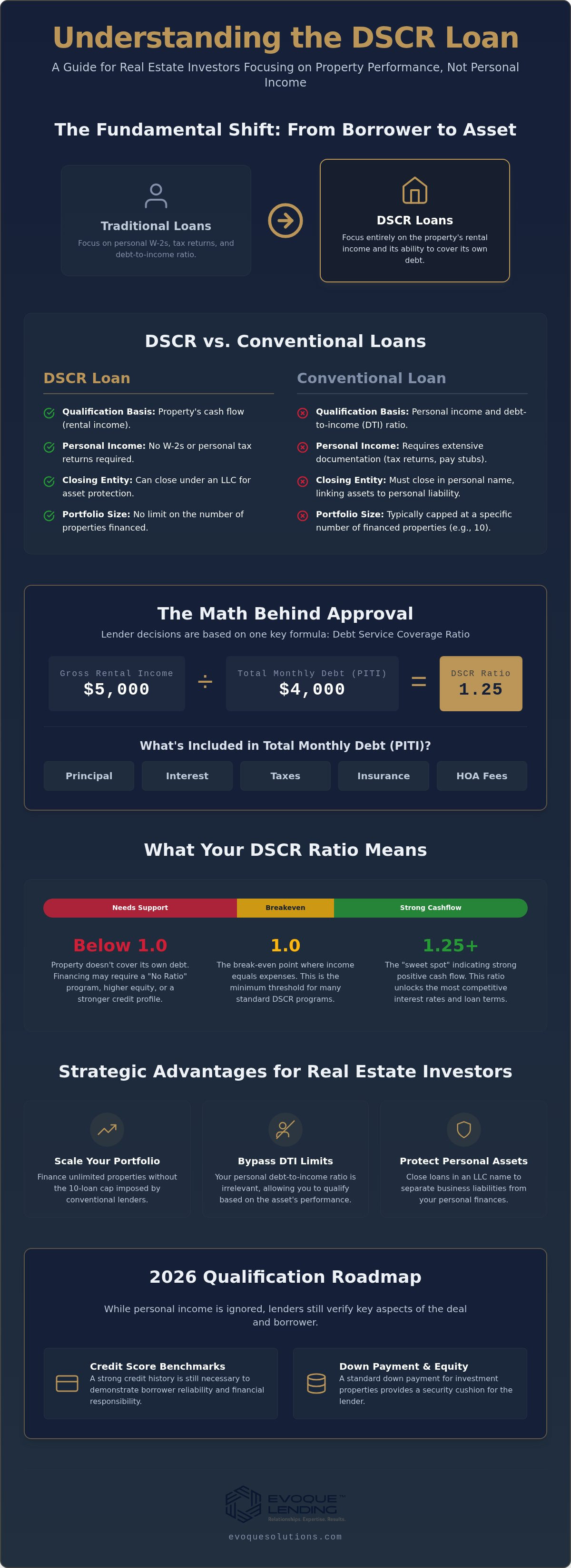
The gap between a conventional mortgage and a DSCR product is wide. Conventional lenders demand a deep dive into your W-2s and personal tax history. They calculate your eligibility based on how much you earn versus how much you owe. In contrast, DSCR qualification relies almost entirely on the property’s rental income. Instead of analyzing your salary, the lender analyzes the lease agreement and the market rent. Your personal DTI is irrelevant here. Additionally, while conventional loans usually require you to borrow in your own name, DSCR loans allow you to close under an LLC. This offers a layer of privacy and asset protection that traditional products simply don't provide.
The Role of Non-QM Lending in 2026
The financial landscape has moved far beyond the "stated income" loans of the past. Modern Non-QM lending in 2026 is built on the concept of "verified cash flow." Lenders use the Debt Service Coverage Ratio (DSCR) to ensure the property can actually support its own debt. This evolution is vital for modern entrepreneurs who operate with complex income structures. Specialized brokers like Evoque Lending, who have operated since 2005, are essential for matching investors with the right programs. They understand that what is a dscr loan to one lender might look different to another. They help bridge that gap to ensure your portfolio continues to grow without personal income constraints. This shift toward property-centric underwriting means your ability to scale is no longer limited by your personal paycheck.
How a DSCR Loan Works: The Formula and Ratio Benchmarks
Understanding what is a dscr loan requires a close look at the math that drives the approval process. Unlike traditional mortgages that weigh your personal income, the lender evaluates the property's ability to pay for itself. The Debt Service Coverage Ratio is the primary metric used to determine risk and loan terms. It's a transparent way to see if an investment property stands on its own two feet or if it requires outside support to survive.
The calculation is straightforward: divide the property’s gross monthly rental income by the total monthly debt obligations, also known as PITI. A ratio of 1.0 indicates that the property earns exactly what it costs to maintain, essentially breaking even. While 1.0 is the typical floor for most lenders, reaching a 1.25 ratio is often the "sweet spot" where investors unlock the most competitive interest rates. For unique scenarios where a property isn't cash-flowing yet, "No Ratio" programs offer a pathway to financing by focusing on equity and credit rather than immediate rental coverage.
Calculating Net Operating Income (NOI) for DSCR
Lenders start with the gross rent, often verified through an existing lease or a market rent analysis. Professional underwriting usually accounts for a vacancy factor to ensure the investment remains stable during tenant turnover. It's vital to remember that HOA fees can significantly impact your coverage ratio. Even a high-earning condo can fail the test if the monthly association dues push the total debt service too high. If you are planning an acquisition, speaking with an expert about DSCR Purchase Loans can help you pre-calculate these figures before you sign a contract.
Total Debt Service: What’s Included?
Total debt service is built on the foundation of PITI: Principal, Interest, Taxes, and Insurance. Every dollar added to these costs lowers your ratio. This is why interest-only payment options are such a powerful tool for modern investors. By removing the principal portion of the payment during the initial years, you reduce the monthly obligation. Strategically choosing interest-only terms can turn a 0.9 ratio into a 1.1 ratio, moving the property from a rejection to an approval. This flexibility allows you to qualify for properties that might otherwise be out of reach due to tight margins.
- Principal: The portion of the payment that reduces the loan balance.
- Interest: The cost of borrowing the capital.
- Taxes: Monthly escrow for property taxes.
- Insurance: Premiums for hazard and liability coverage.
- HOA: Any mandatory homeowner association or condo fees.
Strategic Advantages: Why Real Estate Investors Choose DSCR
Traditional mortgage lending often feels like it's designed to penalize success. The more properties you own, the riskier you look to a conventional underwriter. When you understand what is a dscr loan, you see that the script is flipped. These loans allow you to scale your business based on the strength of your acquisitions rather than the limits of your personal paycheck. It's a fundamental shift that transforms real estate from a side hobby into a scalable enterprise.
One of the most immediate benefits is the sheer speed of the transaction. In a competitive market, waiting sixty days for a big bank to audit two years of tax transcripts is a recipe for a lost deal. DSCR underwriting is streamlined because it skips the personal income deep-dive. By focusing on the lease agreement and the property’s appraisal, lenders can often move toward a closing date in a fraction of the time required for a standard mortgage. This efficiency is a critical tool for investors who need to move quickly on high-value opportunities.
Scalability: Moving Beyond the 10-Property Limit
Conventional financing frequently "caps out" investors once they reach ten financed properties. At this point, Fannie Mae and Freddie Mac guidelines become incredibly restrictive, making it nearly impossible to continue growing. DSCR loans remove this ceiling. Because your personal debt-to-income ratio isn't part of the equation, you can theoretically own dozens of properties across multiple states. This allows for a "portfolio effect" where your established, high-performing assets provide the financial foundation to acquire new units with high growth potential. You're no longer limited by how much you earn at your day job; you're limited only by your ability to find profitable deals.
LLC Borrowing and Asset Protection
Professional investors don't just care about the loan; they care about the legal structure surrounding it. Closing in your personal name is a significant liability risk that most conventional products force upon you. Evoque Lending facilitates financing for corporate entities, allowing you to close in the name of an LLC. This keeps your investment portfolio legally separate from your personal assets, such as your primary residence and savings accounts. While most lenders still require a personal guarantee, the ability to operate as a business entity provides the professional credibility and protection required for modern wealth building. It also offers a distinct tax advantage, as you don't need to show a high personal salary just to qualify for your next acquisition, allowing you to keep your personal tax strategy optimized.
Flexibility for Short-Term Rentals
The rise of Airbnb and VRBO has changed the investment landscape, and DSCR loans have evolved to match it. Many traditional lenders won't consider projected short-term rental income, viewing it as too volatile. However, specialized Short-Term Rental Loans utilize the actual revenue potential of vacation properties. This flexibility ensures that you can secure financing for high-yield properties in tourism-heavy markets where standard long-term leases might not reflect the property's true earning power.
Qualification Roadmap: Requirements for DSCR Financing in 2026
Getting approved for an investment mortgage in 2026 requires a clear understanding of the "rules of the road." While personal income is sidelined, lenders still require evidence of financial stability and property viability. When you ask what is a dscr loan qualification process like, you'll find it's a balance between your credit history and the property’s projected performance. Most programs establish a credit score entry point of 620, though a score of 660 or higher typically unlocks better pricing. You should also prepare for a higher down payment than a primary residence. Most DSCR purchase loans require a 20% to 25% equity stake, which translates to a 75% to 80% Loan-to-Value (LTV) limit.
Liquidity is the final pillar of the qualification roadmap. Lenders want to see that you can handle a "rainy day" without defaulting on the mortgage. This usually manifests as a requirement for cash reserves. You'll typically need to show three to six months of Principal, Interest, Taxes, Insurance, and Association dues (PITIA) in a verified bank account. This ensures that even if the property sits vacant for a few months, the debt remains covered. If you have the capital and the credit, you can get started with a DSCR Purchase Loan to secure your next asset.
The Appraisal Process and Market Rent Verification
The appraisal is the most critical stage of a DSCR loan. Unlike a standard home appraisal, this process includes a specific document called the 1007 Rent Schedule. The appraiser doesn't just look at the home's condition; they analyze local "comps" to determine the fair market rent. This 1007 form determines the income figure used in your DSCR calculation. If the appraiser’s rent estimate is lower than your actual lease, the lender will often use the lower of the two numbers. This can be a hurdle if you're buying in a rapidly appreciating rental market, so it's vital to provide your broker with any data that supports your projected rental income.
Experience Requirements for Borrowers
Your track record as a landlord matters, but it isn't always a dealbreaker. Seasoned pros with a history of managing multiple units often get access to higher LTVs or lower reserve requirements. However, many programs are designed for first-time investors. In these cases, owning a primary residence for at least twelve months can act as a proxy for experience. It demonstrates that you understand the responsibilities of property maintenance and debt management. Even if you've never owned a rental before, a property with a strong cash-flow ratio and a solid appraisal can often carry the weight of the approval on its own merits.
Scaling Your Portfolio with Evoque Lending’s DSCR Programs
Scaling a real estate empire requires more than just finding the right properties. It requires a financial partner who understands the nuances of professional investing and the limitations of traditional bank underwriting. Since 2005, Evoque Lending has specialized in providing Non-QM solutions that bridge the gap between institutional rigidity and the practical needs of modern investors. With a national reach covering over 40 states, we provide the infrastructure needed to scale your portfolio across diverse markets. Our approach goes beyond a simple credit check. We provide personalized loan matching that considers the full economic potential of your assets rather than just your personal history.
Choosing the right lender is just as important as choosing the right property. When you're evaluating what is a dscr loan provider capable of, experience is the most valuable currency. We focus on customized solutions for purchase, cash-out refinance, and portfolio consolidation. This tailored approach ensures that your financing aligns with your long-term growth goals rather than forcing you into a one-size-fits-all institutional box. We see the value in complex income structures that big banks often reject, allowing you to move forward with confidence and clarity.
Cash-Out Refinancing: The Engine of Growth
Many investors sit on "dead equity" without realizing it. A property that has appreciated significantly or has a low loan balance is a dormant capital source that could be working for you. A DSCR cash-out refinance allows you to extract that equity to fund the down payment on your next acquisition. This strategy creates a self-funding cycle of growth that doesn't rely on your personal savings. The process is streamlined to avoid the typical documentation heavy lifting. You don't need to provide new tax returns to access your property's value. We focus on the current rental income and the equity position to get you the capital you need quickly, often closing in a fraction of the time a traditional bank would require.
Getting Started: Your Streamlined Application
We've removed the friction from the application process to help you move at the speed of the market. Our 2-minute online questionnaire is designed to identify your best loan match without a massive time commitment or unnecessary stress. Once you're ready to proceed, the documentation list is concise and focused on the essentials of the deal. You'll generally need to provide your current lease agreements, a valid photo ID, and recent bank statements to verify your liquidity reserves. This efficiency ensures that you spend less time on paperwork and more time identifying your next high-performing asset. Understanding what is a dscr loan is the first step, but taking action with a seasoned guide is what actually builds wealth.
Secure your next investment with a DSCR loan from Evoque Lending and experience a partnership built on transparency and professional expertise.
Empowering Your 2026 Investment Strategy
The path to a commercial-scale residential portfolio no longer requires a perfect W-2 or a massive personal salary. By understanding what is a dscr loan, you've unlocked a mechanism that prioritizes the economic reality of your assets over the limitations of your tax returns. You've seen how a property with a strong coverage ratio can serve as its own qualification engine, allowing you to bypass traditional debt-to-income caps and scale your holdings across multiple states. This shift from personal to property-centric underwriting is the definitive tool for modern wealth building.
Evoque Lending has served as a seasoned guide for non-traditional borrowers since 2005. We understand that true financial strength isn't always reflected in a standard tax transcript. Our team provides the specialized expertise and national reach across 40+ states to ensure your financing aligns with your long-term vision. Whether you're targeting a new purchase or pulling equity from an existing rental, the right partnership makes the complex world of Non-QM lending feel navigable and structured. Don't let institutional red tape stall your momentum.
Apply for a DSCR Loan Today and take the next step toward a more flexible, cash-flow-centric future. Your portfolio's potential is waiting to be realized.
Frequently Asked Questions
Is a DSCR loan hard to get for a first-time investor?
No, DSCR loans are often more accessible for first-time investors because they don't require personal income verification. While traditional banks might demand a long history of professional management, many cash-flow programs only require that you own a primary residence. This allows new investors to enter the market based on the property's potential rather than their own track record. It's an ideal entry point for those with strong capital but complex tax returns.
Can I get a DSCR loan with a 620 credit score?
Yes, you can qualify with a 620 credit score, though it's the standard minimum for most programs. While a 620 score provides access to the market, higher scores like 660 or 720 often unlock more favorable terms and lower down payment requirements. If you're wondering what is a dscr loan qualification like at lower scores, expect lenders to look for stronger cash flow or higher liquidity reserves to offset the risk.
Do DSCR loans require a personal guarantee if I use an LLC?
Yes, most lenders require a personal guarantee even when borrowing through an LLC or corporate entity. This means that while the loan is in the business name for liability and privacy reasons, you're still personally responsible for the debt. This is a standard industry practice that provides lenders with security while still allowing you the asset protection benefits of a corporate structure. It's a balanced approach to risk management for both parties.
How much higher are DSCR interest rates compared to conventional loans?
DSCR interest rates are generally 1% to 2% higher than conventional residential mortgages. This premium reflects the increased risk of investment properties and the flexibility of not providing personal income documentation. Many investors find this cost is easily offset by the ability to scale their portfolios faster and close deals that traditional banks would reject. The speed and lack of red tape often provide more value than a slightly lower rate.
Can I use a DSCR loan for an Airbnb or short-term rental?
Yes, you can use these loans for short-term rentals like Airbnb or VRBO. Specialized short-term rental programs evaluate the property's projected nightly income rather than just long-term lease averages. This is a significant advantage in vacation markets where the revenue potential is much higher than a standard yearly rental. It's a critical tool for investors targeting high-yield tourism areas where traditional financing often falls short of the property's true earning power.
Is there a limit to how many DSCR loans I can have at once?
There is no theoretical limit to the number of DSCR loans an investor can hold simultaneously. Unlike conventional financing, which often caps borrowers at ten properties, these loans focus on the individual performance of each asset. As long as each property meets the required coverage ratio and you have sufficient liquidity reserves, you can continue to grow. This makes it the preferred choice for investors aiming for a commercial-scale residential portfolio.
Do I need to provide tax returns for a DSCR mortgage?
No, you don't need to provide personal tax returns or W-2s to qualify for this mortgage type. The underwriting process focuses on the property's rental income as verified by a lease or an appraiser's rent schedule. This is why understanding what is a dscr loan is so vital for self-employed individuals or those with high tax write-offs. Your qualification is built on the property's economic performance rather than your personal IRS filings.
What is a "No Ratio" DSCR loan and how does it work?
A "No Ratio" loan is a specialized product for properties where the rental income doesn't fully cover the monthly debt obligations. These programs typically require a higher down payment or a stronger credit profile to compensate for the lack of immediate cash flow. They're often used for properties with high appreciation potential or those undergoing a transition. This flexibility allows investors to secure financing for assets that don't yet meet standard coverage benchmarks based on equity alone.
Reviewed by Eddie Luhrassebi, Founder & CEO, NMLS #337071 | CA DRE #01230650
Last updated: August 20, 2026 · About the reviewer