
DSCR Loan Rates 2026: A Comprehensive Guide to Investor Pricing and Spreads
Written by Eddie Luhrassebi · Published August 20, 2026
Master 2026 DSCR loan rates. This guide reveals how lenders price risk, helping you compare spreads and secure better terms for your investment portfolio.
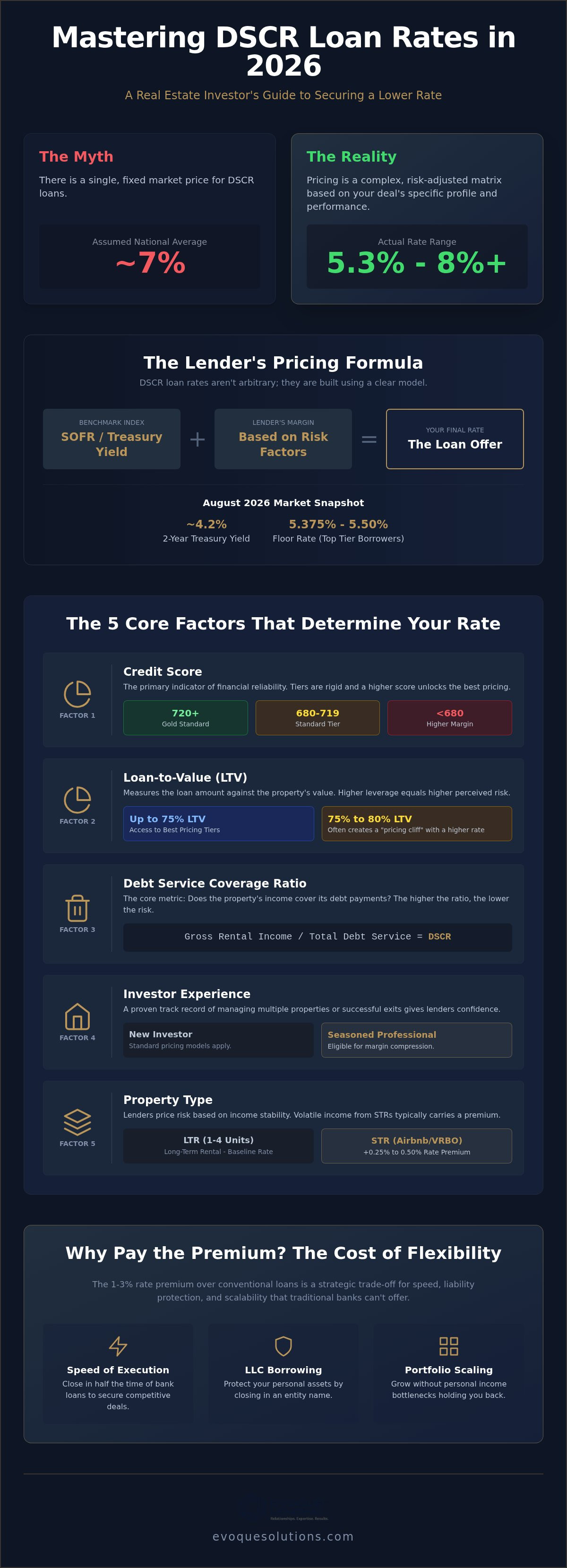
The idea that there is a single, fixed market price for dscr loan rates is a myth that costs real estate investors thousands in annual cash flow. While you might see national averages hovering in the low-7% range as of August 2026, the reality is a complex, risk-adjusted matrix where your property's performance can actually compress the lender's margin. It's frustrating to watch high interest rates eat into your monthly debt service; it's even worse when traditional banks reject your application simply because you're self-employed or have a complex income structure. You deserve a financing partner that understands the nuances of your portfolio rather than one that forces you into a rigid institutional box.
We understand that tracking the spread over SOFR or Treasury benchmarks often feels like a moving target. This guide will help you master the mechanics of pricing so you can secure the most competitive terms for your investment portfolio in 2026. We'll break down how lenders evaluate risk, explain the current 4.2% yield on the 2-Year Treasury's impact on your offer, and provide a clear framework for comparing different loan structures. You're about to gain the technical insight needed to lower your monthly debt service and scale your holdings with confidence.
Understanding the DSCR Rate Landscape in 2026
The pricing for dscr loan rates functions differently than the residential mortgages you might find at a local credit union. These loans are classified as non-agency debt, meaning they aren't backed by government entities like Fannie Mae or Freddie Mac. Instead, they are funded through private label securitizations and the secondary market. Because these lenders take on more perceived risk by not verifying your personal income, they adjust the pricing accordingly. This risk-adjusted model is why you'll see a spread; typically, these rates sit 1% to 3% above conventional 30-year fixed rates. Investors in the secondary market demand this premium to account for the flexibility and specialized nature of the debt.
The Benchmark
- Margin Pricing Model
Lenders don't pick a number out of thin air. They use a formula consisting of an "Index" plus a "Margin." In 2026, the most common index is the 30-day Average SOFR (Secured Overnight Financing Rate) or the 10-Year Treasury yield. If the 2-Year Treasury is trading near 4.2%, lenders add their specific margin on top of that base to ensure the loan is profitable when sold to investors. Your specific rate fluctuates daily based on investor demand for mortgage-backed securities (MBS). When global investors feel uncertain, they may demand higher yields, which pushes your margin wider even if the benchmark stays flat. In the current 2026 economic environment, the floor rate for DSCR loans generally settles between 5.375% and 5.50% for the most highly qualified domestic borrowers.
DSCR vs. Conventional: The Cost of Flexibility
You might wonder if the higher interest rate is worth the cost. For many entrepreneurs and self-employed investors, the "no tax return" qualification is a massive advantage that is often priced at roughly 50 to 100 basis points. This premium covers the lender's inability to look at your personal debt-to-income ratio. The core of this calculation is the Debt Service Coverage Ratio (DSCR), which determines if the property's cash flow can support the debt without relying on your personal income. There are also structural benefits that justify the dscr loan rates premium:
- Speed of Execution: These loans often close in half the time of a traditional bank loan, allowing you to secure deals in competitive markets.
- LLC Borrowing: Unlike conventional loans, you can close in the name of an entity, which provides essential liability protection.
- Portfolio Scaling: Because your personal income isn't the bottleneck, you can theoretically scale to an unlimited number of properties as long as each deal's cash flow is sufficient.
This trade-off between a slightly higher rate and significantly greater flexibility is the primary reason the DSCR market has remained robust through 2026. You're paying for the ability to move quickly and bypass the rigid "bank box" that often stifles growth for modern real estate professionals.
The 5 Core Factors Influencing Your DSCR Interest Rate
Lenders don't look at a deal in isolation. They use a matrix of five core factors to determine your final quote. While the property's cash flow is central, your personal financial reliability and the deal's leverage are equally important. For instance, credit score tiers are rigid. A score of 720 or higher is the gold standard for securing the lowest dscr loan rates. Dropping into the 680 to 700 range can trigger a significant jump in the margin. Similarly, Loan-to-Value (LTV) ratios have strict breakpoints. Pushing your leverage from 75% to 80% often creates a pricing cliff, as lenders view that extra 5% of debt as a major risk factor.
Your experience as an investor is another critical piece of the puzzle. Lenders prefer seasoned borrowers who have managed multiple "doors" or completed several successful exits. If you're a professional with a proven track record, lenders are more willing to compress their margins to win your business. This experience acts as a buffer, giving the lender confidence that the property will be managed efficiently even during market shifts.
Property Type Risk: LTR vs. STR Pricing
Short-term rentals (STRs) hosted on platforms like Airbnb or VRBO offer higher yield potential but come with increased income volatility. Most lenders apply a 0.25% to 0.50% rate premium for these properties to account for that risk. There's also a divide between residential (1 to 4 units) and commercial (5+ units) DSCR loans, with the latter often requiring different appraisal standards. Property condition also plays a role. Lenders prefer C1 to C4 ratings. Distressed properties may require a bridge-to-DSCR strategy before you can lock in long-term dscr loan rates.
The Impact of the DSCR Ratio on Your Quote
The Debt Service Coverage Ratio is the ultimate barometer of deal safety. A ratio of 1.25x is the standard benchmark for par pricing. If your deal produces a 1.50x ratio, you're in a prime position to negotiate better terms. On the other hand, "No Ratio" loans are available for properties with a DSCR below 1.0, though they come with higher costs. You can often lower your quote by increasing your down payment, which improves the ratio by reducing the monthly debt service. If you're feeling restricted by traditional bank requirements, it's helpful to consult with a specialized lender who can navigate these risk tiers on your behalf.
Analyzing Rate Structures: Fixed-Rate vs. Interest-Only Options
While the 30-year fixed mortgage remains the most popular choice for long-term stability, 2026 has seen a resurgence of alternative structures designed to help investors maximize their immediate cash flow. Choosing between a fixed and a variable structure isn't just about the initial quote; it's about aligning the debt with your specific exit strategy. If your goal is a long-term hold, locking in dscr loan rates for three decades protects you from future market volatility. However, if you're looking to scale a portfolio quickly, the structural nuances of Interest-Only (I/O) or Hybrid ARM options might provide the financial breathing room you need.
The Pros and Cons of Interest-Only DSCR
The "Interest-Only paradox" is a concept many investors find counterintuitive at first. You'll typically face a 0.125% to 0.375% rate add-on for an I/O feature, meaning your interest rate is technically higher than a standard amortizing loan. Despite this, your monthly debt service is significantly lower because you aren't paying down any principal during the initial period. This is a powerful tool for maximizing monthly cash flow for reinvestment. Because many lenders calculate the coverage ratio based on that lower interest-only payment, it can turn a marginal deal into a high-performer on paper. You just need a clear risk management plan for when the I/O period, typically 5 or 10 years, ends and the principal payments begin.
Hybrid ARMs in a 2026 Market
Hybrid ARMs, such as the 5/6 or 7/6 structures, are returning as viable tools in the current economic landscape. These loans offer a fixed rate for the first five or seven years before adjusting every six months based on the 30-day Average SOFR plus a predetermined margin. In 2026, choosing a 5/6 ARM can often save you on the initial margin compared to a 30-year fixed product. This is particularly useful if you predict a break-even point for refinancing within the first few years. You should pay close attention to the rate caps and adjustment intervals specified in your term sheet. If you expect dscr loan rates to soften before your first adjustment, a hybrid ARM allows you to benefit from lower initial payments while maintaining the flexibility to refinance when the market shifts.
Tactical Strategies for Reducing Your DSCR Borrowing Costs
Controlling your borrowing costs requires looking beyond the headline figure. While you can't influence the current movement of the 10-Year Treasury, you can manipulate specific loan terms to lower your final quote. Investors often focus solely on the down payment, but levers like prepayment structures and upfront points offer significant opportunities to compress dscr loan rates. By aligning these tactical choices with your intended hold period, you can effectively engineer a deal that maximizes long-term cash flow and portfolio stability.
Prepayment Penalties and Rate Trade-offs
Lenders view early payoffs as a loss of projected interest income. To mitigate this risk, they offer lower start rates to borrowers who are willing to accept longer prepayment penalties. For example, opting for a 5-4-3-2-1 structure, where the penalty decreases annually over five years, typically yields a rate at least 0.25% lower than a shorter 3-2-1 structure. You should also distinguish between soft and hard penalties. A soft prepay often allows you to sell the property without a penalty, only triggering fees during a refinance; a hard prepay applies to any payoff event regardless of the cause. Matching this penalty period to your exit strategy ensures you don't pay a premium for flexibility you don't actually need.
Rate Buydowns: Calculating the ROI of Points
Paying discount points upfront is a strategic move for investors planning to hold a property for at least five to seven years. Each point usually costs 1% of the loan amount and reduces the interest rate by approximately 0.25%. In the current 2026 buyer's market, you can often negotiate seller concessions to cover these costs, effectively buying a lower rate with the seller's equity. To determine if this is a sound investment, you must calculate how many months of lower payments it takes to recoup the upfront cost. The break-even formula for a 1-point rate reduction is the upfront cost of the point divided by the monthly interest savings. If your break-even point is under 36 months and your hold period is 60 months, the buydown provides a substantial return on investment.
Beyond individual deal terms, scaling your portfolio can eventually unlock blanket rates through portfolio lending. Aggregating multiple properties under a single loan structure can reduce administrative overhead and potentially lower your overall margin. If you're ready to see how these tactical adjustments affect your specific numbers, you can apply online to explore custom DSCR solutions that fit your investment goals. Borrowing through an LLC also ensures you're accessing capital buckets specifically designed for professional investors rather than the more restrictive retail market.
Scaling Your Portfolio with Evoque Lending’s DSCR Solutions
Many investors find that even with a high-performing property, traditional institutions refuse to look past personal tax returns. This is where the "bank box" fails modern entrepreneurs. At Evoque Lending, we specialize in bridging this gap by focusing on the asset's potential rather than your W-2 history. We understand that your business structure is complex. Whether you're an LLC-based borrower or a self-employed professional, our approach ensures that dscr loan rates remain accessible and aligned with your portfolio's growth trajectory. We act as your advocate, finding the specific path forward when standard lenders say no.
Working with a national broker provides a distinct advantage for those looking to expand across state lines. We serve over 40 states, allowing you to maintain a consistent lending relationship as you move from local markets into high-growth regions. Our streamlined underwriting process moves you from an initial online questionnaire to a funded deal without the bureaucratic delays common in retail banking. For Short-Term Rental (STR) operators using Airbnb or VRBO, we offer specialized expertise to navigate the unique income volatility of the hospitality sector. We also provide dedicated pathways for Foreign National investors who need reliable capital to enter the U.S. real estate market.
The Evoque Advantage: Personalized Loan Matching
Every deal has its own signature, and a one-size-fits-all approach rarely results in the best pricing. We leverage a proprietary network of Non-QM and private capital lenders to find the specific margin that fits your property's profile. Our dedicated loan specialists speak "investor-speak," focusing on debt coverage and cash flow rather than just credit scores. This level of specialization allows us to compress margins that a generalist bank would otherwise pad with risk premiums. You can get a personalized DSCR rate quote from Evoque Lending to see exactly how your current portfolio benchmarks against the 2026 market.
Beyond DSCR: A Holistic Investment Strategy
Scaling a portfolio often requires a combination of different financial instruments. While dscr loan rates are ideal for long-term holds, you might also benefit from integrating bank statement or asset depletion programs for properties that don't yet meet the standard 1.25x ratio. A popular strategy in the current market involves using a DSCR cash-out refinance to extract equity from a stabilized asset. This capital can then fund the down payment on your next acquisition, creating a self-sustaining cycle of growth. We are here to act as your long-term partner, providing the resourceful problem-solving needed to navigate a competitive market. It's time to start your 2026 investment journey with Evoque and secure the financing your hard work deserves.
Positioning Your Portfolio for 2026 Success
Securing the most competitive dscr loan rates requires more than just watching the bond market. It's about understanding how your property's cash flow and your investment experience create a unique risk profile. By prioritizing debt coverage ratios and strategically selecting between fixed or interest-only structures, you can protect your margins. You don't need a traditional bank to build a legacy.
Evoque Lending has specialized in Non-QM lending since 2005, offering financing solutions across more than 40 states. We qualify borrowers based on property cash flow rather than personal tax returns. This approach supports self-employed investors and short-term rental operators who are often overlooked by institutional lenders. Whether you're scaling a local portfolio or expanding nationally, the right debt structure is essential. Take the next step toward optimizing your capital today. Check your DSCR loan eligibility and current rates with Evoque Lending. Your path to a more profitable portfolio starts with a partner that understands the mechanics of your deals.
Frequently Asked Questions
How are DSCR loan rates determined compared to regular mortgages?
DSCR rates are based on property cash flow rather than personal income. Unlike regular mortgages backed by Fannie Mae or Freddie Mac, these are non-agency loans priced using a spread over benchmarks like SOFR or the 10-Year Treasury. Lenders add a margin to account for the risk of not verifying tax returns or debt-to-income ratios. This usually results in a 1% to 3% premium over conventional investment property rates.
Can I get a DSCR loan with a credit score under 660?
Yes, it's possible to secure a loan with a score under 660, though your options will be more limited. While 720+ is the gold standard for the best dscr loan rates, specialized lenders often have programs for scores as low as 620 or 640. You should expect higher interest rates and lower Loan-to-Value (LTV) requirements to offset the increased credit risk. Providing additional reserves can sometimes help strengthen your application.
Is the interest rate on a DSCR loan tax-deductible for my rental business?
Generally, yes, the interest paid on a mortgage for an investment property is a deductible business expense. Since DSCR loans are used exclusively for business purposes, the interest helps reduce your taxable rental income. You should consult with a qualified tax professional to understand how these deductions apply to your specific entity structure, especially if you're borrowing through an LLC. Maintaining clean financial records for each property is essential for maximizing these benefits.
How much higher are DSCR rates for Airbnb or short-term rentals?
Investors typically pay a premium of 0.25% to 0.50% for short-term rental (STR) properties compared to long-term leases. Lenders view STR income as more volatile because it depends on seasonal demand and platform performance. To secure better dscr loan rates on an Airbnb property, you can provide documented stay history or use specialized projections that prove consistent occupancy throughout the year. This transparency helps lenders feel more confident in your property's cash flow.
Do DSCR loan rates vary by state or region?
While the base index like SOFR is national, the final rate can vary based on regional market conditions and state-specific regulations. Some states have different foreclosure laws or lending costs that influence a lender's margin. Working with a national broker allows you to compare pricing across more than 40 states to find the most favorable geographic environment for your next acquisition. Local property taxes and insurance costs also indirectly affect your final debt coverage ratio.
Can I refinance a DSCR loan if market rates drop in 2027?
You can certainly refinance, but you must account for your current prepayment penalty. Most DSCR loans include a penalty period, such as a 5-4-3-2-1 structure, which may make refinancing expensive in the early years. If market rates drop significantly in 2027, you'll need to calculate if the monthly savings outweigh the cost of the penalty and new closing fees. Strategic investors often wait until the penalty period steps down to its lowest level.
What is the minimum down payment required to get the best DSCR rate?
A down payment of 25% or more is usually required to access the lowest pricing tiers. While some programs allow for as little as 15% or 20% down, lenders offer significantly better margins at lower Loan-to-Value ratios. Increasing your equity position reduces the lender's risk and often results in a lower interest rate and more favorable terms. This upfront investment can significantly improve your property's monthly cash flow and long-term yield.
Does a higher DSCR ratio always result in a lower interest rate?
A higher ratio generally helps, but it hits a point of diminishing returns. Once your ratio exceeds 1.25x or 1.50x, you've already qualified for the best ratio-based pricing tier. At that stage, factors like your credit score, experience level, and the property type become more influential in driving the rate even lower. A high ratio alone won't compensate for a poor credit profile or lack of previous investment experience in the market.
Reviewed by Eddie Luhrassebi, Founder & CEO, NMLS #337071 | CA DRE #01230650
Last updated: August 20, 2026 · About the reviewer