
2026 DSCR Loan Requirements: Real Estate Investor Guide
Written by Eddie Luhrassebi · Published August 20, 2026
Unlock real estate financing in 2026. This guide details all DSCR loan requirements, helping you qualify based on property cash flow, not personal income.
Your personal income shouldn't be the bottleneck that stops your real estate portfolio from growing. It's frustrating when a high debt-to-income ratio or a complex tax return prevents you from securing a conventional loan, especially when the property itself is a cash-flow machine. You've likely felt the sting of a deal falling through because a traditional bank couldn't see past your personal paperwork or understand your business structure. We believe that for the modern investor, the property's performance is the most accurate measure of a loan's viability.
Mastering the specific dscr loan requirements for 2026 is the most effective way to bypass these traditional hurdles. This guide will show you exactly how to qualify for financing based on property cash flow rather than your personal salary. You'll learn how to navigate the current credit and liquidity standards, allowing you to close in an LLC for maximum liability protection with minimal personal documentation. We'll break down the essential benchmarks for FICO scores, reserve requirements, and debt service coverage ratios to ensure your next deal closes without a hitch.
Understanding DSCR Loan Qualification: The Cash Flow Advantage
Traditional mortgage underwriting often feels like an interrogation of your past financial life. For real estate investors, the requirement to provide years of tax returns and proof of personal income can be a massive roadblock. DSCR loans offer a specialized alternative. Instead of scrutinizing your W-2s or 1040s, lenders focus on the Debt Service Coverage Ratio of the specific asset you're buying or refinancing. This shift in perspective allows the property to stand on its own merits.
The primary advantage here is the "Tax Return" bypass. Underwriters for these programs don't care about your personal debt-to-income (DTI) ratio. If you're self-employed with high business write-offs, your taxable income might look low on paper, even if your bank accounts are healthy. Meeting the dscr loan requirements means you can secure financing without worrying about how your tax strategy affects your borrowing power.
The Core DSCR Formula for 2026
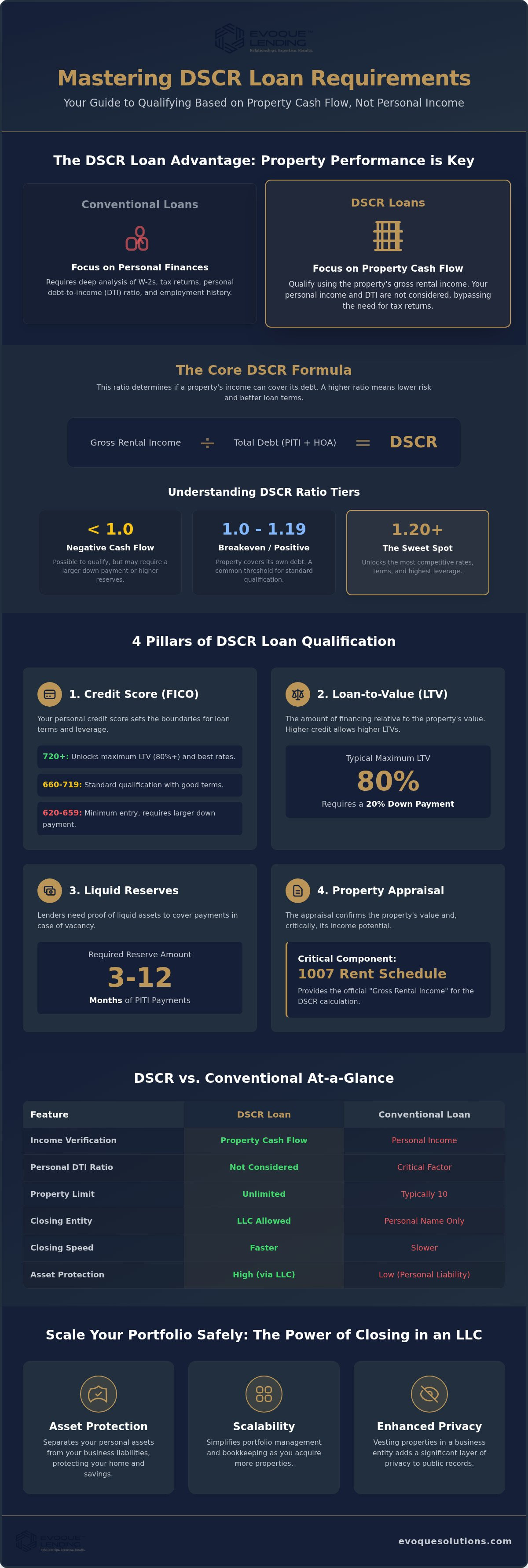
In its simplest form, the DSCR calculation is: (Gross Rental Income) divided by (PITI + HOA). Lenders look for a ratio that demonstrates the property can comfortably cover its own debt obligations. While some programs allow for a ratio as low as 0.75, most investors aim for 1.20 or higher to secure the most competitive terms and leverage.
Determining "Gross Income" isn't always as simple as looking at a current lease. Lenders typically use the 1007 Rent Schedule, which is a specific part of the appraisal report that estimates market rent. If the property is currently vacant, the appraiser's market rent estimate becomes the qualifying figure. This standardized approach provides a uniform benchmark for dscr loan requirements across the United States, making it easier to scale a national portfolio without local income variations getting in the way.
Why Real Estate Investors Choose DSCR Over Conventional
Conventional loans often limit you to ten financed properties. Once you hit that cap, or if your personal DTI becomes too high, traditional banks will turn you away. DSCR financing removes these artificial ceilings. It's built for speed and efficiency, often leading to faster closing times because the documentation burden is significantly lighter.
- Asset Protection: Unlike conventional loans, these programs allow you to close in the name of an LLC. This keeps your personal and business liabilities separate.
- Privacy: Vesting in a business entity adds a layer of privacy to your real estate holdings.
- Flexibility: These loans are ideal for short-term rental properties where income might fluctuate but the annual average remains strong.
For the modern entrepreneur, this flexibility is essential. It aligns the financing with the practical reality of how a business operates. You don't have to fit into a standard institutional box to be a successful investor.
Core Financial Requirements: Credit Scores and LTV Limits
While the property's cash flow is the primary driver of approval, your personal financial profile still sets the boundaries for your loan's structure. Lenders view the borrower as the secondary source of security. If the property's income fails, your credit history and the amount of equity you've committed become the lender's safety net. Understanding how dscr loan requirements balance these factors will help you predict your borrowing costs before you even submit an application.
The relationship between your credit score and your Loan-to-Value (LTV) ratio is the most significant factor in your final quote. Higher risk in one area usually requires a stronger showing in the other. For instance, a borrower with a lower credit score might be required to bring a larger down payment to offset the perceived risk. Conversely, those with top-tier credit can often access the maximum leverage available in the market.
Credit Score Tiers and Leverage
Most national programs establish a floor between 620 and 660, with 640 being a common minimum for standard entry. However, your FICO score directly dictates your maximum leverage. If your score sits in the mid-600s, you should expect to provide a down payment of at least 25% to 30%. To unlock an 80% LTV, or in some specialized cases an 85% LTV, you generally need a score of 720 or higher. Recent credit events, such as a foreclosure or bankruptcy, typically require a seasoning period of 24 to 36 months before you can qualify for the most competitive tiers.
The DSCR Ratio Tiers: 1.0 vs. 1.25
The "sweet spot" for pricing is a DSCR of 1.25 or higher. At this level, the property generates $1.25 in gross income for every $1.00 of debt service, providing a comfortable cushion for the lender. If your property falls into the 1.0 to 1.24 range, you can still qualify, but you may face slightly higher interest rates or more stringent reserve requirements.
For properties in high-value, low-yield markets, "Low-Ratio" programs exist for DSCRs between 0.75 and 0.99. These are specifically designed for investors who prioritize long-term appreciation over immediate cash flow. If you have significant equity, typically an LTV below 65%, you might even qualify for a "No-Ratio" loan. These programs bypass the cash-flow calculation entirely, relying solely on your credit and the property's value. If you're ready to see how your specific scenario maps to these tiers, you can explore customized financing options to find the right fit for your portfolio.
Pricing is never a static number. It's a dynamic intersection of your credit tier, your LTV, and your DSCR ratio. By optimizing even one of these three legs, you can significantly improve the long-term profitability of your investment.
Liquidity and Reserves: The 'Hidden' Qualifying Factors
Many investors focus so heavily on the property's cash flow and their credit score that they overlook the most common deal-killer: liquidity. Lenders don't just want to see that the property can pay for itself; they want proof that you have the staying power to handle a vacancy or an unexpected repair. This is where dscr loan requirements for cash reserves come into play. You'll typically need to show between 3 and 12 months of PITI (Principal, Interest, Taxes, and Insurance) in a liquid or semi-liquid account to secure an approval.
Sourcing and seasoning are the two pillars of this requirement. Most lenders require funds to be seasoned for at least 60 days, which means they'll want to see the money in your account across two consecutive bank statements. If you've recently moved large sums of money, you must provide a clear paper trail to avoid red flags during underwriting. If you're executing a cash-out refinance, there's a significant advantage: many programs allow you to use the loan proceeds themselves to satisfy the reserve requirement. This is a strategic way to meet the necessary standards without tying up your existing cash.
Calculating Your Required Reserve Fund
Lenders distinguish between the "subject property" and your broader "portfolio" when calculating these totals. If you're an experienced investor with a large portfolio, you might face an additional requirement to show reserves for your other financed properties, though this is often a smaller percentage of their respective payments. Experience level directly impacts your burden. For example, first-time DSCR borrowers are usually required to show at least six months of PITI for the property they're purchasing to offset the lack of a proven track record.
Acceptable Sources of Liquidity
You don't necessarily need a mountain of cash in a checking account. Stocks, bonds, and mutual funds are generally acceptable, though retirement accounts like a 401k or IRA are subject to a "haircut" rule. Because these accounts carry market volatility and potential withdrawal penalties, lenders may only count 60% to 70% of the vested balance toward your dscr loan requirements.
- Personal vs. Business Accounts: You can use business bank statements, provided you're the majority owner and can prove access to the funds.
- Gift Funds: While sometimes permitted for a portion of the down payment, gift funds are rarely allowed to satisfy the post-closing reserve requirement.
- Asset Depletion: For high-net-worth investors, asset depletion strategies allow lenders to "convert" your total liquid wealth into a monthly income stream, providing extra security for the loan.
Understanding these liquidity nuances ensures you don't get blindsided at the finish line. It's about demonstrating that you're a responsible operator who is prepared for the practical realities of property management.
Property Standards and Appraisal Requirements
The asset is the foundation of the deal. While conventional lenders focus on your personal income, dscr loan requirements prioritize the property's ability to generate revenue. This means the collateral must be in a condition that allows for immediate occupancy. Eligible properties typically include single-family homes, 2-4 unit multi-family buildings, and even non-warrantable condos that usually fail traditional financing tests. If you're looking at a property that requires significant structural repair, it likely won't fit the DSCR box. These programs are designed for long-term holds and short-term rentals, not "fix-and-flip" candidates that lack a functional kitchen or bathroom.
The most critical document in your appraisal report is the 1007 Rent Schedule. This form is where the appraiser identifies comparable rentals in the immediate area to determine a fair market rent. For short-term rentals (STRs), the process is more nuanced. Many modern programs now accept data from AirDNA or the property's actual 12-month host history to justify the higher income potential of a vacation rental. This flexibility is a major advantage for investors in tourism-heavy markets where traditional long-term rents wouldn't cover the debt service.
Appraising for Rental Income
Appraisers don't just guess at rental rates. They look at verified lease agreements and local market trends. If you're purchasing a vacant property, the lender will rely almost entirely on the appraiser's market rent estimate from the 1007 form. It's important to realize that short-term rental data often yields a higher DSCR than long-term data, but it may come with slightly different LTV limits or interest rate adjustments depending on the specific program. Consistency between the appraisal's market rent and your own projections is key to a smooth approval.
Ineligible Properties and Red Flags
Location and condition can quickly derail an application. Lenders prefer "urban" or "suburban" classifications. Rural properties with significant acreage often fall outside of standard dscr loan requirements because finding comparable rental data in low-density areas is difficult. Similarly, mixed-use properties must remain primarily residential; if the commercial space exceeds 20% to 30% of the total square footage, you'll likely need a commercial loan instead.
The "Deferred Maintenance" trap is another common issue. Peeling paint, roof leaks, or exposed wiring are red flags that can stop an underwriter in their tracks. Lenders want to ensure the collateral is safe and marketable from day one. To ensure your property meets these standards, you can submit your scenario for a professional review before paying for an appraisal. This proactive step helps you avoid deal-killing surprises during the final stages of underwriting.
Strategic Scaling: Applying for a DSCR Loan with Evoque Lending
Since 2005, Evoque Lending has specialized in matching investors with the right Non-QM capital. The broker advantage means we don't force your deal into a single bank's rigid box. Instead, we access a broad network of specialized investors to find the specific fit for your scenario. If you're currently holding properties under your personal name, we can help you transition to a more professional structure. Closing in an LLC is a standard part of our process. It provides the asset protection and privacy that professional investors require to manage risk effectively.
Many of our clients use DSCR debt as a strategic exit. If you've used a high-rate bridge loan to renovate a property, moving into a 30-year fixed DSCR loan is the logical next step to lock in cash flow. We also provide dedicated support for Foreign National borrowers. Non-US citizens can often qualify for these programs without a US credit score or social security number, provided they meet the core dscr loan requirements for down payments and property performance.
Step-by-Step: The DSCR Application Process
The journey begins with a streamlined scenario review. We look at your property's potential and your credit profile to determine the best path forward. If there are unique aspects to your portfolio, we may guide you through a Letter of Explanation (LOE). This simple document allows you to address credit nuances or portfolio structures to ensure you meet all dscr loan requirements before the file reaches the final underwriting stage. Once the appraisal and the 1007 Rent Schedule are complete, funding typically occurs within 30 to 45 days.
Growing Your Portfolio with Alternative Financing
Scaling is about the velocity of capital. By using a cash-out refinance on a seasoned property, you can extract equity to fund your next acquisition. This is a common strategy for investors moving from short-term debt into long-term, stable financing. For those with multiple properties, cross-collateralization or blanket loans can simplify your monthly obligations. While these blanket options offer convenience, they require careful consideration of your future exit strategies for individual assets.
Every investor's path is different. A personalized approach ensures your financing aligns with your five-year growth plan. Start your DSCR loan questionnaire with Evoque Lending today to see how we can help you scale your portfolio with confidence.
Take Command of Your Investment Future
Securing financing in today's market doesn't have to be a battle with personal tax returns. By focusing on the property's performance and maintaining the right balance of credit and liquidity, you can unlock capital that traditional banks simply won't provide. We've explored how dscr loan requirements prioritize the asset's cash flow, giving you the flexibility to close in an LLC and protect your personal wealth. This shift in perspective is the key to scaling your portfolio without the burden of conventional debt-to-income limits.
Since 2005, Evoque Lending has specialized in Non-QM lending, providing national coverage for investors who need more than a standard mortgage box. Whether you're a 1099 professional or a seasoned LLC owner, our dedicated specialists are here to match your unique scenario with the right capital. Success in real estate isn't just about finding the right property; it's about having a financial partner who understands the modern investor's needs.
Get a Personalized DSCR Loan Quote from Evoque Lending
Your next acquisition is within reach when you have the right roadmap. We're ready to help you turn your investment goals into tangible results.
Frequently Asked Questions
What is the minimum credit score for a DSCR loan in 2026?
The minimum credit score for most programs in 2026 typically falls between 620 and 660, with a 640 score serving as the industry standard floor. While entry is possible at these levels, top-tier pricing and maximum leverage usually require a FICO score of 720 or higher. Your score acts as a primary lever for determining your down payment, so improving your credit before applying can significantly lower your upfront capital requirements.
Can I get a DSCR loan for an Airbnb or short-term rental?
You can absolutely secure a DSCR loan for an Airbnb or other short-term rental properties. Unlike traditional banks that struggle with fluctuating income, specialized lenders use tools like AirDNA or the property's actual 12-month host history to verify cash flow. This flexibility allows you to leverage the high-yield potential of vacation rentals while meeting the necessary dscr loan requirements for debt coverage and property standards.
Do DSCR loans require personal tax returns or W-2s?
DSCR loans don't require personal tax returns, W-2s, or pay stubs for the underwriting process. Qualification is based entirely on the gross rental income of the subject property compared to its debt obligations. This "income-blind" approach is ideal for self-employed investors or those with significant tax write-offs that might otherwise disqualify them from conventional financing. It simplifies the application process and focuses on the asset's performance rather than your personal salary.
Can I close a DSCR loan in the name of an LLC?
Yes, closing a DSCR loan in the name of an LLC is a standard practice and is often encouraged for asset protection. This structure keeps your personal liabilities separate from your investment activities, which is a major advantage for professional portfolio growth. While the loan is vested in the entity, you'll typically provide a personal guarantee. Most programs are designed to accommodate this business-centric approach without the hurdles found in traditional institutional lending.
What is a 'No-Ratio' DSCR loan and how do I qualify?
A "No-Ratio" DSCR loan allows you to qualify for financing without meeting a specific cash-flow benchmark, provided you have significant equity in the property. To qualify, you usually need a lower Loan-to-Value (LTV) ratio, often 65% or less, and a strong credit profile. This program is particularly beneficial for high-value properties in low-yield markets where traditional dscr loan requirements for a 1.20x ratio might be difficult to satisfy during the initial acquisition phase.
How many months of reserves do DSCR lenders typically require?
Lenders typically require between 3 and 12 months of Principal, Interest, Taxes, and Insurance (PITI) in liquid reserves. The exact amount depends on your credit score, the property type, and your experience as an investor. For example, a first-time borrower might be asked for 6 months of reserves, while a seasoned professional with a high credit score might only need 3. These funds demonstrate your ability to handle vacancies or repairs without defaulting.
Are DSCR loan interest rates higher than conventional mortgage rates?
Interest rates for DSCR loans are generally 1% to 2% higher than conventional mortgage rates. This reflects the increased risk associated with non-recourse or limited-documentation lending and the specialized nature of Non-QM products. However, the slightly higher rate is often offset by the ability to scale your portfolio quickly, protect your personal debt-to-income ratio, and close deals that traditional banks would reject due to complex income structures or non-traditional property types.
Can first-time investors qualify for a DSCR loan?
First-time real estate investors can qualify for DSCR loans, though they may face slightly stricter standards than veteran landlords. You might be required to provide a larger down payment, perhaps 25% instead of 20%, or show a higher amount of liquid reserves. Despite these initial hurdles, DSCR financing remains an excellent entry point for new investors because it allows you to build a portfolio based on the property's merits rather than your personal track record.
Reviewed by Eddie Luhrassebi, Founder & CEO, NMLS #337071 | CA DRE #01230650
Last updated: August 20, 2026 · About the reviewer