
DSCR Cash-Out Refinance: The Investor’s Guide to Scaling in 2026
Written by Eddie Luhrassebi · Published August 20, 2026
Unlock your property's equity with a DSCR cash-out refinance. Our 2026 guide shows investors how to scale without tax returns or W-2s. Grow your portfolio.
Your personal tax returns shouldn't be the ceiling for your real estate ambitions. For many investors, the frustration of being blocked by high debt-to-income ratios or rigid twelve month seasoning requirements at traditional banks is all too familiar. It's exhausting to have significant property equity sitting idle while you struggle to qualify for the capital needed to close your next deal. You've done the hard work of building a portfolio; you deserve a financing partner that recognizes the value of your assets rather than the complexity of your personal tax filings.
This guide explains how to master the dscr cash out refinance to maintain equity velocity in the 2026 market. You'll learn the specific strategies to leverage your rental property's income to grow your portfolio, consolidate high interest debt, and access liquidity without providing a single W-2. We'll break down current LTV limits, credit requirements, and the streamlined steps to scale your investments through Debt Service Coverage Ratio financing. Whether you're managing multiple LLCs or looking to bypass personal income hurdles, this is your roadmap to professional growth.
What is a DSCR Cash-Out Refinance?
A dscr cash out refinance is a strategic financial maneuver where an investor replaces their current mortgage with a new, larger loan, pocketing the difference in cash. Unlike traditional financing that scrutinizes your personal paystubs, this method relies on the Debt Service Coverage Ratio (DSCR). This metric measures the property's ability to cover its own debt obligations through rental income. In the 2026 market, this Non-QM tool has become essential for investors who want to scale without the friction of conventional banking.
The standout benefit is the "No Tax Return" advantage. Traditional lenders often penalize entrepreneurs for the very deductions that make their businesses efficient. With a DSCR loan, your personal income stays out of the equation. This removes the barrier of high Debt-to-Income (DTI) ratios that frequently stall growth for self-employed borrowers or those with complex LLC structures. The lender cares about the asset's performance, not your personal tax filings.
You should distinguish this from a standard rate-term refinance. A rate-term refinance focuses on lowering your interest rate or changing the loan duration. However, a cash-out refinance allows you to receive more than $2,000 back at the closing table. This liquidity isn't just extra cash; it's the capital you need to fund your next acquisition or improve your existing portfolio.
Why Real Estate Investors Choose DSCR Over Conventional
Conventional loans come with a heavy administrative burden and strict limits. Most big banks cap you at ten financed properties, which is a major roadblock for those building a significant portfolio. DSCR loans offer a path around these ceilings. They provide several key advantages:
- DTI Freedom: Your personal debt obligations don't impact the property's qualification.
- LLC Protection: You can close in the name of an entity, shielding your personal credit and assets.
- Scalability: There are no arbitrary limits on the number of properties you can finance through these programs.
The Concept of Equity Velocity
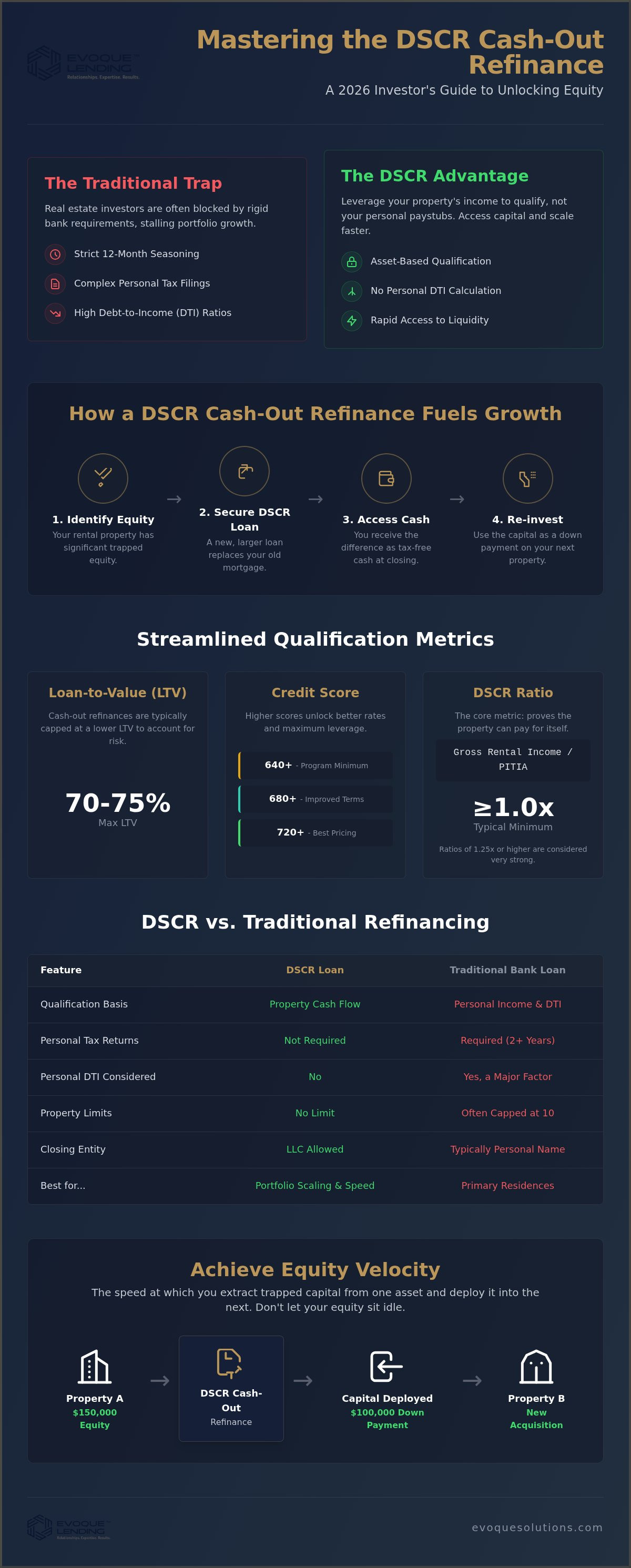
Scaling a portfolio requires movement. Equity velocity is the speed at which you can extract trapped capital from one asset and deploy it into the next. Many investors suffer from "equity bloat," where a property has hundreds of thousands of dollars in value that isn't working for them. A dscr cash out refinance prevents this stagnation. It acts as a bridge, turning dead equity into a down payment for your next purchase. This ensures your capital is always seeking the highest return rather than sitting idle in a single roof.
Qualification Requirements for DSCR Cash-Out Refinancing
Qualification for a dscr cash out refinance is significantly more streamlined than traditional lending, but it remains a data-driven process. Lenders don't look at your personal income, but they do conduct a deep dive into your credit history and the property's earning potential. While a purchase loan might allow for higher leverage, a cash-out refinance typically caps at 70% to 75% Loan-to-Value (LTV). This lower ceiling accounts for the increased risk associated with extracting equity from an asset. Unlike Freddie Mac cash-out refinance guidelines that require extensive DTI checks, DSCR qualification centers on the property's performance.
Credit scores play a pivotal role in determining your final leverage and interest rate. A minimum score of 640 is often required to enter the program, but investors with scores of 680 or higher generally see a marked improvement in terms. To secure the highest LTVs and the most aggressive pricing, aiming for a 720+ score is the best strategy. Additionally, the lender will require a professional appraisal that includes a Form 1007 Rent Schedule. This document is essential because it verifies the current market rent, providing the "income" side of the qualification equation.
Calculating Your DSCR for a Cash-Out Scenario
The calculation is straightforward: Gross Rental Income divided by PITIA (Principal, Interest, Taxes, Insurance, and HOA). It's important to recognize that a cash-out refinance changes the math. Because you're replacing your old mortgage with a larger one, your new principal and interest payments will be higher. This naturally puts downward pressure on your ratio. Most lenders look for a ratio between 1.0x and 1.25x. A 1.0 ratio is often the 'magic number' for approval because it demonstrates the property is generating enough cash to cover its own debt obligations. If your property's performance is strong, you can explore customized leverage options that align with your specific cash-flow goals.
Property Type and Occupancy Standards
DSCR financing is strictly reserved for non-owner-occupied investment properties. You can't use this program for a primary residence or a vacation home you intend to use personally. Eligible assets include single-family residences, 2-4 unit multi-family properties, and warrantable condos. The property must also meet basic habitability standards. Lenders won't approve a cash-out on a "shell" or a property mid-renovation; it must be in a condition that allows for immediate occupancy by a tenant to justify the rental income used in the calculation.
Strategic Benefits: When to Pull Equity
Strategic capital management is the difference between a stagnant portfolio and a scalable enterprise. For investors using a dscr cash out refinance, the goal isn't just to have cash sitting in a bank account. It's about maintaining momentum. By extracting equity, you can transform a single high-performing rental into the down payment for your next two acquisitions. This prevents your net worth from being locked in a single property and allows for geographic diversification across the 40+ states where specialized lending is available.
Beyond simple acquisition, pulling equity serves several critical functions in a 2026 market strategy:
- Debt Consolidation: You can pay off high-interest bridge loans or private money used for the initial purchase, moving that debt into a stable, 30-year DSCR instrument.
- Property Improvements: Equity can fund renovations that justify higher rents, which in turn improves your Debt Service Coverage Ratio for future financing.
- Liquidity Reserves: Maintaining a cash buffer allows you to act quickly when market shifts create distressed buying opportunities.
The BRRRR Method and DSCR Integration
The BRRRR method (Buy, Rehab, Rent, Refinance, Repeat) relies entirely on the Refinance step to keep the cycle moving. To maximize this, you must focus on the Buy and Renovate phases to ensure the highest possible appraised value. Consider a hypothetical 12-month value-add cycle: you purchase a distressed property for $200,000 and invest $50,000 in smart renovations. If the new appraisal comes in at $350,000, a 75% LTV dscr cash out refinance provides $262,500. This covers your entire initial investment and provides a surplus to seed your next project. It's the most efficient way to grow a portfolio using the same "pot" of capital repeatedly.
Managing Seasoning Requirements
Understanding seasoning is vital for timing your exit strategy. You'll often hear the terms Title Seasoning and Loan Seasoning used interchangeably, but they differ. Title seasoning refers to how long you've owned the asset. Most national lenders require six months of title seasoning before they'll allow you to use a new, higher appraised value for a cash-out loan. If you try to refinance before the six-month mark, the loan amount is typically limited to your original purchase price plus documented repair costs. For investors who need to move faster, it's possible to explore delayed financing exceptions if the initial purchase was made with cash, though the six-month rule remains the industry standard for most portfolio-scale moves.
DSCR vs. Traditional Refinancing: A Framework for Choice
Choosing between traditional and specialized lending isn't just about the interest rate. It's a strategic decision about your time and documentation capacity. While conventional loans offer lower rates, they come with a documentation burden that can paralyze a self-employed investor. A dscr cash out refinance bypasses the need for two years of personal tax returns. Instead, the lender looks at a simple rental lease. This shift in focus allows you to maintain your privacy and avoid the "tax return trap" where heavy deductions make you look unqualified to a traditional bank.
Closing speed is another critical factor. Conventional banks often take 45 to 60 days to process a refinance. In a fast-moving market, that delay can be fatal to your next acquisition. Specialized lenders move with the speed of the market, often closing in half the time. While DSCR loans typically include prepayment penalties, these are often structured to align with an investor's long-term hold strategy. They provide the lender with stability while giving you the liquidity you need to stay competitive.
The Opportunity Cost of Waiting for a Bank
Waiting for "cheap money" from a big bank often carries a hidden cost. If you're blocked from accessing your equity for 60 days, you might miss a distressed property purchase that would have yielded a significant return. That small difference in interest rates becomes irrelevant when compared to the profit of a lost deal. Flexibility is your greatest competitive advantage. Accessing your capital quickly through a dscr cash out refinance ensures you're always ready to strike when an opportunity appears. You can start the qualification process online to see how much equity you can unlock today.
LLC Ownership and Asset Protection
Conventional lenders generally force you to hold titles in your personal name. This exposes your personal assets to property-level liabilities. DSCR loans are built for corporate structures, allowing you to close in the name of an LLC or other entity. This provides a layer of privacy and professional asset protection that traditional mortgages simply cannot match. For an investor scaling a portfolio in 2026, keeping business and personal assets separate is a fundamental requirement for long-term security. It allows you to build a professional brand while shielding your family's personal finances from the risks of property ownership.
How to Secure a DSCR Cash-Out Refinance with Evoque Lending
Scaling a real estate portfolio requires more than just capital. It requires a partner who understands the nuances of the Non-QM market and the specific needs of entrepreneurs. Evoque Lending has operated since 2005, serving as a seasoned guide for investors who don't fit into standard institutional boxes. With national coverage in more than 40 states, we provide the stability and expertise needed to navigate the 2026 financial climate. Our consultative approach ensures that your dscr cash out refinance isn't just a transaction; it's a strategic move aligned with your long-term wealth goals.
We believe in transparency and efficiency. That's why we've replaced the traditional, slow banking model with a streamlined online questionnaire. This tool allows you to get matched with potential loan scenarios in minutes, saving you the weeks of back-and-forth typical of big banks. We focus on the practical realities of how modern investors operate, valuing professional relationships over quick transactions. We are advocates for those with complex income structures who deserve a clear path to liquidity.
The Evoque Lending Process: Step-by-Step
The journey to liquidity begins with an initial scenario review. We understand the importance of your credit score, so we offer a first look without a hard credit pull. This allows us to discuss your goals and potential terms before any impact on your credit report. Once we establish a fit, the process moves into a methodical documentation phase. We focus on the essential data: the property's lease agreement, a professional appraisal, and relevant property data. You won't be asked for a mountain of personal tax returns. Finally, a dedicated specialist guides you through underwriting to the finish line, ensuring a smooth closing that respects your timeline.
Preparing Your Portfolio for 2026
The current market environment makes it the ideal time to evaluate your trapped equity. Many investors are sitting on significant value that isn't working for them, often due to the perceived complexity of qualifying for multiple loans. Evoque supports multi-property refinances simultaneously, allowing you to rebalance your entire portfolio in one coordinated effort. This holistic approach prevents equity stagnation and ensures your capital is deployed where it can achieve the highest return. You don't have to wait for traditional banks to catch up with your ambition. Start your DSCR cash-out scenario with Evoque Lending today and unlock the capital needed for your next phase of growth.
Scaling Your Portfolio with Confidence
Your growth shouldn't be limited by the rigid boxes of traditional banking. Mastering the dscr cash out refinance is about more than just accessing capital; it's about reclaiming your time and protecting your professional privacy. By focusing on property performance rather than personal tax filings, you can maintain equity velocity and stay ready for the next opportunity the 2026 market presents. We've seen how extracting trapped capital can transform a single rental into a diversified portfolio, provided you have the right guide.
Evoque Lending has been a trusted partner in the Non-QM space since 2005. We provide national service in more than 40 states, offering a streamlined process that requires no tax returns or W-2s. Our goal is to align your financing with your long-term ambitions, ensuring you have the flexibility to move as fast as the market requires. It's time to put your property's equity to work. Unlock your property equity with a DSCR Cash-Out Refinance from Evoque Lending and take the next step in your investment journey today. You have the vision; we have the tools to help you realize it.
Frequently Asked Questions
How soon can I do a DSCR cash-out refinance after purchasing a property?
Most lenders require six months of title seasoning to use the property's new appraised value for a cash-out loan. If you attempt to refinance before this six month window, your loan amount is typically limited to the original purchase price plus documented renovation costs. This rule ensures the market value has stabilized. For investors who purchased with cash, some delayed financing exceptions may apply to bypass these standard waiting periods.
Can I get a DSCR cash-out refinance if my property is owned by an LLC?
You can absolutely close a dscr cash out refinance in the name of an LLC or corporate entity. This is the preferred structure for most professional investors because it provides essential asset protection and privacy. Unlike conventional bank loans that often force you to keep titles in your personal name, DSCR programs are designed for business purposes. This flexibility allows you to manage your portfolio through professional legal structures.
What is the maximum LTV for a DSCR cash-out refinance in 2026?
The maximum Loan-to-Value (LTV) for a cash-out refinance in 2026 is generally capped at 75%. While purchase loans might offer slightly higher leverage, the cash-out component represents more risk to the lender, requiring you to maintain at least 25% equity in the asset. Your final LTV depends on your credit score and the property's coverage ratio. Higher credit scores of 720 or more typically secure the most aggressive leverage and pricing.
Do I need to provide personal tax returns for a DSCR cash-out loan?
You don't need to provide personal tax returns, W-2s, or paystubs for a dscr cash out refinance. Qualification is based solely on the rental income generated by the property compared to its debt obligations. This is a significant advantage for self-employed entrepreneurs who use legal tax deductions that might show a lower personal income on paper. We focus on the asset's performance and your credit history rather than your personal tax filings.
What is the minimum credit score required for a DSCR refinance?
The minimum credit score required for most DSCR programs is 640. However, investors with scores of 680 or higher generally qualify for better interest rates and higher leverage. To access the maximum 75% LTV and the most competitive terms in the current market, a score of 720 or higher is ideal. Lenders review your credit report to confirm a stable history of managing debt, even though they aren't calculating your personal debt-to-income ratio.
Can I do a cash-out refinance on a short-term rental or Airbnb?
Short-term rentals and Airbnb properties are eligible for cash-out refinancing under DSCR guidelines. Lenders will evaluate the property's income using either its historical performance or a market rent analysis from an appraiser. Because short-term rental income can fluctuate seasonally, some lenders may require a slightly higher coverage ratio or apply a conservative vacancy factor. It remains an excellent way to pull equity from high-performing vacation rentals to fund your next acquisition.
Are DSCR interest rates higher than conventional mortgage rates?
Interest rates for DSCR loans are typically 0.5% to 1.5% higher than conventional residential mortgage rates. This spread reflects the business-purpose nature of the loan and the fact that lenders aren't verifying your personal income. For most investors, the slightly higher rate is a worthwhile trade-off for the ability to close in an LLC, the lack of personal DTI constraints, and the significantly faster closing times compared to traditional institutional banks.
Is there a limit to how many properties I can refinance with DSCR loans?
There is no hard limit on the number of properties you can refinance using DSCR loans. Traditional lenders often cap an individual at ten financed properties, which can halt the growth of a successful portfolio. Because DSCR lenders evaluate each property as an independent business unit, you can continue to scale as long as each asset produces enough income to cover its PITIA. This makes it the premier tool for building a large-scale real estate enterprise.
Reviewed by Eddie Luhrassebi, Founder & CEO, NMLS #337071 | CA DRE #01230650
Last updated: August 20, 2026 · About the reviewer